

2 layers101.6 × 53.3 mm
Sduino mb
roybaer/sduino_mb
A development board with STM8S208MB MCU in Arduino MEGA form factor
56 parts4
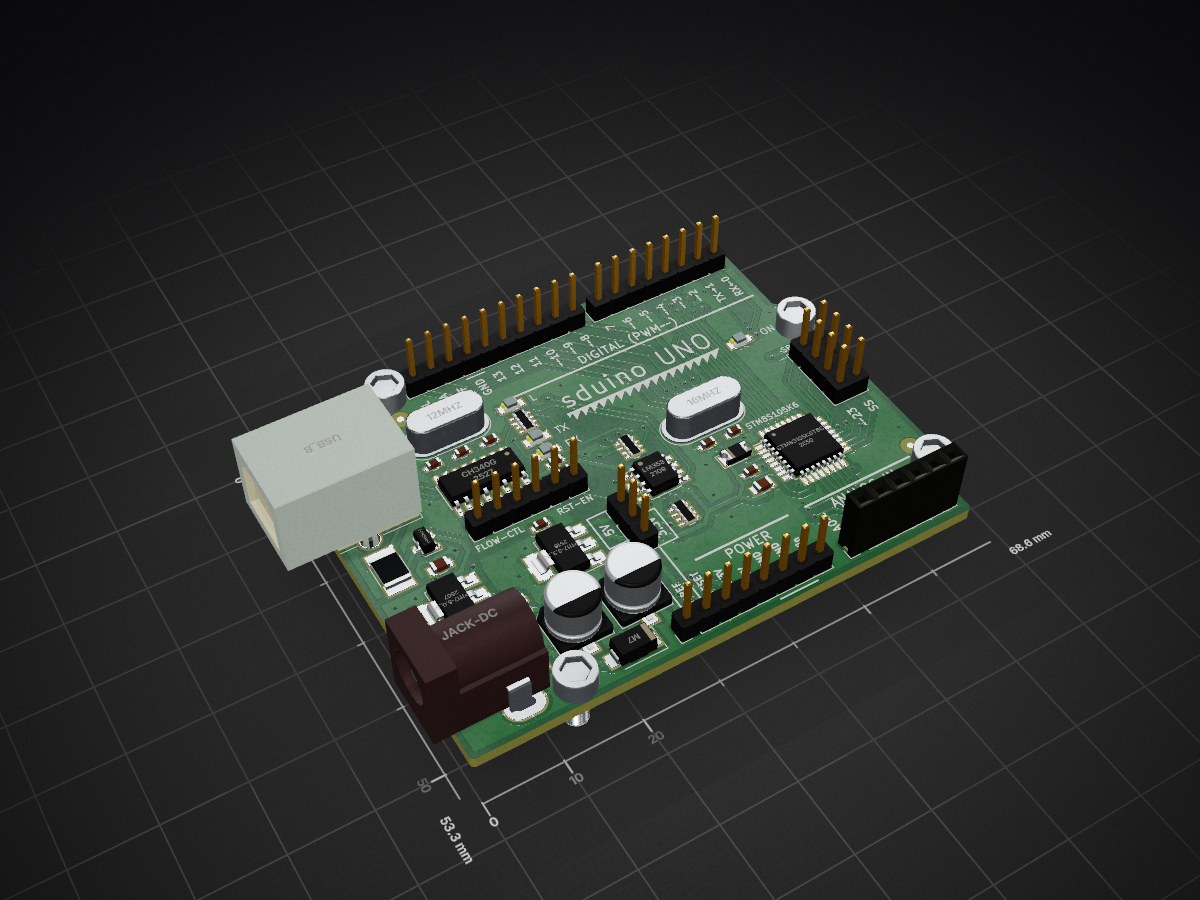
 roybaer/sduino_uno18
A development board with STM8S105K6 MCU in Arduino UNO form factor
Sduino uno is an open-source printed circuit board by roybaer, from the roybaer/sduino_uno repository on GitHub. It is a 2-layer board of 68.6 × 53.3 mm with 51 parts on 61 nets, routed with 826 tracks and 93 vias.
It is built around the CH340G, LM358 and CD1206-S01575, with the FDN340P and MF-MSMF050-2 among its other parts. Its parts include 12 capacitors, 6 ICs, 5 crystals, 2 diodes and 2 connectors. It belongs with the microcontroller boards boards and the AVR (ATmega, ATtiny) and STM8 boards of this library.


The sduino UNO is an attempt at creating a mechanically and electrically Arduino-UNO-compatible development board based on the STM8S105K6 microcontroller. Both, mechanical and electrical design are to a notable degree based on the Arduino UNO board.
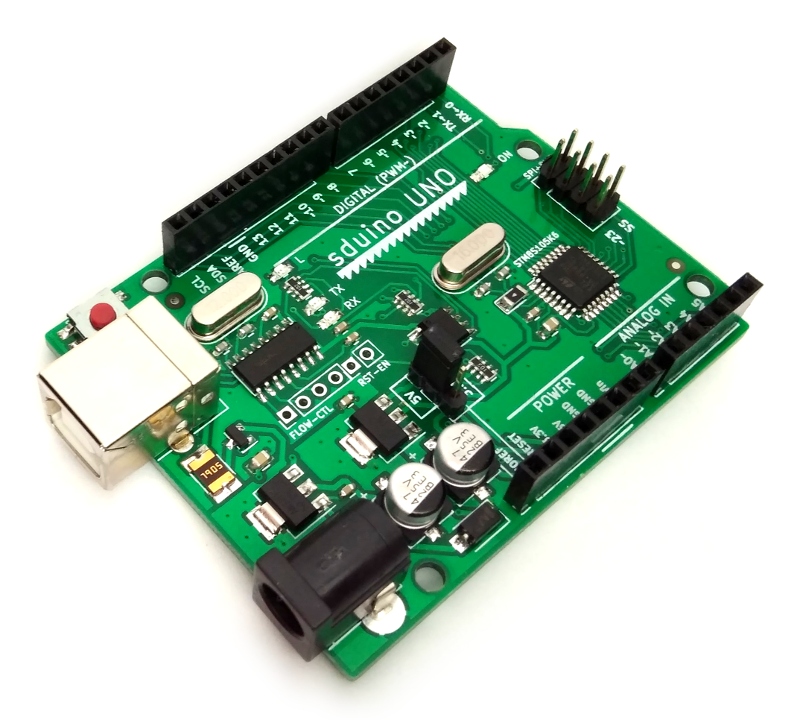
Components and silkscreen can be viewed in more detail in a picture of the component side and a picture of the back side of the assembled board.
| Number | UNO pin name | ATMEGA328 pin name | STM8S105K6 pin name |
|---|---|---|---|
| 0 | IO0/RX | PD0/RXD | PD6/UART2_RX |
| 1 | IO1/TX | PD1/TXD | PD5/UART2_TX |
| 2 | IO2 | PD2/INT0 | PD7/TLI [TIM1_CH4] |
| 3 | IO3 | PD3/INT1/OC2B | PD2 (HS)/TIM3_CH1 [TIM2_CH3] |
| 4 | IO4 | PD4/T0/XCK | PD0 (HS)/TIM3_CH2 [TIM1_BKIN]/[CLK_COO] |
| 5 | IO5 | PD5/T1/OC0B | PD4 (HS)/TIM2_CH1 [BEEP] |
| 6 | IO6 | PD6/AIN0/OC0A | PD3 (HS)/TIM2_CH2/ADC_ETR |
| 7 | IO7 | PD7/AIN1 | PD1 (HS)/SWIM |
| 8 | IO8 | PB0/ICP1/CLKO | PC1 (HS)/TIM1_CH1/UART2_CK |
| 9 | IO9 | PB1/OC1A | PC3 (HS)/TIM1_CH3 |
| 10 | IO10/ | PB2/NSS/OC1B | PC4 (HS)/TIM1_CH4 |
| 11 | IO11/MOSI | PB3/MOSI/OC2A | PC6 (HS)/SPI_MOSI |
| 12 | IO12/MISO | PB4/MISO | PC7 (HS)/SPI_MISO |
| 13 | IO13/SCK | PB5/SCK | PC5 (HS)/SPI_SCK |
| 14 | AD0 | PC0/ADC0 | PB0/AIN0 [TIM1_CH1N] |
| 15 | AD1 | PC1/ADC1 | PB1/AIN1 [TIM1_CH2N] |
| 16 | AD2 | PC2/ADC2 | PB2/AIN2 [TIM1_CH3N] |
| 17 | AD3 | PC3/ADC3 | PB3/AIN3 [TIM1_ETR] |
| 18 | AD4/SDA | PC4/ADC4 | PB5/AIN5 [I2C_SDA] |
| 19 | AD5/SCL | PC5/ADC5 | PB4/AIN4 [I2C_SCL] |
| 20 | AD6 | -- | -- |
| 21 | AD7 | -- | -- |
| 22 | AREF | AREF | PF4/AIN12 |
| 23 | IO23 | -- | PC2 (HS)/TIM1_CH2 |
| 24 | IO24/SS | -- | PE5/SPI_NSS |
| -- | RESET | NRESET | NRST |
| -- | -- | PB6/TOSC1/XTAL1 | PA1/OSCIN |
| -- | -- | PB7/TOSC2/XTAL2 | PA2/OSCOUT |
For evaluation purposes, most of the sduino UNO's functionality can be imitated with an STM8-DISCOVERY board and a USB to Serial converter, as described in this document.
The following paragraphs highlight the most important differences between Arduino UNO and sduino UNO.
The gap between the upper socket strips has been reduced from 0.06 to 0.05 inches. This should not significantly impact mechanical compatibility with Arduino UNO shields and increases the available radius around the center of the upper left M3 mounting hole from 2.286 to 2.54 millimeters, which should be just enough to fit in a standard M3 spacer (5mm wrench).
Most importantly, the sduino UNO can be switched between 5V and 3.3V operating voltage. The RX and TX LEDs are connected to the RX and TX lines (IO pin 0 and 1, respectively) via 1k resistors, rather than to the USB interface chip.
Like many Arduino UNO clones, the sduino UNO uses a CH340G USB to serial converter instead of an Atmega16U2 for communication with the host PC. The USB interface Chip therefore cannot be repurposed as a coprocessor or keyboard/mouse simulator.
There is no analog comparator in the STM8S105K6 microcontroller and AREF is actually an additional analog input. Its use as reference voltage for A/D conversion has to be imitated in software. IO11 has no hardware PWM functionality for analog_write, IO8 and IO4 have. IO2, AD0, AD1 and AD2 can be used as PWM outputs via alternate function mapping.
Likewise, IO10 does not serve as hardware-slave-select line for the SPI bus. This, however, can mostly be overcome by software-emulation, because the STM8 allows for slave-select to be controlled in software, e.g. in an interrupt handler. The actual slave-select line has been made available via an exra pin.
Unfortunately, there is no free C++ compiler available for the STM8 platform, yet. The Arduino language along with the large pool of existing Arduino sketches can therefore not be used without modifications.
Fortunately, there is the C-based sduino library that in fact inspired the creation of the sduino UNO and that this board borrows its name from. By using the sduino library, the changes required to run many exsting Arduino sketches on an STM8 platform can be kept within manageable bounds.
Possibilities to bring C++ support to the STM8 platform with a free compiler are being evaluated.
Even though the sduino UNO CAD files have been created from scratch and the design is not identical, to avoid legal ambiguity, the CAD files for the sduino UNO board are released under the same creative commons license as those of the Arduino UNO board:
This work is licensed under the Creative Commons Attribution-ShareAlike 2.5 Generic License. To view a copy of this license, visit http://creativecommons.org/licenses/by-sa/2.5/ or send a letter to Creative Commons, PO Box 1866, Mountain View, CA 94042, USA.
| Qty | Value | Footprint | References |
|---|---|---|---|
| 6 | 100n | Capacitors_SMD:C_0603 | C7, C8, C9, C10, C11, C12 |
| 4 | 22p | Capacitors_SMD:C_0603 | C1, C2, C5, C6 |
| 3 | YELLOW | LEDs:LED_0805 | LED_L1, LED_RX1, LED_TX1 |
| 2 | 1k | Resistors_SMD:R_Array_Concave_4x0603 | RN2, RN3 |
| 2 | 1µ | Capacitors_SMD:C_0805 | C3, C4 |
| 2 | 47µ | Capacitors_SMD:CP_Elec_6.3x5.8 | PC1, PC2 |
| 2 | Conn_01x08 | Socket_Strips:Socket_Strip_Straight_1x08_Pitch2.54mm | IOL1, POWER1 |
| 1 | 10k | Resistors_SMD:R_Array_Concave_4x0603 | RN1 |
| 1 | 12MHz | Crystals:Crystal_HC49-4H_Vertical | Y1 |
| 1 | 16MHz | Crystals:Crystal_HC49-4H_Vertical | Y2 |
| 1 | CD1206-S01575 | Diodes_SMD:D_1206 | D2 |
| 1 | CH340G | Housings_SOIC:SOIC-16_3.9x9.9mm_Pitch1.27mm | U3 |
| 1 | Conn_01x02 | Pin_Headers:Pin_Header_Straight_1x02_Pitch2.54mm | J2 |
| 1 | Conn_01x03 | Pin_Headers:Pin_Header_Straight_1x03_Pitch2.54mm | VSEL1 |
| 1 | Conn_01x04 | Pin_Headers:Pin_Header_Straight_1x04_Pitch2.54mm | J1 |
| 1 | Conn_01x06 | Socket_Strips:Socket_Strip_Straight_1x06_Pitch2.54mm | AD1 |
| 1 | Conn_01x10 | Socket_Strips:Socket_Strip_Straight_1x10_Pitch2.54mm | IOH1 |
| 1 | Conn_02x04_Odd_Even | Pin_Headers:Pin_Header_Straight_2x04_Pitch2.54mm | SPI_PWR1 |
| 1 | FDN340P | TO_SOT_Packages_SMD:SOT-23 | Q1 |
| 1 | GREEN | LEDs:LED_0805 | LED_ON1 |
| 1 | Jack-DC | Connect:JACK_ALIM | X1 |
| 1 | LM358 | Housings_SOIC:SOIC-8_3.9x4.9mm_Pitch1.27mm | U5 |
| 1 | M7 | Diodes_SMD:D_SMA | D1 |
| 1 | MF-MSMF050-2 | Resistors_SMD:R_1812 | F1 |
| 1 | NCP1117-3.3_SOT223 | TO_SOT_Packages_SMD:SOT-223-3Lead_TabPin2 | U2 |
| 1 | NCP1117-5.0_SOT223 | TO_SOT_Packages_SMD:SOT-223-3Lead_TabPin2 | U1 |
| 1 | STM8S105K6T6C_LQFP32 | Housings_QFP:LQFP-32_7x7mm_Pitch0.8mm | U4 |
| 1 | STM8S105K6U6A_UFQFPN32 | Housings_DFN_QFN:QFN-32-1EP_5x5mm_Pitch0.5mm | U6 |
| 1 | TS42031-160R-TR-7260 | Buttons_Switches_SMD:SW_SPST_B3S-1000 | RESET1 |
| 1 | USB_B | Connect:USB_B | X2 |
| 1 | USB_OTG | Connectors_USB:USB_Micro-B_Molex_47346-0001 | X3 |
The 45 most common of 51 parts.
It measures 68.6 × 53.3 mm and has 2 copper layers, 1.6 mm thick.
51 parts, built around the CH340G, LM358, CD1206-S01575 and FDN340P. The full list of its parts is on this page, with links to each part's symbol and footprint where PCBKit's library has them.
From the roybaer/sduino_uno repository on GitHub, at the commit this page was made from: the board is kicad/sduino_uno.kicad_pcb. PCBKit opens the board in the browser, with nothing to install.
Its repository states no licence, so its author keeps all rights: ask roybaer before reusing the design.
roybaer/sduino_mb
A development board with STM8S208MB MCU in Arduino MEGA form factor


kaustubh850/ArduinoEquipped
A Repo wit Arduino Uno Compatible Boards with on-board Addons.


olexsu/ATmega328_control_Board
Custom ATmega328 embedded control board designed in KiCad with Arduino firmware.


sabogalc/KiCad-Arduino-Boards
A collection of Arduino boards recreated from scratch in KiCad. Legacy USB connectors have been replaced with USB-C where applicable.
