2 layers28.3 × 39.8 mm
LevelShifter
gusmanb/logicanalyzer
24 channel, 100Msps logic analyzer hardware and software
21 parts5.1kGPL-3.0

 rockola/guanaco-rojo
Guanaco Rojo PCB, yet another Red Llama clone
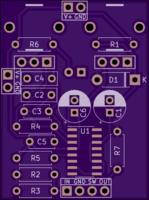
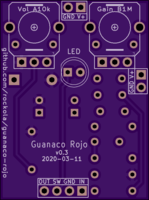
Guanaco rojo is an open-source printed circuit board by rockola, from the rockola/guanaco-rojo repository on GitHub, published under the MIT licence. It is a 2-layer board of 30 × 40.1 mm with 21 parts on 18 nets, routed with 98 tracks and 0 vias.
Its parts include 7 resistors, 6 capacitors, 3 connectors, 2 diodes and 1 IC.
Guanaco Rojo PCB, yet another Red Llama clone
| Qty | Value | Footprint | References |
|---|---|---|---|
| 3 | 1M | Resistor_THT:R_Axial_DIN0207_L6.3mm_D2.5mm_P7.62mm_Horizontal | R2, R5, R7 |
| 2 | 100k | Resistor_THT:R_Axial_DIN0207_L6.3mm_D2.5mm_P7.62mm_Horizontal | R3, R4 |
| 1 | 100p | Capacitor_THT:C_Disc_D5.0mm_W2.5mm_P5.00mm | C5 |
| 1 | 100u | Capacitor_THT:CP_Radial_D6.3mm_P2.50mm | C1 |
| 1 | 10u | Capacitor_THT:CP_Radial_D6.3mm_P2.50mm | C6 |
| 1 | 1N4001 | Diode_THT:D_DO-41_SOD81_P7.62mm_Horizontal | D1 |
| 1 | 1k | Resistor_THT:R_Axial_DIN0207_L6.3mm_D2.5mm_P7.62mm_Horizontal | R1 |
| 1 | 33n | Capacitor_THT:C_Rect_L7.0mm_W2.5mm_P5.00mm | C4 |
| 1 | 4049 | Package_SO:SOIC-16_3.9x9.9mm_P1.27mm | U1 |
| 1 | 47p | Capacitor_THT:C_Disc_D5.0mm_W2.5mm_P5.00mm | C3 |
| 1 | 4k7 | Resistor_THT:R_Axial_DIN0207_L6.3mm_D2.5mm_P7.62mm_Horizontal | R6 |
| 1 | 68n | Capacitor_THT:C_Rect_L7.0mm_W2.5mm_P5.00mm | C2 |
| 1 | A10k | potentiometers:9MM_METAL_SHAFT | RV2 |
| 1 | Alt. power | rockola_kicad_footprints:Power_Header_2pin | J3 |
| 1 | B1M | potentiometers:9MM_METAL_SHAFT | RV1 |
| 1 | LED | LED_THT:LED_D5.0mm | D2 |
| 1 | Power_Connector | rockola_kicad_footprints:Power_Header_2pin_TOP | J2 |
| 1 | Stomp_Connector | rockola_kicad_footprints:Stomp_4pin | J1 |
gusmanb/logicanalyzer
24 channel, 100Msps logic analyzer hardware and software

mntmn/amiga2000-gfxcard
MNT VA2000, an Open Source Amiga 2/3/4000 Graphics Card (Zorro II/III), written in Verilog


hackclub/OnBoard
💡 Join 1,000 teenagers and make your first PCB with a $100 grant!

drandyhaas/KiCadRoutingTools
A set of Python/Rust tools to aid routing in KiCad

Arrow-air/project-quiver
Project Quiver documentation, designs, and project artifacts.


It measures 30 × 40.1 mm and has 2 copper layers, 1.6 mm thick.
21 parts. The full list of its parts is on this page, with links to each part's symbol and footprint where PCBKit's library has them.
From the rockola/guanaco-rojo repository on GitHub, at the commit this page was made from: the board is guanaco-rojo.kicad_pcb and its schematic guanaco-rojo.kicad_sch. PCBKit opens the board in the browser, with nothing to install.
Its repository publishes it under the MIT licence: you may reuse it on that licence's terms (keep the author's notice, and for a copyleft licence share your changes alike).