2 layers
Skilleye 1.0
rizalfanex/SkillEye
Submission for the 8th CTCI Science and Technology Creativity Competition 2026 (Sports theme).
4 parts

 rizalfanex/SkillEye
Submission for the 8th CTCI Science and Technology Creativity Competition 2026 (Sports theme).
Skilleye 2.0 is an open-source printed circuit board by rizalfanex, from the rizalfanex/SkillEye repository on GitHub. It is a 2-layer board of 52 × 74.8 mm with 8 parts on 29 nets, routed with 56 tracks and 9 vias.
Its parts include 2 ICs, 1 connector and 1 switch. It belongs with the ESP32 and RISC-V boards of this library.
Submission for the 8th CTCI Science and Technology Creativity Competition 2026 (Sports theme).
Existing racket-sport analytics apps (e.g. SwingVision) center on ball tracking and match outcome — where the ball landed, who won the point. SkillEye instead analyzes the player's movement, extracting a normalized 2D skeleton from swing video with RTMPose and modeling it with a Spatio-Temporal Graph Convolutional Network (ST-GCN), toward the goal of a per-swing motion-quality score with joint/phase-level error detection and rule-based correction feedback. This addresses both the "training methods" and "injury prevention" sub-themes of the competition through one shared representation.
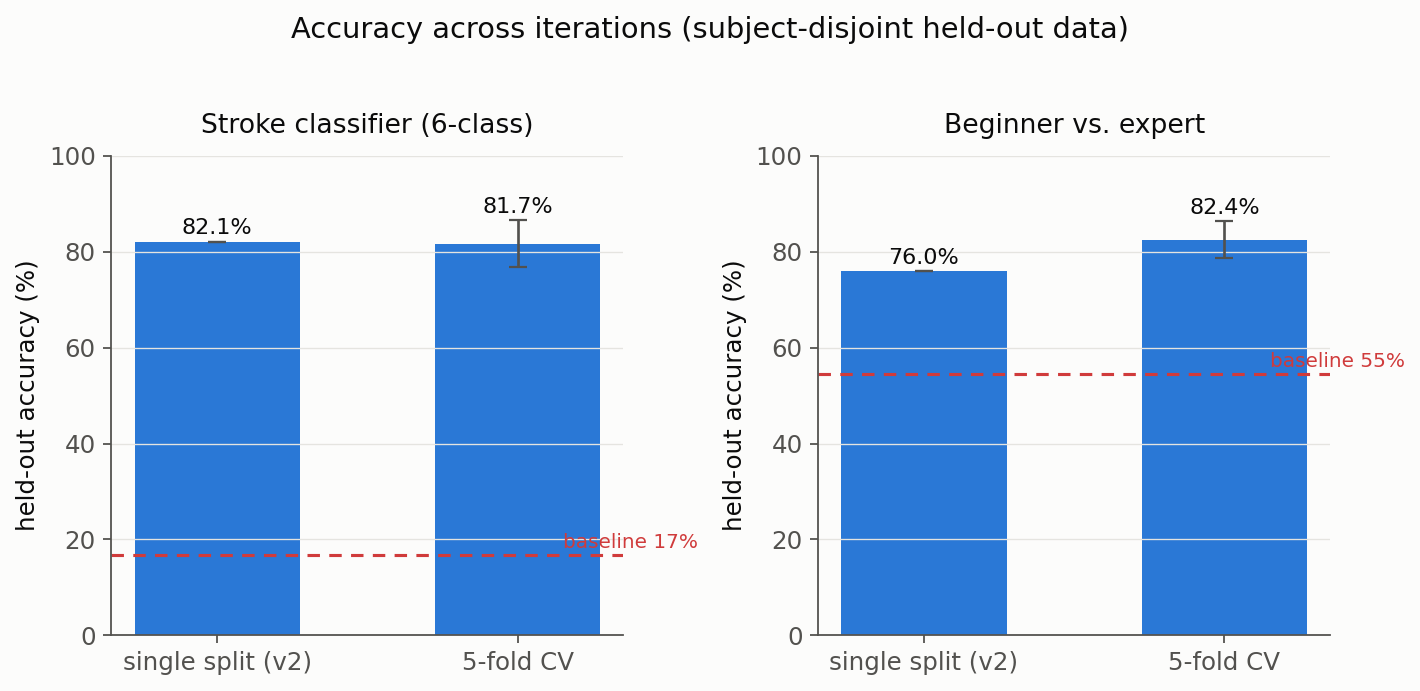
This document reports the technical work completed to date on the THETIS tennis dataset: a validated pose-extraction pipeline (1,980/1,980 clips, 0 failures), a 6-class stroke-type classifier (81.7% ± 4.9%, 5-fold subject-disjoint cross-validation), and a beginner-vs-expert motion-quality proxy classifier (82.4% ± 3.8%). Both are real trained results on held-out subjects, not projected targets. A rule-based v1 of that quality-score system — phase detection, per-joint deviation from expert-clip templates, and generated correction suggestions — is implemented and demonstrated through an accompanying Streamlit UI. Two later additions (Sections 2.8–2.10) build on this: a correlated version of the scorer that checks each joint against the others rather than in isolation, two rules that check for specific mistakes published biomechanics research links to lower skill, and a racket-mounted sensor that has moved from a finalized PCB design to a built, tested board streaming real motion data. A third addition (Section 2.11) closes the loop those first two open: the full pipeline -- capture, pose extraction, both scorers, the skill-level rules -- run end to end on footage this team recorded itself, not just THETIS, with real, specific findings (Section 3.5). Section 4 discusses what these results do and do not establish, and Section 5 lays out the remaining work toward the full quality-score system.
Amateur and intermediate racket-sport players typically improve technique through in-person coaching, which is expensive, geographically limited, and infrequent relative to how often players practice alone. Video-based swing analysis could close this gap, but existing consumer tools (SwingVision and similar) are built around ball-tracking and scorekeeping — they answer "did the shot land in" rather than "what did the player's body do." Movement quality is the input a coach actually reasons about (elbow position at contact, hip rotation timing, follow-through), and it is not derivable from ball trajectory alone.
The technical approach follows two established lines of work rather than proposing new architectures: RTMPose for real-time 2D human pose estimation, and ST-GCN (Yan, Xiong & Lin, 2018) for skeleton-based action recognition, which models a keypoint sequence as a spatio-temporal graph — spatial edges follow the human skeleton, temporal edges connect the same joint across frames. The novelty in SkillEye is the application: using this representation not just to classify what stroke was performed (a mature task), but as the foundation for scoring how well it was performed, which is comparatively unexplored for racket sports at consumer scale. The THETIS dataset itself (Gourgari et al., CVPR 2013 workshop) was built for action recognition, not quality assessment — Section 2.1 and 4.1 discuss what that means for how it can and cannot be used here.
A useful point of comparison is Wagner's tennis serve dataset (2024, jasnwag/tennis_serve_dataset), which takes a near-opposite set of trade-offs to THETIS: broadcast footage of the 2024 US Open, 109 professional players, 5,966 serves, with 3D pose (RTMPose → MotionBERT lifting → DTW-aligned) rather than 2D, and — notably — an actual serve-quality classification task (84.0% reported), where THETIS offers only the subject-level beginner/expert proxy used in Section 2.4/3.2. Table 2 summarizes the contrast:
Table 2. Dataset comparison.
| THETIS (this work) | Wagner tennis serve dataset | |
|---|---|---|
| Source | controlled gym recording (Kinect) | broadcast video, 2024 US Open |
| Camera angle | near-frontal | broadcast (side/elevated) |
| Pose dimensionality | 2D (COCO-17) | 3D (COCO-17, MotionBERT-lifted) |
| Subjects | 55 (31 beginner, 24 expert) | 109 professional players |
| Stroke coverage | 12 categories, all strokes | serves only |
| Clips | 1,980 | 5,966 serves |
| Quality ground truth | none (subject-level skill label only) | serve-quality labels available |
| License | dataset's own terms | CC BY 4.0 |
The two datasets are complementary rather than substitutable for this project: THETIS's frontal angle and 2D pose match what a consumer phone camera can realistically capture (the deployment target), while the serve dataset's 3D pose and side/elevated broadcast angle are closer to what the biomechanical joint-angle rules in Section 4.7 of the proposal actually need, and its existing quality labels are exactly the kind of ground truth Path A/B (Section 5) is trying to establish independently. It is treated here as a comparative reference and a candidate source for cross-dataset validation once the 2D pipeline has a 3D-compatible variant, not (yet) as training or evaluation data for the models in Section 3 — see Section 5 for that as a concrete next step.
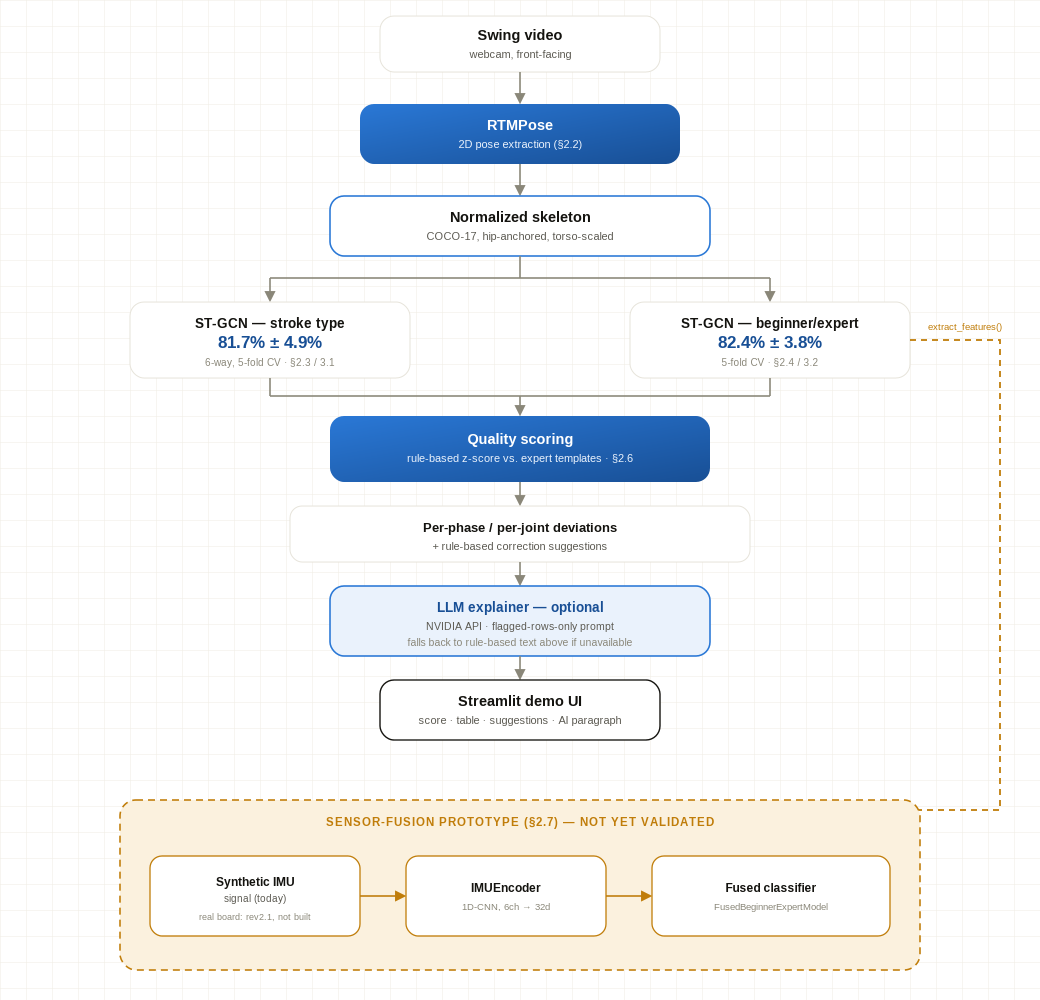
Before the section-by-section detail below, this is how the pieces fit together end to end — from a raw swing video to what a user actually sees. Solid blue boxes are built and validated with real trained results (Sections 2.1–2.6, 3); the dashed amber subgraph is the sensor-fusion prototype (Section 2.7), which is real code and a real hardware design, but not yet trained on real sensor data.
THETIS (Gourgari et al., 2013) provides 1,980 RGB
video clips across 12 tennis action categories, performed by 55 subjects (p1–p31 labeled
beginner, p32–p55 labeled expert per the dataset's own metadata), recorded at ~17–19 fps,
640×480, with a Kinect camera facing the subject (near-frontal, not side-on). Only the
VIDEO_RGB subset is used — VIDEO_Skelet2D/3D uses Kinect's joint definition (not COCO-17,
the format the deployed pipeline actually produces) and covers only 1,217 of 8,374 sequences,
so it would not be representative even if remapped.
Class composition after the merge described in 2.3 (Table 1):
| stroke | THETIS sub-categories merged | clips |
|---|---|---|
| backhand | backhand, backhand2hands, backhand_slice | 495 |
| forehand | forehand_flat, forehand_openstands, forehand_slice | 495 |
| backhand_volley | backhand_volley | 165 |
| forehand_volley | forehand_volley | 165 |
| serve | flat_service, kick_service, slice_service | 495 |
| smash | smash | 165 |
| total | 1,980 |
By skill label: 1,116 clips from 31 beginner subjects, 864 clips from 24 expert subjects.
Measured limitations relevant to this project (checked directly on sample frames, not assumed from the dataset paper): the ~17-19fps frame rate is below what the proposal's biomechanical rules assume is needed to resolve fast strokes (e.g. serves), and the near-frontal camera angle does not capture the side-on view that joint-angle-based error-detection rules require. THETIS is therefore treated here as suitable for pretraining the motion representation and for stroke/skill classification (both established, well-precedented tasks — this is what Sections 2.3–2.4 and 3 use it for), but not as a substitute for purpose-collected side-view footage when the actual per-swing quality-score model is built (Section 5).
Each clip is processed frame-by-frame with RTMPose (rtmpose-s_simcc-body7, lightweight
mode, COCO-17 keypoints) for pose estimation and YOLOX-tiny for person detection, both run
via rtmlib/ONNX Runtime. Frames may contain more than one person (other players/staff visible
in the gym), so a dedicated tracking step selects a single, temporally consistent subject:
Result: 1,980/1,980 clips extracted successfully, 0 dropped, 0 failed, ~1.4s/clip. Code:
ml/skilleye/skeleton_pipeline.py (steps above), ml/skilleye/batch_extract.py (CLI batch runner,
resumable — skips clips that already have output on disk, so an interrupted run can restart
without redoing completed work).
THETIS's 12 action categories are merged into 6 target classes (Table 1) reflecting the strokes
the proposal is actually built around — serve merges the three service sub-types (genuinely
one stroke with different spin), but forehand_volley and backhand_volley are kept separate
rather than merged into a single "volley" class, since they are visually and kinematically
distinct motions (an earlier iteration that merged them made that class disproportionately hard
to classify — see Section 4.1).
Architecture: a compact ST-GCN — 6 spatio-temporal blocks operating on the COCO-17 skeleton
graph (symmetric-normalized adjacency, self-loops included), channel widths 32→64→128→256,
global average pooling, linear classification head. Input is a 4-channel tensor per joint per
frame: 2D position plus its temporal finite-difference (velocity), giving the model direct
access to motion speed/direction rather than only inferring it across pooled layers. Each clip
is time-resampled to a fixed 64 frames (linear interpolation) so variable clip lengths (THETIS
clips range from roughly 2 to 8+ seconds) can be batched. Code: ml/skilleye/stgcn_model.py.
Training: Adam (lr 1e-3, weight decay 1e-4), cosine-annealed learning rate, class-weighted
cross-entropy (classes are imbalanced — see Table 1), 80–100 epochs, batch size 32. With only 55
subjects total, label-preserving data augmentation is applied at train time: left-right mirroring
(negate the x-coordinate and swap left/right joint indices — a mirrored forehand is still a
forehand, just as a left-handed player's would look), random temporal cropping (retain a random
85–100%-length contiguous sub-window before resampling), and small Gaussian coordinate jitter
(σ=0.02, in normalized units). Code: ml/skilleye/train_stroke_classifier.py.
To test whether motion quality — not just stroke identity — is learnable from this representation, a second model is trained on THETIS's beginner/expert subject-level label (Section 2.1) as a weak proxy for swing quality, ahead of collecting real coach ratings (Section 5). Two approaches were tried, reported both for transparency:
ml/skilleye/beginner_expert_check.py):
9 interpretable per-clip features (mean/std swing speed, jerk, elbow/knee joint-angle
variance, wrist extension range) fed into a linear classifier.ml/skilleye/train_beginner_expert_stgcn.py): identical architecture and
augmentation to Section 2.3, but with a binary beginner/expert output head, trained directly
on the raw skeleton sequence rather than hand-summarized statistics.All splits are subject-disjoint: no subject's clips appear in both the training and validation sets. THETIS clips from the same subject are highly correlated (same body, same camera, same session), so a clip-level random split would leak subject identity into validation and overstate accuracy — the model would partly be recognizing people, not strokes or skill.
Headline numbers use 5-fold subject-disjoint cross-validation (ml/skilleye/cross_validate.py):
subjects are split into 5 folds, stratified so each fold's held-out group keeps a
beginner/expert mix; each fold trains a fresh model on the other 4 folds' subjects (~44) and
evaluates on the held-out fold's subjects (~11). This is reported as mean ± standard
deviation across folds, rather than a single split's number, because with only 55 subjects a
single split's held-out accuracy depends materially on which subjects happened to be held
out — the fold-to-fold spread reported in Section 3 is itself informative about that variance.
The proposal's central promised feature -- a per-swing motion-quality score with per-joint/phase error detection and rule-based correction suggestions (Section 4.7) -- is implemented here as a rule-based comparison against expert-clip statistics, not a learned regression model. No coach-rating ground truth exists yet (Path A/B, Section 5), so a supervised quality-score model cannot be trained honestly; this is an explicitly-scoped interim v1, in the same spirit as the v1->v2->v3 iterations already described for the classifiers above.
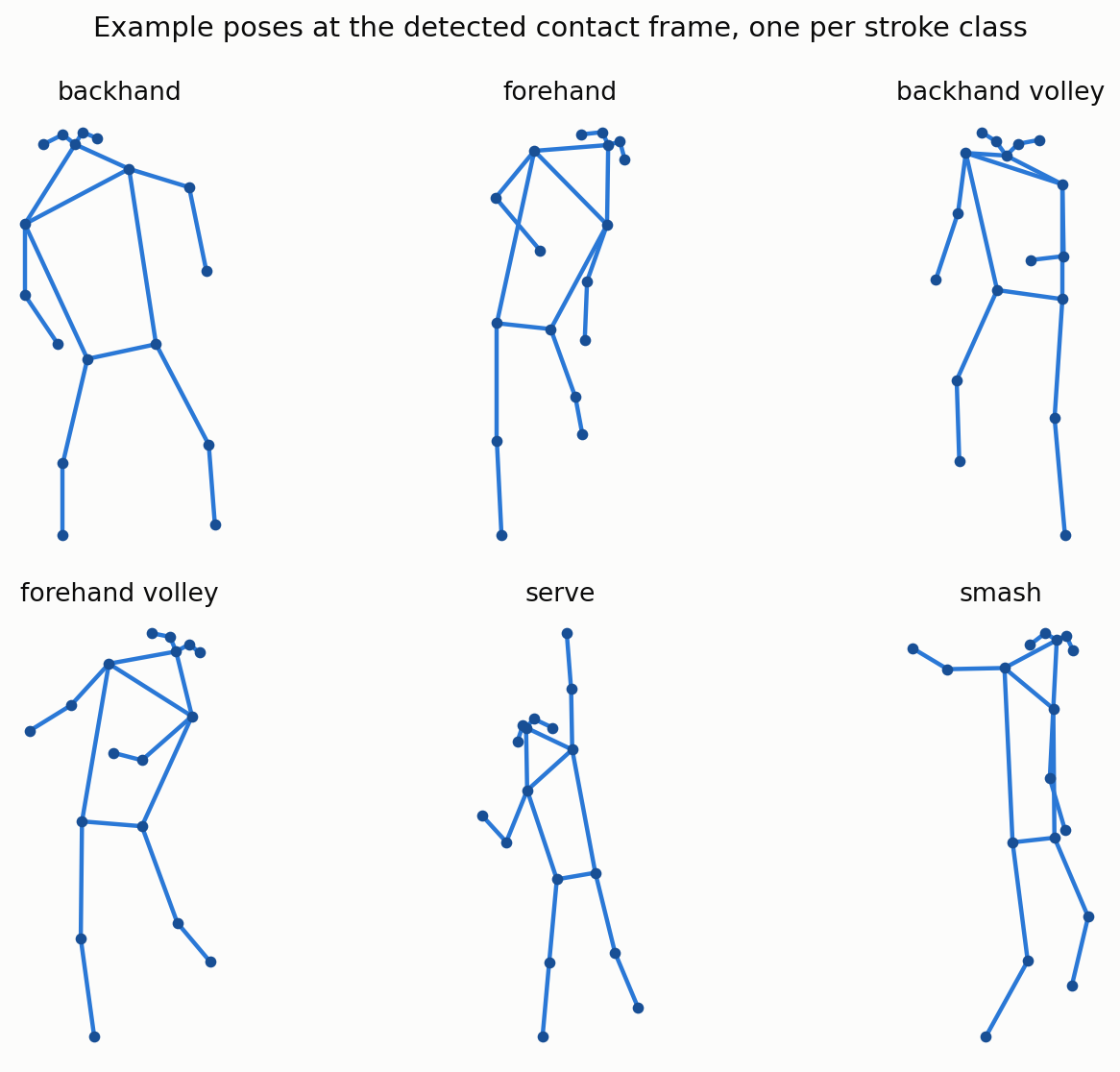
Phase detection (ml/skilleye/quality/phases.py): each clip's dominant wrist (whichever
moves more overall -- a proxy for the hitting arm, since THETIS doesn't label handedness)
is used to find the contact frame (peak wrist speed, a standard swing-analysis heuristic),
splitting the clip into three phases: backswing, a short window around contact, and
follow-through.
Joint angles (ml/skilleye/quality/angles.py): per phase, six flexion angles
(left/right shoulder, left/right elbow, left/right knee) plus a trunk-rotation proxy
(shoulder-line vs. hip-line angle) are averaged into one scalar per (phase, joint) — 7
joints × 3 phases = 21 values per clip. Shoulder angle (angle at the shoulder between hip
and elbow) was added in a later pass (Section 2.8) so Elliott (2006)'s "shoulder" kinetic-chain
contributor has a tracked joint to correspond to; it is a 2D flexion/abduction proxy, not a
reconstruction of true 3D shoulder rotation, which a single camera cannot measure.
Expert templates (ml/skilleye/build_expert_templates.py, run once offline): for each
stroke class, the mean and standard deviation of each (phase, joint) scalar across that
class's expert-labeled clips, computed only from the training side of this project's
standard subject-disjoint split (Section 2.5) -- never from the held-out validation
subjects, which remain available as genuinely unseen demo inputs.
Scoring (ml/skilleye/quality/score.py): a query clip's (phase, joint) scalars are
z-scored against its predicted stroke's template; |z| > 1.5 is flagged and mapped to a
fixed coaching-tip sentence, and the overall 0-100 score is a monotonic function of mean
absolute deviation. SCORE_SCALE/FLAG_THRESHOLD are sanity-checked (Section 3.3), not
formally calibrated -- that calibration is exactly what Path A/B ground truth would
enable.
Demo UI (ml/skilleye/app.py, Streamlit): pick a stroke category and a sample clip
(restricted to the held-out validation subjects, so every demo score is computed against
a template that never saw that subject) and see the skeleton, the existing stroke
classifier's prediction, the quality score, the per-phase/joint table, and the correction
suggestions together. Run with streamlit run app.py from ml/skilleye/.
AI-generated explanation (optional): a "Generate AI explanation" button in the demo
UI rewrites the already-flagged deviations above into one natural coaching paragraph via
an LLM (NVIDIA's build.nvidia.com API). The LLM is only ever given the (phase, joint,
z-score) rows the rule-based system already flagged — it never inspects raw angles or
introduces a new diagnosis — so this is a communication layer over the existing,
smoke-checked scoring system, not a new source of truth. It requires an NVIDIA_API_KEY
environment variable; without one (or if the API call fails for any reason), the button
falls back to a short warning and the rule-based suggestions list above remains the
result, so the demo never depends on network access to function. Design:
docs/superpowers/specs/2026-07-23-llm-correction-explainer-design.md.
A team discussion identified a concrete limitation already described in Section 4.1: a single frontal 2D camera cannot see racket-face angle or wrist-snap dynamics at contact — exactly the kind of high-frequency, off-camera-plane signal a racket-mounted IMU (accelerometer + gyroscope) would capture directly. This section covers both halves of that work: the hardware (designed by a teammate, in parallel with everything else in this document) and the software fusion prototype that will eventually consume its data.
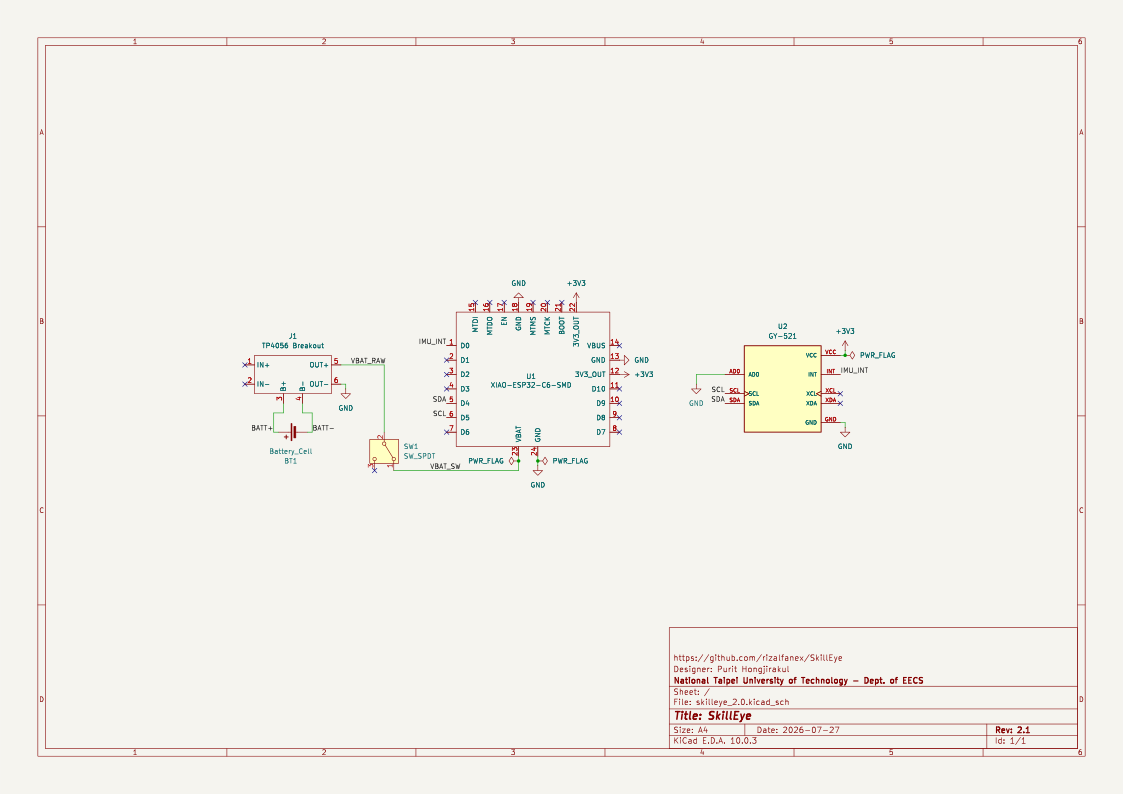
Hardware — rev2.1, finalized (designed by @kyriosaa):
the design went through two iterations. Rev1.0/1.1 was a fully custom board — an
ESP32-C6-WROOM-1 microcontroller, an ST LSM6DSO 6-axis IMU, and discrete
TP4056/DW01A/FS8205A charging-protection ICs, refined once (rev1.1: added a VBUS sense
divider). Rev2.0/2.1 then deliberately traded that custom-everything approach for
off-the-shelf breakout modules — a GY-521 (the standard MPU6050 accelerometer+gyroscope
breakout — the exact sensor originally proposed in the team's first discussion of this
feature, Section 2.7's origin) on a Seeed Studio XIAO microcontroller, with a TP4056
charging breakout — lower assembly risk for a first real board, at the cost of a larger
footprint than the fully custom rev1.0. Full PCB layout is done (skilleye_2.0.kicad_pcb),
and the project now includes a PCBWay logo asset, indicating the design is being prepared
for fabrication. Full KiCad project: hardware/skilleye_2.0/; rendered schematic below,
source at docs/schematics/2.0/rev2.1/. The earlier rev1.0/1.1 custom-board files remain in
hardware/skilleye_1.0/ / docs/schematics/1.0/ for reference.
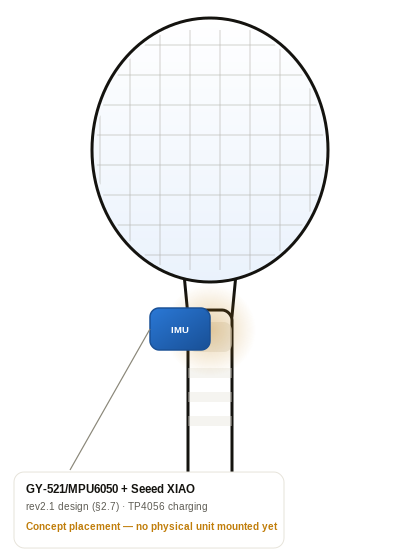
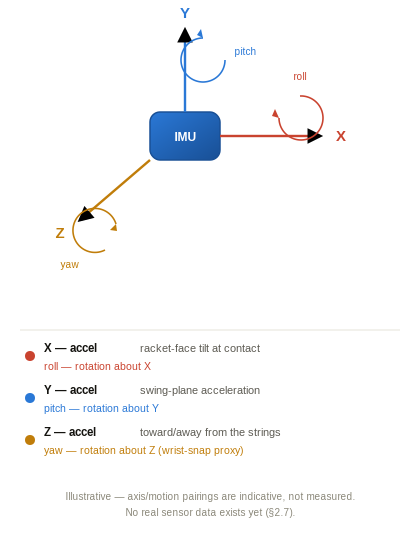
Where this board would sit on the racket, and what its two sensing modalities are meant to pick up (both are concept diagrams — no physical unit has been mounted yet):
Placement
Sensing mechanism
Update — the board is now built and streaming real data. What follows was true when the
design above was finalized, but is no longer the current state: firmware has been written
(hardware/firmware/firmware.ino — the XIAO ESP32-C6 + GY-521 hosts its own WiFi network and
streams accelerometer/gyroscope readings at 200 Hz the moment a laptop connects), a computer-side
client exists (hardware/client/imu_client.py), and real recordings exist for
backhand/forehand/serve (with and without ball contact) plus one volley take. A live-monitoring
dashboard (hardware/client/live_dashboard.py, Streamlit) was built and tested against the
physical device on real WiFi, confirming the full sensor → firmware → recording pipeline works
end to end — see Section 2.10. The fusion model in this section still trains on synthetic data
only (below) — swapping in real recordings for that specific model is the one piece of this
section still pending, not the whole hardware effort.
Software architecture (ml/skilleye/imu_fusion.py): STGCN is refactored to expose
its pooled pre-classifier features via extract_features() (ml/skilleye/stgcn_model.py,
backward compatible — every existing caller is unaffected). A small IMUEncoder (1D-CNN
over a 6-channel accelerometer+gyroscope stream) is fused with that skeleton branch via
concatenation before one classification head (FusedBeginnerExpertModel), targeting the
beginner/expert distinction specifically, since that is the axis this sensor is meant to
inform.
Synthetic data, stated plainly: because no real sensor data exists yet,
synthetic_imu_from_skeleton() derives a placeholder signal from the skeleton itself
(wrist acceleration, forearm angular velocity) rather than from a real sensor. This signal
is, by construction, redundant with information the skeleton branch already has access to
— so train_beginner_expert_fusion_prototype.py's output is a demonstration that the
fusion architecture and training loop work end to end, not an accuracy result, and its
numbers must not be cited alongside Section 3.2's cross-validated 82.4% ± 3.8%.
Path to real data: a documented collection protocol (~100-200 Hz logging, a tap-based
manual sync event between the video and IMU streams, resampled to the same fixed frame
count skeletons already use) is in
docs/superpowers/specs/2026-07-23-imu-fusion-prototype-design.md — written before either
hardware revision existed, describing a generic MPU6050+ESP32 pairing; the rev2.x board
above (GY-521/MPU6050 on a Seeed XIAO) matches that description closely, and the collection
method (sampling rate, sync approach) applies unchanged either way. Swapping
synthetic_imu_from_skeleton()'s call site for a real-data loader is the only code change
needed once the board above is built and recordings exist.
The next three subsections describe work added after the rest of this document, and are written in plainer language on purpose so they're easy to follow even without a machine learning background.
The scoring system described in Section 2.6 checks every joint on its own. It looks at one joint's angle, compares it only to that joint's own usual value, and flags it if it's too different. This misses something real: sometimes a joint looks "off" only because another joint pulled it along. For example, if the trunk rotates a lot during a swing, the elbow angle naturally shifts too — that isn't a mistake, it's just how a real swing moves. The old system couldn't tell the difference between "this joint is genuinely wrong" and "this joint moved because the rest of the body moved."
Module A fixes this by scoring each joint together with the others, not alone. Instead of asking "is this elbow angle unusual by itself?", it asks "is this elbow angle unusual, given what the rest of the body is doing right now?" This uses a statistics tool called a covariance matrix — a table that captures how pairs of joints move together across real expert swings — plus a formula that predicts one joint's expected value from the others' current values. The gap between the real value and that prediction is the new score.
This covariance matrix is built separately for each stroke type (a serve and a volley move very differently, so they shouldn't share one set of rules), using the same expert-labeled clips already used to build the original templates — 1,584 training clips across the full 1,980-clip dataset. For strokes with fewer expert examples (volleys and smash, ~55-57 clips), the matrix is nudged toward a small, clearly-labeled "prior" — a rough guess, based on Elliott (2006)'s description of how the shoulder, elbow, and trunk work together during a swing, used only to keep the statistics stable when there isn't much data, not presented as a precise number from that paper.
The output format is unchanged: still one score per (phase, joint), the same 21 values as
before, and the existing correction messages still work — only how each score is
calculated is different. Code: ml/skilleye/quality/correlation.py,
score_clip_correlated() in ml/skilleye/quality/score.py. Design:
docs/superpowers/specs/2026-08-14-correlated-zscore-module-a-design.md. Validation
results: Section 3.4.
Module A still only compares a swing to what experts typically look like. It has no idea what beginners specifically tend to do wrong — it can only say "this is unusual," not "this is the mistake beginners commonly make." Module B closes that gap with a small number of hand-written rules, each based on one specific finding from a published biomechanics paper that directly compared skilled and less-skilled players.
Two rules were built, both for the backhand volley specifically (the one stroke a suitable comparison study exists for):
signed_shoulder_pelvis_twist_series, signed_pelvic_rotation_series in
ml/skilleye/quality/angles.py) specifically so a direction reversal can be detected at
all.A third rule — using Aydin & Aydemir (2026)'s finding that lower, more controlled racket
acceleration corresponds to higher skill in a volley (elite players use a "controlled,
abbreviated swing" rather than muscling the shot) — was implemented as a standalone check,
check_volley_swing_effort(), but is not yet wired into the main pipeline: it needs a real
racket-acceleration reading from an actual ball-contact volley swing, and no such recording
exists yet (Section 2.10 explains what does exist). A fourth candidate rule, for
forehand/backhand/serve, was investigated (a paper comparing high-performance and
intermediate forehand drives) but turned out to need motion-capture and muscle-sensor
(EMG) hardware this project doesn't have, so it was not attempted.
Every rule here produces its own separate flag, kept apart from Module A's 21 scores, since
that's a structurally different kind of check (comparing to both skill groups, not just
to experts). Code: ml/skilleye/quality/skill_rules.py. Design:
docs/superpowers/specs/2026-08-14-skill-level-rules-module-b-design.md.
Separately from the modeling work above, a small tool was built to watch the racket
sensor's data live, on a computer screen, while the racket is actually being swung — useful
both as a quick "is the hardware actually working right now" check and as something to show
during a demo. It reuses the existing recording client's networking code, runs the WiFi
connection on a background thread, and redraws two live charts (accelerometer and
gyroscope) plus simple stats (samples per second, dropped samples, peak force) a few times
a second. It is intentionally kept separate from the main quality-scoring demo, so a problem
here can never affect the validated, already-working pipeline. Code:
hardware/client/live_buffer.py (the data-buffering logic, unit-tested), hardware/client/live_dashboard.py
(the Streamlit page — run with streamlit run live_dashboard.py from hardware/client/).
This tool was tested against the real, physical racket sensor: connected over its WiFi network, confirmed streaming at the firmware's target 200 Hz, and used to record a genuine 58-second volley take (11,659 samples, zero dropped) — the project's first volley recording (previous recordings covered backhand/forehand/serve only). That specific take was swung without a ball, so its numbers are not yet comparable to Aydin & Aydemir (2026)'s ball-contact-based reference (Section 2.9) — but it did prove the complete chain, from physical sensor through to a rule-checking function, runs correctly end to end. A recording made with a real ball is the next step before that specific rule's output can be trusted.
Synchronized video + IMU recording (hardware/client/sync_recorder.py, needs pip install opencv-python): starts the laptop's webcam and the racket's IMU stream together from
one command, instead of two manually-launched programs, for collecting the real (not
synthetic) data Section 2.7's fusion model needs. The IMU's own clock and the webcam's frame
clock still have no hardware link between them, so both are anchored to the recording
computer's wall clock at the moment each starts (written to <name>_alignment.json) — this
removes the human delay of starting two programs by hand, but the tap-sync convention above
remains the fine-grained sync point, not replaced by it. Its frame-capture and recording logic
is unit-tested with a fake camera and the same mock-device pattern used for imu_client.py
(Section 2.10 above); actually recording a full session — multiple people, multiple swings —
is tracked in Section 5 as separate, larger work.
A desktop GUI version also exists (hardware/client/sync_recorder_gui.py, additionally needs
pillow): Start/Stop buttons plus a live webcam preview while recording (a framing check, not
live pose tracking — this project's pose estimation runs offline on saved clips elsewhere), and
a native "Save As" dialog on Stop, so the take's name is chosen after seeing it was worth
keeping rather than before recording starts. Its file-renaming logic is unit-tested; the Tk
window itself isn't (no display/camera to drive it against in this dev environment) — same
manual-QA convention as live_dashboard.py.
Sections 2.1–2.6 validate this project's pipeline entirely on THETIS. This section closes that loop once: every stage — capture, pose extraction, both quality scorers, and Module B — run end to end on footage this team recorded itself, with its own hardware, not a public dataset.
Capture. One take per stroke (backhand, forehand, backhand volley, forehand volley, serve,
smash) was recorded with hardware/client/sync_recorder_gui.py (§2.10): the laptop's own
webcam and the racket-mounted IMU sensor, started together and anchored to a shared wall-clock
reference (<name>_alignment.json), with the tap-sync convention kept as the fine-grained
backup. All six takes tracked the subject with RTMPose at 99–100% frame confidence — as high
as anything in the THETIS pipeline.
Extraction (ml/skilleye/extract_real_recordings.py): the same rtmpose-s_simcc-body7
model and skeleton_pipeline.clean_clip() normalization used for THETIS (§2.2), pointed at
these six arbitrary-filename .mp4 files instead of THETIS's batch folder convention. No
pipeline code changed — proof that the extraction pipeline generalizes past the one dataset
it was built and validated on.
Evaluation (ml/skilleye/evaluate_real_recordings.py): each extracted skeleton is scored
with both score_clip() (independent, §2.6) and score_clip_correlated() (Module A, §2.8)
against the existing THETIS-trained templates; the backhand-volley clip is additionally
checked with evaluate_backhand_volley_skill_rules() (Module B, §2.9); and each take's real
IMU peak acceleration is checked with check_volley_swing_effort() (§2.9) for both volley
clips. The contact frame (peak wrist speed, same heuristic as quality/phases.py) is rendered
as a skeleton figure alongside the real IMU trace for that take — Section 3.5 shows these.
Two limits, stated plainly rather than left implicit: (1) the templates being scored against were built from THETIS's Kinect footage — a different camera, room, and distance than this laptop webcam, so absolute scores here demonstrate the pipeline working, not a calibrated judgment of technique (§4.2 already makes this distinction for every other quality-score number in this project); (2) this is one clip per stroke from one person, not a dataset — a pipeline smoke test, not a statistically powered evaluation.
81.7% ± 4.9% held-out accuracy (6-way; majority-class baseline 16.7%), fold range 72.5%–86.1%.
| class | precision | recall | f1 | support |
|---|---|---|---|---|
| backhand | 0.79 | 0.90 | 0.84 | 495 |
| forehand | 0.87 | 0.79 | 0.83 | 495 |
| backhand_volley | 0.66 | 0.63 | 0.64 | 165 |
| forehand_volley | 0.68 | 0.67 | 0.68 | 165 |
| serve | 0.93 | 0.88 | 0.90 | 495 |
| smash | 0.73 | 0.78 | 0.75 | 165 |
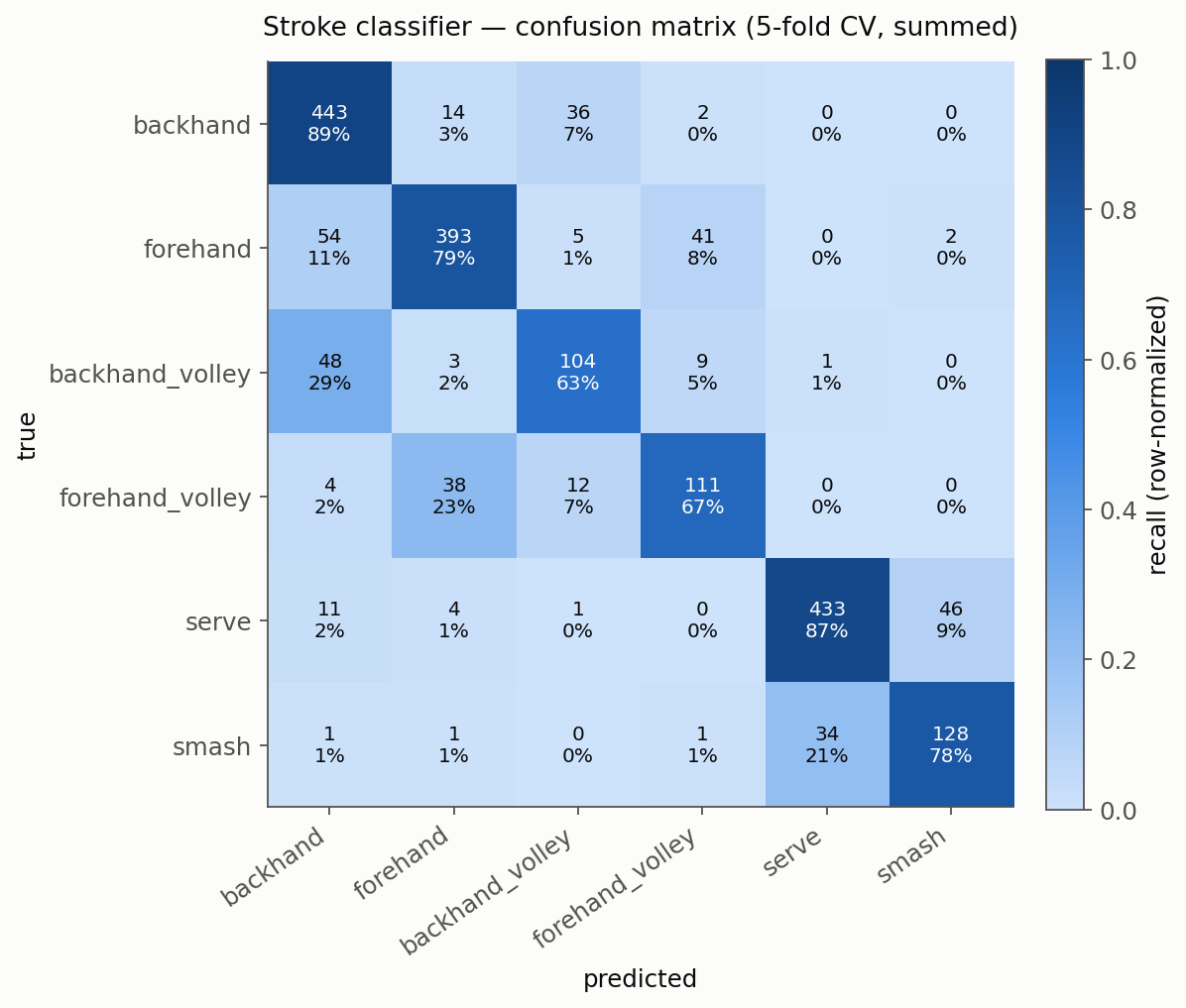
serve is the strongest class — mechanically the most distinct motion (toss + overhead
strike). The volley classes are weakest, and the confusion matrix shows why: forehand_volley
is confused primarily with forehand, backhand_volley primarily with backhand — i.e. a volley
shares arm-swing kinematics with its groundstroke counterpart, and the near-frontal 2D camera
does not capture the footwork/court-position difference (volleys are played closer to the net)
that would otherwise disambiguate them. This is discussed further in Section 4.1.
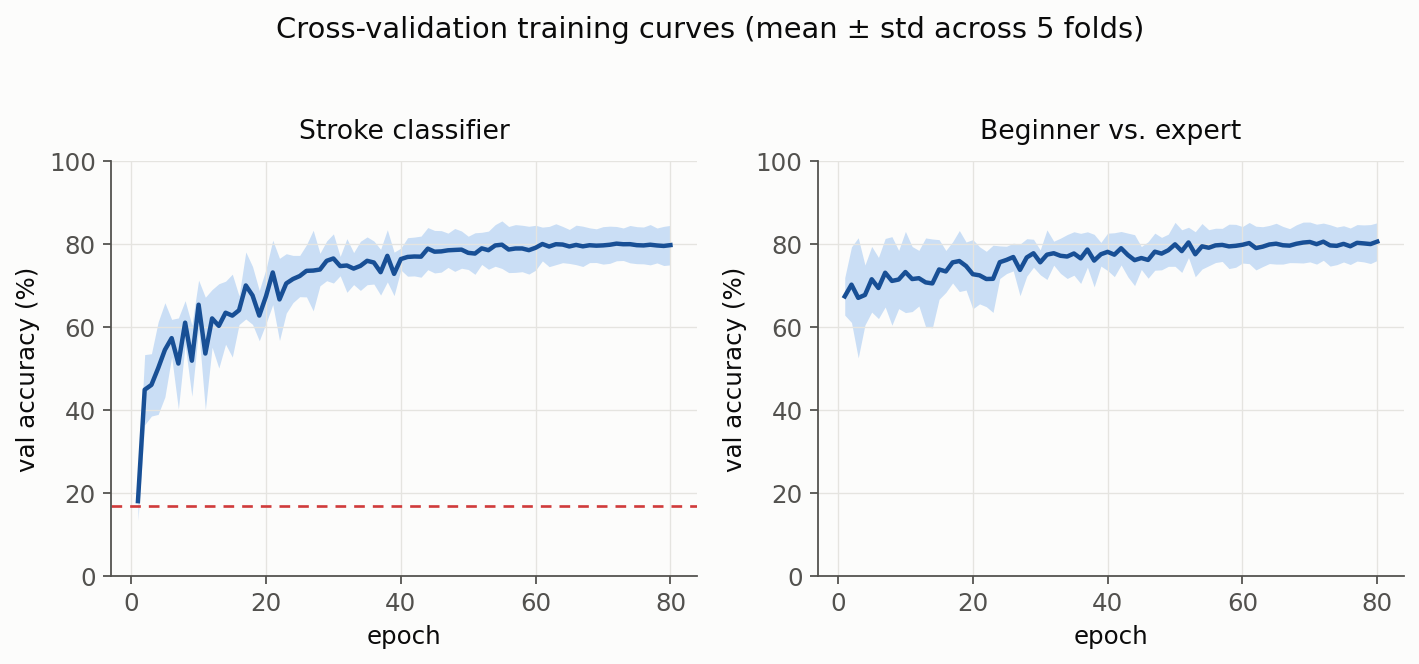
82.4% ± 3.8% held-out accuracy (2-way; majority-class baseline 54.6%), fold range 78.5%–89.7%. The v1→v2 progression:
| iteration | method | held-out accuracy |
|---|---|---|
| v1 | 9 hand-crafted features + logistic regression, single split | 58.6% (baseline 54.6%) |
| v2 | ST-GCN on raw skeleton sequence, single split | 76.0% |
| v3 | ST-GCN, 5-fold cross-validation | 82.4% ± 3.8% |
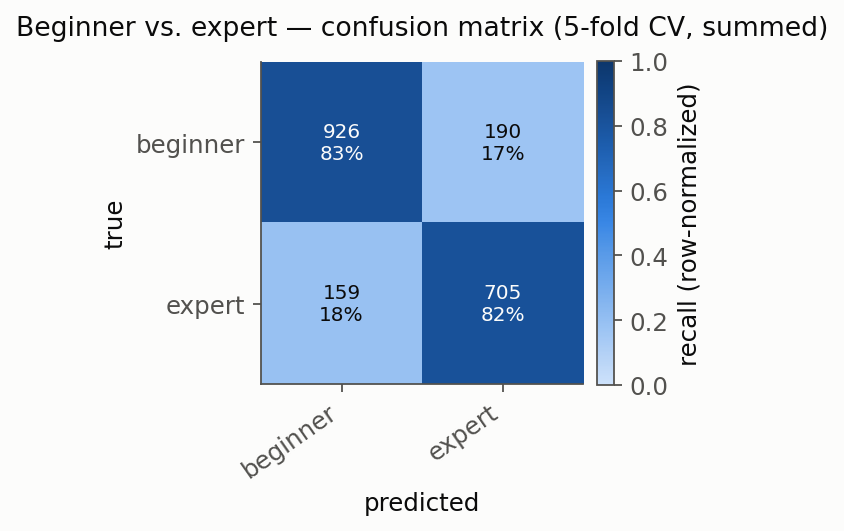
v1 established that population-level differences between beginner and expert clips are real and highly significant (Welch's t-test on all 9 features, p<0.02, most p<1e-10, n=1,980) — notably, experts showed higher swing speed, jerk, and joint-angle variance than beginners, not lower, i.e. expert swings read as more dynamic/forceful rather than smoother in this dataset, which should inform how a smoothness-based quality heuristic is weighted. But v1's linear model on those 9 summary statistics only reached 58.6% held-out accuracy — barely above baseline, meaning the signal existed in aggregate but wasn't usable per-subject with simple features.
v2 replaced the hand-crafted features with the same ST-GCN architecture used for stroke classification, trained directly on the raw skeleton sequence, and reached 76.0% on a single split. v3 cross-validated that result and found it was, if anything, an unfavorable split — the cross-validated mean (82.4%) is higher than the single-split number, with folds ranging 78.5%–89.7% (Table above; per-class breakdown: beginner precision 0.85/recall 0.83, expert precision 0.79/recall 0.82, summed over all 5 folds' held-out predictions).
No formal ground truth exists yet to validate quality scores against (Section 2.6) -- this instead checks the one directional claim the system must satisfy to be credible: held-out expert clips should score higher on average than held-out beginner clips, per stroke class, against that stroke's own expert template.
| stroke | expert mean | beginner mean | experts higher? |
|---|---|---|---|
| backhand | 88.9 | 86.5 | yes |
| backhand_volley | 89.5 | 85.8 | yes |
| forehand | 88.5 | 86.7 | yes |
| forehand_volley | 87.2 | 79.8 | yes |
| serve | 87.3 | 87.0 | yes |
| smash | 87.9 | 87.9 | no |
(Table above uses the current 7-joint angle set, Section 2.8 — regenerated after the
shoulder joints were added; see Section 3.4 for what changed and the honest discussion of
the smash row.) Experts scored higher on 5 of 6 strokes with held-out data
(ml/skilleye/smoke_check_quality_scoring.py). This is a sanity check, not a validation --
it confirms the scoring system's direction is sane on the same subject-level proxy label
used in Section 3.2, not that its absolute scores or flagged joints are correct at the
level of a real coach's judgment. That remains gated on Path A/B ground truth (Section 5).
The aggregate numbers above are a directional average -- the actual per-clip output looks
like this (two real held-out forehand_volley clips, the largest expert/beginner gap in
the table above):
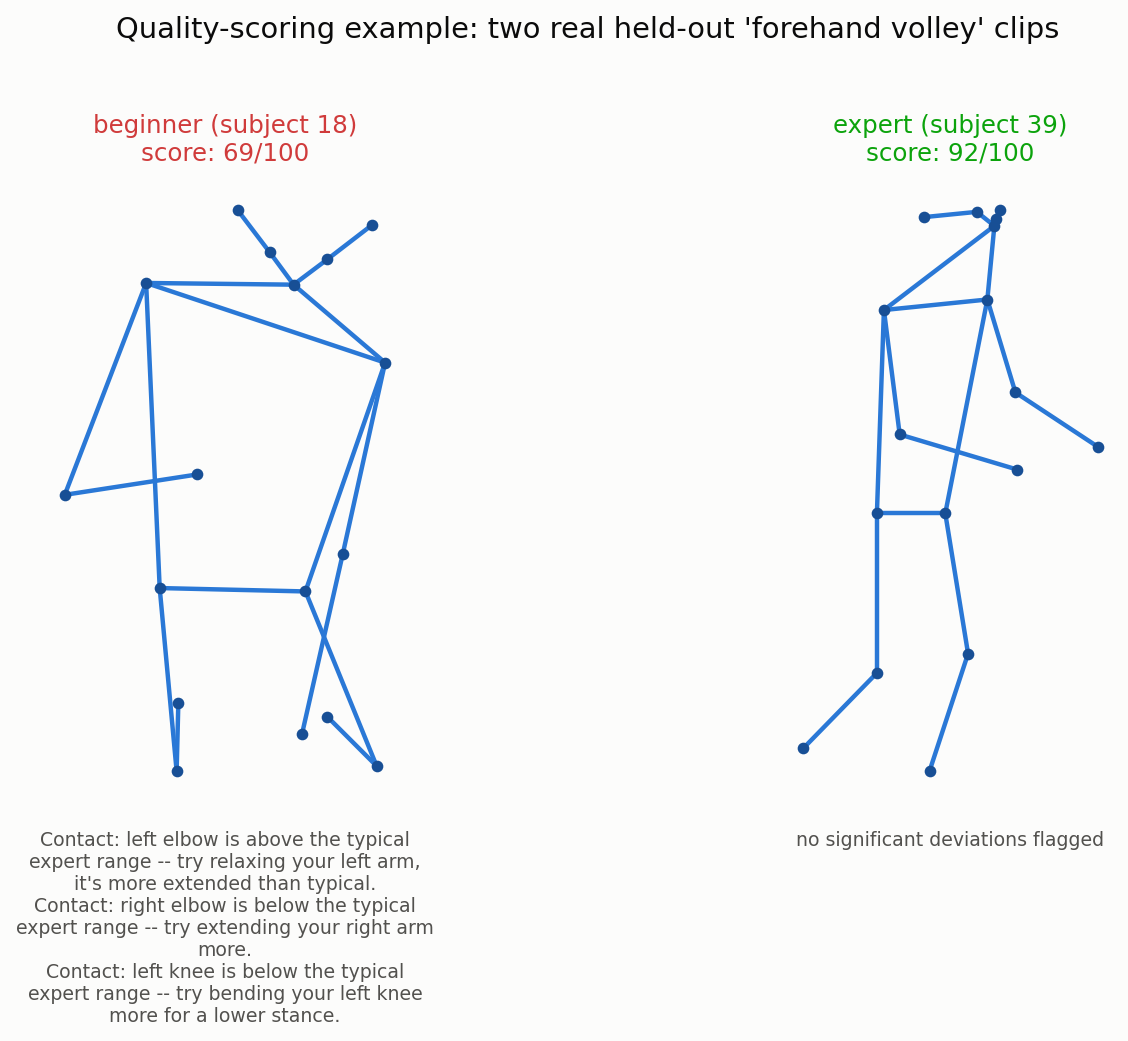
The beginner clip's flagged joints are concrete and actionable (left elbow over-extended, right elbow under-extended, left knee not bent enough at contact) rather than an opaque number -- this is what "rule-based correction suggestions" (proposal Section 4.7) actually produces today, not a mockup of what it might eventually say.
This section reports what happened when Module A (Section 2.8) and Module B (Section 2.9) were actually run and checked, including a result that did not come out clean — included here in full rather than left out, in keeping with how every other result in this document is reported.
Module A, same smoke check as Section 3.3, but with the new correlated scoring:
| stroke | expert mean | beginner mean | experts higher? |
|---|---|---|---|
| backhand | 89.3 | 86.0 | yes |
| backhand_volley | 88.6 | 83.9 | yes |
| forehand | 86.2 | 83.2 | yes |
| forehand_volley | 87.1 | 77.0 | yes |
| serve | 87.6 | 85.5 | yes |
| smash | 86.7 | 87.0 | no |
(ml/skilleye/smoke_check_correlated_quality_scoring.py.) Same result as the independent
scorer above: 5 of 6 strokes pass, smash does not. Because both the old (independent) and
new (correlated) scorers fail on smash once the shoulder joints are included, this is not a
bug introduced by Module A specifically -- it appears to be an effect of adding the
shoulder angle, on a stroke class that only has 55-57 expert training clips (one of the
thinnest classes). No attempt was made to adjust constants until the number looked better;
that would be fitting the system to a desired answer rather than measuring it honestly. This
is flagged as a real, open finding for further investigation (candidates: check whether
beginners' shoulder angle happens to be unusually consistent for smash specifically, or
whether 55-57 clips is simply too few for a stable 7-dimensional covariance estimate),
not something papered over.
Module B, real hardware: the racket sensor was connected live and used to record a real
58-second volley take (Section 2.10). check_volley_swing_effort() was run against 28
segmented swings from that recording: 18 fell on the lower-force side, 10 on the
higher-force side of the reference midpoint. Because that recording had no ball contact,
this result is a pipeline check (the full sensor-to-rule chain works), not a skill
assessment -- see Section 2.10 for why a ball-less swing isn't comparable to the paper's
reference values.
The six real takes from Section 2.11, scored end to end:
| Stroke | Score (v1) | Score (Module A) | Peak accel | Module B / volley-effort flags |
|---|---|---|---|---|
| Backhand | 83/100 | 81/100 | 13.2 g (130 m/s²) | -- |
| Forehand | 89/100 | 86/100 | 12.6 g (123 m/s²) | -- |
| Backhand Volley | 82/100 | 86/100 | 12.3 g (121 m/s²) | 3 Module B flags; volley-effort: amateur-leaning |
| Forehand Volley | 80/100 | 68/100 | 11.8 g (116 m/s²) | volley-effort: amateur-leaning |
| Serve | 87/100 | 85/100 | 17.5 g (172 m/s²) | -- |
| Smash | 86/100 | 86/100 | 12.8 g (126 m/s²) | -- |
The backhand volley take is the most interesting result: it's flagged by every Module B/effort check built in this project, on real self-recorded data, not a THETIS clip.
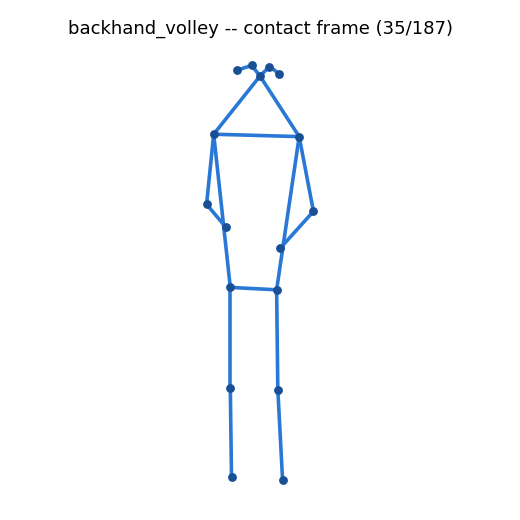
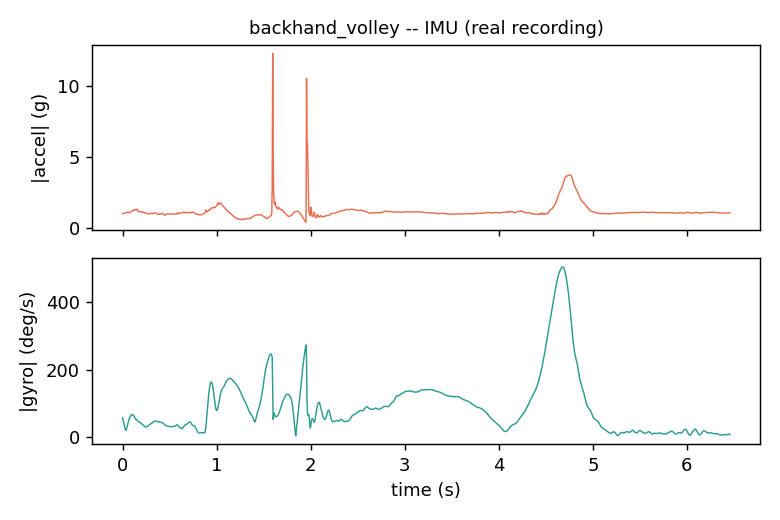
Katsumi et al. (2026)'s two rules both fire: the shoulder-pelvis twist reverses sign between backswing and contact, and pelvic rotation is on the higher side at both phases -- the exact pattern the paper associates with less-skilled backhand volleys (§2.9). Aydin & Aydemir (2026)'s volley-effort check also flags this take (peak 121 m/s² against a 52.6 m/s² reference midpoint) -- and independently, the forehand-volley take does too (116 m/s²). Whether these particular takes had real ball contact wasn't recorded as metadata for this batch (unlike the explicitly ball-less test in Section 3.4) -- the peak values are real either way, but the comparison to Aydin & Aydemir's ball-contact reference should be read with that context marked unknown, not assumed favorable.
The other four strokes score in a broadly similar 80-89/100 range under both scorers, with no
rule-based flags -- consistent with (though not proof of) those takes not containing the same
patterns. Figures and raw numbers for all six takes:
hardware/client/newresult_eval/ (results.json + one skeleton/IMU figure pair per stroke).
Taken together, Sections 3.1 and 3.2 support two concrete design decisions for the system described in the proposal's Section 4.7: (1) stroke-type classification is solved to a practical standard on this representation and can run as a preprocessing step before stroke-specific quality rules are applied, and (2) motion quality is measurable from the same representation in principle, but the production quality-score model will need either per-swing ground truth (real coach ratings, or synthetic perturbation of known-good motion — both already planned as Path A/B) or a training signal richer than a subject-level label, because Section 3.2's result is a proof of learnability, not a finished quality metric. Section 2.6/3.3's rule-based scorer is a further step in that direction -- a working, demonstrable system rather than only a proof of concept -- but it is calibrated by a sanity check, not by the coach ratings or synthetic ground truth that would let its scores be trusted at face value.
This work establishes, with real trained and cross-validated results rather than projected targets, that (1) a resumable, validated pipeline exists from raw racket-sport video to a normalized skeleton representation, (2) stroke type is classifiable from that representation to a practical standard (81.7% ± 4.9%, 6-way), and (3) motion quality signal — not just stroke identity — is present and learnable in the same representation (82.4% ± 3.8% on a weak proxy label), which supports the project's central premise ahead of collecting stronger ground truth. Sections 2.8-2.10 and 3.4 add to this: a correlated (not-independent) version of the quality scorer, two literature-grounded rules that specifically catch beginner mistakes, and a racket-mounted sensor that is now confirmed working on real hardware, not just designed on paper.
Remaining work, in priority order:
Done since the last pass (kept here briefly rather than silently dropped, so progress is
visible): Module A and Module B are now wired into the demo UI (ml/skilleye/app.py) with a
scoring-mode toggle and a skill-level-checks panel, not just reachable through their own
scripts. 24 real synced webcam+IMU takes have been recorded across all 6 strokes
(hardware/client/newresult/ + result/), and the full pipeline — capture, RTMPose,
both scorers, Module B — has been run end to end on 6 of them (Section 2.11/3.5), the
milestone item 6 below used to describe as not yet started.
check_volley_swing_effort() (Section 2.9) at real, high peak accelerations — but
whether any of them had actual ball contact was never logged, so that comparison's context
is currently unknown rather than confirmed. Cheap fix: extend sync_recorder_gui.py to ask
before each take, then a real, trustworthy check is one recording session away.FusedBeginnerExpertModel (Section 2.7) still
trains only on a synthetic signal derived from the skeleton, and retraining it on real data
needs multiple people and multiple swings per stroke, following the same 5-fold rigor as
Section 3.2. Protocol: docs/superpowers/specs/2026-07-23-imu-fusion-prototype-design.md.FLAG_THRESHOLD/SCORE_SCALE
against real quality judgments instead of a directional sanity check.ml/skilleye/ pipeline and modeling code
skeleton_pipeline.py RTMPose output -> tracked subject -> normalized skeleton (§2.2)
batch_extract.py CLI batch runner over a THETIS-shaped folder tree (resumable)
skeleton_records.py skeleton-JSON loading + subject-disjoint/k-fold splitting (torch-free)
stroke_dataset.py category merging (Table 1), torch Dataset -- re-exports skeleton_records.py
stgcn_model.py ST-GCN architecture, COCO-17 skeleton graph (§2.3)
train_stroke_classifier.py stroke classifier, single split
train_beginner_expert_stgcn.py beginner/expert ST-GCN, single split (§2.4)
beginner_expert_check.py beginner/expert hand-crafted-feature baseline, v1 (§2.4)
cross_validate.py 5-fold cross-validation for both classifiers (§2.5)
generate_figures.py renders ml/results/figures/*.png from the metrics JSONs
quality/ phase detection, joint angles, template scoring (§2.6)
quality/correlation.py conditional (correlated) z-score, Module A (§2.8)
quality/skill_rules.py skill-level-specific rules, Module B (§2.9)
build_expert_templates.py builds ml/results/quality_templates/templates.json (§2.6, §2.8)
smoke_check_quality_scoring.py experts-score-higher-than-beginners sanity check, independent scorer (§3.3)
smoke_check_correlated_quality_scoring.py same check, correlated scorer (§3.4)
generate_qualitative_figures.py renders the stroke-gallery and quality-comparison examples (§2.6/3.3)
app.py Streamlit demo UI (§2.6) -- run: streamlit run app.py
quality/llm_explainer.py optional LLM-generated correction paragraphs (§2.6, needs NVIDIA_API_KEY)
imu_fusion.py synthetic IMU signal + fusion model prototype (§2.7)
train_beginner_expert_fusion_prototype.py trains the fusion prototype (synthetic data, §2.7)
requirements.txt
README.md environment setup notes (incl. GPU-specific gotchas)Dataset (not included in this repository — see ml/skilleye/README.md for how to fetch it):
THETIS, VIDEO_RGB + papers subsets only.
The Katsumi and Aydin & Aydemir figures cited in Sections 2.9 and 3.4 were extracted via an automated read of each paper's published page rather than a manual PDF read — worth a spot-check against the source before citing in a formal submission.
| Qty | Value | Footprint | References |
|---|---|---|---|
| 3 | LOGO | LOGO | G***, G***, G*** |
| 1 | Battery_Cell | Connector_Wire:SolderWirePad_2x01_SMD_1.5x3mm | BT1 |
| 1 | GY-521 | GY-521:MODULE_GY-521 | U2 |
| 1 | SW_SPDT | Button_Switch_THT:SW_Slide_SPDT_Straight_CK_OS102011MS2Q | SW1 |
| 1 | TP4056 Breakout | TP4056_breakout:TP4056_breakout | J1 |
| 1 | XIAO-ESP32-C6-SMD | Seeed_Studio_XIAO_Series:XIAO-ESP32-C6-SMD | U1 |
rizalfanex/SkillEye
Submission for the 8th CTCI Science and Technology Creativity Competition 2026 (Sports theme).


joeycastillo/Sensor-Watch
A board replacement for the classic Casio F-91W wristwatch

rusefi/rusefi
rusefi - GPL internal combustion engine control unit

hoglet67/RGBtoHDMI
Bare-metal Raspberry Pi project that provides pixel-perfect sampling of Retro Computer RGB/YUV video and conversion to HDMI

shanteacontrols/OpenDeck
A platform for building interactive control and sensing devices using MIDI and OSC built with Zephyr RTOS.

hackclub/OnBoard
💡 Join 1,000 teenagers and make your first PCB with a $100 grant!

dangiu/PicoMemcard
Emulating PSX Memory Card (or controller) using a Raspberry Pi Pico

OLIMEX/DIY-LAPTOP
Do It Yourself Open Source Hardware and Software Modular Hacker's Friendly Laptop
It measures 52 × 74.8 mm and has 2 copper layers, 1.2 mm thick.
8 parts. The full list of its parts is on this page, with links to each part's symbol and footprint where PCBKit's library has them.
From the rizalfanex/SkillEye repository on GitHub, at the commit this page was made from: the board is hardware/skilleye_2.0/skilleye_2.0.kicad_pcb and its schematic hardware/skilleye_1.0/skilleye_1.0.kicad_sch. PCBKit opens the board in the browser, with nothing to install.
Its repository states no licence, so its author keeps all rights: ask rizalfanex before reusing the design.