4 layers106 × 121 mm
CAN Gateway
risingtideresearch/CAN-Gateway
Platform for collecting, logging, interpreting, and relaying CAN messages on multiple busses
487 parts
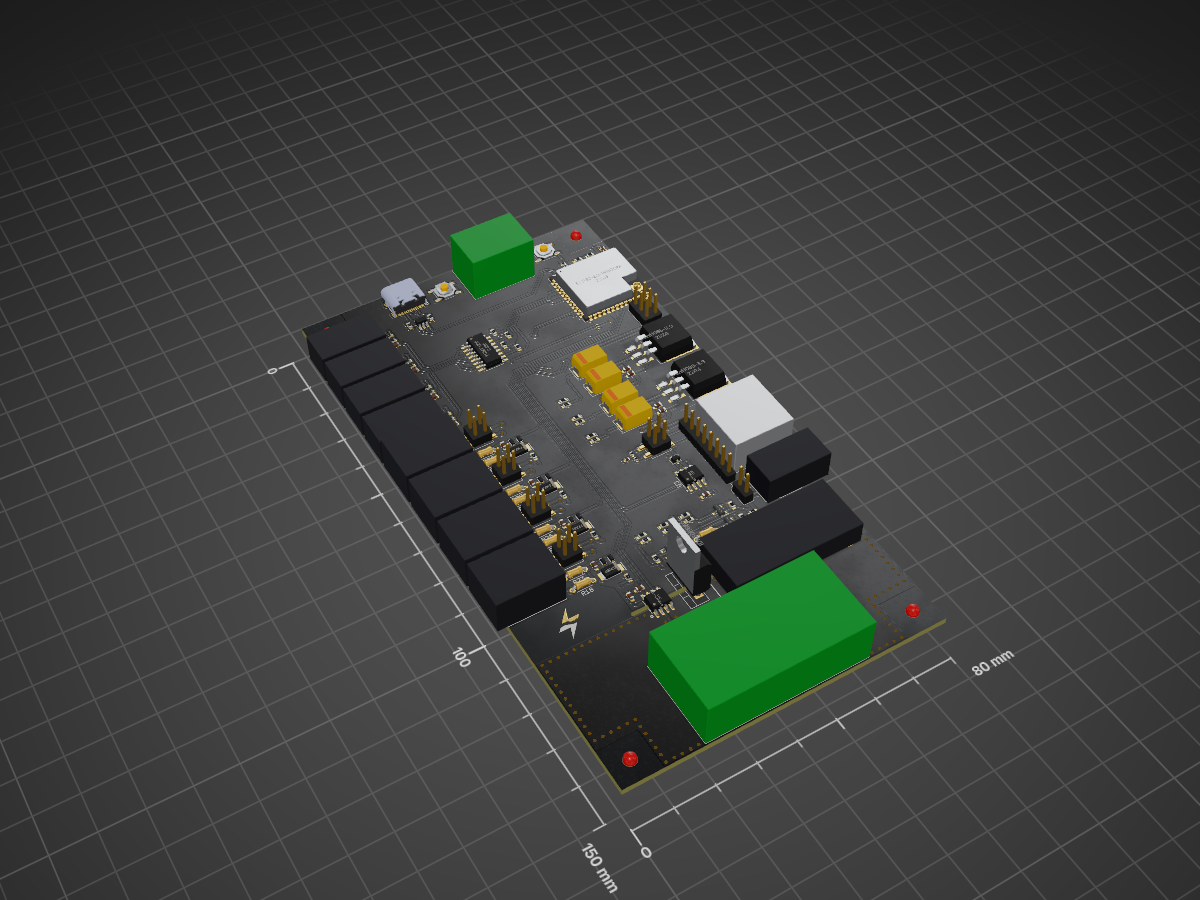
 risingtideresearch/CAN-Power-Control
CAN device for switching high-current DC loads and reading sensors and switch closures
CAN Power Control is an open-source printed circuit board by risingtideresearch, from the risingtideresearch/CAN-Power-Control repository on GitHub. It is a 4-layer board of 80 × 150 mm with 131 parts on 101 nets, routed with 688 tracks and 286 vias.
It is built around the ESP32-S3-WROOM-1U-N16R2, ACS71240LLCBTR-050U5 and TCMT4100, with the CDBU0520, FMMT625TA and BAT60A among its other parts. Its parts include 41 resistors, 24 capacitors, 23 diodes, 21 connectors and 6 ICs. It belongs with the ESP32 boards of this library.


CAN device for switching high-current DC loads and reading sensors and switch closures
| Qty | Value | Footprint | References |
|---|---|---|---|
| 9 | 1k | RisingTideResearch-Resistor:R_Axial_DIN0204_L3.6mm_D1.6mm_P5.08mm_Horizontal | R1, R18, R23, R24, R25, R26, R27, R29, R30 |
| 9 | 330 | RisingTideResearch-Resistor:R_0603_1608Metric | R6, R9, R10, R11, R12, R13, R14, R15, R16 |
| 8 | 1k | RisingTideResearch-Resistor:R_0603_1608Metric | R2, R3, R5, R7, R8, R17, R28, R35 |
| 8 | CDBU0520 | RisingTideResearch-Semiconductor:SOD-523 | D6, D7, D10, D11, D13, D14, D17, D18 |
| 7 | 0.1uF | RisingTideResearch-Capacitor:C_0603_1608Metric | C1, C2, C3, C22, C23, C24, C25 |
| 6 | Red | RisingTideResearch-LED:LED_0603_1608Metric | D3, D4, D5, D20, D21, D22 |
| 5 | Conn_02x02_Pin | RisingTideResearch-Connector:PinHeader_2x02_P2.54mm_Vertical_SMD | J5, J16, J21, J23, J25 |
| 5 | WAGO 2601-1102 | RisingTideResearch-Connector:WAGO_1x2_2601-1102 | J4, J6, J7, J8, J20 |
| 4 | 1.0nF | RisingTideResearch-Capacitor:C_0603_1608Metric | C14, C15, C16, C17 |
| 4 | 10uF | RisingTideResearch-Capacitor:CP_EIA-7343-30_AVX-N | C18, C19, C20, C21 |
| 4 | C | RisingTideResearch-Capacitor:C_0603_1608Metric | C4, C5, C6, C7 |
| 4 | WAGO 2601-1103 | RisingTideResearch-Connector:WAGO_1x3_2601-1103 | J17, J22, J24, J26 |
| 4 | Zener | RisingTideResearch-Semiconductor:SOD-128 | D8, D9, D12, D15 |
| 3 | 10k | SparkFun-Resistor:R_0603_1608Metric | R19, R20, R21 |
| 3 | 200 | RisingTideResearch-Resistor:R_0603_1608Metric | R4, R33, R34 |
| 3 | FMMT625TA | RisingTideResearch-Semiconductor:SOT96P240X110-3N | Q1, Q2, Q3 |
| 2 | 1.0mm | RisingTideResearch-Connector:TestPoint-1.0mm | TP3, TP4 |
| 2 | 470 | RisingTideResearch-Resistor:R_0603_1608Metric | R37, R42 |
| 2 | 5.1k | RisingTideResearch-Resistor:R_0603_1608Metric | R38, R41 |
| 2 | 60.4R | RisingTideResearch-Resistor:R_0402_1005Metric | R39, R40 |
| 2 | SMD_5.2x5.2mm_h1.9mm | RisingTideResearch-Switch:Push_SMD_5.2x5.2mm_h1.9mm | SW1, SW2 |
| 1 | 0.1uF | RisingTideResearch-Capacitor:C_0402_1005Metric | C9 |
| 1 | 1.0uF | RisingTideResearch-Capacitor:C_0402_1005Metric | C10 |
| 1 | 10k | RisingTideResearch-Resistor:R_0402_1005Metric | R32 |
| 1 | 10k | RisingTideResearch-Resistor:R_0603_1608Metric | R22 |
| 1 | 10uF | RisingTideResearch-Capacitor:C_0402_1005Metric | C8 |
| 1 | 1Meg | RisingTideResearch-Resistor:R_0603_1608Metric | R36 |
| 1 | 4.7nF | RisingTideResearch-Capacitor:C_0402_1005Metric | C92 |
| 1 | 4.7uF | RisingTideResearch-Capacitor:C_0402_1005Metric | C11 |
| 1 | 8P8C | RisingTideResearch-Connector:RJ45_Amphenol_RJHSE5380 | J2 |
| 1 | ACS71240LLCBTR-050U5 | RisingTideResearch-Semiconductor:SOIC-8_3.9x4.9mm_P1.27mm_Power | U2 |
| 1 | BAT60A | RisingTideResearch-Semiconductor:SOD-323 | D1 |
| 1 | Blue | RisingTideResearch-LED:LED_0603_1608Metric | D19 |
| 1 | Conn 01x08 Socket | RisingTideResearch-Connector:1x08 | J3 |
| 1 | Conn 02x03 Odd Even | RisingTideResearch-Connector:PinHeader_2x03_P2.54mm_Vertical | J10 |
| 1 | Conn_01x02_Pin | CAN-Power-Lib:PinHeader_1x02_P2.54mm_Vertical | J1 |
| 1 | DT1042-04SO | RisingTideResearch-Semiconductor:SOT23-6 | D23 |
| 1 | ESD2CANxx24-Q1 | RisingTideResearch-Semiconductor:SOT-323_SC-70 | D16 |
| 1 | ESP32-S3-WROOM-1U-N16R2 | RisingTideResearch-Module:ESP32-S3-WROOM-1U | U6 |
| 1 | G*** | kibuzzard-6881B6C9 | kibuzzard-6881B6C9 |
| 1 | G*** | kibuzzard-6881B704 | kibuzzard-6881B704 |
| 1 | IDP30E65D1 | RisingTideResearch-Semiconductor:TO-220-2_Vertical | D2 |
| 1 | LM1085-3.3 | RisingTideResearch-Semiconductor:TO-263-3_TabPin2 | U4 |
| 1 | LM1085-5.0 | RisingTideResearch-Semiconductor:TO-263-3_TabPin2 | U7 |
| 1 | LOGO | RisingTideResearch-Aesthetic:Logo_4mm | G*** |
| 1 | LOGO | RisingTideResearch-Aesthetic:Logo_6mm_Half | G*** |
| 1 | MCP2562-E-SN | RisingTideResearch-Semiconductor:SOIC-8_3.9x4.9mm_P1.27mm | U3 |
| 1 | Power Relay AZDC007 | RisingTideResearch-Electromechanical:AZDC007 | K1 |
| 1 | Screw Terminal 2Pos 8.5mm Pitch | RisingTideResearch-Connector:TerminalBlock_DoraboDBT10_8.5mm | J9 |
| 1 | Screw Terminal 3Pos 12.7mm Pitch | RisingTideResearch-Connector:TerminalBlock_Molex_0389690003 | J11 |
| 1 | TCMT4100 | RisingTideResearch-Semiconductor:SOP-16_4.4x10.4mm_P1.27mm | U5 |
| 1 | USB-C Receptacle | RisingTideResearch-Connector:USB-C_16 | J12 |
The 127 most common of 131 parts.
risingtideresearch/CAN-Gateway
Platform for collecting, logging, interpreting, and relaying CAN messages on multiple busses

MattisLind/teleprinterHat
A RaspberryPi HAT that interfaces a old school teleprinter

sparkfun/SparkFun_GNSSDO
The SparkFun GNSS Disciplined Oscillator (GNSSDO / GNSSDO+) is a precision time and frequency reference based on the Septentrio mosaic-T GNSS receiver.

sparkfun/SparkFun_Audio_Player_Breakout_MY1690X-16S
A small breakout board for the serial-controlled MY1690X-16S MP3/WAV audio player module.

sparkfun/SparkFun_GNSS_DAN-F10N
A USB evaluation board for the dual L1/L5 frequency DAN-F10N GNSS receiver.

sparkfun/SparkFun_GNSS_mosaic-T
Breakout board for the Septentrio mosaic-T GNSS timing receiver

sparkfun/SparkFun_Serial_MP3_Player_Shield-MY1690X
An Arduino R3 compatible shield for playing MP3s with a serial interface.

It measures 80 × 150 mm and has 4 copper layers, 1.6 mm thick.
131 parts, built around the ESP32-S3-WROOM-1U-N16R2, ACS71240LLCBTR-050U5, TCMT4100 and CDBU0520. The full list of its parts is on this page, with links to each part's symbol and footprint where PCBKit's library has them.
From the risingtideresearch/CAN-Power-Control repository on GitHub, at the commit this page was made from: the board is Hardware/CAN-Power-Control/CAN-Power-Control.kicad_pcb and its schematic Hardware/CAN-Power-Control/CAN-Power-Control.kicad_sch. PCBKit opens the board in the browser, with nothing to install.
Its repository states no licence, so its author keeps all rights: ask risingtideresearch before reusing the design.