4 layers149.6 × 98 mm
 ReFil/Hyper7-Evo
Hyper7-Evo
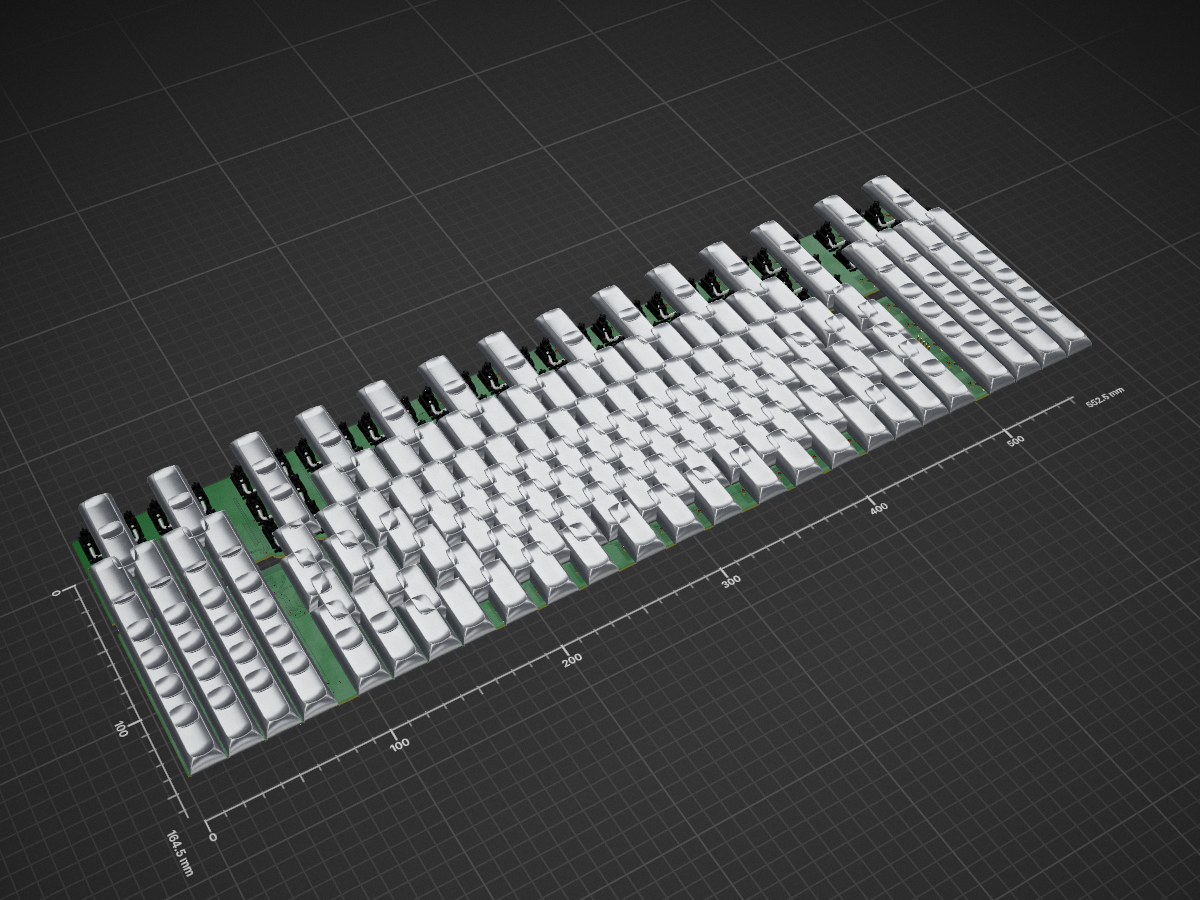
Hyper7-Evo is an open-source printed circuit board by ReFil, from the ReFil/Hyper7-Evo repository on GitHub. It is a 2-layer board of 552.5 × 164.5 mm with 873 parts on 527 nets, routed with 5,969 tracks and 888 vias.
It is built around the MDBT50Q-1MV2, 74HC595 and BQ24075RGT, with the USBLC6-2P6, 1N4148WS and SK6805-EC15 among its other parts. Its parts include 183 diodes, 21 capacitors, 17 connectors, 16 resistors and 10 ICs. It belongs with the nRF52 and nRF5x boards of this library.


| Qty | Value | Footprint | References |
|---|---|---|---|
| 183 | 1206REVMNT | ergo-pw:1206REVMNT | LED1, LED10, LED11, LED100, LED101, LED102, LED103, LED104, LED105, LED106, LED107, LED108, LED109, LED110, LED111, LED112 +167 |
| 183 | 1N4148WS | ergo-pw:SOD-323 | SWD1, SWD10, SWD11, SWD100, SWD101, SWD102, SWD103, SWD104, SWD105, SWD106, SWD107, SWD108, SWD109, SWD110, SWD111, SWD112 +167 |
| 183 | 1k | ergo-pw:R_0603_1608Metric | LEDR1, LEDR10, LEDR11, LEDR100, LEDR101, LEDR102, LEDR103, LEDR104, LEDR105, LEDR106, LEDR107, LEDR108, LEDR109, LEDR110, LEDR111, LEDR112 +167 |
| 183 | MX_SW_solder | ergo-pw:SW_MX_1u | MX1, MX10, MX11, MX100, MX101, MX102, MX103, MX104, MX105, MX106, MX107, MX108, MX109, MX110, MX111, MX112 +167 |
| 39 | SK6805-EC15 | ergo-pw:SK6805-EC15 | RGB1, RGB2, RGB10, RGB11, RGB12, RGB13, RGB14, RGB15, RGB16, RGB17, RGB18, RGB19, RGB20, RGB21, RGB22, RGB23 +23 |
| 30 | STAB-2U | ergo-pw:STAB-2U | ST1, ST2, ST10, ST11, ST12, ST13, ST14, ST15, ST16, ST17, ST18, ST19, ST20, ST21, ST22, ST23 +14 |
| 7 | 100nF | ergo-pw:C_0402_1005Metric | C1, C3, C4, C6, C8, C10, C12 |
| 6 | 10uF | ergo-pw:C_0402_1005Metric | C33, C34, C35, C36, C37, C38 |
| 6 | 1uF | ergo-pw:C_0402_1005Metric | C2, C5, C7, C9, C11, C13 |
| 6 | BM02B-SRSS-TB | ergo-pw:BM02B-SRSS-TB | J2, J9, J10, J11, J12, J13 |
| 5 | 74HC595 | Package_DFN_QFN:DHVQFN-16-1EP_2.5x3.5mm_P0.5mm_EP1x2mm | U4, U7, U8, U9, U10 |
| 4 | 100k | ergo-pw:R_0402_1005Metric | R5, R6, R8, R16 |
| 4 | 5.1k | ergo-pw:R_0402_1005Metric | R2, R3, R9, R10 |
| 3 | Conn_01x05 | Connector_PinHeader_2.54mm:PinHeader_1x05_P2.54mm_Vertical | J3, J6, J8 |
| 3 | SI1308EDL-T1-GE3 | ergo-pw:SOT-323_SC-70 | Q1, Q2, Q3 |
| 2 | 10k | ergo-pw:R_0402_1005Metric | R1, R7 |
| 2 | 12pF | ergo-pw:C_0402_1005Metric | C31, C32 |
| 2 | 27 | ergo-pw:R_0402_1005Metric | R11, R12 |
| 2 | Conn_01x02 | Connector_PinHeader_2.54mm:PinHeader_1x02_P2.54mm_Vertical | J16, J17 |
| 2 | Conn_01x03 | Connector_PinHeader_2.54mm:PinHeader_1x03_P2.54mm_Vertical | J4, J5 |
| 2 | Conn_01x04 | Connector_PinHeader_2.54mm:PinHeader_1x04_P2.54mm_Vertical | J14, J15 |
| 1 | 1.1k | ergo-pw:R_0402_1005Metric | R14 |
| 1 | 1.8k | ergo-pw:R_0402_1005Metric | R13 |
| 1 | 100 | ergo-pw:R_0402_1005Metric | R4 |
| 1 | 10uH | ergo-pw:L_0603_1608Metric | L2 |
| 1 | 590 | ergo-pw:R_0402_1005Metric | R15 |
| 1 | BQ24075RGT | ergo-pw:VQFN-16-1EP_3x3mm_P0.5mm_EP1.6x1.6mm | U6 |
| 1 | Conn_02x03_Odd_Even | ergo-pw:Tag-Connect_TC2030-IDC-NL_2x03_P1.27mm_Vertical | J7 |
| 1 | Crystal | ergo-pw:Crystal_SMD_2012-2Pin_2.0x1.2mm | Y1 |
| 1 | MDBT50Q-1MV2 | ergo-pw:XCVR_MDBT50Q-1MV2 | U5 |
| 1 | MOMENTARY-SWITCH-SPST-SMD-4.6X2.8MM | ergo-pw:TACTILE_SWITCH_SMD_4.6X2.8MM | S2 |
| 1 | PW_LOGO | ergo-pw:PW_LOGO | LOGO1 |
| 1 | SK-3296S-01-L1 | ergo-pw:SK3296S01L1 | S1 |
| 1 | SiP32431DR3 | ergo-pw:SOT-363_SC-70-6 | U3 |
| 1 | USBLC6-2P6 | ergo-pw:SOT-666 | U1 |
| 1 | XB3303ASOT23 | ergo-pw:SOT-23 | U2 |
| 1 | XKB-USB-C16PIN | ergo-pw:XKB-USB-C-16P | J1 |
It measures 552.5 × 164.5 mm and has 2 copper layers, 1.6 mm thick.
873 parts, built around the MDBT50Q-1MV2, 74HC595, BQ24075RGT and USBLC6-2P6. The full list of its parts is on this page, with links to each part's symbol and footprint where PCBKit's library has them.
From the ReFil/Hyper7-Evo repository on GitHub, at the commit this page was made from: the board is Hyper7-Evo.kicad_pcb and its schematic Hyper7-Evo.kicad_sch. PCBKit opens the board in the browser, with nothing to install.
Its repository states no licence, so its author keeps all rights: ask ReFil before reusing the design.


rajeev2705/PROJECTS
Welcome to my PCB projects repository! This space is dedicated to documenting my journey in designing, creating, and improving printed circuit boards (PCBs).


wszeto9/ESP32-S3-HUB75-Driver
This board serves as the Matrix Display driver for MIT's 2.007 gameboards in Spring 2024 and Spring 2025. The board can take 4 button inputs, Stemma-QT I2C sensors, and breaks out 8 GPIO pins for future use.

Bastardkb/Dilemma
The Dilemma is a vertical stagger low-profile keyboard with mods.