2 layers85 × 60 mm
CleverCoffee ESP32 Dev SMD
rancilio-pid/clevercoffee-hardware
hardware layouts for CleverCoffee
32 parts19

 rancilio-pid/clevercoffee-hardware19
hardware layouts for CleverCoffee
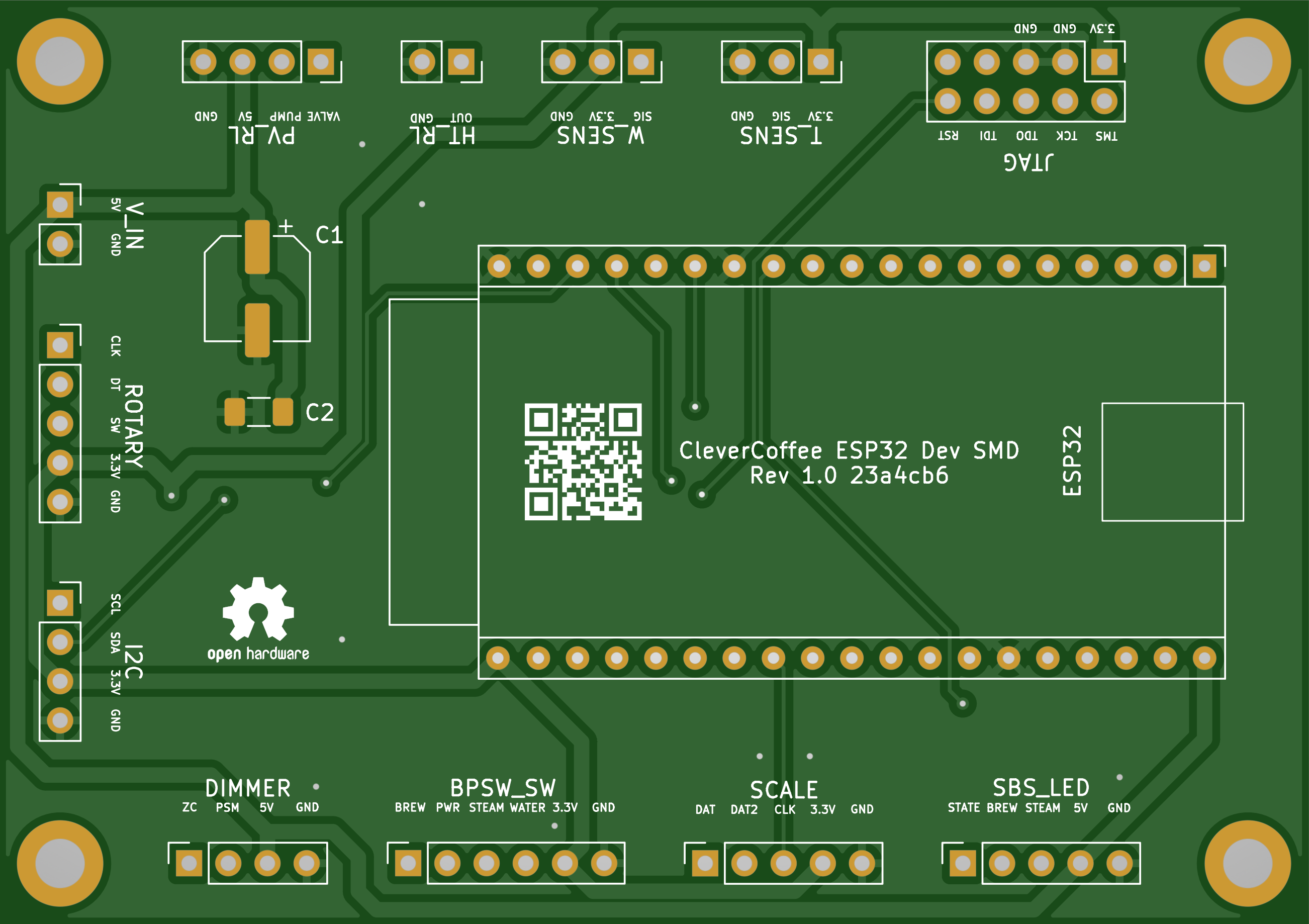
CleverCoffee ESP32 Dev is an open-source printed circuit board by rancilio-pid, from the rancilio-pid/clevercoffee-hardware repository on GitHub. It is a 2-layer board of 95 × 65 mm with 34 parts on 42 nets, routed with 406 tracks and 26 vias.
Its parts include 9 resistors and 2 capacitors. It belongs with the ESP32 and ESP8266 boards of this library.
KiCAD projects for breakout boards based on the ESP32 DevKitC v4

This work is licensed under a Creative Commons Attribution-NonCommercial-ShareAlike 4.0 International License
| Qty | Value | Footprint | References |
|---|---|---|---|
| 4 | 47K Ω | Resistor_THT:R_Axial_DIN0207_L6.3mm_D2.5mm_P10.16mm_Horizontal | R1, R2, R3, R9 |
| 4 | Conn_01x03 | Connector_PinSocket_2.54mm:PinSocket_1x03_P2.54mm_Vertical | F_SENS, S_LED, T_SENS, W_SENS |
| 4 | MountingHole_3.2mm_M3_DIN965_Pad | MountingHole:MountingHole_3.2mm_M3_DIN965_Pad | H1, H2, H3, H4 |
| 3 | 220 Ω | Resistor_THT:R_Axial_DIN0207_L6.3mm_D2.5mm_P10.16mm_Horizontal | R4, R5, R6 |
| 3 | Conn_01x04 | Connector_PinSocket_2.54mm:PinSocket_1x04_P2.54mm_Vertical | DIMMER, I2C, PV_RL |
| 2 | 4K7 Ω | Resistor_THT:R_Axial_DIN0207_L6.3mm_D2.5mm_P10.16mm_Horizontal | R7, R8 |
| 2 | Conn_01x02 | Connector_PinSocket_2.54mm:PinSocket_1x02_P2.54mm_Vertical | HT_RL, V_IN |
| 2 | Conn_01x05 | Connector_PinSocket_2.54mm:PinSocket_1x05_P2.54mm_Vertical | ROTARY, SCALE |
| 1 | 100 nF | Capacitor_THT:C_Axial_L5.1mm_D3.1mm_P7.50mm_Horizontal | C2 |
| 1 | 220 μF | Capacitor_THT:CP_Radial_D8.0mm_P3.80mm | C1 |
| 1 | Conn_01x02 | Connector_PinSocket_2.54mm:PinSocket_1x03_P2.54mm_Vertical | BS_LED |
| 1 | Conn_01x06 | Connector_PinSocket_2.54mm:PinSocket_1x06_P2.54mm_Vertical | BPSW_SW |
| 1 | Conn_ARM_JTAG_SWD_10 | Connector_PinHeader_2.54mm:PinHeader_2x05_P2.54mm_Vertical | JTAG |
| 1 | LOGO | LOGO | G*** |
| 1 | NodeMCU_DevKitC_v4 | Module:NodeMCU DevKitC v4 | ESP32 |
| 1 | SolderJumper_2_Open | Jumper:SolderJumper-2_P1.3mm_Open_Pad1.0x1.5mm | JP1 |
| 1 | SolderJumper_3_Open | Jumper:SolderJumper-3_P1.3mm_Open_Pad1.0x1.5mm | JP2 |
The 33 most common of 34 parts.
rancilio-pid/clevercoffee-hardware
hardware layouts for CleverCoffee

rancilio-pid/clevercoffee-hardware
hardware layouts for CleverCoffee

rancilio-pid/clevercoffee-hardware
hardware layouts for CleverCoffee


FrameworkComputer/ExpansionCards
Reference designs and documentation to create Expansion Cards for the Framework Laptop

mntmn/amiga2000-gfxcard
MNT VA2000, an Open Source Amiga 2/3/4000 Graphics Card (Zorro II/III), written in Verilog

hackclub/OnBoard
💡 Join 1,000 teenagers and make your first PCB with a $100 grant!


strangeparts/niubi-headphones
Flexible circuit board design for adding a headphone jack to an iPhone 7


baldengineer/bit-preserve
Project for capturing vintage, classic, aka old computer schematics in KiCad.
It measures 95 × 65 mm and has 2 copper layers, 1.6 mm thick.
34 parts. The full list of its parts is on this page, with links to each part's symbol and footprint where PCBKit's library has them.
From the rancilio-pid/clevercoffee-hardware repository on GitHub, at the commit this page was made from: the board is CleverCoffee_ESP32_Dev/CleverCoffee_ESP32_Dev.kicad_pcb and its schematic ABP2_Breakoutboard/KiCad/APB2_Breakout.kicad_sch. PCBKit opens the board in the browser, with nothing to install.
Its repository states no licence, so its author keeps all rights: ask rancilio-pid before reusing the design.