2 layers103 × 30.5 mm
 QuantDreamGit/AT28C16-Programmer
This project implements an EEPROM-based lookup table to convert an 8-bit value into decimal digits using a hardware-only decoding approach.
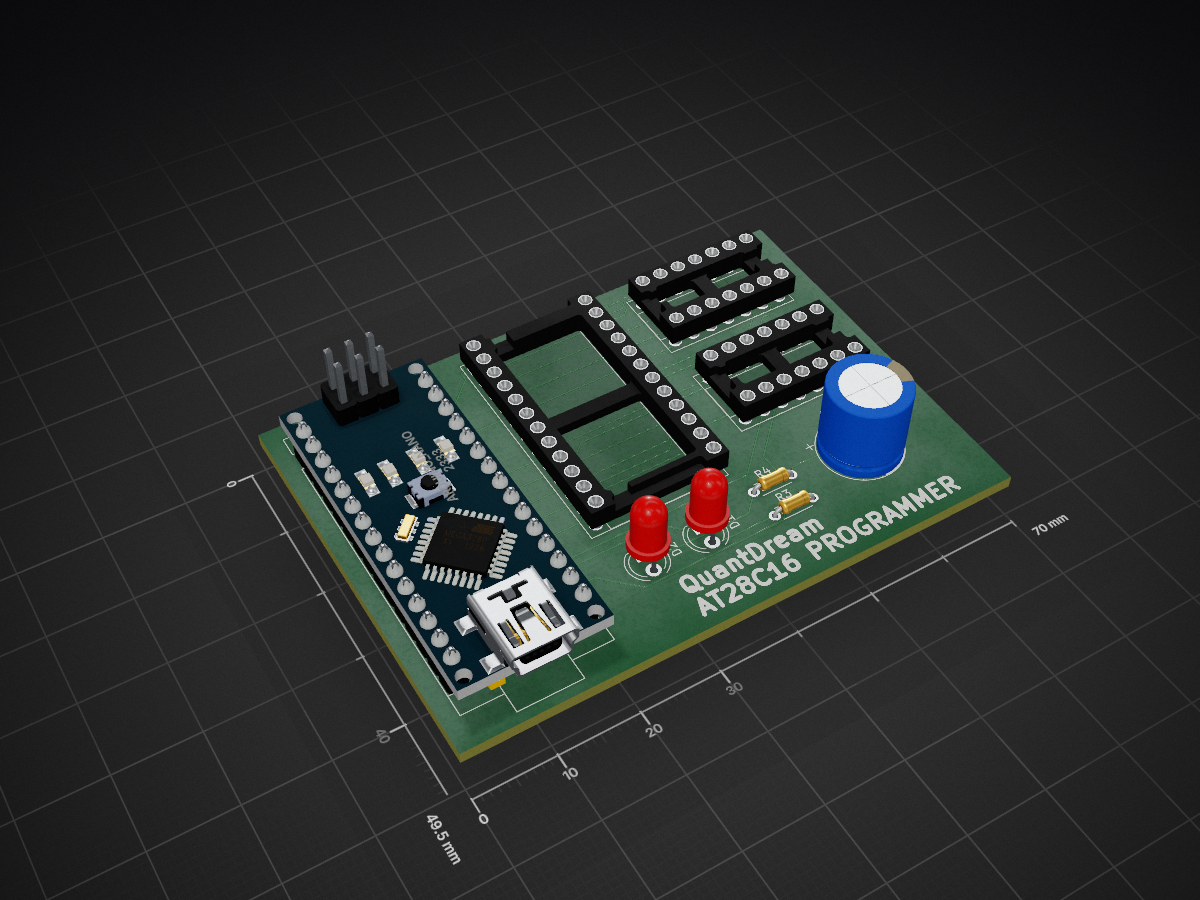
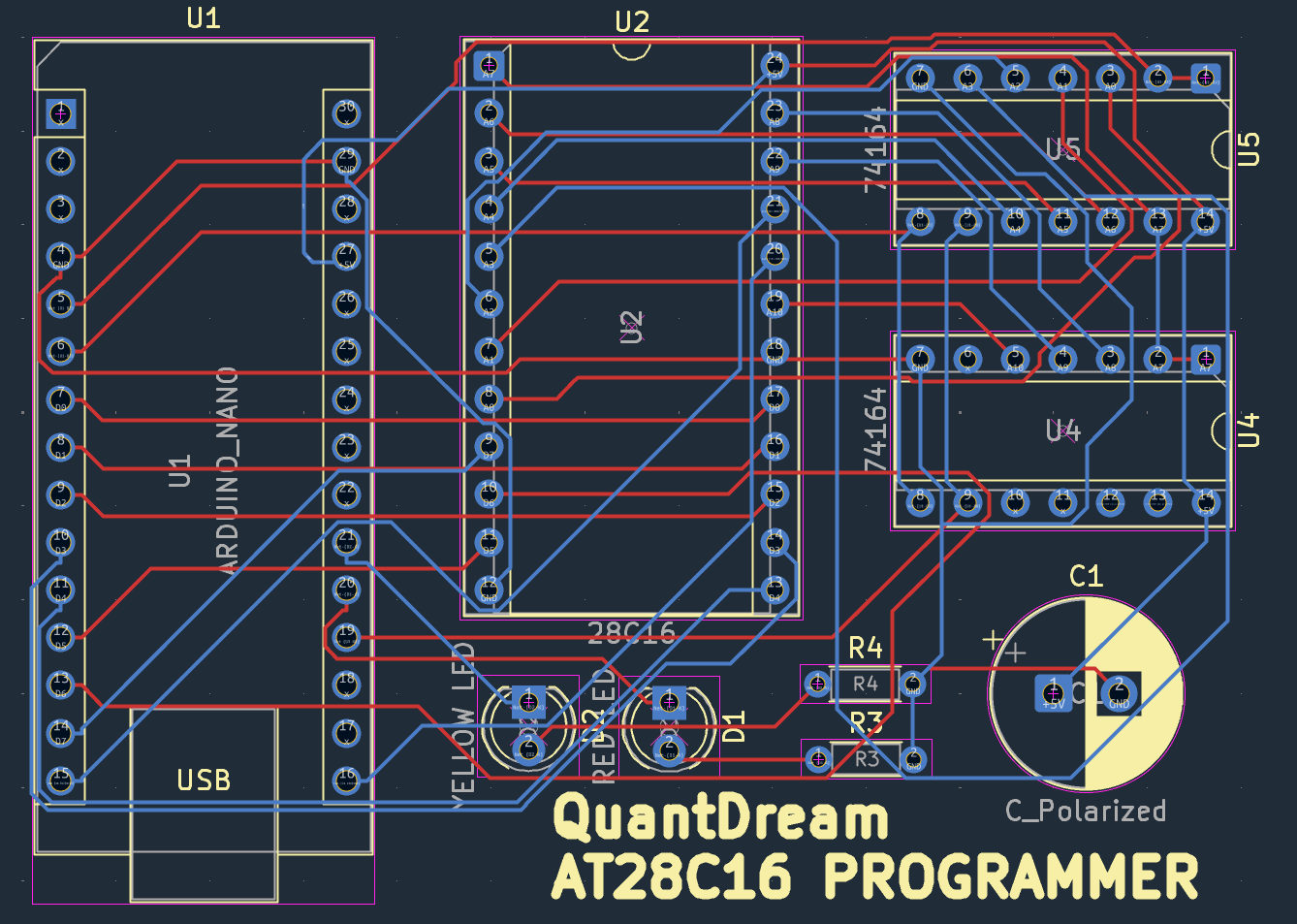
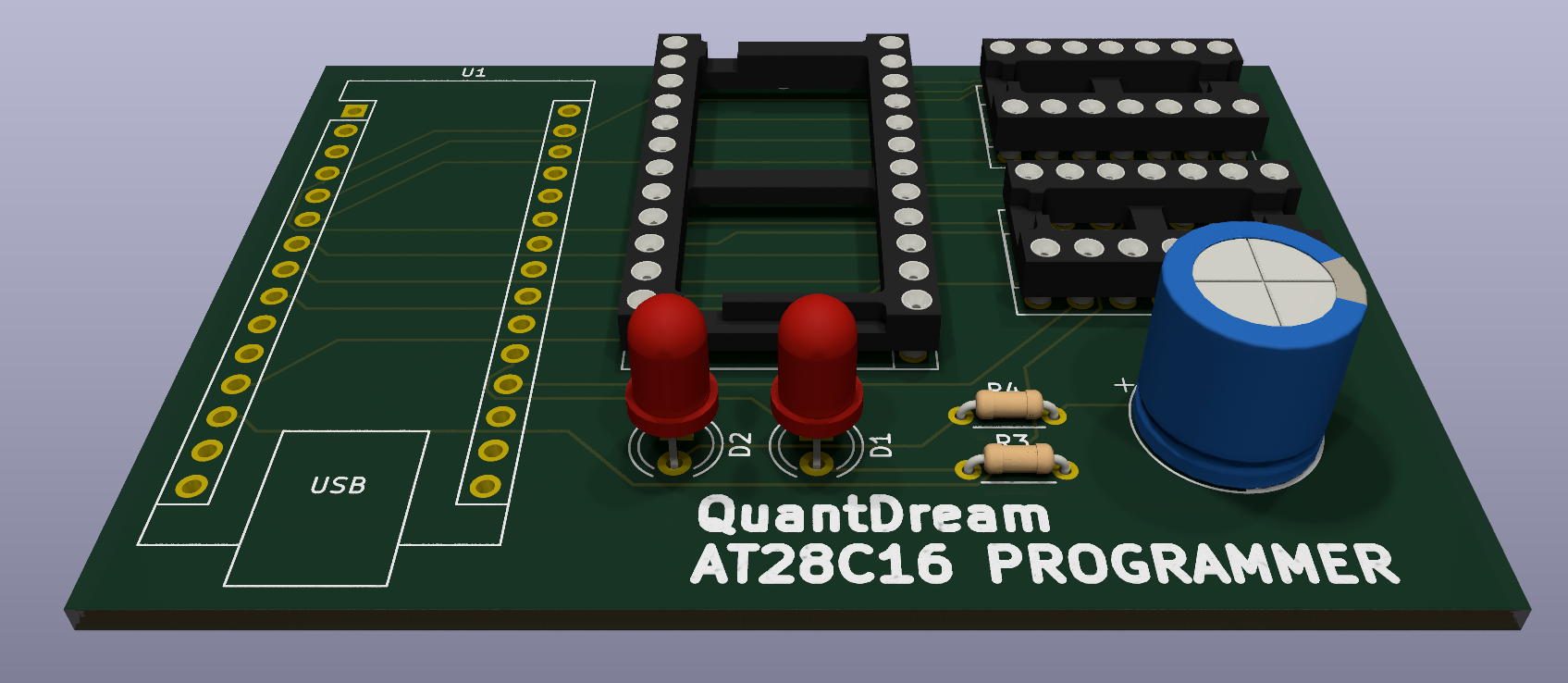
Eeprom16 is an open-source printed circuit board by QuantDreamGit, from the QuantDreamGit/AT28C16-Programmer repository on GitHub, published under the MIT licence. It is a 2-layer board of 70 × 49.5 mm with 9 parts on 47 nets, routed with 255 tracks and 0 vias.
Its parts include 4 ICs, 2 resistors, 2 diodes and 1 capacitor. It belongs with the AVR (ATmega, ATtiny) boards of this library.
This project implements an EEPROM-based lookup table to convert an 8-bit value into decimal digits using a hardware-only decoding approach.
The EEPROM is programmed using an Arduino Nano Every and a shift-register-driven address bus.
The system:
0x00–0xFF into decimal digitsWE, OE, CLRAddresses are shifted serially into the 74HC164, while data is written in parallel.
0x00–0xFF)| Address | Content |
|---|---|
0x000–0x0FF | Ones |
0x100–0x1FF | Tens |
0x200–0x2FF | Hundreds |
0x300–0x3FF | Sign (0x00) |
-128 → 127)| Address | Content |
|---|---|
0x400–0x4FF | Ones |
0x500–0x5FF | Tens |
0x600–0x6FF | Hundreds |
0x700–0x7FF | Sign (0x00 / 0x80) |
abs(value)0x80| Digit | Hex |
|---|---|
| 0 | 0x7B |
| 1 | 0x12 |
| 2 | 0xB9 |
| 3 | 0xB3 |
| 4 | 0xD2 |
| 5 | 0xE3 |
| 6 | 0xEB |
| 7 | 0x32 |
| 8 | 0xFB |
| 9 | 0xF2 |
| - | 0x80 |
For each byte:
D0–D7)WE (write enable)Readback uses the same address logic with OE enabled.
digitalWrite() already satisfies all timing constraints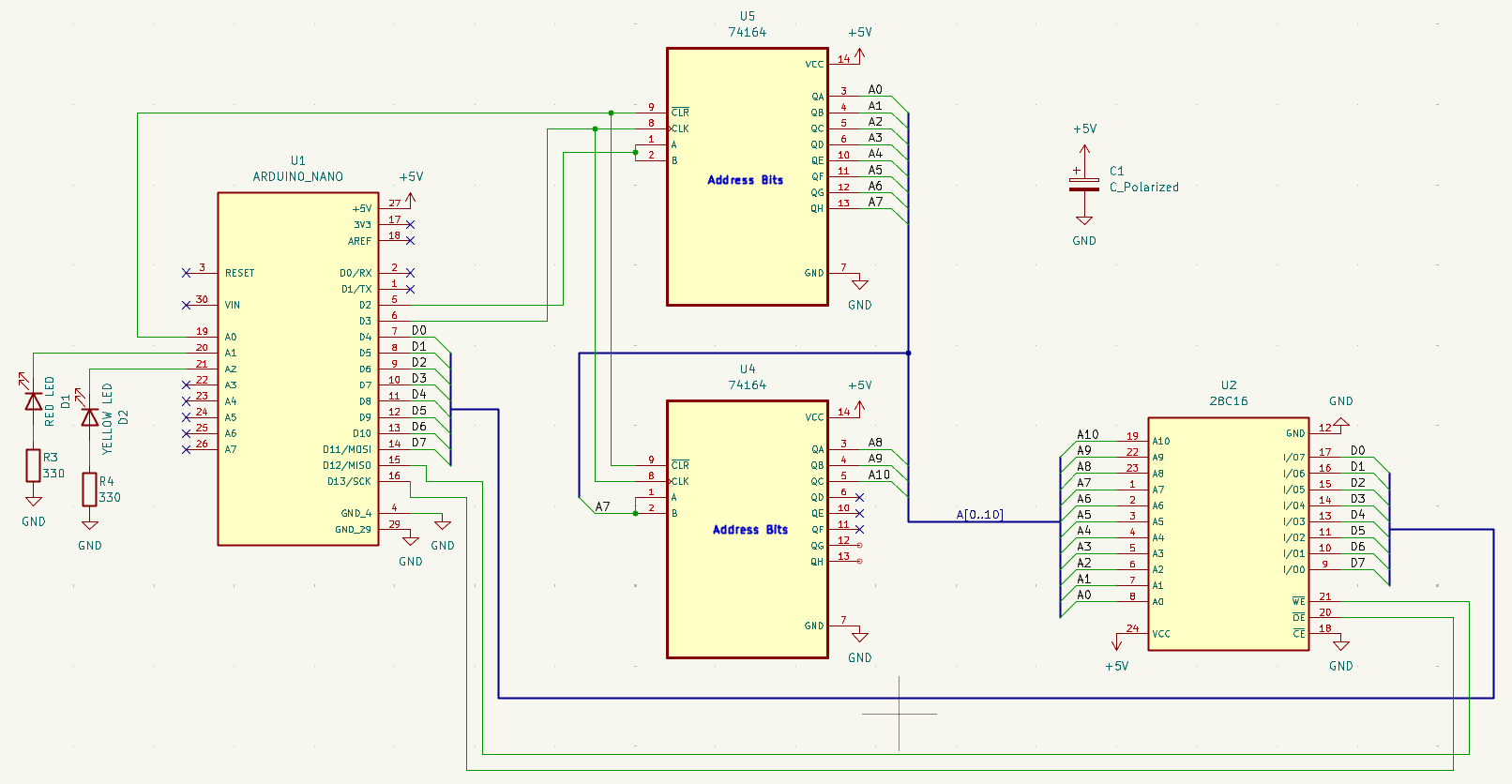

.
├── firmware/
├── hardware/
├── images/
└── README.md| Qty | Value | Footprint | References |
|---|---|---|---|
| 2 | 330 | Resistor_THT:R_Axial_DIN0204_L3.6mm_D1.6mm_P5.08mm_Horizontal | R3, R4 |
| 2 | 74164 | Package_DIP:DIP-14_W7.62mm_Socket | U4, U5 |
| 1 | 28C16 | Package_DIP:DIP-24_W15.24mm_Socket | U2 |
| 1 | ARDUINO_NANO | Module:Arduino_Nano | U1 |
| 1 | C_Polarized | Capacitor_THT:CP_Radial_D10.0mm_P3.50mm | C1 |
| 1 | RED LED | LED_THT:LED_D4.0mm | D1 |
| 1 | YELLOW LED | LED_THT:LED_D4.0mm | D2 |
It measures 70 × 49.5 mm and has 2 copper layers, 1.6 mm thick.
9 parts. The full list of its parts is on this page, with links to each part's symbol and footprint where PCBKit's library has them.
From the QuantDreamGit/AT28C16-Programmer repository on GitHub, at the commit this page was made from: the board is hardware/eeprom16.kicad_pcb and its schematic hardware/eeprom16.kicad_sch. PCBKit opens the board in the browser, with nothing to install.
Its repository publishes it under the MIT licence: you may reuse it on that licence's terms (keep the author's notice, and for a copyleft licence share your changes alike).


FrameworkComputer/ExpansionCards
Reference designs and documentation to create Expansion Cards for the Framework Laptop

VoronDesign/Voron-Hardware
Cool Hardware designed by the Voron Design group

hackclub/OnBoard
💡 Join 1,000 teenagers and make your first PCB with a $100 grant!


adamws/kicad-kbplacer
KiCad plugin for automatic keyboard's key placement and routing