4 layers60 × 60 mm
Ummon
JonaWe/ummon
ummon (from German Umgebungsmonitor, "environment monitor") is an ESP32-C6 based environmental sensor board with USB-C power.
95 parts

 Qeteshpony/CN1055
Mitsubishi CN105 compatible heatpump controller for ESPHome and Home Assistant
CN105 is an open-source printed circuit board by Qeteshpony, from the Qeteshpony/CN105 repository on GitHub, published under the BSD-2-Clause licence. It is a 4-layer board of 34 × 49 mm with 33 parts on 35 nets, routed with 118 tracks and 43 vias.
It is built around the ESP32-C6-WROOM-1-N8, LME78_03-1.0 and KT-0603R. Its parts include 10 resistors, 4 capacitors, 4 diodes, 2 ICs and 2 transistors. It belongs with the home automation and IoT and radio and wireless boards and the ESP32 and RISC-V boards of this library.


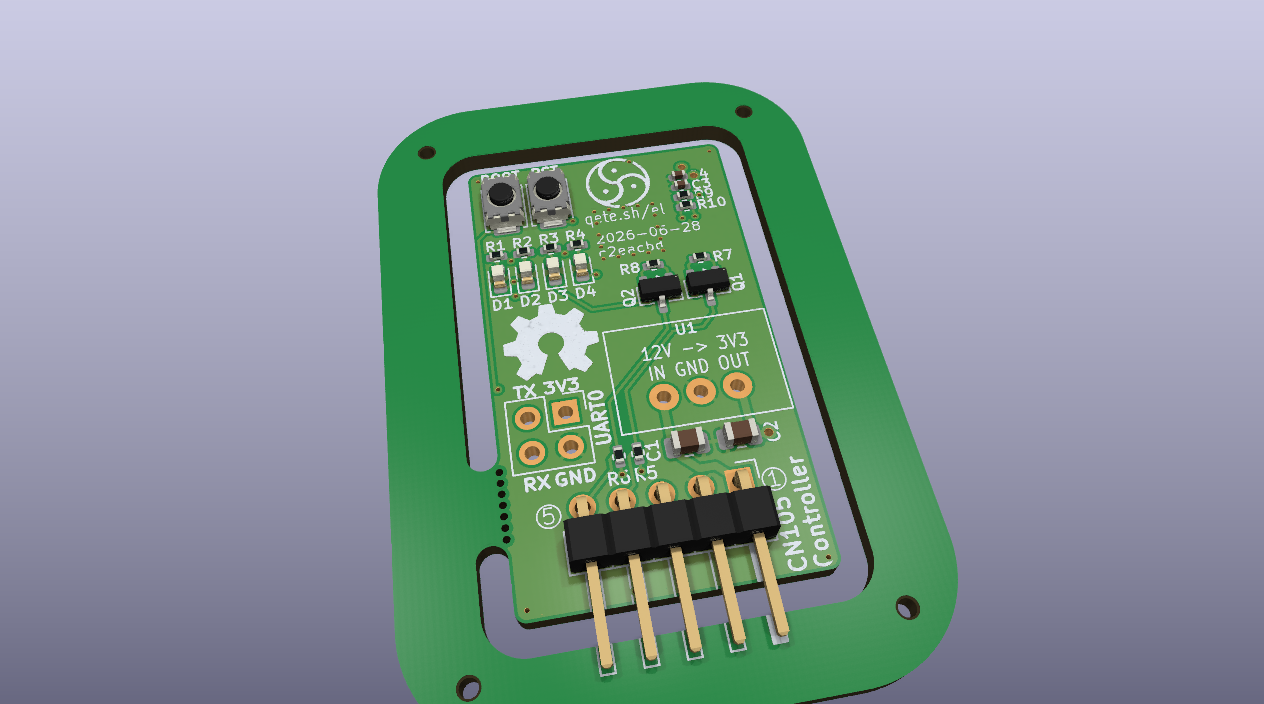
I ordered these boards from JLCPCB (Not a sponsor) and had only the smd components on the top side assembled. You then still need an ESP32-C6-WROOM-1 module (gets soldered on the bottom) and a Gaptec LME78_03-1.0 DC/DC Regulator. Also some header pins and a cable with a JST PAP-V-S PA 2.0 5 pin connector which goes into the CN105 port on the heatpumps main board.
I decided to use the DC/DC regulator and pull power from the 12V pin of the heatpump since the 5V pin can't handle much current and I didn't want to risk damaging the heatpump. The 5V pin is just used for the pullups on the logic level converter since the heatpumps CN105 connector uses 5V logic which the ESP can't handle properly.
LEDs 1 and 2 are connected to GPIO 23 and 22 and can be used freely by your software.
LEDs 3 and 4 show activity on TX and RX and can be left out if you don't want the module to blink all the time...
Mine are running with ESPHome and the external component found at github.com/echavet/MitsubishiCN105ESPHome
Since this board uses the ESP32-C6, it can use WiFi as well as Thread to communicate with Home Assistant.
Keep in mind that cheap serial adapters might not deliver enough power to successfully flash the ESP. I had to feed external power while flashing it. In that case only connect GND, RX and TX of the UART0 header to your serial adapter and feed anything between 6 and 36 volts (That's what the LME78 can handle) into the 12V pin of the boards CN105 header. When using ESPHome this is also just needed once. Updates can then be installed OTA.
| Qty | Value | Footprint | References |
|---|---|---|---|
| 6 | 10k | Resistor_SMD:R_0402_1005Metric | R5, R6, R7, R8, R9, R10 |
| 4 | 680R | Resistor_SMD:R_0402_1005Metric | R1, R2, R3, R4 |
| 4 | KT-0603R | LED_SMD:LED_0603_1608Metric | D1, D2, D3, D4 |
| 2 | 100n | Capacitor_SMD:C_0402_1005Metric | C3, C4 |
| 2 | 2N7002 | Package_TO_SOT_SMD:SOT-23 | Q1, Q2 |
| 1 | 10u | Capacitor_SMD:C_0805_2012Metric | C1 |
| 1 | 22u | Capacitor_SMD:C_0805_2012Metric | C2 |
| 1 | BOOT | Button_Switch_SMD:SW_Push_SPST_NO_Alps_SKRK | SW2 |
| 1 | CN105 | Connector_PinHeader_2.54mm:PinHeader_1x05_P2.54mm_Horizontal | J1 |
| 1 | ESP32-C6-WROOM-1 | PCM_Espressif:ESP32-C6-WROOM-1 | U2 |
| 1 | LME78_03-1.0 | My_Footprints:LME78_1.0-Series | U1 |
| 1 | LOGO | My_Footprints:CutieMark5mmInverted | G*** |
| 1 | RESET | Button_Switch_SMD:SW_Push_SPST_NO_Alps_SKRK | SW1 |
| 1 | UART0 | Connector_PinHeader_2.54mm:PinHeader_2x02_P2.54mm_Vertical | J2 |
| 1 | VAL** | Panelization:mouse-bite-2x5mm-slot-onesided-v2 | mouse-bite-2mm-slot |
The 28 most common of 33 parts.
JonaWe/ummon
ummon (from German Umgebungsmonitor, "environment monitor") is an ESP32-C6 based environmental sensor board with USB-C power.


jfm92/everAliveSensor
Solar-powered BLE environmental sensor (temp, humidity, pressure) with a 50F supercapacitor — potentially infinite lifetime, 19-day dark autonomy. ESP32 + BME680. Experimental.


Nicolai-Electronics/tanmatsu-hardware
Hardware design of the Tanmatsu mainboard

It measures 34 × 49 mm and has 4 copper layers, 1.6 mm thick.
33 parts, built around the ESP32-C6-WROOM-1-N8, LME78_03-1.0 and KT-0603R. The full list of its parts is on this page, with links to each part's symbol and footprint where PCBKit's library has them.
From the Qeteshpony/CN105 repository on GitHub, at the commit this page was made from: the board is pcb/CN105.kicad_pcb and its schematic pcb/CN105.kicad_sch. PCBKit opens the board in the browser, with nothing to install.
Its repository publishes it under the BSD-2-Clause licence: you may reuse it on that licence's terms (keep the author's notice, and for a copyleft licence share your changes alike).