2 layers80 × 80 mm
Breadboard grid-2.54mm 2x2
probably-Erwins-Cat/Circuit-Nodes
Circuit Nodes is an educational tool shared under CC BY-NC-SA 4.0 to help students understand electronic circuits by physically building them.
645 parts3

 probably-Erwins-Cat/Circuit-Nodes3
Circuit Nodes is an educational tool shared under CC BY-NC-SA 4.0 to help students understand electronic circuits by physically building them.
Component LED replacable is an open-source printed circuit board by probably-Erwins-Cat, from the probably-Erwins-Cat/Circuit-Nodes repository on GitHub. It is a 2-layer board of 40 × 40 mm with 7 parts on 2 nets, routed with 6 tracks and 0 vias.
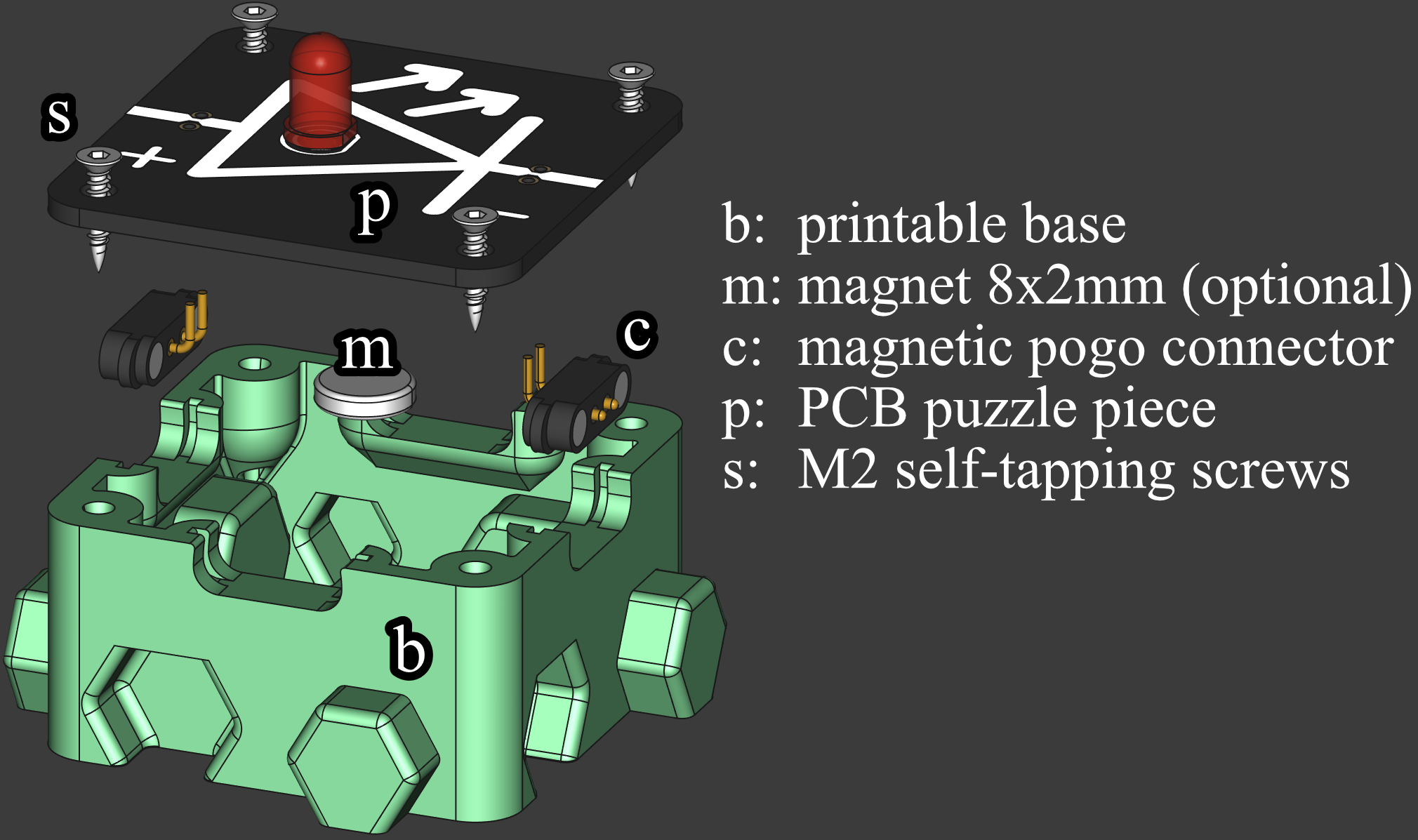
Circuit Nodes is an educational tool shared under CC BY-NC-SA 4.0 to help students understand electronic circuits by physically building them. Each module consists of a small PCB mounted on a 3D-printed base with puzzle-like notches, allowing users to create circuits in a grid-based structure. The PCBs include simple circuit elements such as resistors, capacitors, wire traces, switches, LEDs, lamps, and voltage or current measurement points, with their schematic representations printed directly on them. Magnetic connectors enable both physical attachment and electrical connection.
This system provides a low-cost entry point into electronics education while remaining scalable. By starting with basic components and expanding into more complex circuits, learners of all levels can benefit. The pedagogical value lies in reinforcing the connection between abstract circuit diagrams and tangible, working implementations, making theoretical concepts easier to grasp through hands-on experimentation.
Complete guides, examples, research insights, and best practices are available in our comprehensive GitHub Pages site:
| Chapter | Link |
|---|---|
| Introduction | https://probably-erwins-cat.github.io/Circuit-Nodes/introduction |
| Getting Started | https://probably-erwins-cat.github.io/Circuit-Nodes/getting-started |
| Printable Bases | https://probably-erwins-cat.github.io/Circuit-Nodes/printable-bases |
| Assembly Instructions | https://probably-erwins-cat.github.io/Circuit-Nodes/assembly-instructions |
| Component Guide | https://probably-erwins-cat.github.io/Circuit-Nodes/component-guide |
| Sourcing & Manufacturing | https://probably-erwins-cat.github.io/Circuit-Nodes/sourcing-manufacturing |
| Getting Started | https://probably-erwins-cat.github.io/Circuit-Nodes/getting-started |
If you are an educator or represent a school interested in testing Circuit Nodes, I can provide kits for evaluation and classroom use. Please reach out for more details, see below
Modular Design: 40x40mm PCBs mounted on 3D-printed bases with interlocking puzzle-like edges.
Hands-on Learning: Users assemble working circuits based on schematic diagrams.
Magnetic Connectors: Ensure secure physical and electrical connections.
Visual Representation: Each PCB features the corresponding circuit schematic for intuitive learning.
Expandable: Additional modules with more components can be designed and added.
Low Cost & Scalable: An affordable introduction to electronics that can be expanded as needed.
Pre-Assembled Kits Available: If the initial effort of manufacturing and assembling the components seems too high, I can provide ready-made circuit kits to make getting started easier.
Refer to the repository contents below for a dedicated list and example circuits.
Plan what puzzle pieces you need and how many. An entry electronics kit for school settings needs less than 40 to cover most grounds.
Download the necessary Gerber files for the circuits or kits you want to build from this repository.
Manufacture the PCBs using your preferred(accessible) PCB fabrication service.
Decide which style of the 3D printable base you prefer for your scenario:
Before you go mass printing the base parts, check which tolerance class, 0.15mm and 0.2mm, suits your printer capabilities.
Solder the component of the schematic of the PCB onto it first.
Assemble the puzzle pieces by placing the magnetic connectors in the pockets for the dedicated PCBs first. Slots without electrical connection stay empty.
Place the PCB on top of the pins of the magnetic connectors and screw in four screws into the base. Screws should auto-center the PCB on the base.
Solder the magnetic connectors to the PCB.
Start building and experimenting with different circuit configurations!
You can also contact me for production and sale, I stock the puzzle pieces in my inventory and do quality checks including all other parts for assembly.
Contributions are welcome! Feel free to submit pull requests with new module designs, improvements, or documentation updates. If you are a teacher and would like to see specific schematics that align with your curriculum, but lack the KiCAD skills to design them, I am happy to assist with the schematic design process. Just reach out with your requirements, and I can help bring them to life for your students.
Before submitting files, read CONTRIBUTING.md. It explains how contributed designs remain available for future Circuit Nodes kits while contributors keep ownership of their work.
For questions or collaboration, please open an discussion or reach out to me.

Circuit Nodes material is offered under CC BY-NC-SA 4.0 (Creative Commons Attribution-NonCommercial-ShareAlike 4.0 International) where the project holds the necessary rights. You may use the design files to make your own Circuit Nodes for noncommercial purposes. Schools may be able to commission ordinary fabrication and assembly services for that use. The public license does not permit use of licensed material primarily for commercial advantage. The project creator retains the right to manufacture and sell products based on material for which they hold the necessary rights. See LICENSING.md for scope and LICENSE for the full license.
This project is supported by peer-reviewed research published in Physics Education:
Kubitschke, H., Hennig, F., Gleichmann, J., Schnauß, J., & Bitzenbauer, P. (2024). Modular 3D-printed Circuit Nodes for low-cost and hands-on Electricity Education. Physics Education, 61(1), 015010. DOI: 10.1088/1361-6552/ae1abd
The paper includes:
Read the research publication for detailed insights.
| Qty | Value | Footprint | References |
|---|---|---|---|
| 4 | MH M3 | EASYEDA2KICAD:MountingHole_3.0mm_M3_tight | H1, H2, H3, H4 |
| 2 | Conn_01x02_Pin | EASYEDA2KICAD:Magnetic_Connector_1x02_P2.5mm_Horizontal_round-ears | J1, J5 |
| 1 | Conn_02x03_Odd_Even | EASYEDA2KICAD:CONN-SMD_HC-PM254-5.0H-2X3PS-02A | J2 |
probably-Erwins-Cat/Circuit-Nodes
Circuit Nodes is an educational tool shared under CC BY-NC-SA 4.0 to help students understand electronic circuits by physically building them.

probably-Erwins-Cat/Circuit-Nodes
Circuit Nodes is an educational tool shared under CC BY-NC-SA 4.0 to help students understand electronic circuits by physically building them.

probably-Erwins-Cat/Circuit-Nodes
Circuit Nodes is an educational tool shared under CC BY-NC-SA 4.0 to help students understand electronic circuits by physically building them.

probably-Erwins-Cat/Circuit-Nodes
Circuit Nodes is an educational tool shared under CC BY-NC-SA 4.0 to help students understand electronic circuits by physically building them.

probably-Erwins-Cat/Circuit-Nodes
Circuit Nodes is an educational tool shared under CC BY-NC-SA 4.0 to help students understand electronic circuits by physically building them.

probably-Erwins-Cat/Circuit-Nodes
Circuit Nodes is an educational tool shared under CC BY-NC-SA 4.0 to help students understand electronic circuits by physically building them.

probably-Erwins-Cat/Circuit-Nodes
Circuit Nodes is an educational tool shared under CC BY-NC-SA 4.0 to help students understand electronic circuits by physically building them.

probably-Erwins-Cat/Circuit-Nodes
Circuit Nodes is an educational tool shared under CC BY-NC-SA 4.0 to help students understand electronic circuits by physically building them.

probably-Erwins-Cat/Circuit-Nodes
Circuit Nodes is an educational tool shared under CC BY-NC-SA 4.0 to help students understand electronic circuits by physically building them.

probably-Erwins-Cat/Circuit-Nodes
Circuit Nodes is an educational tool shared under CC BY-NC-SA 4.0 to help students understand electronic circuits by physically building them.

probably-Erwins-Cat/Circuit-Nodes
Circuit Nodes is an educational tool shared under CC BY-NC-SA 4.0 to help students understand electronic circuits by physically building them.

probably-Erwins-Cat/Circuit-Nodes
Circuit Nodes is an educational tool shared under CC BY-NC-SA 4.0 to help students understand electronic circuits by physically building them.

byrantech/laptop
anyon_e, a highly integrated, high end, open source laptop. Attempt the impossible.


AxxAxx/AxxSolder
STM32 Based soldering station for JBC cartridges, 9-24 VDC and USB-PD power


jamro/tiny-engineer
A small desktop robot that brings an AI coding assistant to life, physically acting out when it reads files, thinks, writes code, and finishes work.

hoglet67/RGBtoHDMI
Bare-metal Raspberry Pi project that provides pixel-perfect sampling of Retro Computer RGB/YUV video and conversion to HDMI

It measures 40 × 40 mm and has 2 copper layers, 1.6 mm thick.
7 parts. The full list of its parts is on this page, with links to each part's symbol and footprint where PCBKit's library has them.
From the probably-Erwins-Cat/Circuit-Nodes repository on GitHub, at the commit this page was made from: the board is puzzle-pieces/component_LED_replacable/component_LED_replacable.kicad_pcb. PCBKit opens the board in the browser, with nothing to install.
Its repository states no licence, so its author keeps all rights: ask probably-Erwins-Cat before reusing the design.