4 layers50 × 20 mm
RobustEEG AFE
ppolGTMonster/RobustEEG_forUHFMRI
Hardware for an Open Source EEG usable in high magnetic Fields
58 parts1

 ppolGTMonster/RobustEEG_forUHFMRI1
Hardware for an Open Source EEG usable in high magnetic Fields
RobustEEG Base is an open-source printed circuit board by ppolGTMonster, from the ppolGTMonster/RobustEEG_forUHFMRI repository on GitHub. It is a 4-layer board of 85 × 125 mm with 107 parts on 169 nets, routed with 738 tracks and 164 vias.
It is built around the 74LVC1G17Z, ADS1299-4PAGR and TPD4E1B06DCKR-TP, with the MC7805CDTRKG, TPS72325DBV and TPS7A2033PDBVR-TP among its other parts. Its parts include 37 capacitors, 16 resistors, 15 ICs, 13 diodes and 12 connectors.


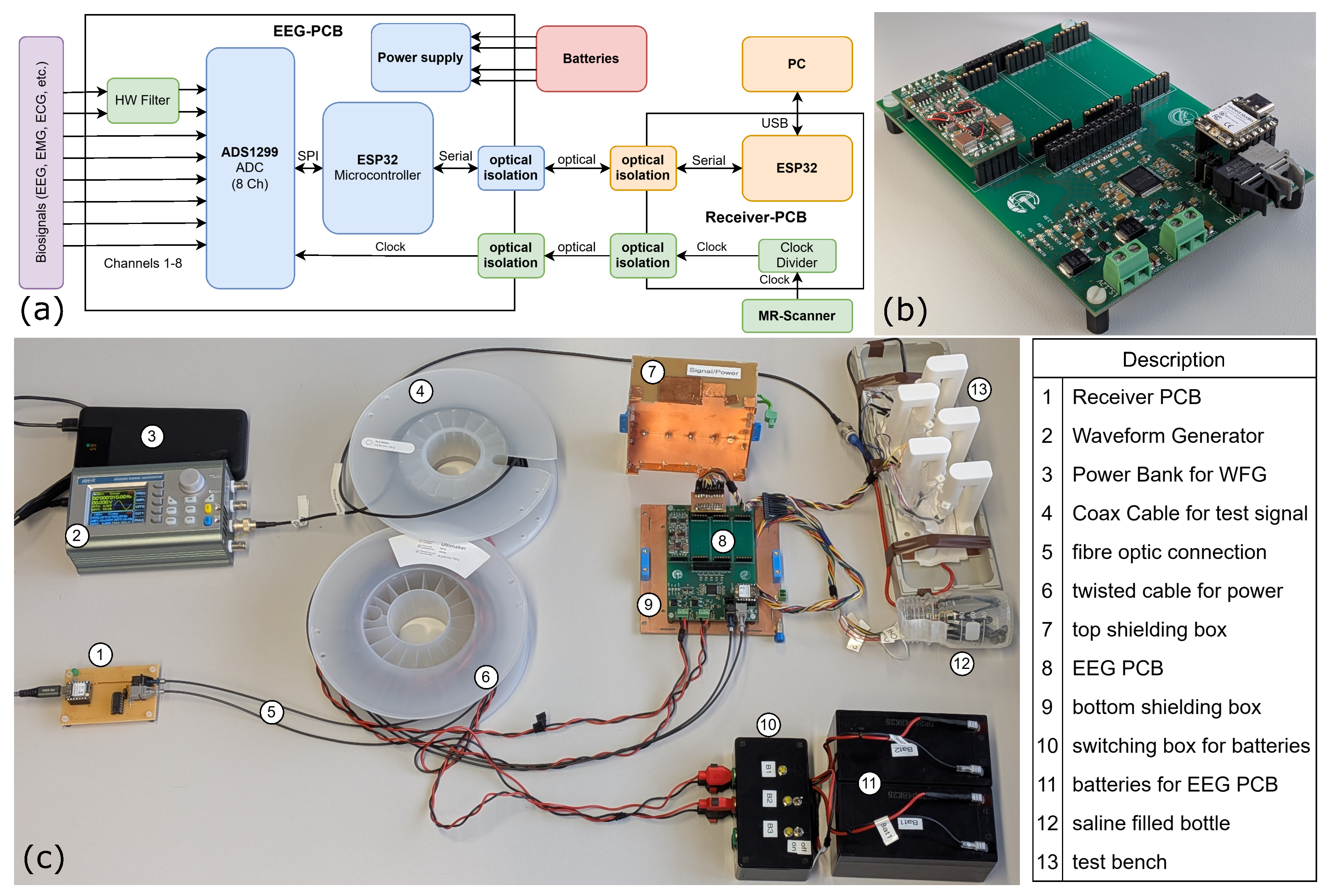
Overview: MR-compatible 8-ch EEG system: (a) System architecture. (b) EEG-PCB with one HW-Filter PCB. (c) Experimental setup.
Hardware and firmware for a robust, MR-compatible EEG acquisition system validated inside MR-Scanners at 3 T, 9.4 T, and 14.1 T field strengths.
Developed as part of a research thesis at the Max-Planck-Institut for Biological Cybernetics, Tübingen, by Felix Krull, in partnership with the ILH at the University of Stuttgart.
The system consists of four custom PCBs:
| Board | Function |
|---|---|
| RobustEEG_Base | Main acquisition board: ESP32-C3 MCU, TI ADS1299 ADC, optical fiber interface, LDO power supply, connectors for AFE and EEG cap |
| RobustEEG_AFE (opt.) | Analog Front-End board (plug-in): signal conditioning for 2 channels: instrumentation amplifier, high-pass filter and low-pass filter |
| RobustEEG_Adapter (opt.) | Cap adapter board: connects multiple EEG caps and amplifier inputs |
| RobustEEG_Dongle | Receiver board: translate opticale fiber to serial over USB |
The hardware design is based on the OpenBCI Cyton architecture (TI ADS1299, 24-bit, 8 channels).
Data is streamed via Lab Streaming Layer (LSL) and compatible with the Cerelog ESP-EEG software stack.
The ESP32-C3 firmware handles ADC communication (SPI) and optical data transmission. See 5_Software/ folder.
This project is based on the Cerelog ESP-EEG software stack, which provides LSL streaming, a forked OpenBCI GUI, and Brainflow API support.
KiCad project files, schematics, and Gerbers are located in 2.X_Work_Kicad_X/.
| Folder | Content |
|---|---|
2.1_Work_KiCad_Base/ | Main acquisition board |
2.2_Work_KiCad_AFE/ | Analog Front-End plug-in board |
2.3_Work_KiCad_Adapter/ | Cap adapter board |
2.3_Work_KiCad_Dongle/ | Optical Communication Dongle board |
The firmware is based on the Arduino IDE for the ESP32-C3. With small changes, other ESP32 modules or Arduino-compatible microcontrollers can be used.
However, only the ESP32-C3 was successfully tested to perform inside MR-scanners with field strengths up to 14.1 T.
Other hardware tested, specifically the ESP32-S3, did not survive even the static field of 3 T and is therefore not suitable for simultaneous EEG and MRI.
5_Software/README.md for detailed instructions).RobustEEG.py to enable LSL streaming, allowing you to log data and stream it to the OpenBCI GUI.| Component | License |
|---|---|
| Hardware (schematics, PCB layouts) | CERN-OHL-S v2 |
| Firmware / Software | MIT License |
| Documentation | CC BY 4.0 |
⚠️ This system is intended for research, engineering, and educational purposes only. It is not a medical device and has not been clinically evaluated or certified.
The authors and affiliated institutions accept no liability for any direct, indirect, or consequential damages arising from the use of this hardware or software, including but not limited to data loss, equipment damage, or personal injury.
Use of any third-party tools, libraries, or services referenced in this repository is at the user's own risk.
If you use this hardware in your research, please cite:
Krull, F. (2026). Development of a Robust Open-Source EEG Platform for Simultaneous Investigation with functional MRI. Research Thesis, Universität Stuttgart / MPI für Biologische Kybernetik.
| Qty | Value | Footprint | References |
|---|---|---|---|
| 8 | 100n | Capacitor_SMD:C_0603_1608Metric | C8, C11, C17, C18, C22, C25, C27, C29 |
| 7 | 1k | Resistor_SMD:R_0603_1608Metric_Pad0.98x0.95mm_HandSolder | R2, R3, R4, R5, R7, R10, R11 |
| 7 | LED | LED_SMD:LED_0603_1608Metric | D3, D4, D5, D6, D7, D8, D13 |
| 7 | TPD4E1B06DCKR | RobustEEG:SOT65P210X110-6N | IC4, IC7, IC8, IC9, IC10, IC11, IC12 |
| 6 | 1u | Capacitor_SMD:C_0805_2012Metric | C5, C9, C10, C19, C21, C24 |
| 6 | SBR3U60P1Q-13 | Diode_SMD:D_PowerDI-123 | D1, D2, D9, D10, D11, D12 |
| 5 | 10u | Capacitor_SMD:C_0805_2012Metric | C12, C16, C20, C26, C28 |
| 5 | 2.2u | Capacitor_SMD:C_0805_2012Metric | C3, C4, C7, C14, C15 |
| 5 | CAY16-2201F4LF | RobustEEG:RESCAX80P160X320X60-8N | R20, R21, R22, R23, R24 |
| 5 | W2A45C102KAT2A | RobustEEG:W2A45C102KAT2A | CN1, CN2, CN3, CN4, CN5 |
| 4 | 10u | Capacitor_SMD:C_1206_3216Metric | C39, C40, C42, C44 |
| 4 | EEG_AFE | RobustEEG:EEG_AFE | PCB1, PCB2, PCB3, PCB4 |
| 4 | MountingHole | MountingHole:MountingHole_3.2mm_M3_DIN965 | H1, H2, H3, H4 |
| 4 | opt | Capacitor_SMD:C_1206_3216Metric | C37, C38, C41, C43 |
| 2 | 0 | Resistor_SMD:R_0603_1608Metric_Pad0.98x0.95mm_HandSolder | R8, R9 |
| 2 | 2.2u | Capacitor_SMD:C_1206_3216Metric | C1, C2 |
| 2 | Jumper_3_Open | Connector_PinHeader_2.54mm:PinHeader_1x03_P2.54mm_Vertical | JP1, JP13 |
| 2 | MC7805CDTRKG | RobustEEG:MJD1221G | IC1, IC2 |
| 2 | TestPoint | Connector_PinHeader_1.00mm:PinHeader_1x01_P1.00mm_Vertical | TP1, TP2 |
| 1 | 100 | Resistor_SMD:R_0603_1608Metric_Pad0.98x0.95mm_HandSolder | R1 |
| 1 | 100u | Capacitor_SMD:C_1206_3216Metric | C23 |
| 1 | 10n | Capacitor_SMD:C_0603_1608Metric | C6 |
| 1 | 113991054 | RobustEEG:SEED_XIAO_ESP32_C3 | U4 |
| 1 | 1M | Resistor_SMD:R_0603_1608Metric_Pad0.98x0.95mm_HandSolder | R6 |
| 1 | 1n | Capacitor_SMD:C_0603_1608Metric | C13 |
| 1 | 74LVC1G17 | Package_TO_SOT_SMD:SOT-353_SC-70-5 | U1 |
| 1 | ADS1299-4PAGR | RobustEEG:QFP50P1200X1200X120-64N | IC6 |
| 1 | AFBR-1521Z_TX | RobustEEG:HFBR1521Z | J7 |
| 1 | AFBR-2521Z_RX | RobustEEG:HFBR2521Z | J8 |
| 1 | BAT1 | RobustEEG:phoenix_terminal_block_1729128 | J1 |
| 1 | BAT2 | RobustEEG:phoenix_terminal_block_1729128 | J2 |
| 1 | Conn_01x10 | Connector_PinSocket_2.54mm:PinSocket_1x10_P2.54mm_Vertical | J3 |
| 1 | INPUT | Connector_PinHeader_2.54mm:PinHeader_2x14_P2.54mm_Vertical | J9 |
| 1 | Logo_Open_Hardware_Small | 2_Logos_MPI:bioKyb_10mm | L1 |
| 1 | Logo_Open_Hardware_Small | 2_Logos_MPI:MPI_10mm | L2 |
| 1 | P50E-050P1-S1-EA | RobustEEG:P50E050P1S1EA | J5 |
| 1 | TPS70625DBVR | RobustEEG:SOT95P280X145-5N | IC3 |
| 1 | TPS72325DBV | Package_TO_SOT_SMD:SOT-23-5 | U2 |
| 1 | TPS7A2033PDBVR | RobustEEG:SOT95P280X145-5N | IC5 |
ppolGTMonster/RobustEEG_forUHFMRI
Hardware for an Open Source EEG usable in high magnetic Fields

ppolGTMonster/RobustEEG_forUHFMRI
Hardware for an Open Source EEG usable in high magnetic Fields

ppolGTMonster/RobustEEG_forUHFMRI
Hardware for an Open Source EEG usable in high magnetic Fields


Mo3tasemO/Graduation_Project
This repository will be for the Graduation Project.


Monolith-BCI/Trillium-PCB
We're a group of teens working on creating a BCI PCB to start running our own experiments on noise filtering, signal processing speed, and data collection.


Ishaka-M26/EEG-Platform
A custom multichannel EEG acquisition platform for exploring real-time EEG processing and closed-loop neurotechnology.
It measures 85 × 125 mm and has 4 copper layers, 1.6 mm thick.
107 parts, built around the 74LVC1G17Z, ADS1299-4PAGR, TPD4E1B06DCKR-TP and MC7805CDTRKG. The full list of its parts is on this page, with links to each part's symbol and footprint where PCBKit's library has them.
From the ppolGTMonster/RobustEEG_forUHFMRI repository on GitHub, at the commit this page was made from: the board is 2.1_Work_KiCad_Base/RobustEEG_Base.kicad_pcb and its schematic 2.1_Work_KiCad_Base/RobustEEG_Base.kicad_sch. PCBKit opens the board in the browser, with nothing to install.
Its repository states no licence, so its author keeps all rights: ask ppolGTMonster before reusing the design.