2 layers47 × 20.6 mm

 ppetr/hw-opto-counter
Universal infrared proximity sensor/counter of events
Opto counter is an open-source printed circuit board by ppetr, from the ppetr/hw-opto-counter repository on GitHub, published under the Apache-2.0 licence. It is a 2-layer board of 27.9 × 27.9 mm with 13 parts on 16 nets, routed with 88 tracks and 3 vias.
It is built around the ATTINY3224-SSU, TSSP6038TR and TSAL4400. Its parts include 3 resistors, 3 connectors, 2 ICs, 2 diodes and 1 capacitor. It belongs with the AVR (ATmega, ATtiny) boards of this library.


Disclaimer: This is not an officially supported Google product.
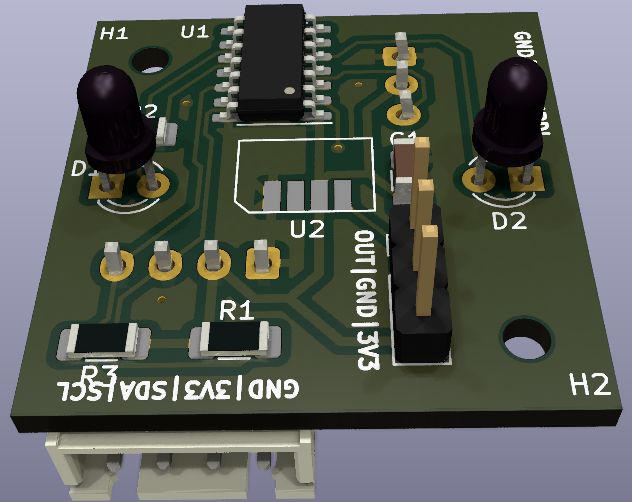
The board uses two IR LEDs with a modulated signal (both either 38KHz or 56KHz, depending on the receiver type) whose light reflects off objects in front of the device into an IR receiver.
Using two LEDs allows to determine an approximate position (or direction of movement) of an object in one dimension. Modulating the signal significantly reduces interference from natural IR light sources.
The microcontroller (ATtiny3224) varies the signal strength to compute the strength of the reflected signal using the binary search algorithm.
The measured values are made available through I²C (subordinate).
In addition to reporting current values of reflections from both LEDs, the microcontroller also counts the number of times the reflection quickly changes (which we call "events"). These events are defined using two parameters:
There are the following event types that are counted independently:
LED1:  ___|‾‾‾|___
LED2: ___________LED1: __|‾‾‾|____
LED2: ____|‾‾‾|__Development of a prototype.
Please see Code of Conduct and Contributing.
| Qty | Value | Footprint | References |
|---|---|---|---|
| 2 | 4k7 | Resistor_SMD:R_1206_3216Metric_Pad1.30x1.75mm_HandSolder | R1, R3 |
| 2 | MountingHole | MountingHole:MountingHole_2.2mm_M2 | H1, H2 |
| 2 | TSAL4400 | LED_THT:LED_D3.0mm_IRBlack | D1, D2 |
| 1 | 100nF | Capacitor_SMD:C_1206_3216Metric_Pad1.33x1.80mm_HandSolder | C1 |
| 1 | 220 | Resistor_SMD:R_1206_3216Metric_Pad1.30x1.75mm_HandSolder | R2 |
| 1 | ATtiny3224-SS | Package_SO:SOIC-14_3.9x8.7mm_P1.27mm | U1 |
| 1 | IR-REC | Connector_PinHeader_2.54mm:PinHeader_1x03_P2.54mm_Vertical | J1 |
| 1 | TSSP6038 | opto-counter:TSS60xx | U2 |
| 1 | UPDI | Connector_JST:JST_XH_S3B-XH-A_1x03_P2.50mm_Horizontal | J3 |
| 1 | qwiic | Connector_JST:JST_XH_S4B-XH-A_1x04_P2.50mm_Horizontal | J2 |

ieb/BatterySensor
A Modbus RTU Battery Current and Voltage sensor board based Attiny3224, MAX485, MAX9918 chips.


jaco-pixeldump/attiny-soic-14-barebone-breakout-board
A compact, breadboard-friendly breakout adapter PCB for 14-pin SOIC Microchip ATtiny microcontrollers (such as ATtiny3224, ATtiny1624, ATtiny824, ATtiny424, as well as 1-series and 0-series parts like ATtiny1614…


hschack/ZB3245TSS_OPENPNP
More to come Link Mellow Fly Super8Pro https://teamgloomy.github.io/flysuper8proh723general35.html

ieb/autopilot
An ML Autopilot designed and written almost entirely by Google AntiGravity.
It measures 27.9 × 27.9 mm and has 2 copper layers, 1.6 mm thick.
13 parts, built around the ATTINY3224-SSU, TSSP6038TR and TSAL4400. The full list of its parts is on this page, with links to each part's symbol and footprint where PCBKit's library has them.
From the ppetr/hw-opto-counter repository on GitHub, at the commit this page was made from: the board is hw/opto-counter.kicad_pcb and its schematic hw/opto-counter.kicad_sch. PCBKit opens the board in the browser, with nothing to install.
Its repository publishes it under the Apache-2.0 licence: you may reuse it on that licence's terms (keep the author's notice, and for a copyleft licence share your changes alike).