2 layers141 × 56.9 mm

 Plokkke/sauter-marapi-esphome
ESPHome / Home Assistant pilot wire (fil pilote) controller for the Sauter Marapi tactile towel radiator — KiCad PCB, reverse engineering notes. Study phase, untested.
Radiator controller is an open-source printed circuit board by Plokkke, from the Plokkke/sauter-marapi-esphome repository on GitHub. It is a 2-layer board of 76 × 66 mm with 19 parts on 31 nets, routed with 64 tracks and 4 vias.
It is built around the HLK-PM01, WEMOS D1 MINI and MOC3043M, with the 1N4148W, MMBT2222A and SRD-05VDC-SL-C among its other parts. Its parts include 3 resistors, 3 diodes, 2 ICs, 1 transistor and 1 connector. It belongs with the home automation and IoT boards and the ESP8266 and STM32 boards of this library.


Français · English
Module DIY qui pilote le sèche-serviettes Sauter Marapi tactile 1750 W (anthracite) depuis Home Assistant, par son fil pilote 6 ordres (Confort, Confort −1, Confort −2, Éco, Hors-gel, Arrêt).
Firmware ESPHome sur un Wemos D1 mini (ESP8266), deux optotriacs MOC3043 + diodes, un relais de repli en Éco, alimenté en 230 V par l'arrivée murale du sèche-serviettes.
[!WARNING] Projet en phase d'étude. Le module complémentaire (schéma, circuit imprimé, firmware) n'a encore été ni fabriqué ni testé : ses informations sont théoriques. Seules les données du fabricant (notice, signaux du fil pilote) et les photos de la carte d'origine sont des faits ; les pistes de rétro-ingénierie (touche Boost, liaison interne) sont des hypothèses. À vérifier avant toute réalisation.
Mots-clés : Sauter Marapi tactile, sèche-serviettes soufflant, radiateur fil pilote, Groupe Atlantic, ESPHome, Home Assistant, domotique, ESP8266, MOC3043, carte HM011 TD1N01 RAD, 74 60 5004, STM32F091CCT6, touche Boost, liaison Linap, Err 10.
| Dossier | Contenu |
|---|---|
firmware/ | configuration ESPHome : common.yaml (Wi-Fi, API, OTA, LED, diagnostic), controlleur-seche-serviettes.yaml (fil pilote), secrets.example.yaml |
hardware/ | KiCad 10 : schéma (.kicad_sch, rendu .svg), circuit imprimé (.kicad_pcb, rendus -top.png / -bottom.png), modèle 3D radiator-controller.step pour le boîtier (Fusion 360), symbole et empreinte du D1 mini, règles d'isolement (.kicad_dru) |
enclosure/ | boîtier (à venir) |
knowledge/ | architecture.md (rôles, contrat, sécurité), fil-pilote.md (signaux, schéma, nomenclature), backlog.md, notice Sauter (manuals/) |
Le module travaille sur le secteur, dans une salle de bains. Lire la section Sécurité de knowledge/fil-pilote.md avant de câbler. Couper au tableau avant toute intervention.
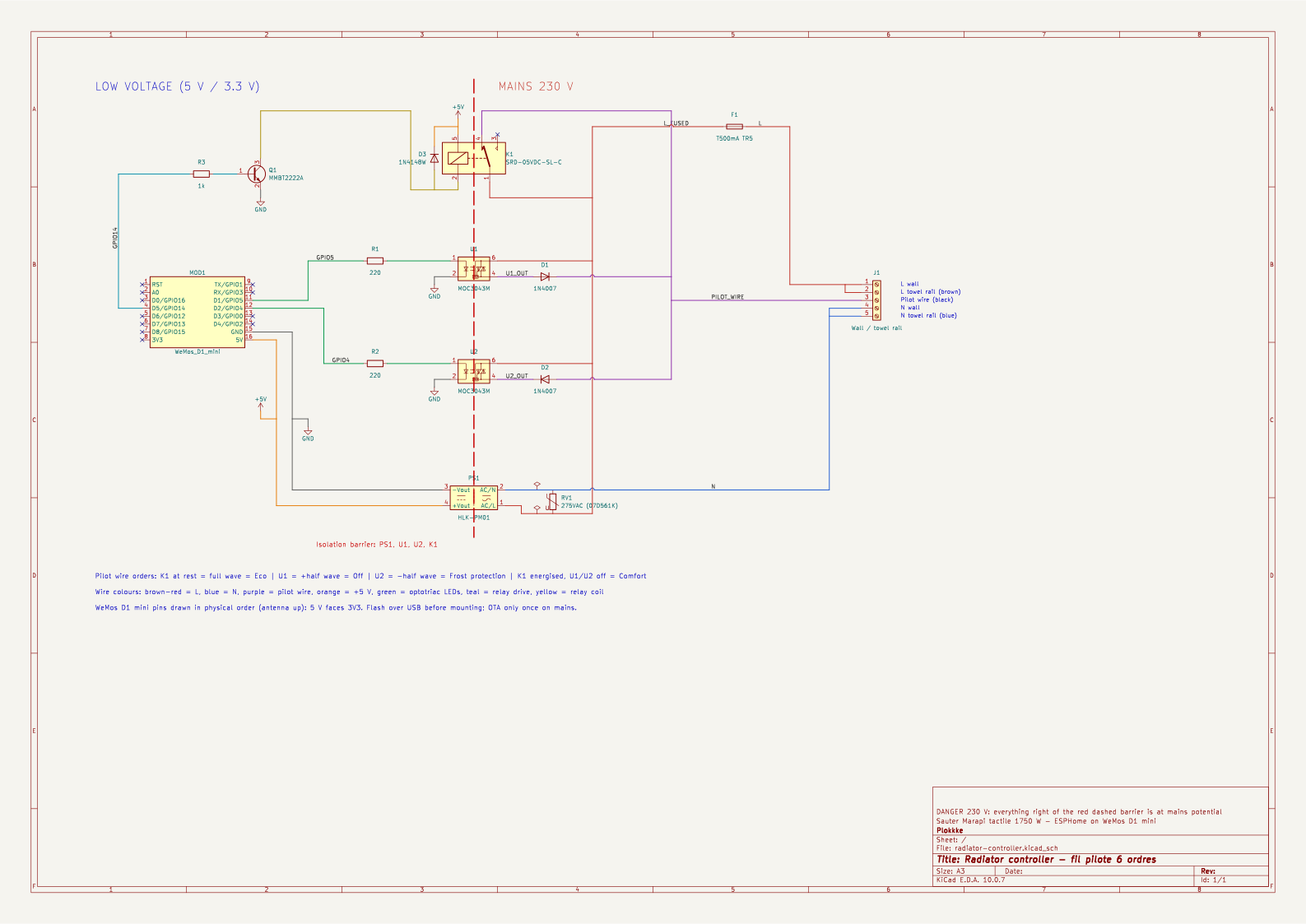
Ouvrir hardware/radiator-controller.kicad_pro dans KiCad, ou en ligne sur KiCanvas. Détails (signaux, nomenclature, sécurité) dans knowledge/fil-pilote.md. En bref :
| D1 mini | Branché sur |
|---|---|
5V / GND | sortie du HLK-PM01 |
D1 (GPIO5) | 220 Ω → MOC3043 U1 (alternance positive) |
D2 (GPIO4) | 220 Ω → MOC3043 U2 (alternance négative) |
D5 (GPIO14) | 1 kΩ → MMBT2222A → relais K1 (contact repos = Éco) |
Sur le sèche-serviettes, sélectionner le mode Programme Inactif pour qu'il obéisse au fil pilote.
76 × 66 mm, 2 couches. Basse tension à gauche, 230 V à droite, séparés par une fente de 1 mm ; HLK-PM01, MOC3043 et relais sont à cheval sur la fente.
| Dessus | Dessous |
|---|---|
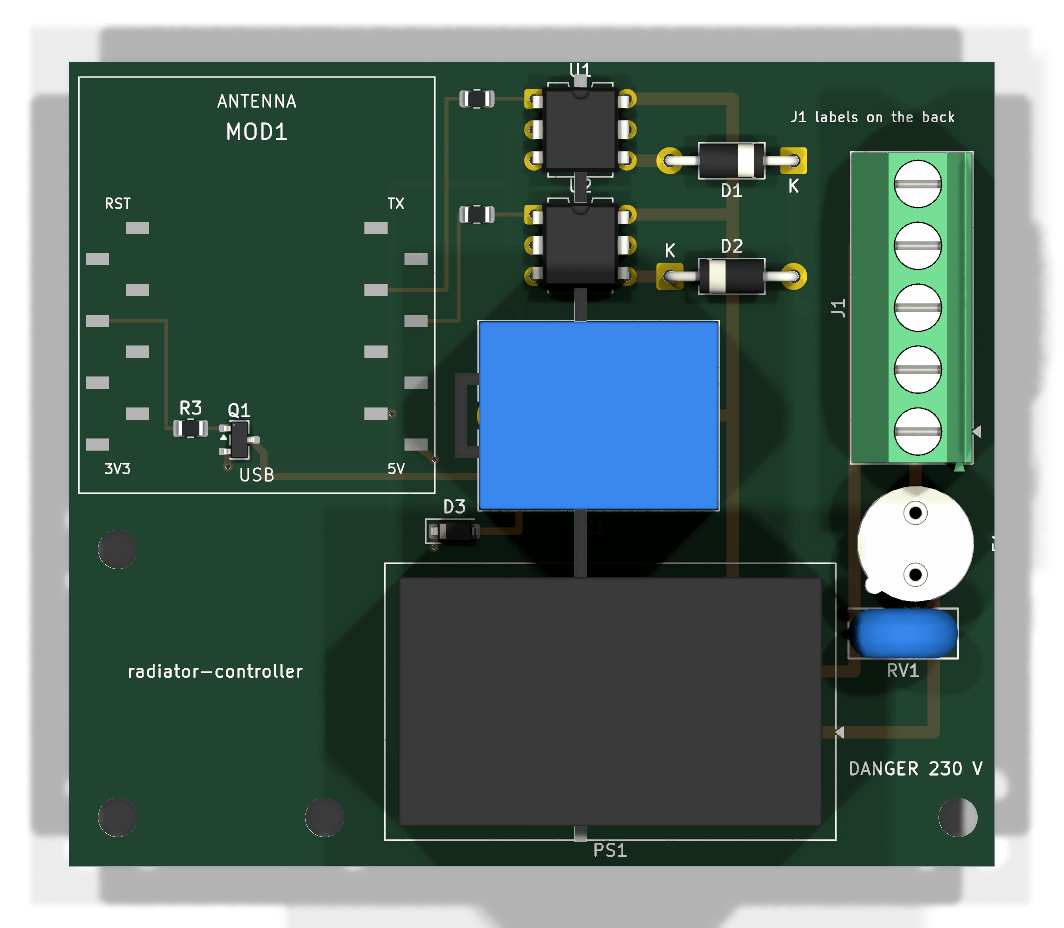 | 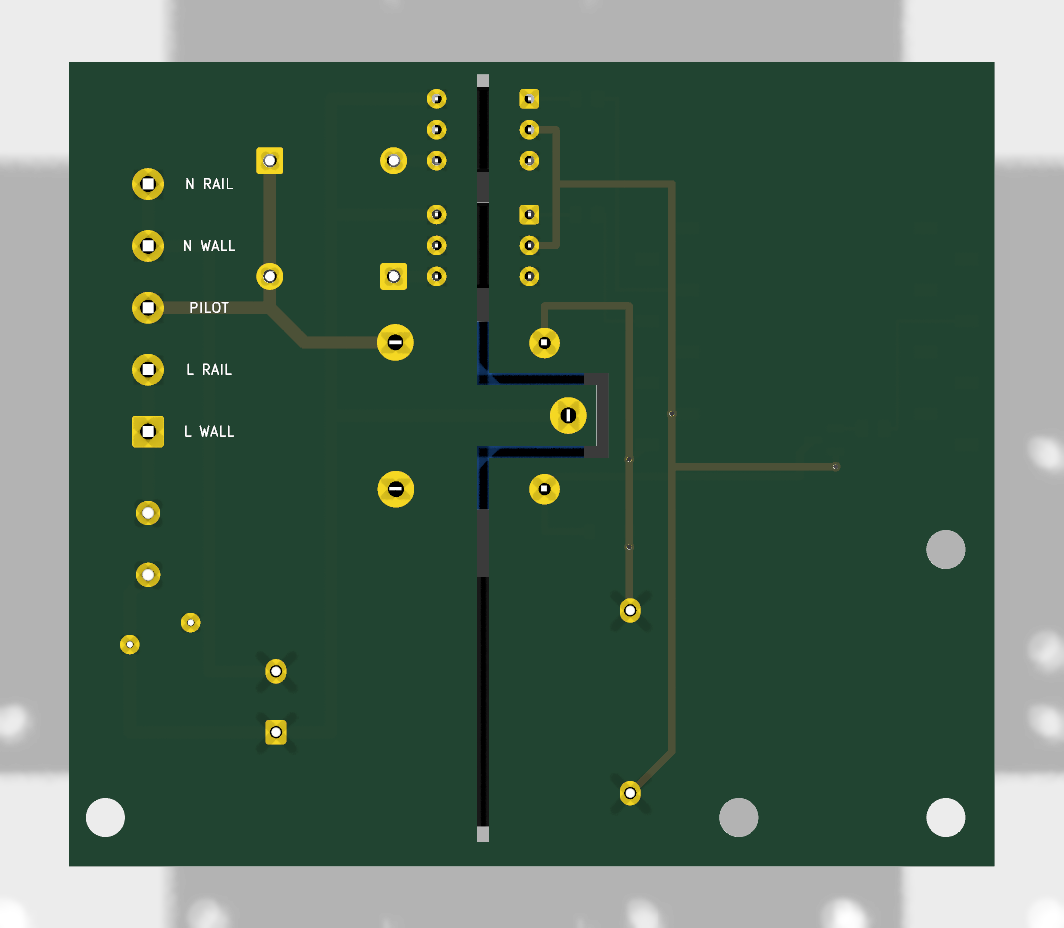 |
radiator-controller.kicad_dru) : entre 230 V et basse tension, 3 mm dans l'air et 6 mm de ligne de fuite ; entre conducteurs 230 V, 2,5 mm. Le DRC (kicad-cli pcb drc --schematic-parity) passe sans erreur ; restent 18 avertissements de sérigraphie coupée par la fente, voulus.RST/TX en haut, 3V3/5V en bas. Repères du bornier au dos de la carte.uv tool install esphome
cp firmware/secrets.example.yaml firmware/secrets.yaml # puis renseigner les valeurs
cd firmware
esphome run controlleur-seche-serviettes.yaml --device /dev/cu.usbserial-XXXX # premier flash, hors secteur
esphome run controlleur-seche-serviettes.yaml --device controlleur-seche-serviettes.local # ensuite, OTA
esphome logs controlleur-seche-serviettes.yaml --device controlleur-seche-serviettes.localselect.controlleur_seche_serviettes_pilot_wire_order : Comfort, Comfort -1, Comfort -2, Eco, Frost protection, Off. En panne ou sans HA pendant 30 min : Eco.
| Qty | Value | Footprint | References |
|---|---|---|---|
| 4 | MountingHole_3.2mm_M3 | MountingHole:MountingHole_3.2mm_M3 | H1, H2, H3, H4 |
| 2 | 1N4007 | Diode_THT:D_DO-41_SOD81_P10.16mm_Horizontal | D1, D2 |
| 2 | 220 | Resistor_SMD:R_0805_2012Metric | R1, R2 |
| 2 | MOC3043M | Package_DIP:DIP-6_W7.62mm | U1, U2 |
| 1 | 1N4148W | Diode_SMD:D_SOD-123 | D3 |
| 1 | 1k | Resistor_SMD:R_0805_2012Metric | R3 |
| 1 | 275VAC (07D561K) | Varistor:RV_Disc_D9mm_W4.1mm_P5mm | RV1 |
| 1 | HLK-PM01 | Converter_ACDC:Converter_ACDC_Hi-Link_HLK-PMxx | PS1 |
| 1 | MMBT2222A | Package_TO_SOT_SMD:SOT-23 | Q1 |
| 1 | SRD-05VDC-SL-C | Relay_THT:Relay_SPDT_SANYOU_SRD_Series_Form_C | K1 |
| 1 | T500mA TR5 | Fuse:Fuseholder_TR5_Littelfuse_No560_No460 | F1 |
| 1 | Wall / towel rail | TerminalBlock_Phoenix:TerminalBlock_Phoenix_MKDS-1,5-5-5.08_1x05_P5.08mm_Horizontal | J1 |
| 1 | WeMos_D1_mini | radiator-controller:WEMOS_D1_mini_SMD_sockets | MOD1 |


walterwhiteita/esp8266-mqtt-gate-controller
Welcome to the ESPGate repository! This project offers a comprehensive retrofit solution tailored to upgrade a variety of gate control boards.

wildsystems/ws-uc06
Custom ESP32-C6 development board with power input protection, relay outputs, opto-isolated I/O, NTC sensor input, and JTAG debugging. Designed as a DIY-friendly controller base.

Jochen0x90h/RoomControl
Smart home room controller based on nRF52840 with MQTT and and IEEE 802.15.4 radio support. Buttons and relays for lights and roller shutters can also be connected with a local bus using LIN physical layer


It measures 76 × 66 mm and has 2 copper layers, 1.6 mm thick.
19 parts, built around the HLK-PM01, WEMOS D1 MINI, MOC3043M and 1N4148W. The full list of its parts is on this page, with links to each part's symbol and footprint where PCBKit's library has them.
From the Plokkke/sauter-marapi-esphome repository on GitHub, at the commit this page was made from: the board is hardware/radiator-controller.kicad_pcb and its schematic hardware/radiator-controller.kicad_sch. PCBKit opens the board in the browser, with nothing to install.
Its repository states no licence, so its author keeps all rights: ask Plokkke before reusing the design.