4 layers112 × 57 mm

 petrinm/ESP32Dali11
Interface with DALI compatible lighting devices using ESPHome project
ESPDali is an open-source printed circuit board by petrinm, from the petrinm/ESP32Dali repository on GitHub, published under the MIT licence. It is a 2-layer board of 34 × 46 mm with 46 parts on 53 nets, routed with 241 tracks and 63 vias.
It is built around the ESP32-WROOM-32, LM27313XMF and TLP185, with the BCX56-16, MB1S and NSR0530H among its other parts. Its parts include 16 resistors, 9 capacitors, 6 diodes, 5 ICs and 3 transistors. It belongs with the home automation and IoT and lEDs and displays boards and the ESP32 boards of this library.


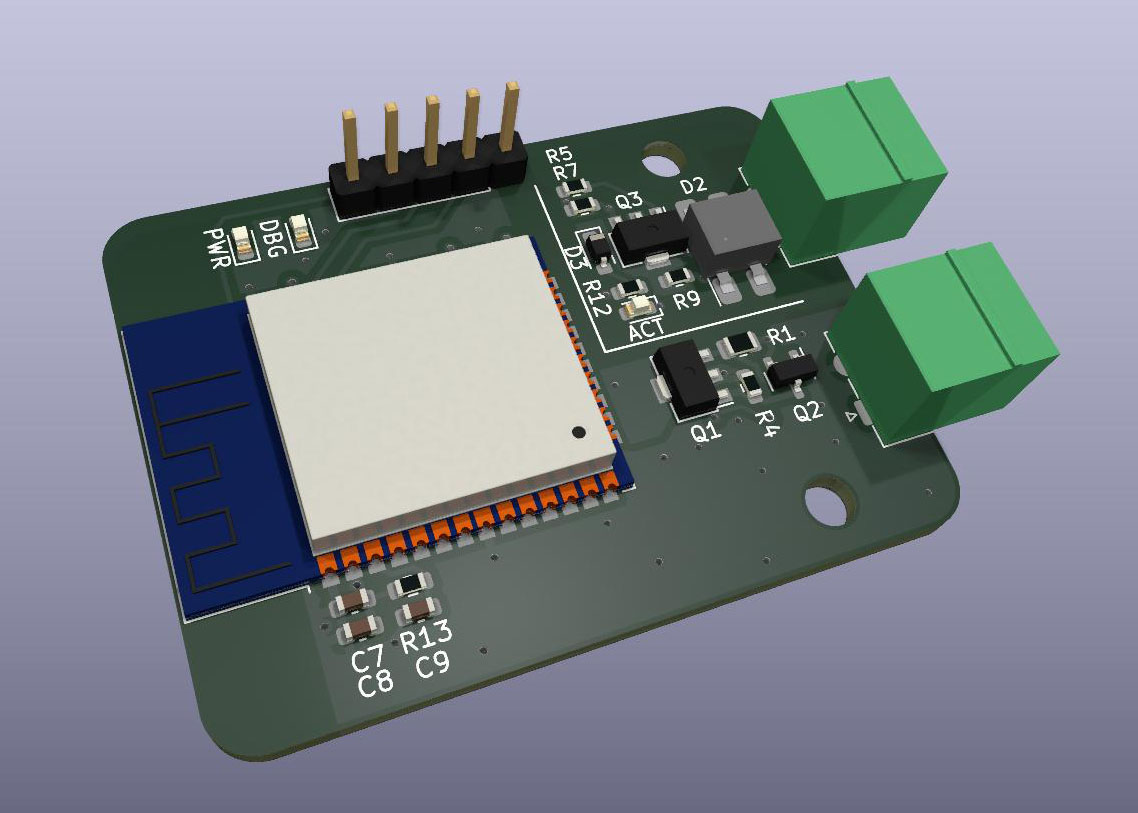
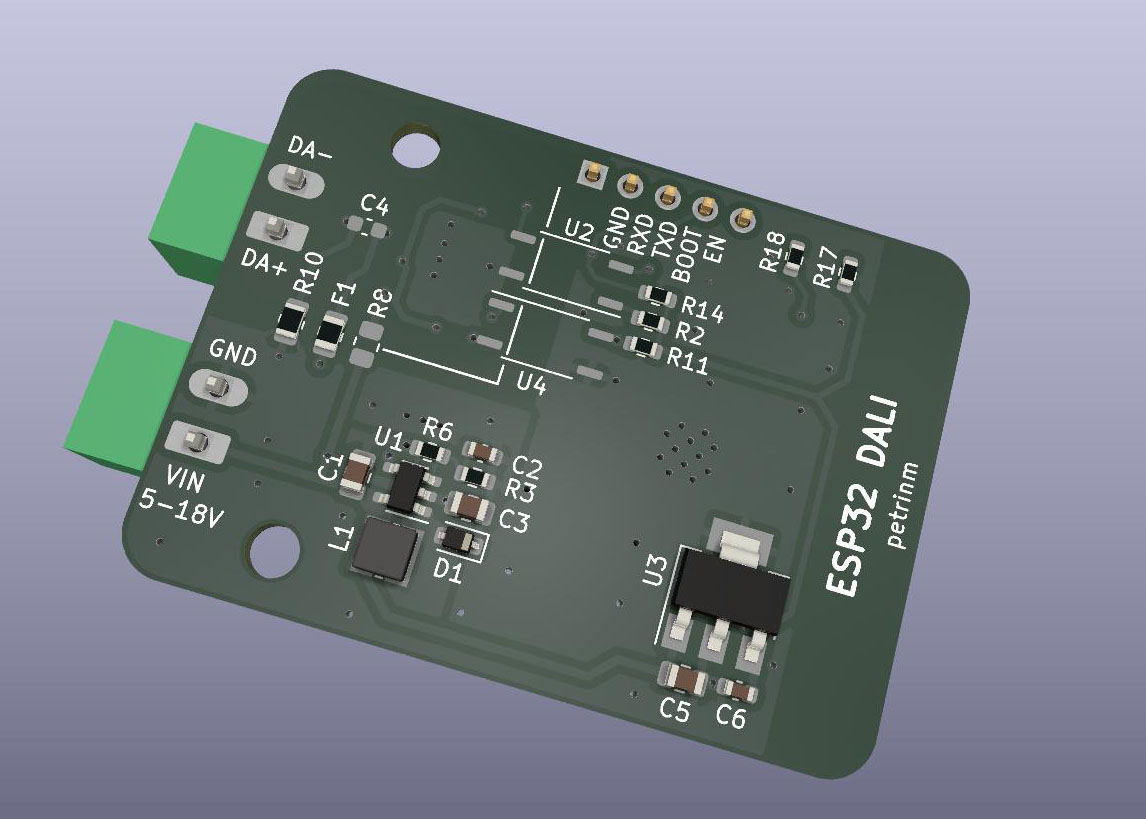
ESP32Dali is an ESP32-based, ESPHome-friendly interface to DALI lighting devices. It acts as a master on the DALI bus through an isolated front-end, and can also provide 18 V DALI supply voltage from 5 V input.
The board is a matchbox-sized 2-layer PCB that hosts an ESP32-WROOM-32 plus the DALI interface.
hw/ (KiCanvas, PDF)3d/components/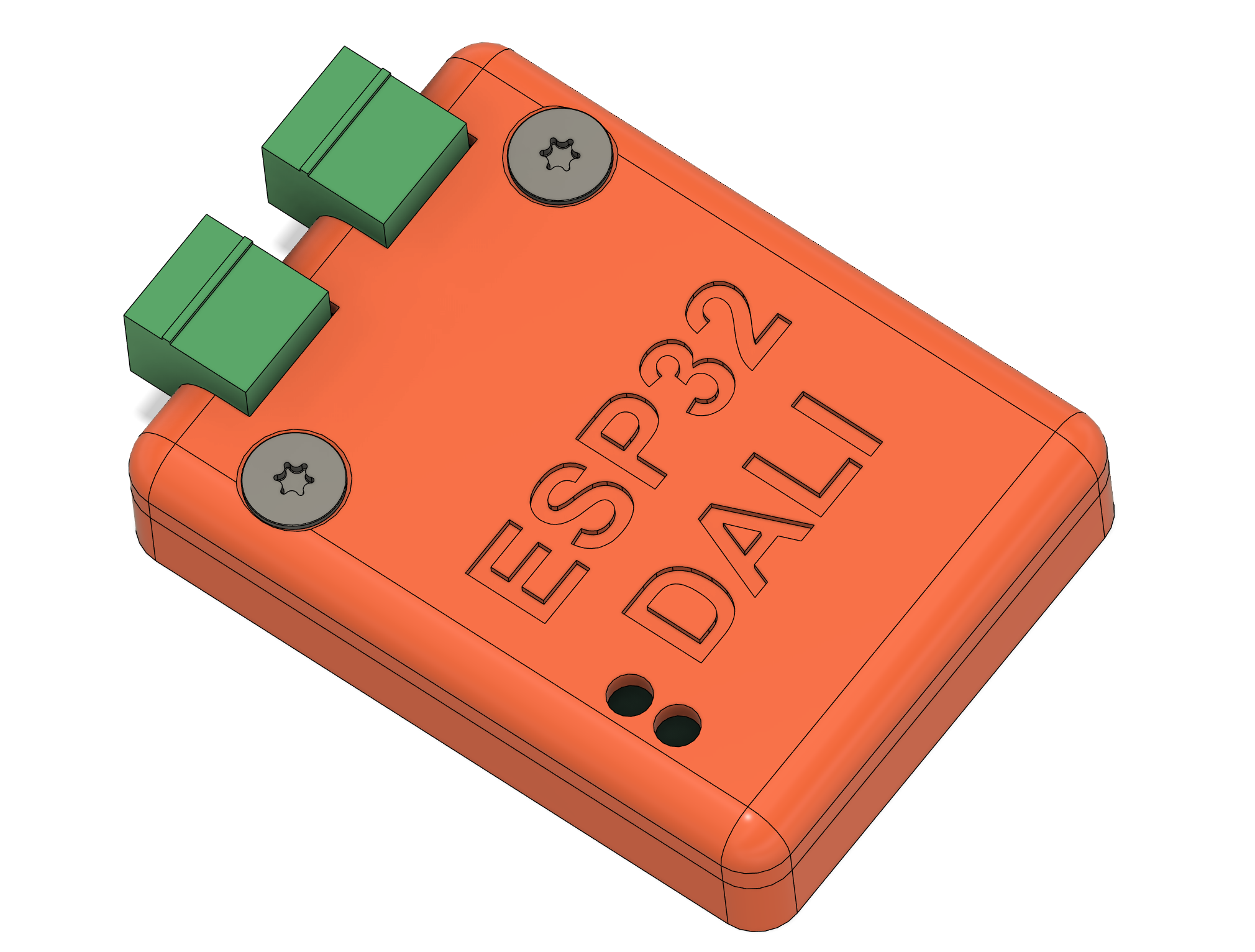
The dali component can be pulled in as an external component, so the same configuration works on the ESP32Dali board and on any other ESP32 with a compatible DALI front-end.
esphome:
  name: livingroom
  friendly_name: Livingroom

esp32:
  board: esp32dev
  framework:
    type: arduino

external_components:
  - source:
      type: git
      url: https://github.com/petrinm/ESP32Dali.git
    components: [ dali ]

dali:
  id: dali_if
  tx_pin:
    number: 17
    inverted: true
  rx_pin:
    number: 16
    inverted: true
Build and flash with:
$ esphome run livingroom.yamlReleased under the MIT License.
| Qty | Value | Footprint | References |
|---|---|---|---|
| 2 | 0R | Resistor_SMD:R_0805_2012Metric | R8, R10 |
| 2 | 10k | Resistor_SMD:R_0603_1608Metric | R7, R11 |
| 2 | 1k | Resistor_SMD:R_0603_1608Metric | R4, R17 |
| 2 | 2pin 3.5mm terminal block | Connector_Phoenix_MC:PhoenixContact_MC_1,5_2-G-3.5_1x02_P3.50mm_Horizontal | J1, J2 |
| 2 | 330 | Resistor_SMD:R_0603_1608Metric | R2, R5 |
| 2 | BCX56-16 | Package_TO_SOT_SMD:SOT-89-3 | Q1, Q3 |
| 2 | MountingHole | MountingHole:MountingHole_3.2mm_M3 | H1, H2 |
| 2 | Red LED | LED_SMD:LED_0603_1608Metric | D4, D6 |
| 2 | TLP185 | Package_SO:SOIC-4_4.55x3.7mm_P2.54mm | U2, U4 |
| 1 | 0R | Resistor_SMD:R_0603_1608Metric | R9 |
| 1 | 100n | Capacitor_SMD:C_0603_1608Metric | C7 |
| 1 | 100p | Capacitor_SMD:C_0603_1608Metric | C4 |
| 1 | 10u | Inductor_SMD:L_Wuerth_MAPI-3020 | L1 |
| 1 | 12k | Resistor_SMD:R_0603_1608Metric | R13 |
| 1 | 13k | Resistor_SMD:R_0603_1608Metric | R6 |
| 1 | 180k | Resistor_SMD:R_0603_1608Metric | R3 |
| 1 | 1n | Capacitor_SMD:C_0603_1608Metric | C9 |
| 1 | 1u | Capacitor_SMD:C_0603_1608Metric | C8 |
| 1 | 1u 25V | Capacitor_SMD:C_0805_2012Metric | C5 |
| 1 | 1u 6V | Capacitor_SMD:C_0603_1608Metric | C6 |
| 1 | 2.54mm pin header | Connector_PinHeader_2.54mm:PinHeader_1x05_P2.54mm_Vertical | J3 |
| 1 | 200mA Polyfuse | Fuse:Fuse_0805_2012Metric | F1 |
| 1 | 220p | Capacitor_SMD:C_0603_1608Metric | C2 |
| 1 | 2R7 1% | Resistor_SMD:R_0805_2012Metric | R1 |
| 1 | 2u2 25V | Capacitor_SMD:C_0805_2012Metric | C1 |
| 1 | 330R | Resistor_SMD:R_0603_1608Metric | R18 |
| 1 | 3V Zener | Diode_SMD:D_SOD-323 | D3 |
| 1 | 4k7 | Resistor_SMD:R_0603_1608Metric | R12 |
| 1 | 4u7 25V | Capacitor_SMD:C_0805_2012Metric | C3 |
| 1 | 5k | Resistor_SMD:R_0603_1608Metric | R14 |
| 1 | Blue LED | LED_SMD:LED_0603_1608Metric | D5 |
| 1 | ESP32-WROOM-32 | RF_Module:ESP32-WROOM-32 | U5 |
| 1 | LM27313XMF | Package_TO_SOT_SMD:SOT-23-5 | U1 |
| 1 | MB1S | ESPDali:MB1S | D2 |
| 1 | MCP1703A-330 | Package_TO_SOT_SMD:SOT-223-3_TabPin2 | U3 |
| 1 | NSR0530H | Diode_SMD:D_SOD-323 | D1 |
| 1 | SMBT2222A | Package_TO_SOT_SMD:SOT-23 | Q2 |
It measures 34 × 46 mm and has 2 copper layers, 1.67 mm thick.
46 parts, built around the ESP32-WROOM-32, LM27313XMF, TLP185 and BCX56-16. The full list of its parts is on this page, with links to each part's symbol and footprint where PCBKit's library has them.
From the petrinm/ESP32Dali repository on GitHub, at the commit this page was made from: the board is hw/ESPDali.kicad_pcb and its schematic hw/ESPDali.kicad_sch. PCBKit opens the board in the browser, with nothing to install.
Its repository publishes it under the MIT licence: you may reuse it on that licence's terms (keep the author's notice, and for a copyleft licence share your changes alike).

Mozzie-AU/LeafOBC-WafflePlate
Reverse engineering the "waffle plate" power module from the 2012 Nissan Leaf on-board charger (OBC), with the goal of building a functional replica from regular, off-the-shelf components.


nebularnoise/quadrants
Skiff-friendly SMD version of the Prok Eurorack Drum Modules.


Tobias0110/EVN_Kaifa_ESP_MQTT
Allows you to read the MBus data of a Kaifa smartmeter used by the EVN in Austria, decrypt the packages and send the values over MQTT.

repowered-electronics/UWB_Module_Hardware
Hardware files for our DWM1000 based localization module

bradencamp/ECE-Lab-USB-MultiTool
This USB Multi-function Laboratory Instrument will be inexpensive and therefore less capable than the AD2 or ADALM 2000 while still fulfilling the requirements for most laboratory exercises in the undergraduate ECE…