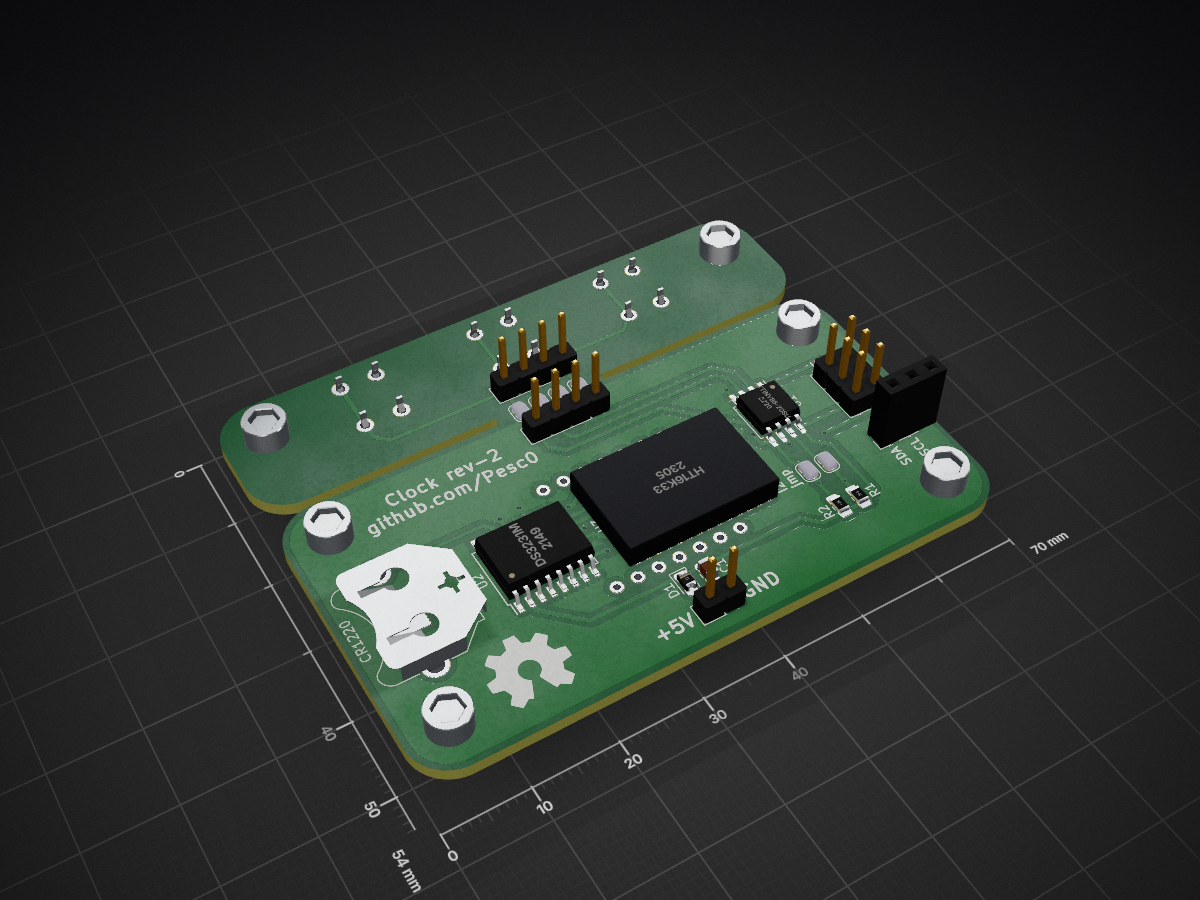
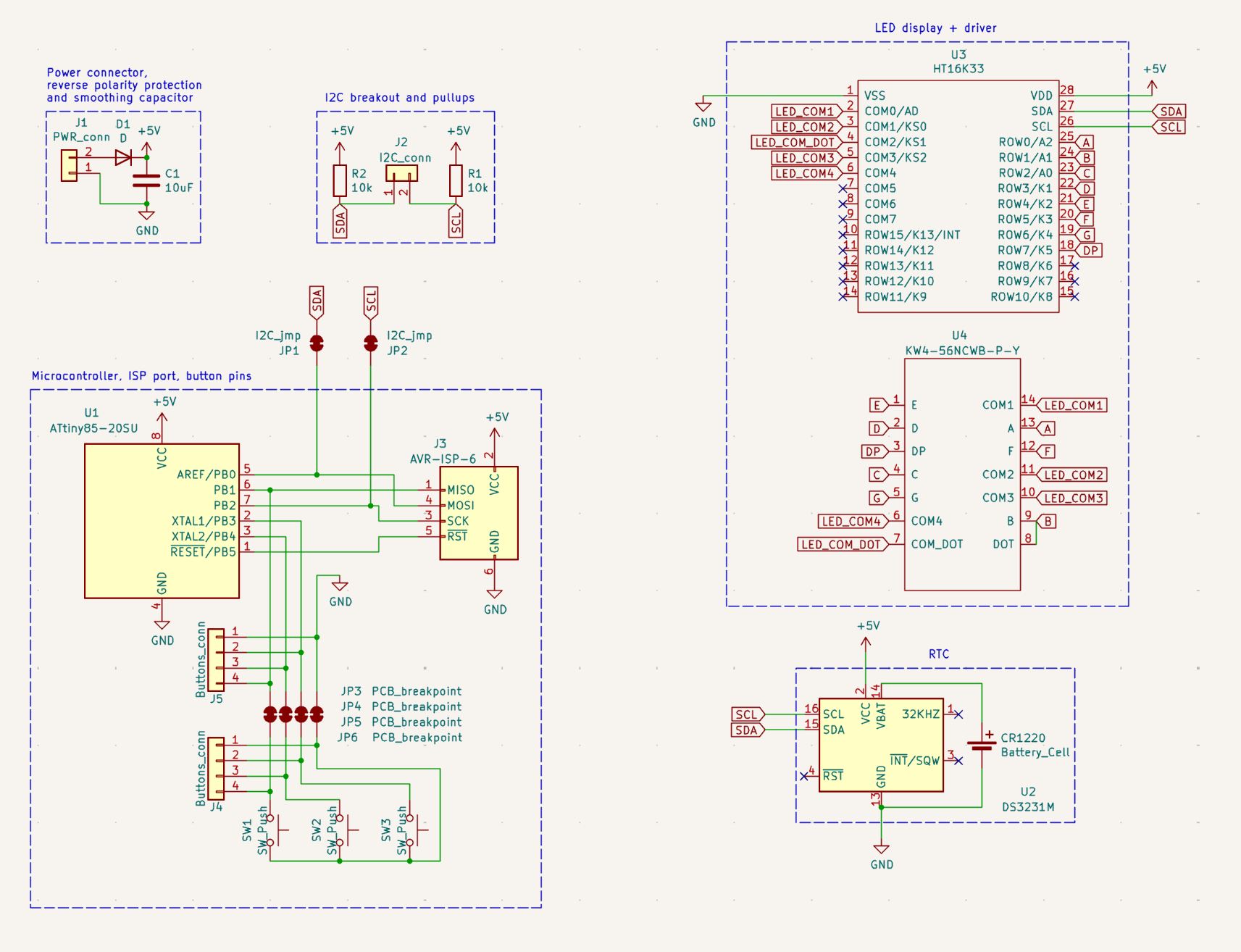
Clock is an open-source printed circuit board by Pesc0, from the Pesc0/Clock repository on GitHub, published under the GPL-3.0 licence. It is a 2-layer board of 70 × 54 mm with 30 parts on 43 nets, routed with 351 tracks and 36 vias.
It is built around the ATTINY85-20SU, HT16K33 and DS3231MZ+. Its parts include 5 connectors, 4 ICs, 3 switches, 2 resistors and 1 capacitor. It belongs with the lEDs and displays boards and the AVR (ATmega, ATtiny) boards of this library.
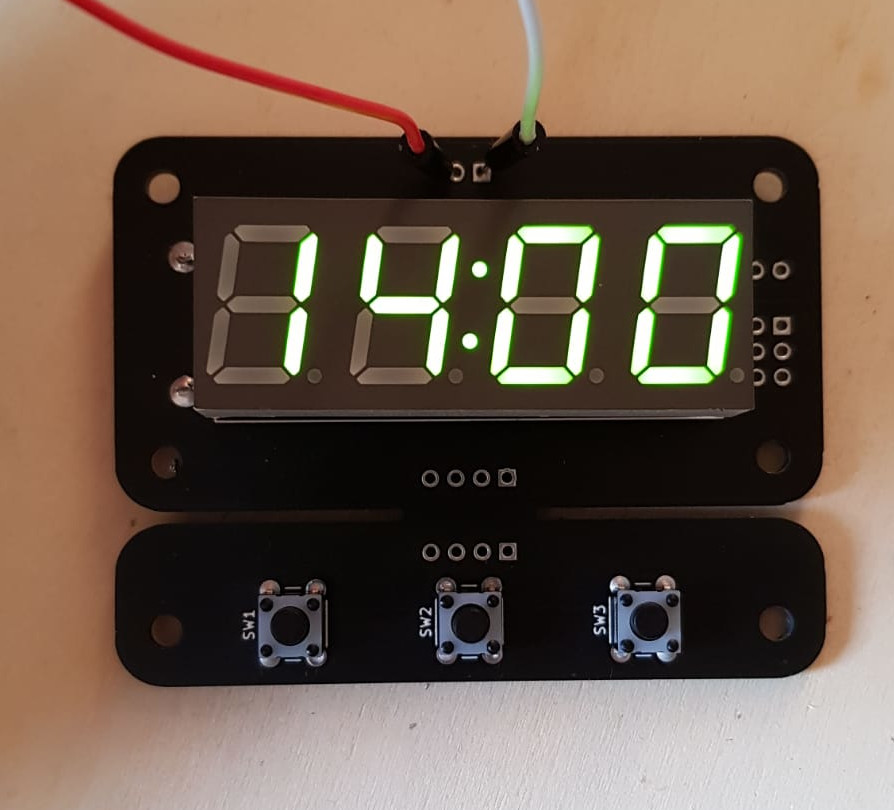
A digital clock based on the AtTiny85 and DS3231 chips.
Features:
Simple interface, designed for the elderly who just need a simple clock.
Time is kept even after a power loss, provided the battery is working.
Great time keeping accuracy, thanks to the 2ppm accuracy of the DS3231 chip (basically in the worse case it will gain/lose 1 minute every year).
Brightness can be adjusted, the value is saved and will be restored even after a complete power loss.
Can display ambient temperature (the value is updated internally every minute or so).
Easy to build PCB, ideal for beginners.
Cheap, around $10.
The display consumes most of the power, so in theory it's possible to run the clock on batteries [not tested].
Fully open source.
PCB Design
Things to note:
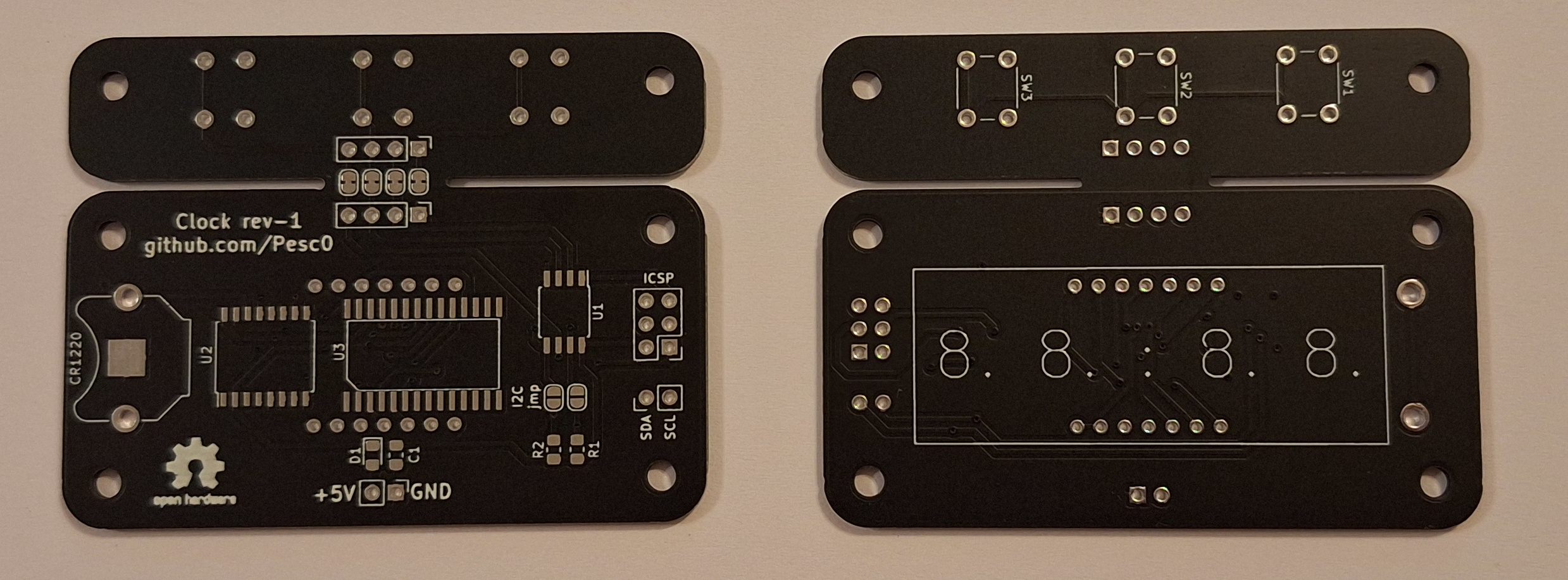
The board is symmetrical to simplify the design of mounting mechanisms.
The button panel is "removable" from the main pcb body, to allow repositioning of the buttons.
On the board are present two jumpers that disconnect the ATTiny from the I2C bus, for debug purposes.
3D printed case
TBD
Building and Flashing the firmware
You will need a working avr toolchain, with avr-gcc and avrdude installed on your computer. They are very easy to install on a linux computer, but on windows you will have to fiddle with Arduino IDE.
You will also need an AVR programmer, or alternatively you can use "Arduino as ISP".
You may need to modify the makefile and replace /dev/ttyACM0 with the usb port where your ICSP programmer is connected.
Once the programmer is connected to the board simply run
text
make install
Gallery
Revisions
rev-1: initial design
rev-2: fix display was upside down, despite silkscreen being right side up
It measures 70 × 54 mm and has 2 copper layers, 1.6 mm thick.
What parts does the Clock use?
30 parts, built around the ATTINY85-20SU, HT16K33 and DS3231MZ+. The full list of its parts is on this page, with links to each part's symbol and footprint where PCBKit's library has them.
Where can I download the Clock KiCad files?
From the Pesc0/Clock repository on GitHub, at the commit this page was made from: the board is KiCad/clock.kicad_pcb and its schematic KiCad/clock.kicad_sch. PCBKit opens the board in the browser, with nothing to install.
Can I use the Clock design in my own project?
Its repository publishes it under the GPL-3.0 licence: you may reuse it on that licence's terms (keep the author's notice, and for a copyleft licence share your changes alike).