
2 layers50 × 100 mm

Hardware for adapting Karaoke DSP board to eurorack
DSP 1.1 is an open-source printed circuit board by Owen-Patrick, from the Owen-Patrick/SoftSynthetics-DSP repository on GitHub. It is a 2-layer board of 161.3 × 263.9 mm with 115 parts on 45 nets, routed with 445 tracks and 15 vias.
It is built around the PT2399, TL072 and L7805. Its parts include 19 resistors, 12 capacitors, 4 ICs, 3 connectors and 1 transistor. It belongs with the audio and music boards of this library.


This Repository Contains hardware for adapting a cheap Karaoke DSP board to eurorack.
It turns one of these:
into an 10HP eurorack stereo multi-effects module with some fun clock modulation voltage control:
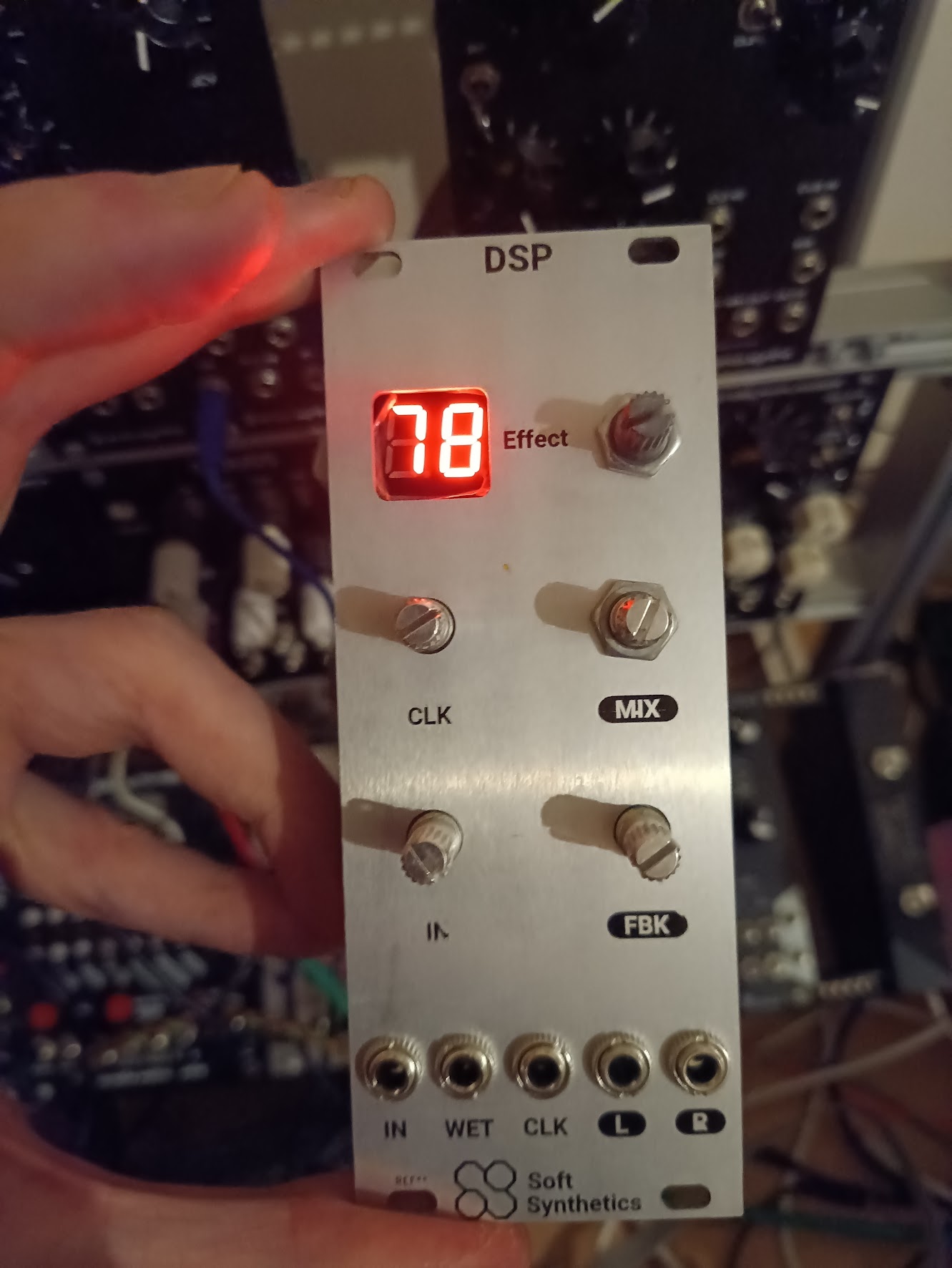
This repository contains:
More information is avaialbe here:
v1.1 This is an untested revision of the original board which had some clearance issues. I believe they have been rectified but please do double check! I have not printed it because v1.0 did work with plenty of bodging which I do not recommend.
THe clock modulator circuit requires a fairly simple modifaction to the board in order to override the clock input (x). All you have to do is remove the crystal and replace with in a header to connect "x" instead, which is a new clock siglan being generated by the pt2399. From what I can tell, the frequency of the DSP boards clock changes between manufacturers so experimentation to find the ideal frequency and modulation amount. If that doesn't excite then you could just modify the PCB layout and remove that whole part of the circuit from the PCB and front panel.
It's also not the prettiest in constuction and requires some pretty cosy bends of the cables that connect the DSP boards display and main board (i've seen some folk replace that cable with softer wires). The final consution is as so:
*the display board attaches to the main back board of via 2 M3 stadnoffs. *That display board connects to the interface with an m3 standoff and 2.54mm pin headers. *The DSP processor board mounts to the interface. *The cables fit together that way you'd expect: x to the clock in, in, Lout, Rout to the DSP PCB, and 5v to power in of the DSP.
If I have time i'll make a little diagram at some point! until then it mostly makes sense.
This project is a culmination of various other creators work into one package which shares the benefits they each brung to the table. Those insanley talented peaople are:
* -
I adopted the wonderfully creative clock control using a PT2399 chip.
*Jos from LMNC forums -
*I took inspiration from single gang pot Wet/Dry mixer used in this scehmatic
Hagiwo -
Hagiwo is a powerhouse in making lovely, innovative, and accessable DIY modules. They put me onto this device in the first place
CC BY-SA 4.0
which . AKA be nice :)
| Qty | Value | Footprint | References |
|---|---|---|---|
| 9 | , , , , , , , , | ||
| 5 | AudioJack2_SwitchT | Connector_Audio:Jack_3.5mm_QingPu_WQP-PJ398SM_Vertical_CircularHoles | feedback/wet1, In1, In2, Left1, Right1 |
| 4 | 100k | Potentiometer_THT:Potentiometer_Alpha_RD901F-40-00D_Single_Vertical | RV1, RV2, RV3, RV4 |
| 4 | 100k | Resistor_THT:R_Axial_DIN0207_L6.3mm_D2.5mm_P10.16mm_Horizontal | R1, R2, R7, R8 |
| 4 | 100n | Capacitor_THT:C_Axial_L5.1mm_D3.1mm_P10.00mm_Horizontal | C1, C2, C4, C7 |
| 4 | 10k | Resistor_THT:R_Axial_DIN0207_L6.3mm_D2.5mm_P10.16mm_Horizontal | R3, R4, R5, R6 |
| 4 | 2k | Resistor_THT:R_Axial_DIN0207_L6.3mm_D2.5mm_P10.16mm_Horizontal | R12, R13, R15, R16 |
| 4 | G*** | kibuzzard-643BAFCE | kibuzzard-643BAFCE, kibuzzard-643BAFCE, kibuzzard-643BAFCE, kibuzzard-643BAFCE |
| 4 | G*** | kibuzzard-643BAF55 | kibuzzard-643BAF55, kibuzzard-643BAF55, kibuzzard-643BAF55, kibuzzard-643BAF55 |
| 3 | 20k | Resistor_THT:R_Axial_DIN0207_L6.3mm_D2.5mm_P10.16mm_Horizontal | R9, R14, R18 |
| 2 | 100n | Capacitor_THT:C_Disc_D7.5mm_W2.5mm_P5.00mm | C10, C11 |
| 2 | 10uF | Capacitor_THT:CP_Radial_D5.0mm_P2.50mm | C14, C15 |
| 2 | 1k | Resistor_THT:R_Axial_DIN0207_L6.3mm_D2.5mm_P10.16mm_Horizontal | R19, R20 |
| 2 | 22pF | Capacitor_THT:C_Disc_D7.5mm_W2.5mm_P5.00mm | C8, C9 |
| 2 | Conn_01x07_Male | Connector_PinHeader_2.54mm:PinHeader_2x06_P2.54mm_Vertical | Jpcb1, Jpcb2 |
| 2 | G*** | kibuzzard-64D80CCD | kibuzzard-64D80CCD, kibuzzard-64D80CCD |
| 2 | G*** | kibuzzard-643BB32E | kibuzzard-643BB32E, kibuzzard-643BB32E |
| 2 | G*** | kibuzzard-643BAFC1 | kibuzzard-643BAFC1, kibuzzard-643BAFC1 |
| 2 | G*** | kibuzzard-643BB339 | kibuzzard-643BB339, kibuzzard-643BB339 |
| 2 | G*** | kibuzzard-643BB3B1 | kibuzzard-643BB3B1, kibuzzard-643BB3B1 |
| 2 | G*** | kibuzzard-644033FD | kibuzzard-644033FD, kibuzzard-644033FD |
| 2 | G*** | kibuzzard-643BB390 | kibuzzard-643BB390, kibuzzard-643BB390 |
| 2 | G*** | kibuzzard-644033EB | kibuzzard-644033EB, kibuzzard-644033EB |
| 1 | 10uF | Capacitor_THT:CP_Radial_D6.3mm_P2.50mm | C5 |
| 1 | 1M | Resistor_THT:R_Axial_DIN0207_L6.3mm_D2.5mm_P10.16mm_Horizontal | Rx3 |
| 1 | 1u | Capacitor_THT:C_Axial_L5.1mm_D3.1mm_P10.00mm_Horizontal | C6 |
| 1 | 2.2M | Resistor_THT:R_Axial_DIN0207_L6.3mm_D2.5mm_P10.16mm_Horizontal | Rx4 |
| 1 | 2.2k / 200 | Resistor_THT:R_Axial_DIN0207_L6.3mm_D2.5mm_P10.16mm_Horizontal | Rx1 |
| 1 | 22k | Resistor_THT:R_Axial_DIN0207_L6.3mm_D2.5mm_P10.16mm_Horizontal | R10 |
| 1 | 2N3904 | Package_TO_SOT_THT:TO-92_Inline | Q1 |
| 1 | 33K | Resistor_THT:R_Axial_DIN0207_L6.3mm_D2.5mm_P10.16mm_Horizontal | Rx2 |
| 1 | 3k | Resistor_THT:R_Axial_DIN0207_L6.3mm_D2.5mm_P10.16mm_Horizontal | R11 |
| 1 | 470K | Resistor_THT:R_Axial_DIN0207_L6.3mm_D2.5mm_P10.16mm_Horizontal | Rx5 |
| 1 | Conn_01x01 | Connector_PinHeader_2.54mm:PinHeader_1x01_P2.54mm_Vertical | JX0 |
| 1 | Conn_01x02_Female | Connector_PinHeader_2.54mm:PinHeader_1x02_P2.54mm_Vertical | J2 |
| 1 | Conn_01x05_Male | Connector_PinHeader_2.54mm:PinHeader_1x05_P2.54mm_Vertical | J1 |
| 1 | EURO_PWR_2x5 | europi:IDC-2x5 | P1 |
| 1 | L7805 | Package_TO_SOT_THT:TO-220-3_Horizontal_TabDown | U3 |
| 1 | PT2399 | Package_DIP:DIP-16_W7.62mm_LongPads | U4 |
| 1 | TL072 | Package_DIP:DIP-8_W7.62mm_LongPads | U2 |
| 1 | TL074 | Package_DIP:DIP-14_W7.62mm_LongPads | U1 |
The 89 most common of 115 parts.


MatthewATaylor/Modular-Synth-Hardware
KiCad schematics and PCB layouts for my modular synth

CuriousMotor/MoonRock-Delay-Pedal
A PCB for simple PT2399 based delay effect guitar pedal based on Boy In Well.

benjiaomodular/HackableDelay
A hackable delay circuit for eurorack modular synthesizers, designed in KiCad.
It measures 161.3 × 263.9 mm and has 2 copper layers, 1.6 mm thick.
115 parts, built around the PT2399, TL072 and L7805. The full list of its parts is on this page, with links to each part's symbol and footprint where PCBKit's library has them.
From the Owen-Patrick/SoftSynthetics-DSP repository on GitHub, at the commit this page was made from: the board is v1.1/DSP 1.1.kicad_pcb and its schematic v1.0/gerbers/PANEL/Panel.kicad_sch. PCBKit opens the board in the browser, with nothing to install.
Its repository states no licence, so its author keeps all rights: ask Owen-Patrick before reusing the design.