2 layers145.3 × 44.5 mm

 oskitone/scout114
3D-printed, Arduino-compatible, 17-key mono synth. Squeeeee!
Keyboard matrix is an open-source printed circuit board by oskitone, from the oskitone/scout repository on GitHub. It is a 2-layer board of 175.3 × 28.6 mm with 25 parts on 9 nets, routed with 207 tracks and 6 vias.
Its parts include 20 switches and 1 connector. It belongs with the keyboards and input and lEDs and displays boards of this library.
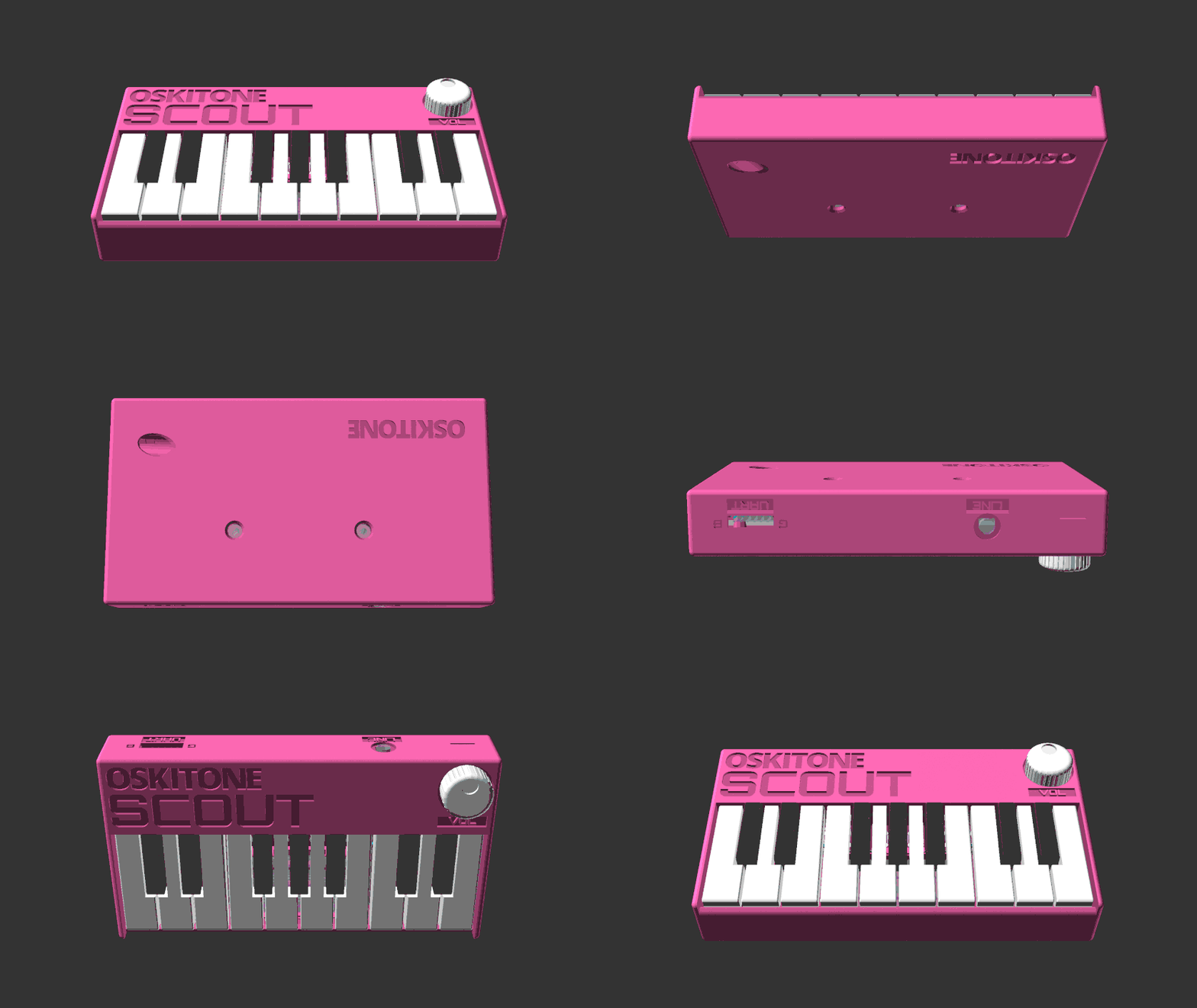
scout (/skout/):
The Scout is:
In addition to it being the first microcontroller-controlled instrument from Oskitone, the Scout would also make a fine introductory DIY instrument for the budding electronics hobbyist. (Some experience soldering and a general familiarity with how electricity works are recommended though!)
As such, it is intentionally minimal, with the goal of the shortest possible time from starting the kit to making music with it. No MIDI/CV or other IO, as is. If you're looking for a full-featured studio instrument, this ain't it, bub! :)
Demo: https://vimeo.com/587660426
Purchase a kit: https://www.oskitone.com/product/scout-synth-diy-electronics-kit
Assembly guide: https://oskitone.github.io/scout/
Blog post: https://blog.tommy.sh/posts/scout/
The Scout's 3D-printed models are written in OpenSCAD.
Assumes poly555 and apc repos are in a sibling directory and are both up to date on the main branch. Here's how I've got it:
\ oskitone
    \ apc
    \ poly555
    \ scout
You'll also need to install the Orbitron font.
STLs are generated with make_stls.sh. Run ./make_stls.sh -h for full flags list.
To develop, cd assembly_guide then npm run start.
Designed by Oskitone. Please support future synth projects by purchasing from Oskitone.
Creative Commons Attribution/Share-Alike, all text above must be included in any redistribution. See license.txt for additional details.
| Qty | Value | Footprint | References |
|---|---|---|---|
| 20 | SPST | Button_Switch_THT:SW_PUSH_6mm | SW1, SW2, SW3, SW4, SW5, SW10, SW11, SW12, SW13, SW14, SW15, SW16, SW17, SW18, SW19, SW20 +4 |
| 4 | 3.2mm | MountingHole:MountingHole_3.2mm_M3 | , , , |
| 1 | Conn_01x09 | Connector_PinHeader_2.54mm:PinHeader_1x09_P2.54mm_Horizontal | J1 |

google/mozc-devices
Circuit diagrams and firmware source code for Gboard DIY keyboards

davidphilipbarr/Sweep
Sweep - a small promicro based keyboard inspired by the Ferris.


hackclub/OnBoard
💡 Join 1,000 teenagers and make your first PCB with a $100 grant!

xyphro/UsbGpib
Versatile, cheap and portable USB to GPIB converter (USBTMC class based)


jes/scamp-cpu
A homebrew 16-bit CPU with a homebrew Unix-like-ish operating system.

It measures 175.3 × 28.6 mm and has 2 copper layers, 1.6 mm thick.
25 parts. The full list of its parts is on this page, with links to each part's symbol and footprint where PCBKit's library has them.
From the oskitone/scout repository on GitHub, at the commit this page was made from: the board is kicad/keyboard_matrix/keyboard_matrix.kicad_pcb. PCBKit opens the board in the browser, with nothing to install.
Its repository states no licence, so its author keeps all rights: ask oskitone before reusing the design.