4 layers55.5 × 50 mm

 oskirby/pysun-usb4
USB Radio for IEEE802.15.4 SUN Protocols and Micropython
Fsk radio is an open-source printed circuit board by oskirby, from the oskirby/pysun-usb repository on GitHub, published under the GPL-2.0 licence. It is a 4-layer board of 48.8 × 20 mm with 66 parts on 85 nets, routed with 885 tracks and 85 vias.
It is built around the AT86RF215-ZU, NC7SZ04M5 and 0896BM15E0025E, with the 2450FB15A050E and PRTR5V0U2X among its other parts. Its parts include 24 capacitors, 8 connectors, 6 resistors, 6 ICs and 3 diodes. It belongs with the radio and wireless boards and the STM32 boards of this library.


The PySUN is a USB dongle for IEEE 802.15.4 Smart Utility Networking protocols. This project is based around an STM32F4-series microprocessor and the Atmel/Microchip AT86RF215 dual-band IEEE 802.15.4 transceiver. This board also supports a Micropython programming environment. The two RF bands from the transceiver are combined into a single antenna port using an RF diplexer.
This board is released as an Open Source Hardware project, including the full PCB design files from KiCAD.
Attached to the STM32F4 microcontroller, are the following peripherals:
Castellated edges are provided, exposing:
Power is provided by a 2MHz synchronous buck regulator and the clock reference is provided from a 26MHz TCXO.
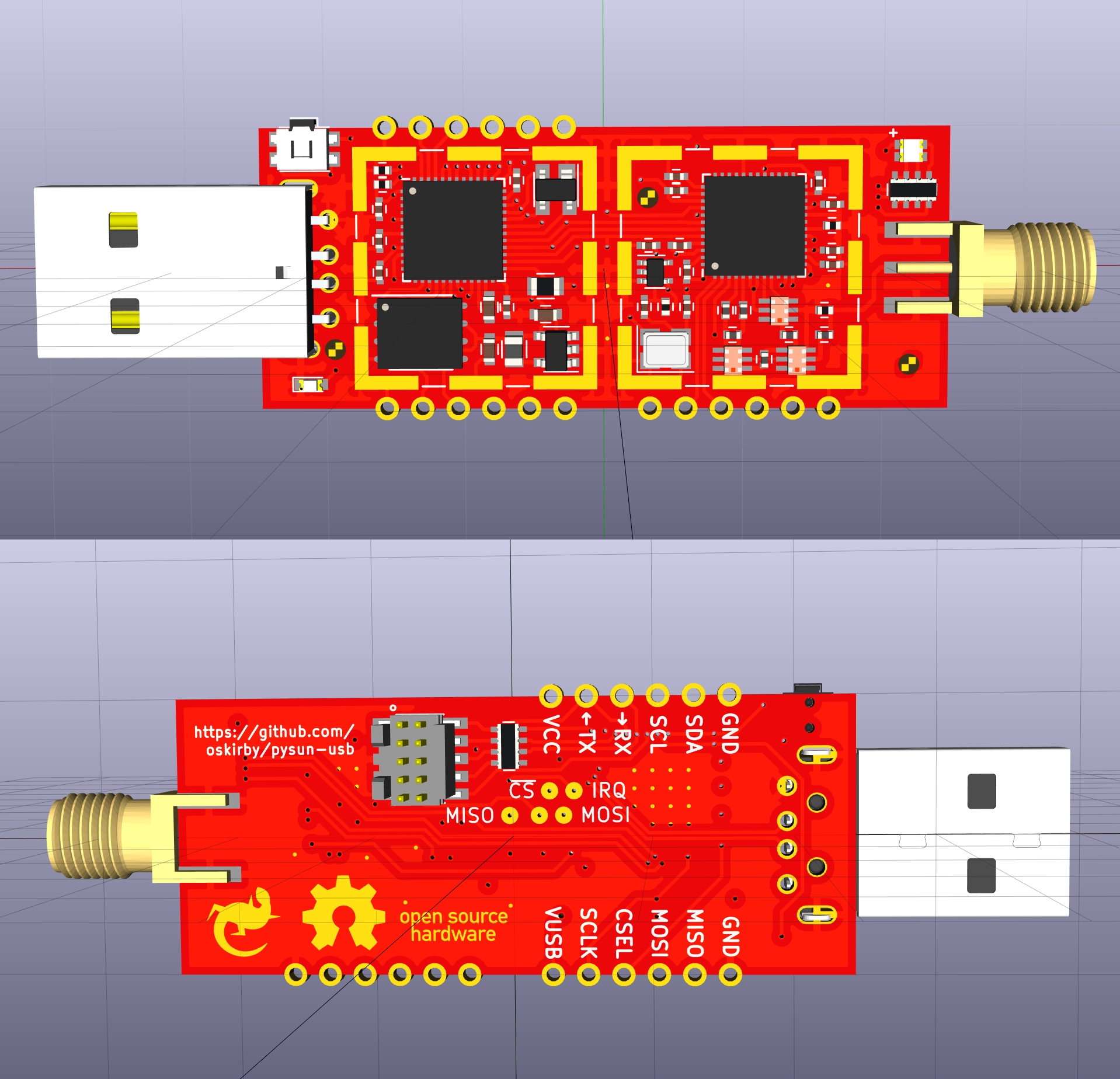
| Qty | Value | Footprint | References |
|---|---|---|---|
| 8 | C | Capacitors_SMD:C_0402 | C19, C20, C21, C22, C23, C24, C25, C28 |
| 6 | 100n | Capacitors_SMD:C_0402 | C4, C5, C6, C8, C10, C17 |
| 5 | TEST | FSK Parts:Measurement_Point_Round-SMD-Pad_XSmall | ~SELN1, IRQ1, MISO1, MOSI1, SCLK1 |
| 3 | 4.7u | Capacitors_SMD:C_0603 | C3, C7, C11 |
| 3 | Conn_01x06 | FSK Parts:Castellated_Edge_6pin_2.54mm | J2, J6, J8 |
| 3 | Fiducial_1mm_Dia_2.54mm_Outer_CopperTop | FSK Parts:Fiducial_1mm_checker_1.5mm_mask | FID1, FID2, FID2 |
| 2 | 1.8p | Inductors_SMD:L_0402 | C31, C32 |
| 2 | 10k | Resistors_SMD:R_0402 | R1, R17 |
| 2 | 15pF | Inductors_SMD:L_0402 | C27, C29 |
| 2 | 1n | Capacitors_SMD:C_0402 | C9, C15 |
| 2 | R | Resistors_SMD:R_0402 | R3, R4 |
| 2 | RF_Shield_One_Piece | FSK Parts:Laird_Technologies_BMI-S-102_16.50x16.50mm_Paste | J4, J5 |
| 1 | 0 | Resistors_SMD:R_0805 | R5 |
| 1 | 0.8pF | Inductors_SMD:L_0402 | C26 |
| 1 | 0896BM15E0025 | FSK Parts:Balun_0805 | B9 |
| 1 | 2.2u | Inductors_SMD:L_0805 | L1 |
| 1 | 22 | Resistors_SMD:R_Array_Concave_4x0603 | RN3 |
| 1 | 2450FB15A050 | FSK Parts:Balun_0805 | B24 |
| 1 | 270 | Resistors_SMD:R_0402 | R2 |
| 1 | 330 | Resistors_SMD:R_Array_Concave_4x0603 | RN1 |
| 1 | 5.6n | Inductors_SMD:L_0402 | L2 |
| 1 | AT86RF215 | Housings_DFN_QFN:QFN-48-1EP_7x7mm_Pitch0.5mm | IC2 |
| 1 | CONN_02X05 | FSK Parts:ftsh-105-01-dv | J3 |
| 1 | DPX202700DT | FSK Parts:Balun_0805 | IC7 |
| 1 | G*** | FSK Parts:oshw-mask | oshw-silks |
| 1 | G*** | FSK Parts:oshw-text | oshw-text |
| 1 | LED | LEDs:LED_0603 | D3 |
| 1 | LED_RGB_ANODE | FSK Parts:LED_0606_RGB | D1 |
| 1 | LM3671 | TO_SOT_Packages_SMD:SOT-23-5 | IC3 |
| 1 | NC7SZ04 | TO_SOT_Packages_SMD:SOT-353_SC-70-5 | IC4 |
| 1 | PRTR5V0U2X | TO_SOT_Packages_SMD:SOT-143 | D2 |
| 1 | SMA | FSK Parts:SMA-Board-Edge | J7 |
| 1 | STM32F4xx-QFN48 | Housings_DFN_QFN:QFN-48-1EP_7x7mm_Pitch0.5mm | IC1 |
| 1 | SW_Push | Buttons_Switches_SMD:SW_SPST_EVQP7C | SW1 |
| 1 | TXETBLSANF-26 | Crystals:Crystal_SMD_3225-4pin_3.2x2.5mm | X1 |
| 1 | USB_A | FSK Parts:CUI-UP2-AH-TH | J1 |
| 1 | W25Q32BVZPIP | Housings_DFN_QFN:DFN-S-8-1EP_6x5mm_Pitch1.27mm | IC6 |
| 1 | exegin-logo | FSK Parts:exegin-logo-mask | exegin-logo |


maribu/at86rf215-breakout
An breakout board for the AT86RF215 dual band (sub-gigahertz & 2.4 gigahertz) IEEE 802.15.4 transceiver


collins-emasi/KiCAD-PROJECTS-PCB
In this repository, I will be sharing some of the project I'm working on with KiCAD software.

shanteacontrols/OpenDeck
A platform for building interactive control and sensing devices using MIDI and OSC built with Zephyr RTOS.

It measures 48.8 × 20 mm and has 4 copper layers, 1.6 mm thick.
66 parts, built around the AT86RF215-ZU, NC7SZ04M5, 0896BM15E0025E and 2450FB15A050E. The full list of its parts is on this page, with links to each part's symbol and footprint where PCBKit's library has them.
From the oskirby/pysun-usb repository on GitHub, at the commit this page was made from: the board is fsk-radio.kicad_pcb. PCBKit opens the board in the browser, with nothing to install.
Its repository publishes it under the GPL-2.0 licence: you may reuse it on that licence's terms (keep the author's notice, and for a copyleft licence share your changes alike).