2 layers188 × 98 mm
 oscimp/efts_tuning_fork1
EFTS laboratory session: quartz tuning fork
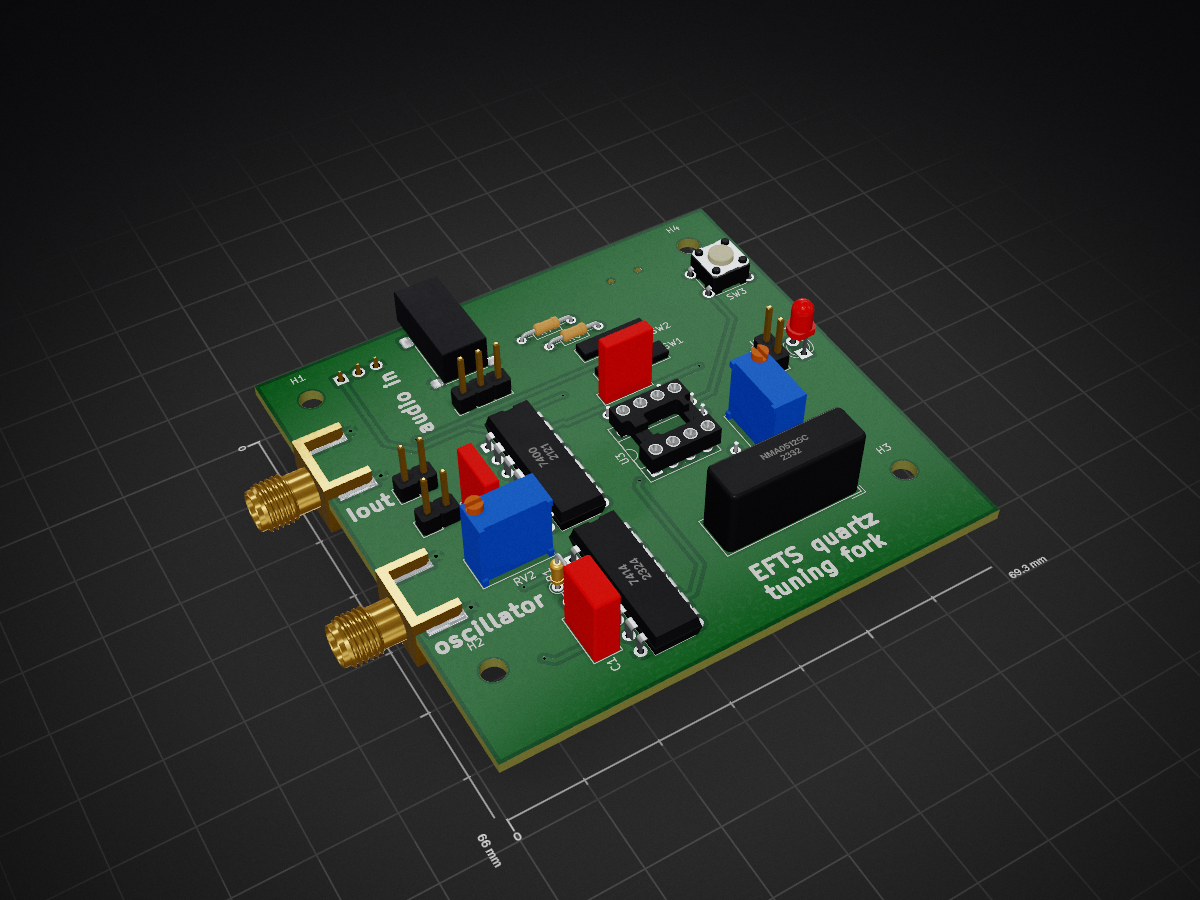
Tuning fork is an open-source printed circuit board by oscimp, from the oscimp/efts_tuning_fork repository on GitHub. It is a 2-layer board of 69.3 × 66 mm with 34 parts on 25 nets, routed with 183 tracks and 8 vias.
It is built around the NMA0512SC and TL072. Its parts include 9 connectors, 6 resistors, 5 capacitors, 4 ICs and 3 switches.


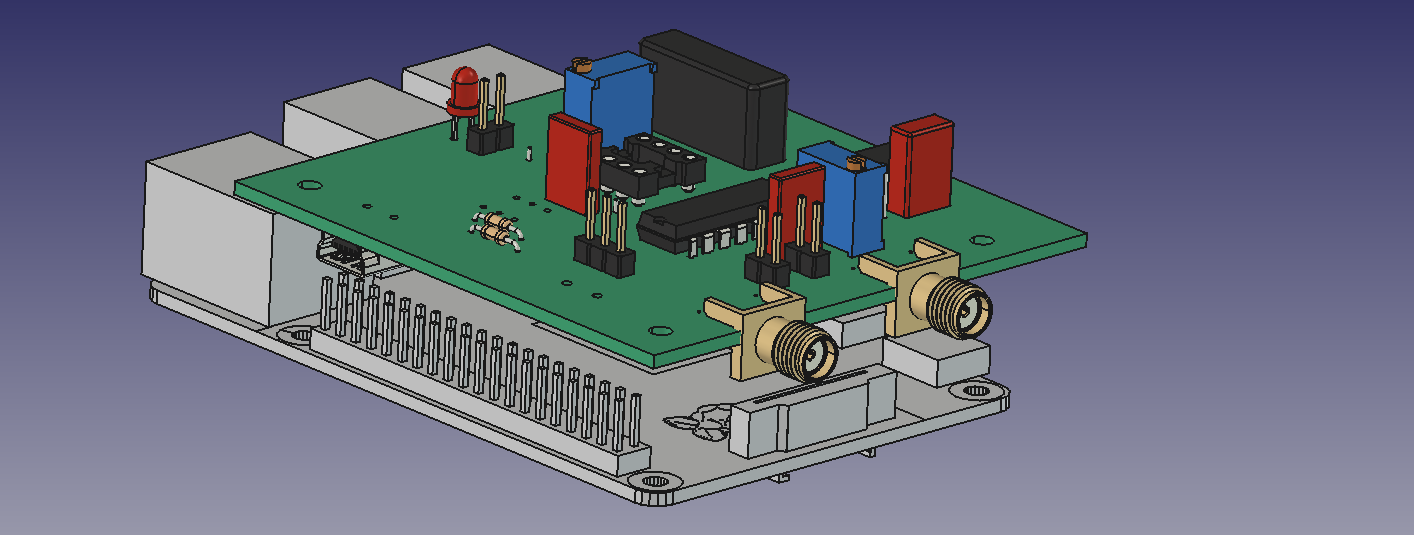
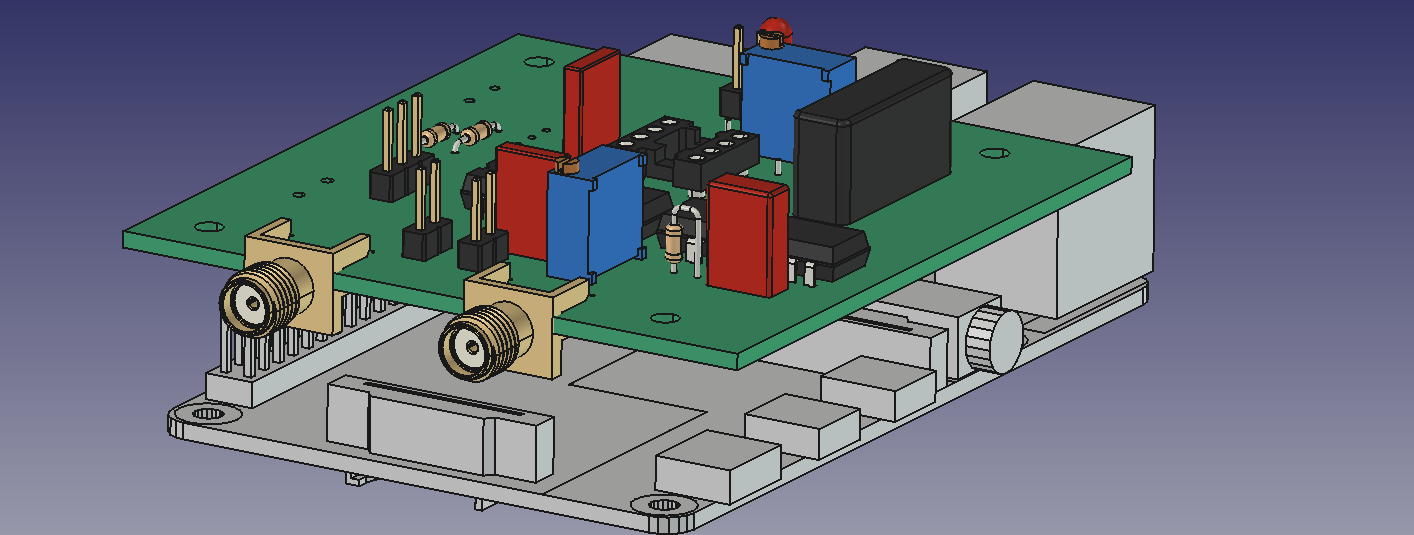
The non-plated through holes have been placed with a spacing compatible with installing the board on top of a Raspberry Pi 4/5 single board computer for a compact setup. Whether the heat dissipated by the processor will affect the resonator performance remains to be demonstrated.
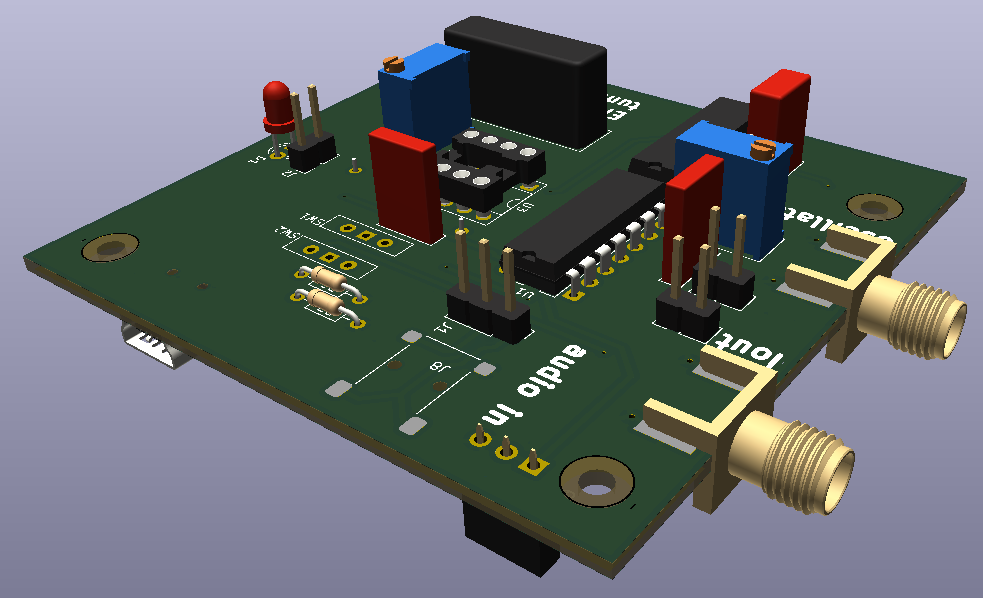
The potentiometer closest to the audio input aims at adding a DC offset to bring the audio output within the range of the Schmitt trigger toggling voltage. Set the sound card output to maximum amplitude to increase chances of the Schmitt trigger toggling. The potentiometer further from the audio input is the negative impedance and should be tuned so that the oscillator starts (slowly !) at resonance frequency of the tuning fork.
The setup is designed to be assembled on a Rapsberry Pi 4/5:
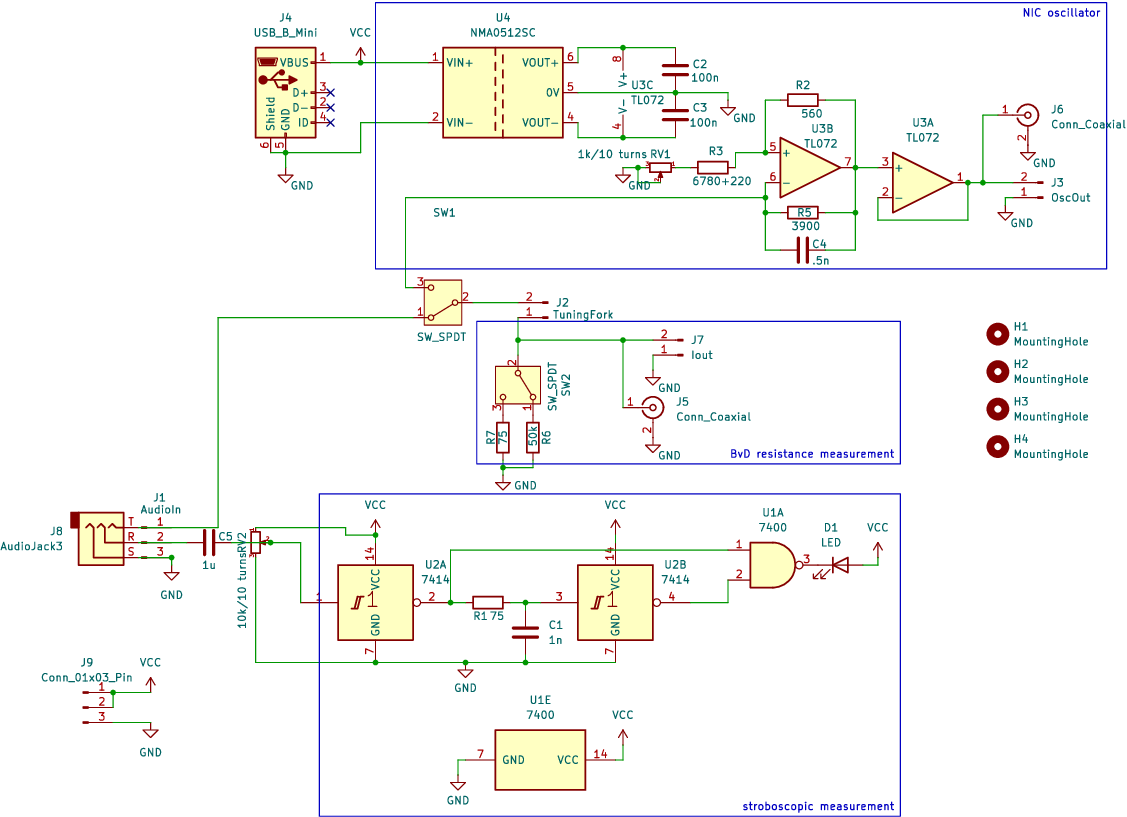
| Qty | Value | Footprint | References |
|---|---|---|---|
| 4 | MountingHole | MountingHole:MountingHole_3.2mm_M3 | H1, H2, H3, H4 |
| 2 | 100n | Capacitor_SMD:C_0805_2012Metric_Pad1.18x1.45mm_HandSolder | C2, C3 |
| 2 | Conn_Coaxial | Connector_Coaxial:SMA_Molex_73251-1153_EdgeMount_Horizontal | J5, J6 |
| 2 | SW_SPDT | Button_Switch_THT:SW_Slide-03_Wuerth-WS-SLTV_10x2.5x6.4_P2.54mm | SW1, SW2 |
| 1 | .5n | Capacitor_THT:C_Rect_L7.0mm_W2.0mm_P5.00mm | C4 |
| 1 | 10k/10 turns | Potentiometer_THT:Potentiometer_Bourns_3296W_Vertical | RV2 |
| 1 | 1k/10 turns | Potentiometer_THT:Potentiometer_Bourns_3296W_Vertical | RV1 |
| 1 | 1n | Capacitor_THT:C_Rect_L7.0mm_W3.5mm_P5.00mm | C1 |
| 1 | 1u | Capacitor_THT:C_Rect_L7.0mm_W2.0mm_P5.00mm | C5 |
| 1 | 3900 | Resistor_THT:R_Axial_DIN0204_L3.6mm_D1.6mm_P7.62mm_Horizontal | R5 |
| 1 | 50k | Resistor_THT:R_Axial_DIN0204_L3.6mm_D1.6mm_P7.62mm_Horizontal | R6 |
| 1 | 560 | Resistor_THT:R_Axial_DIN0204_L3.6mm_D1.6mm_P7.62mm_Horizontal | R2 |
| 1 | 6780+220 | Resistor_THT:R_Axial_DIN0204_L3.6mm_D1.6mm_P7.62mm_Horizontal | R3 |
| 1 | 7400 | Package_DIP:DIP-14_W7.62mm | U1 |
| 1 | 7414 | Package_DIP:DIP-14_W7.62mm | U2 |
| 1 | 75 | Resistor_THT:R_Axial_DIN0204_L3.6mm_D1.6mm_P2.54mm_Vertical | R1 |
| 1 | 75 | Resistor_THT:R_Axial_DIN0204_L3.6mm_D1.6mm_P7.62mm_Horizontal | R7 |
| 1 | AudioIn | Connector_PinHeader_2.54mm:PinHeader_1x03_P2.54mm_Vertical | J1 |
| 1 | AudioJack3 | Connector_Audio:Jack_3.5mm_Lumberg_1503_02_Horizontal | J8 |
| 1 | Conn_01x03_Pin | Connector_PinSocket_2.54mm:PinSocket_1x03_P2.54mm_Vertical | J9 |
| 1 | Iout | Connector_PinHeader_2.54mm:PinHeader_1x02_P2.54mm_Vertical | J7 |
| 1 | LED | LED_THT:LED_D3.0mm | D1 |
| 1 | NMA0512SC | Converter_DCDC:Converter_DCDC_Murata_NMAxxxxSC_THT | U4 |
| 1 | OscOut | Connector_PinHeader_2.54mm:PinHeader_1x02_P2.54mm_Vertical | J3 |
| 1 | SW_SPST | Button_Switch_THT:SW_TH_Tactile_Omron_B3F-100x | SW3 |
| 1 | TL072 | Package_DIP:DIP-8_W7.62mm_Socket | U3 |
| 1 | TuningFork | Connector_PinHeader_2.54mm:PinHeader_1x02_P2.54mm_Vertical | J2 |
| 1 | USB_B_Mini | Connector_USB:USB_Mini-B_Lumberg_2486_01_Horizontal | J4 |
It measures 69.3 × 66 mm and has 2 copper layers, 1.6 mm thick.
34 parts, built around the NMA0512SC and TL072. The full list of its parts is on this page, with links to each part's symbol and footprint where PCBKit's library has them.
From the oscimp/efts_tuning_fork repository on GitHub, at the commit this page was made from: the board is kicad/tuning_fork.kicad_pcb and its schematic kicad/tuning_fork.kicad_sch. PCBKit opens the board in the browser, with nothing to install.
Its repository states no licence, so its author keeps all rights: ask oscimp before reusing the design.

greenMikeEU/shrdzm
SHRDZM (just a name, not an acronym) is an ESP8285/ESP8266 based sensor and actor integration platform.

ohmtech-rdi/eurorack-blocks
Software to Hardware Prototyping for Eurorack using C++, Max/Gen~ or Faust

ctag-fh-kiel/ctag-tbd
CTAG TBD >>to be determined<< an extendible open source Eurorack sound module

plinkysynth/plinky_public
a public release of the plinky sw and hw


matthewcieplak/super-sixteen
Code and schematics for the Super Sixteen Eurorack sequencer