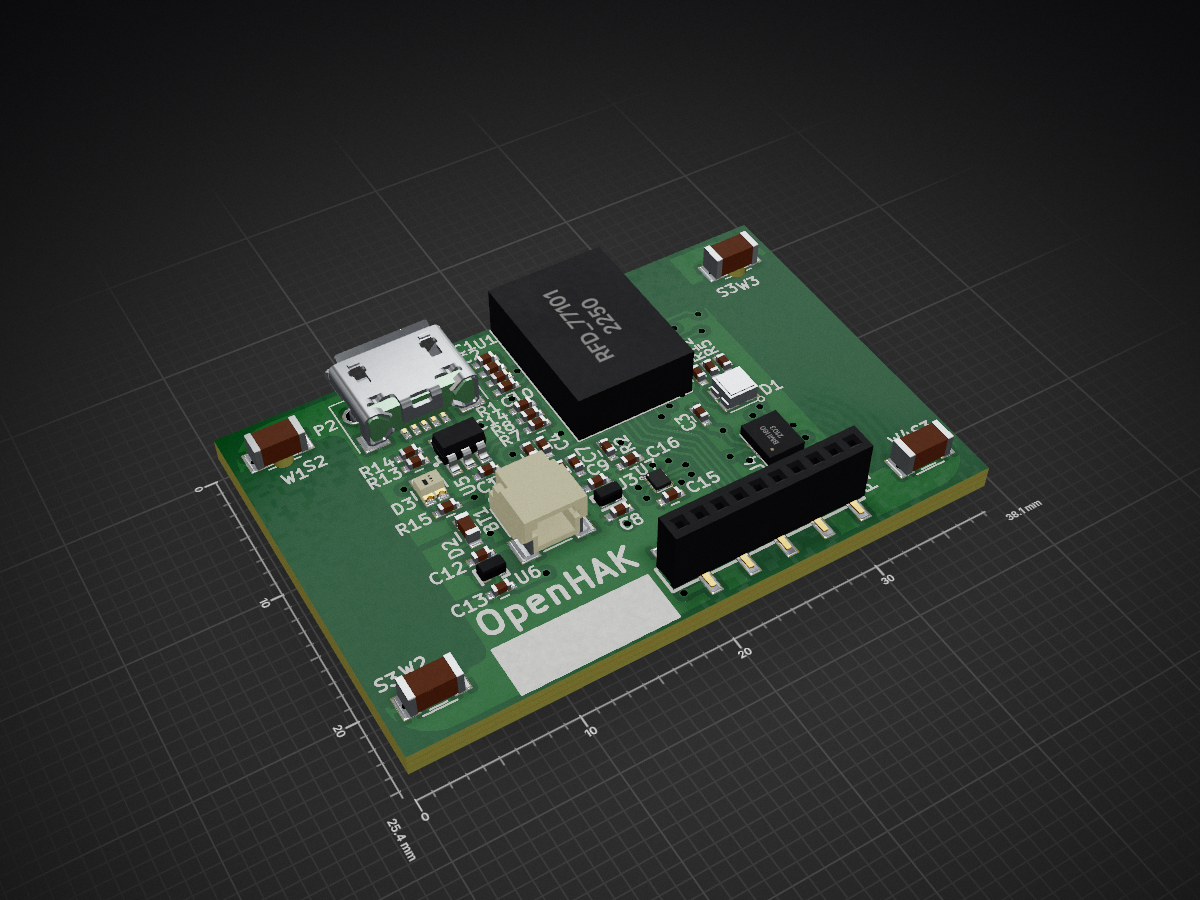
4 layers38.1 × 25.4 mm
 OpenHAK/OpenHAK_Hardware56
Opensource Health Activity Kit Hardware files
OpenHAK 03 is an open-source printed circuit board by OpenHAK, from the OpenHAK/OpenHAK_Hardware repository on GitHub. It is a 4-layer board of 38.1 × 25.4 mm with 51 parts on 63 nets, routed with 310 tracks and 53 vias.
It is built around the MAX30100EFD+, BMI160 and MCP73831T-2ATI/OT-HXY, with the MIC5365-1.8YMT-TZ, MIC5365-3.0YMT-TZ and TXS0102DQER among its other parts. Its parts include 16 capacitors, 10 resistors, 8 switches, 7 ICs and 3 diodes.


KiCad files for the beta OpenHAK boards.
Check the branches tab! There is a branch for the BioHacking Village Badge at DEFCON 27 and also a OSH Park Beta Tester branch
Hi. Here you'll find everything that you need to make yourself your very own OpenHAK! If, that is, you have any spare Simblees lying around. Should you do have some Simblees that are just taking up space, then you're in luck! Simblees are very well trained to handle reflow with a hot air gun or toaster oven many, many times. Trust me, they are tough buggers. If you don't have any Simblees propping open your window or shimming up your wobbly cafe table, then you're out of luck... Or are you....?
OpenHAK is an Open source Health Activity Kit. Right out of the box you can wear it on your wrist (or your ankle, if you're into that kind of thing) and start tracking your steps and heart rate with a mobile app. No kidding. All of it is open-source and ready to use, modify, and share. We were going to call it an Open Source Health Information Tracker, but we don't want to confuse people.
Data? What data? We don't own anything. We don't keep secrets from you, or try to distract you with shiny things while we stuff your data into our AI mattress monster. No. All the data is yours. YOU can delete it or share it or analyze it or whatever it. We don't care, just don't ask us for it 'cause we don't have it. It's yours and it gets stored on your phone, or tablet, or whatever you hack the OpenHAK to spit your data into.
So glad you asked. Right now, we are engaging with our beta testers and the hardware has some features that we are excitedly happy to tell you about.
The board is fit with physical features that will capture pins from an 18mm watch band. 18mm is a standard watch band size so you can accessorize with watch bands to your heart's delight!
We placed the MAX30101 sensor all by itself on the (recommended) skin side of the board. We did this to facilitate enclosure design. We have a prototype case (link) that performs well under reasonable circumstances (no, we haven't mountain-biked in a wintery mix with it yet...).
If you've gotten this far then you're not even halfway down! Keep mining this repo and, don't be shy, we're only an issue away!
| Qty | Value | Footprint | References |
|---|---|---|---|
| 8 | 1uF | Capacitors_SMD:C_0402 | C2, C4, C6, C8, C9, C12, C13, C14 |
| 8 | C_1206 | Capacitors_SMD:C_1206 | S1, S2, S3, S3, S3, S4, S4, S4 |
| 5 | 0.1uF | Capacitors_SMD:C_0402 | C1, C7, C10, C15, C16 |
| 4 | Watch_Pin_50mil | Solutions:Watch_Pin_50mil | W1, W2, W3, W4 |
| 3 | 100R | Capacitors_SMD:C_0402 | R5, R12, R17 |
| 3 | 10uF | Capacitors_SMD:C_0402 | C3, C5, C11 |
| 2 | 10K | Capacitors_SMD:C_0402 | R1, R14 |
| 2 | 1M | Capacitors_SMD:C_0402 | R7, R8 |
| 2 | 470 | Capacitors_SMD:C_0402 | R13, R15 |
| 1 | 18-225SURSYGC/S530-A4/E4/TR8 | Solutions:0606_Bi-Color | D3 |
| 1 | 4K7 | Capacitors_SMD:C_0402 | R2 |
| 1 | ASMB-KTF0-0A306 | Solutions:CLMVB-FKA-CFHEHLCBB7a363 | D1 |
| 1 | BMI160 | Solutions:LGA_2.5x3 | U4 |
| 1 | Battery | Connectors_JST:JST_SH_SM02B-SRSS-TB_02x1.00mm_Angled | BT1 |
| 1 | D_Schottky | Capacitors_SMD:C_0603 | D2 |
| 1 | Harwin M52 Series | Solutions:M52-Series_Harwin_SMT_10P | P1 |
| 1 | MAX30100 | Solutions:MAX30100 | U2 |
| 1 | MCP73831T-2ATI/OT | TO_SOT_Packages_SMD:SOT-23-5 | U5 |
| 1 | MIC5365-1.8YMT-TZ | Solutions:MLF-4 1mm x 1mm | U3 |
| 1 | MIC5365-3.0YMT-TZ | Solutions:MLF-4 1mm x 1mm | U6 |
| 1 | TXS0102DQER | Solutions:X2SON8_1.4mm_x_1mm | U7 |
| 1 | USB_OTG | Solutions:10118193_microUSB | P2 |
| 1 | rfd_77101 | Solutions:RFD77101 | U1 |
It measures 38.1 × 25.4 mm and has 4 copper layers, 1.6 mm thick.
51 parts, built around the MAX30100EFD+, BMI160, MCP73831T-2ATI/OT-HXY and MIC5365-1.8YMT-TZ. The full list of its parts is on this page, with links to each part's symbol and footprint where PCBKit's library has them.
From the OpenHAK/OpenHAK_Hardware repository on GitHub, at the commit this page was made from: the board is KiCAD Files/OpenHAK_03.kicad_pcb. PCBKit opens the board in the browser, with nothing to install.
Its repository states no licence, so its author keeps all rights: ask OpenHAK before reusing the design.


alienware-sa/harness_tester_challenge
Harness Tester Challenge Leaderboard · comma.ai/jobs · Discord · X

Martins-Lucaas/PRJ-SEMB
Repositório criado para o projeto final da disciplina da SISTEMAS EMBARCADOS da UFU

Protocentral/protocentral_pulse_hardware
Open-source hardware design files for the ProtoCentral Pulse MAX30102 pulse-oximetry breakout


P-r-i-t-h-v-i/PRAHARI
Prototype carrier PCB for PRAHARI, The Countdown Band (Point Break, SIH 2026, PS 26181).
