
2 layers103 × 30.5 mm
Electrical Impedance Tomography PCB design
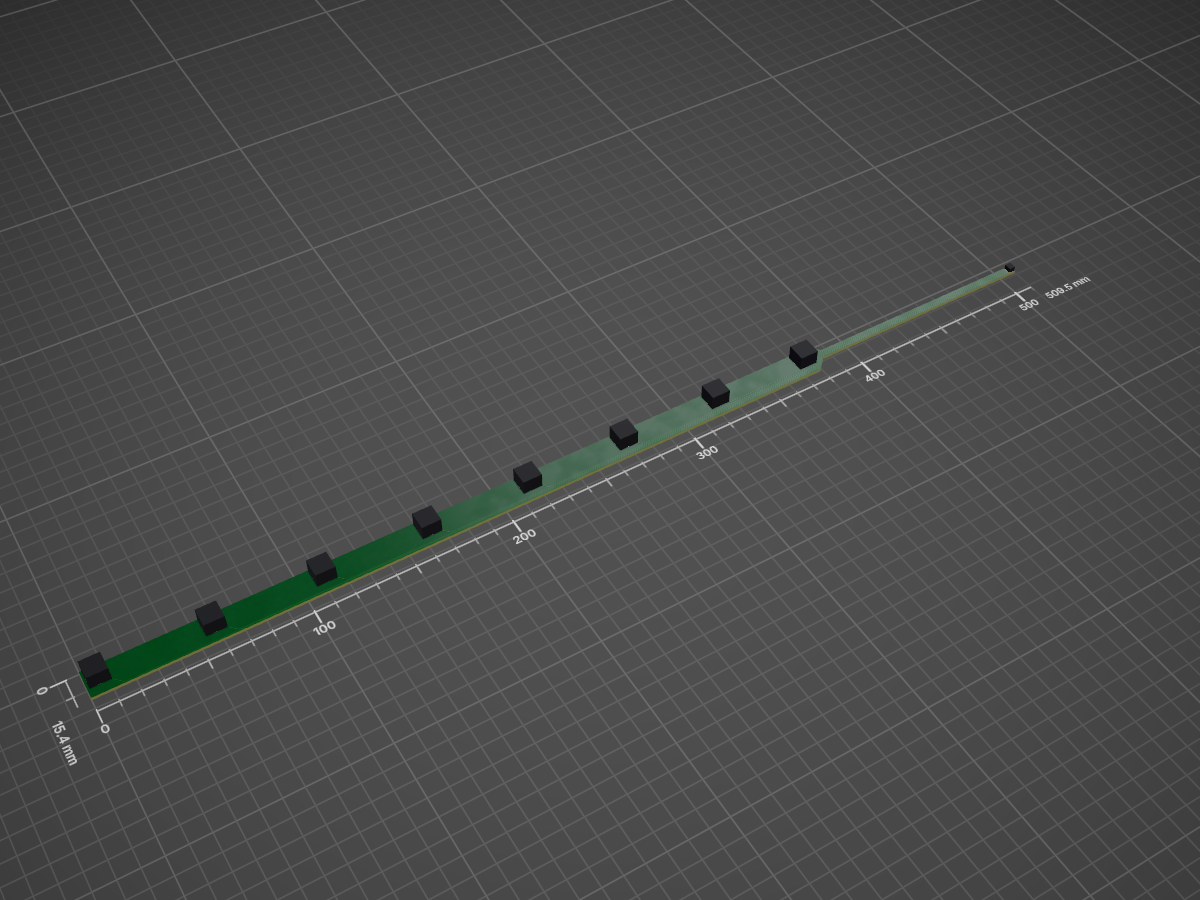
Eit is an open-source printed circuit board by OpenEIT, from the OpenEIT/EIT_EE repository on GitHub. It is a 2-layer board of 509.5 × 15.4 mm with 9 parts on 8 nets, routed with 32 tracks and 0 vias.
The schematic for the 32 electrode EIT system is called Spectra.pdf and is contained in the top level directory. Please let me know if you think it should have any modifications.
Note: the following design is an older design for an 8 electrode system. I have a newer better system which was designed in Altium which I'll put up here as soon as crowd supply campaign finalized. In the meantime I'd love it if you wanted to join the mailing list!
https://www.crowdsupply.com/mindseye-biomedical/spectra
Electrical Impedance Tomography is a new way to image conductivity changes inside any mostly liquid medium - such as the human body. It's attractive as it doesn't use ionizing radiation like the X-rays used in a CATSCAN, and could be relatively cheap to mass produce.
This project is an example of a working system from PCB to firmware to reconstruction algorithm. Further work could certainly improve the resolution, but for now we have functionality in all sub sections.
This is everything required for the basic 8 electrode design to work. Photo of the assembled PCB included.
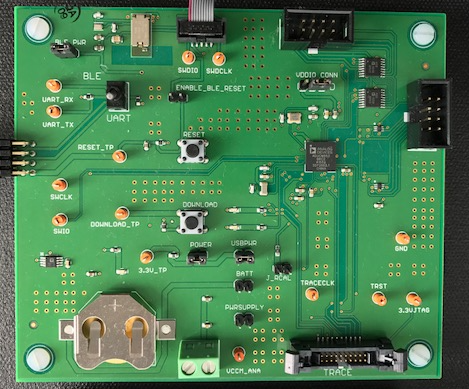
The design is based on the ADuCM350 which has a dedicated high precision front end with 16 bit resolution 160 kSPS data speed.The front end also performs a DFT at the rate of 13.8ms per calculation. This leads to a high performance minimal noise set up, excellent for both R&D or educational purposes.
In the not too distant future kits may be available with a smaller version of the PCB mounted in a box, an electrode harness for mounting to the body, and all cables required to run.
This combination would be an excellent educational tool for those researching this area, as it allows you to try most of the reconstruction algorithms or come up with your own and quantify any improvements in results.
It's the same technique as is used in CATSCAN's, except the current running through the body instead of dangerous ionizing radiation of X-Rays.
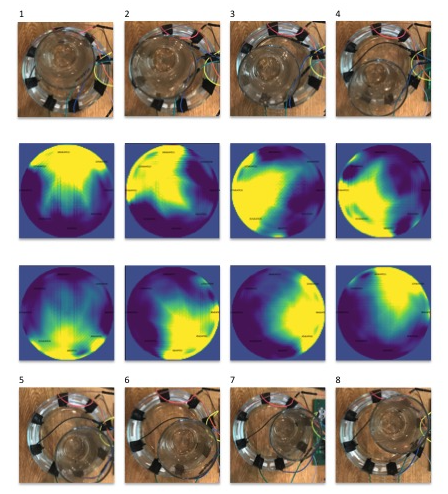
Improvements are welcome to this design. To increase resolution you could make a rotational version which is time resolution limited, or simply add more electrodes and re-compute the reconstruction that way. Another intended improvement is to move to tetrapolar differential electrodes set up. If you'd like to collaborate just pull the repository or email contact@mindseyebiomedical.com
We'd love to hear how you are using this!
We have a newer better board design which is uploaded and called Spectra.pdf. Check it out.
Are hatching! Join the technical discussion list to discuss further at openeit.github.io
The Creative Commons Attribution-NonCommercial-ShareAlike 4.0 International License seems to fit best with this project. Check out the human readable summary here:

This work is licensed under a Creative Commons Attribution-NonCommercial-ShareAlike 4.0 International License.
If you'd like to make a derivative of this project in a commercial setting, we'd love a payment so that we can afford to spend time both maintaining this project and making more projects like this one. If this hybrid open source model works, it would enable open source projects to receive some funding, making the global commons stronger to benefit everyone.
| Qty | Value | Footprint | References |
|---|---|---|---|
| 8 | TEST_1P | eit:electrode10mm | J1, J2, J3, J4, J5, J6, J7, J8 |
| 1 | Conn_01x08 | ownlib:fpc-0.5mm-8p | J9 |
It measures 509.5 × 15.4 mm and has 2 copper layers, 1.6 mm thick.
9 parts. The full list of its parts is on this page, with links to each part's symbol and footprint where PCBKit's library has them.
From the OpenEIT/EIT_EE repository on GitHub, at the commit this page was made from: the board is 8_electrode_flex/eit.kicad_pcb. PCBKit opens the board in the browser, with nothing to install.
Its repository states no licence, so its author keeps all rights: ask OpenEIT before reusing the design.


FrameworkComputer/ExpansionCards
Reference designs and documentation to create Expansion Cards for the Framework Laptop

VoronDesign/Voron-Hardware
Cool Hardware designed by the Voron Design group

hackclub/OnBoard
💡 Join 1,000 teenagers and make your first PCB with a $100 grant!


adamws/kicad-kbplacer
KiCad plugin for automatic keyboard's key placement and routing