
4 layers165 × 119.5 mm
Esp32 patch bay circuit
james-l-key/Esp32_patch_bay_circuit
Circuit and PCB for Esp32_patch_bay
189 parts

An open source electronic circuit to drive pockel cells.
PC driver is an open-source printed circuit board by Open-2-Photon-Microscope, from the Open-2-Photon-Microscope/pockel-cell-controller repository on GitHub, published under the GPL-3.0 licence. It is a 2-layer board of 98 × 57 mm with 28 parts on 19 nets, routed with 91 tracks and 3 vias.
It is built around the CA3240AE, LM10CLN and ADG419BNZ. Its parts include 7 resistors, 5 connectors, 3 capacitors, 3 ICs and 2 diodes.


An open source circuit to modulate laser intensity in a 2 Photon microscope. This modulation is necessary when visual stimulation is used to elicit responses from biological tissue (photoreceptors). The laser power is tunned high and low periodically (in our systems at 500Hz using a square wavefom at 80% duty cycle). When laser power is low, visual stimulation is on, when laser power is high, visual stimulation is off.
This driver was built to control a laser modulator from Conoptics. Specifically his model.
The main purpose of this circuit is to condition an analog signal using an fast switch IC that opens and closes the analog line using a digital 0-5V square signal (0V circuit open, 5V circuit closed). The original switching signal is 1.6ms at 5V and 0.4ms at 0V (composing a 500Hz signal), but other signals can be used.
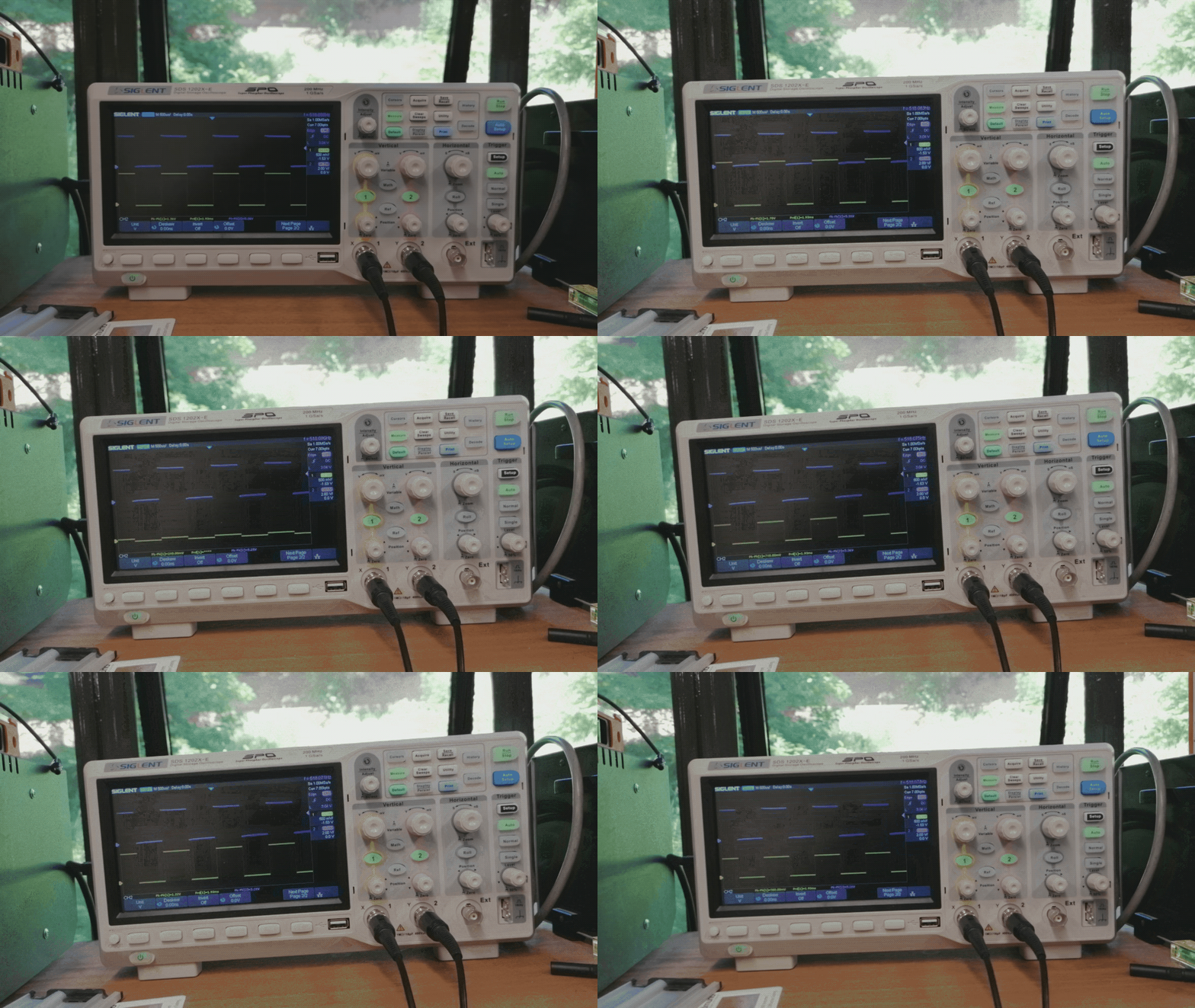
This board can take an internal analog signal, where the signal amplitude (and therefore the laser intensity) is set by a potentiometer, or an external signal connected via a BNC cable.
The Pockels' cell driver was inspired by earlier devices designed and built by R. Berndt (HIH Tübingen), part of a project of T. Euler's lab.
v2.0
V1.0
Footprints for KiCad downloaded from ultralibrarian.
| Qty | Value | Footprint | References |
|---|---|---|---|
| 2 | 100k | Resistor_THT:R_Axial_DIN0309_L9.0mm_D3.2mm_P12.70mm_Horizontal | R1, R6 |
| 2 | 100nF | Capacitor_THT:C_Disc_D5.0mm_W2.5mm_P2.50mm | C1, C3 |
| 2 | 3k6 | Resistor_THT:R_Axial_DIN0309_L9.0mm_D3.2mm_P12.70mm_Horizontal | R3, R7 |
| 1 | 10k | Resistor_THT:R_Axial_DIN0309_L9.0mm_D3.2mm_P12.70mm_Horizontal | R2 |
| 1 | 10nF | Capacitor_THT:C_Disc_D5.0mm_W2.5mm_P2.50mm | C2 |
| 1 | 60 | Resistor_THT:R_Axial_DIN0309_L9.0mm_D3.2mm_P12.70mm_Horizontal | R4 |
| 1 | 90k | Resistor_THT:R_Axial_DIN0309_L9.0mm_D3.2mm_P12.70mm_Horizontal | R5 |
| 1 | ADG419BN | Package_DIP:DIP-8_W7.62mm | U3 |
| 1 | Analog_Input (0-5V) | Connector_Coaxial:BNC_Amphenol_B6252HB-NPP3G-50_Horizontal | J1 |
| 1 | Analog_out (0to5V) | Connector_Coaxial:BNC_Amphenol_B6252HB-NPP3G-50_Horizontal | J3 |
| 1 | CA3240AE | Package_DIP:DIP-8_W7.62mm | U2 |
| 1 | LM10CLN | Package_DIP:DIP-8_W7.62mm | U1 |
| 1 | SW_SPDT | Button_Switch_THT:SW_E-Switch_EG1224_SPDT_Angled | SW1 |
| 1 | TTL_input (blanking) | Connector_Coaxial:BNC_Amphenol_B6252HB-NPP3G-50_Horizontal | J4 |
| 1 | USB_C_Plug_USB2.0 | Connector_USB:USB_C_Receptacle_GCT_USB4085 | P1 |
| 1 | add_resist_jumper | Connector_PinHeader_2.54mm:PinHeader_1x03_P2.54mm_Vertical | J2 |
| 1 | laser_int 5k | Potentiometer_THT:Potentiometer_ACP_CA14-H5_Horizontal | RV1 |
| 1 | potent_led | LED_THT:LED_D5.0mm_Clear | D1 |
| 1 | switch_led | LED_THT:LED_D5.0mm_Clear | D2 |
The 22 most common of 28 parts.
It measures 98 × 57 mm and has 2 copper layers, 1.6 mm thick.
28 parts, built around the CA3240AE, LM10CLN and ADG419BNZ. The full list of its parts is on this page, with links to each part's symbol and footprint where PCBKit's library has them.
From the Open-2-Photon-Microscope/pockel-cell-controller repository on GitHub, at the commit this page was made from: the board is electronics/PC_driver/PC_driver.kicad_pcb. PCBKit opens the board in the browser, with nothing to install.
Its repository publishes it under the GPL-3.0 licence: you may reuse it on that licence's terms (keep the author's notice, and for a copyleft licence share your changes alike).
james-l-key/Esp32_patch_bay_circuit
Circuit and PCB for Esp32_patch_bay

joeycastillo/Sensor-Watch
A board replacement for the classic Casio F-91W wristwatch

TalismanDesign/PocketMage_PDA
An E-Ink PDA device using the ESP32 S3.

rusefi/rusefi
rusefi - GPL internal combustion engine control unit

hackclub/OnBoard
💡 Join 1,000 teenagers and make your first PCB with a $100 grant!

asterics/esp32_mouse_keyboard
ESP32 implementation for HID over GATT Keyboard and Mouse (Bluetooth Low Energy). Including serial API for external modules (similar to Adafruit EZKey HID)


Luos-io/luos_engine
Open-source and real-time orchestrator for cyber-physical-systems, to easily design, test and deploy embedded applications and digital twins.