2 layers285 × 95.1 mm
 ojthetiny/OpenTKL103
Fully Open source TKL keyboard
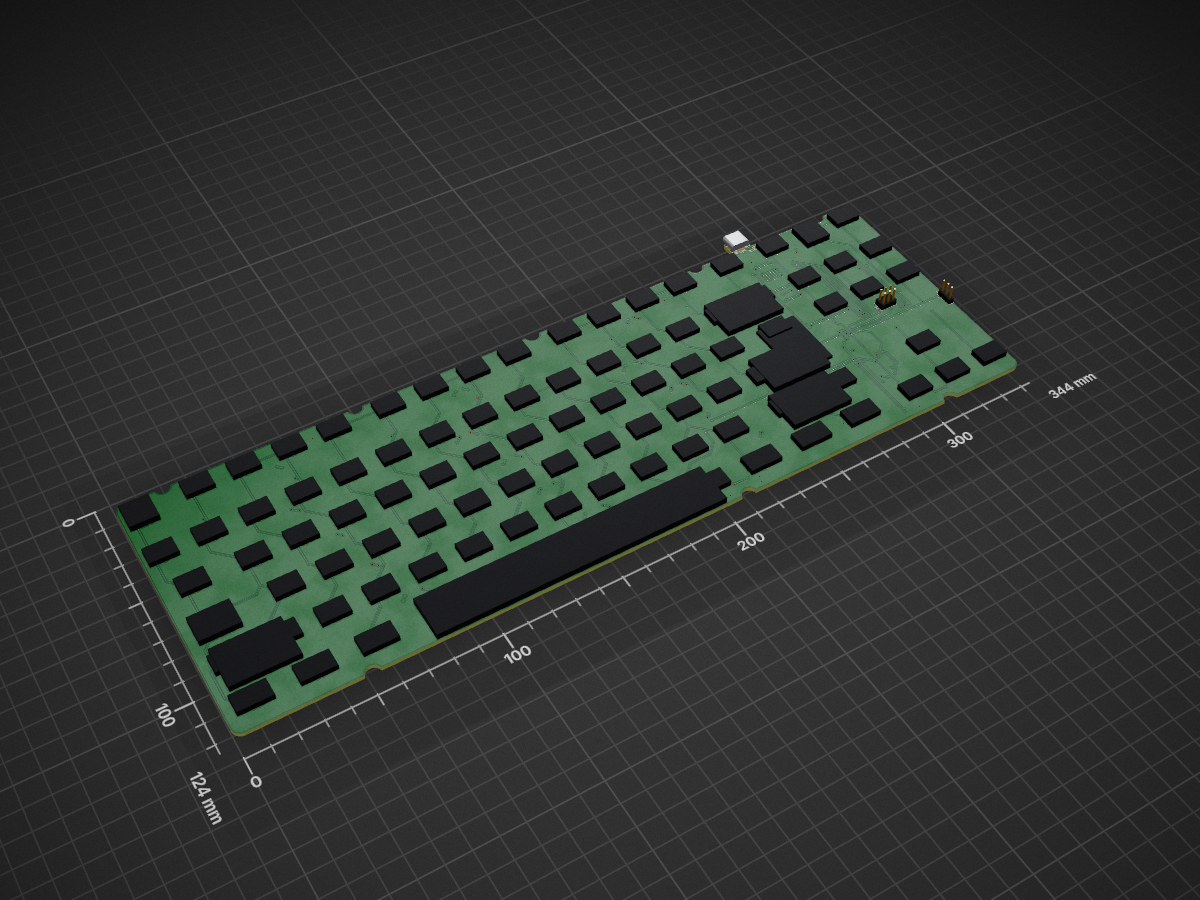
UniversalTKL is an open-source printed circuit board by ojthetiny, from the ojthetiny/OpenTKL repository on GitHub, published under the GPL-3.0 licence. It is a 2-layer board of 344 × 124.5 mm with 175 parts on 138 nets, routed with 1,545 tracks and 224 vias.
It is built around the ATMEGA32U4-MU and PRTR5V0U2X. Its parts include 49 diodes, 4 connectors, 1 IC, 1 crystal and 1 fuse. It belongs with the AVR (ATmega, ATtiny) boards of this library.


Fully open souce TKL keyboard project
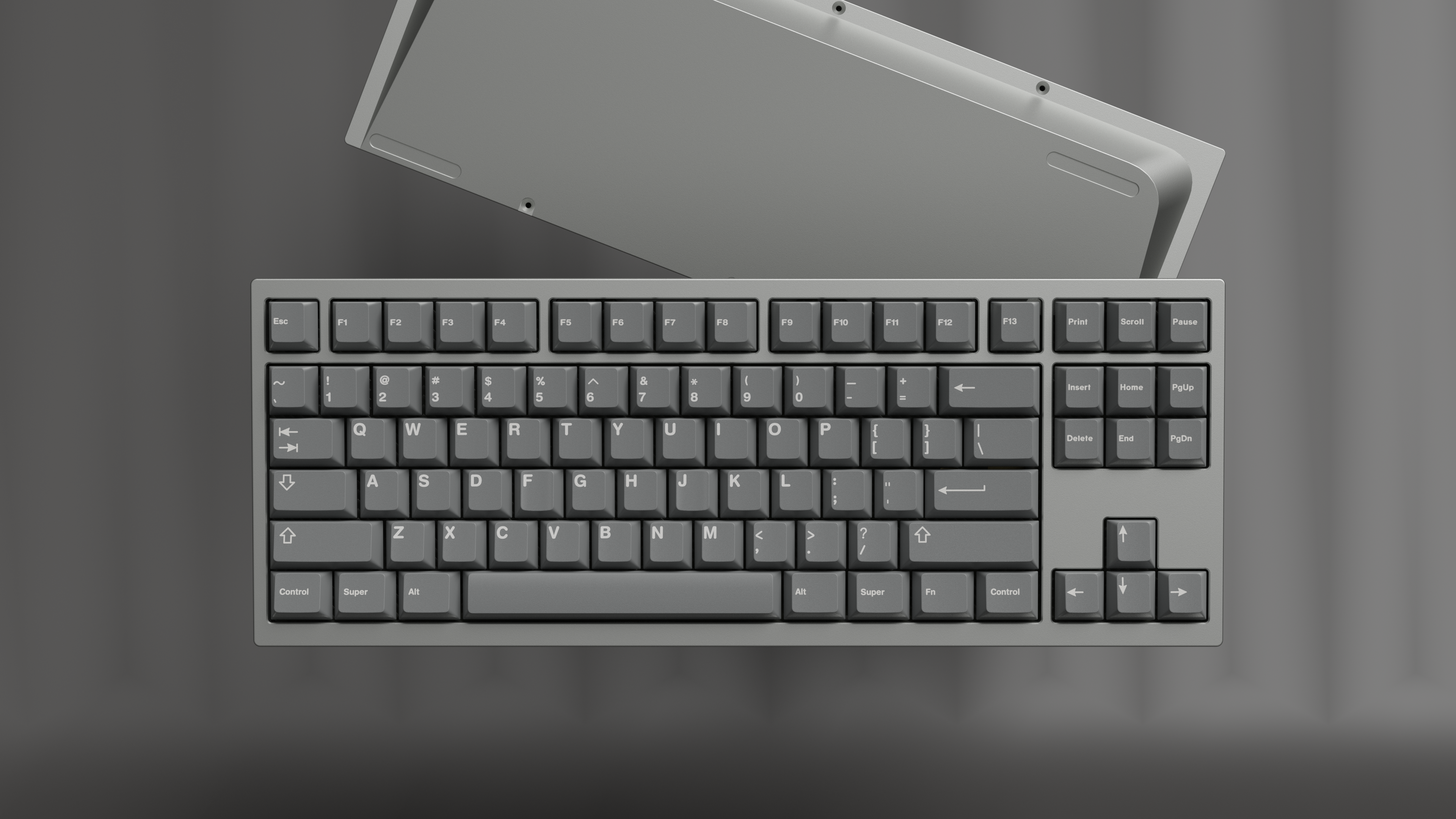
Use as a base for your own designs, renders or order as is (read important info at the bottom).
Details:
Important Info (READ BEFORE ORDERING):
If you use this as a template for your own design, please give credit(same goes for renders).
| Qty | Value | Footprint | References |
|---|---|---|---|
| 78 | MX-NoLED | MX_Alps_Hybrid:MX-1U-NoLED | MX11, MX12, MX13, MX14, MX15, MX16, MX18, MX19, MX20, MX21, MX22, MX100, MX101, MX102, MX103, MX104 +62 |
| 44 | BAV70_Small | Package_TO_SOT_SMD:SOT-23 | D1, D2, D10, D11, D12, D13, D14, D15, D16, D17, D19, D20, D21, D22, D23, D24 +28 |
| 8 | MX-NoLED | MX_Alps_Hybrid:MX-1.25U-NoLED | MX2, MX3, MX10, MX17, MX60, MX61, MX73, MX81 |
| 6 | MX-NoLED | MX_Alps_Hybrid:MX-1.5U-NoLED | MX6, MX9, MX23, MX67, MX86, MX90 |
| 4 | D_Small | Diode_SMD:D_SOD-123 | D46, D47, D48, D79 |
| 3 | .1u | Capacitor_SMD:C_0402_1005Metric | C_DECOUP1, C_DECOUP2, C_DECOUP3 |
| 3 | 220 | Resistor_SMD:R_0402_1005Metric | R_INDICATOR1, R_INDICATOR2, R_INDICATOR3 |
| 2 | 10k | Resistor_SMD:R_0402_1005Metric | R_HWB1, R_RST1 |
| 2 | 22 | Resistor_SMD:R_0402_1005Metric | R_DATA1, R_DATA2 |
| 2 | 5k1 | Resistor_SMD:R_0402_1005Metric | R_USB1, R_USB2 |
| 2 | MX-LED | MX_Alps_Hybrid:MX-1U | MX4, MX95 |
| 1 | 10u | Capacitor_SMD:C_0402_1005Metric | C_DECOUP4 |
| 1 | 1u | Capacitor_SMD:C_0402_1005Metric | C_UCAP1 |
| 1 | ATmega32U4-M | Package_DFN_QFN:QFN-44-1EP_7x7mm_P0.5mm_EP5.2x5.2mm | U1 |
| 1 | CONN_DB | Connector_JST:JST_SH_SM04B-SRSS-TB_1x04-1MP_P1.00mm_Horizontal | J3 |
| 1 | CONN_RGB | Connector_PinHeader_2.54mm:PinHeader_1x03_P2.54mm_Vertical | J2 |
| 1 | HRO-TYPE-C-31-M-12 | Components:HRO-TYPE-C-31-M-12-Assembly | USB1 |
| 1 | ISP_Breakout | Connector_PinHeader_2.54mm:PinHeader_2x03_P2.54mm_Vertical | J4 |
| 1 | MX-LED | FancyHybridPrints:MX-1.25U | MX1 |
| 1 | MX-LED | MX_Alps_Hybrid:MX-1.75U | MX7 |
| 1 | MX-NoLED | MX_Alps_Hybrid:MX-6.25U-ReversedStabilizers-NoLED | MX39 |
| 1 | MX-NoLED | MX_Alps_Hybrid:MX-7U-ReversedStabilizers-NoLED | MX45 |
| 1 | MX-NoLED | MX_Alps_Hybrid:MX-2.25U-ReversedStabilizers-NoLED | MX84 |
| 1 | MX-NoLED | MX_Alps_Hybrid:MX-1.75U_NoLED | MX78 |
| 1 | MX-NoLED | MX_Alps_Hybrid:MX-2.25U-NoLED | MX8 |
| 1 | MX-NoLED | MX_Alps_Hybrid:MX-ISO-ReversedStabilizers | MX80 |
| 1 | MX-NoLED | MX_Alps_Hybrid:MX-2.75U-NoLED | MX72 |
| 1 | MX-NoLED | MX_Alps_Hybrid:MX-2U-NoLED | MX89 |
| 1 | PRTR5V0U2X | Package_TO_SOT_SMD:SOT-143 | D18 |
| 1 | Polyfuse_Small | Fuse:Fuse_0805_2012Metric | F1 |
| 1 | Reset Jumper | Button_Switch_SMD:SW_SPST_TL3342 | J1 |
| 1 | Resonator_Small | Crystal:Resonator_SMD_Murata_CSTxExxV-3Pin_3.0x1.1mm | Y1 |
It measures 344 × 124.5 mm and has 2 copper layers, 1.6 mm thick.
175 parts, built around the ATMEGA32U4-MU and PRTR5V0U2X. The full list of its parts is on this page, with links to each part's symbol and footprint where PCBKit's library has them.
From the ojthetiny/OpenTKL repository on GitHub, at the commit this page was made from: the board is PCB/Kicad Files/UniversalTKL.kicad_pcb and its schematic PCB/Kicad Files/UniversalTKL.kicad_sch. PCBKit opens the board in the browser, with nothing to install.
Its repository publishes it under the GPL-3.0 licence: you may reuse it on that licence's terms (keep the author's notice, and for a copyleft licence share your changes alike).


jpskenn/Jones
Row-staggered 60% keyboard with gapless R2-R3 row. GH60 case compatible.

jpskenn/Nora
Narrow pitch keyboard with Choc switches and keycaps. GH60 compatible.

calvin-mcd/Didaktik-40
a 40s keyboard inspired by the Didaktik computer & keyboard

paindrivendev/le-yiffre
Le Yiffre is a modified hotswap Le Chiffre pcb as an experimental design with different thumb clusters.Thanks to tominabox1 for creating Le Chiffre Keyboard and making it open source.
