2 layers63.4 × 28.1 mm

 object1037/Vespa
Wireless ortholinear keyboard
Vespa is an open-source printed circuit board by object1037, from the object1037/Vespa repository on GitHub, published under the CC-BY-4.0 licence. It is a 2-layer board of 256.5 × 100.3 mm with 121 parts on 83 nets, routed with 718 tracks and 90 vias.
It is built around the XCL103D333CR-G and BU4210G-TR. Its parts include 54 switches, 52 diodes, 4 capacitors, 3 ICs and 1 resistor. It belongs with the keyboards and input boards and the nRF52 and nRF5x boards of this library.


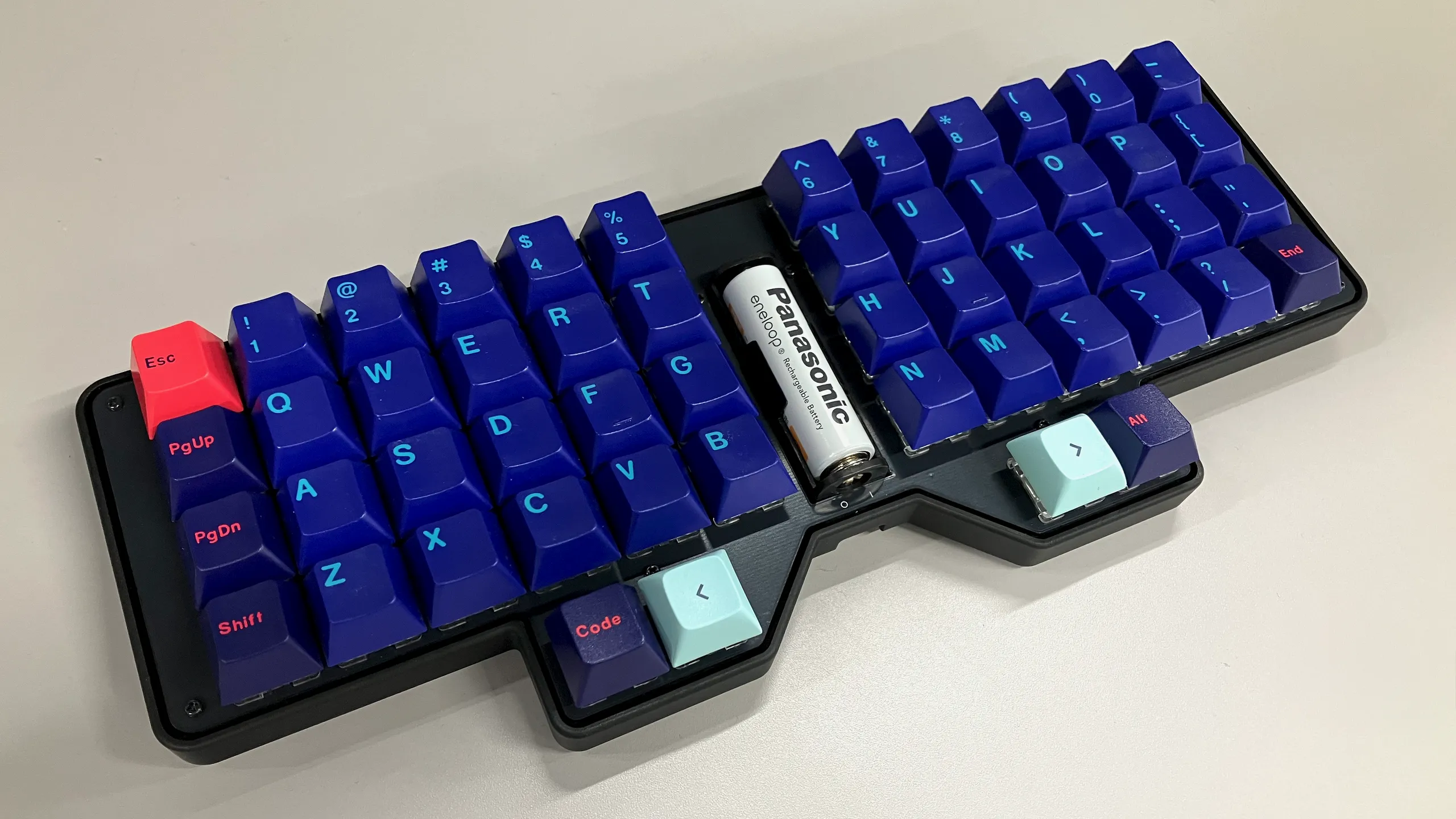
The Vespa is a 50% wireless keyboard with an ortholinear layout.
| Qty | Value | Footprint | References |
|---|---|---|---|
| 52 | D | Diode_SMD:D_SOD-323_HandSoldering | D1, D2, D10, D11, D12, D13, D14, D15, D16, D17, D18, D19, D20, D21, D22, D23 +36 |
| 52 | SW_Push | kbd_SW_PCBA:MX_Choc_v1v2_Hotswap_1u | SW1, SW2, SW10, SW11, SW12, SW13, SW14, SW15, SW16, SW17, SW18, SW19, SW20, SW21, SW22, SW23 +36 |
| 4 | Val** | kbd_Hole:m2_Spacer_Hole | Ref**, Ref**, Ref**, Ref** |
| 2 | 10u | Capacitor_SMD:C_0603_1608Metric_Pad1.08x0.95mm_HandSolder | C1, C2 |
| 1 | 100k | Resistor_SMD:R_0603_1608Metric_Pad0.98x0.95mm_HandSolder | R1 |
| 1 | 100p | Capacitor_SMD:C_0402_1005Metric_Pad0.74x0.62mm_HandSolder | C3 |
| 1 | 1n | Capacitor_SMD:C_0402_1005Metric_Pad0.74x0.62mm_HandSolder | C4 |
| 1 | BU4210G-TR | My_lib:SSOP5 | U3 |
| 1 | Battery_Cell | Battery:BatteryHolder_Keystone_2460_1xAA | BT1 |
| 1 | LOGO | LOGO | G*** |
| 1 | Q_PMOS | Package_TO_SOT_SMD:SOT-23-3 | Q1 |
| 1 | RotaryEncoder | My_lib:re111f | SW53 |
| 1 | SW_SPDT | My_lib:SW_SPDT_IS-1245T | SW54 |
| 1 | XCL103D333CR-G | My_lib:CL2025-02 | U2 |
| 1 | XIAO nRF52840 Plus | My_lib:XIAO-nRF52840-Plus-SMD | U1 |
It measures 256.5 × 100.3 mm and has 2 copper layers, 1.6 mm thick.
121 parts, built around the XCL103D333CR-G and BU4210G-TR. The full list of its parts is on this page, with links to each part's symbol and footprint where PCBKit's library has them.
From the object1037/Vespa repository on GitHub, at the commit this page was made from: the board is hardware/vespa.kicad_pcb and its schematic hardware/vespa.kicad_sch. PCBKit opens the board in the browser, with nothing to install.
Its repository publishes it under the CC-BY-4.0 licence: you may reuse it on that licence's terms (keep the author's notice, and for a copyleft licence share your changes alike).

zynthian/zynthian-hw
Zynthian hardware stuff: PCBs, schemes, parts specifications, pin assignment, ...


Spaceboards/SpaceboardsHardware
A collection of open source hardware that has been designed by Spaceboards

OpenElectronicsLab/OpenHardwareExG
The OpenHardwareExG is a platform for ECG, EEG, EMG, ENG, EOG, and evoked potential applications. http://openelectronicslab.github.io/OpenHardwareExG/

robfinch/Cores
Cores ===== RTF's Cores Use at your own risk. Welcome to my galaxy of cores. Contained in the directories are IP cores, source code for digital circuits.

