
2 layers50.8 × 22.9 mm
Drawbridge featherwing
nstielau/gate_controller
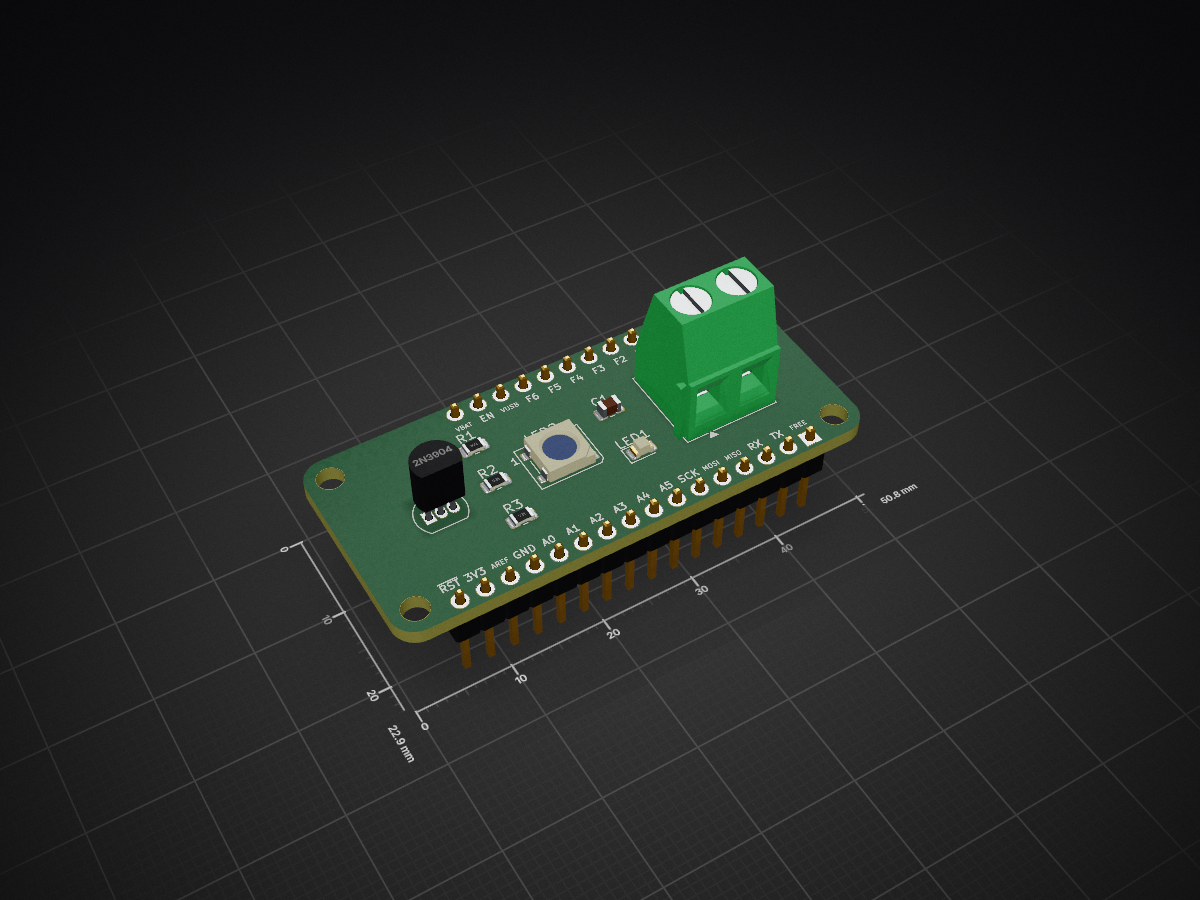
This is a revision-stamped prototype board for a Feather-compatible host, including the Unexpected Maker FeatherS3[D] and Adafruit ESP32-S3 Reverse TFT Feather.
16 parts
 nstielau/gate_controller
This is a revision-stamped prototype board for a Feather-compatible host, including the Unexpected Maker FeatherS3[D] and Adafruit ESP32-S3 Reverse TFT Feather.
Gate controller is an open-source printed circuit board by nstielau, from the nstielau/gate_controller repository on GitHub. It is a 2-layer board of 50.8 × 22.9 mm with 14 parts on 33 nets.
It is built around the WS2812B. Its parts include 3 resistors, 3 connectors, 2 diodes, 1 capacitor and 1 transistor.
This is a revision-stamped prototype board for a Feather-compatible host, including the Unexpected Maker FeatherS3[D] and Adafruit ESP32-S3 Reverse TFT Feather. It provides the existing, proven 2N3904 transistor output unchanged: J3 pin 1 is the switched output and J3 pin 2 is the shared ground. The Feather module is not part of the assembly BOM.
Schematic and PCB signal names use portable Feather header labels:
WIFI_D5, MQTT_D6, HOLD_D9, and CTRL_D11. GPIO numbers differ between
Feather models and therefore are not part of these net names.
The generated PCB is drawbridge-featherwing.kicad_pcb and the schematic is
drawbridge-featherwing.kicad_sch. Generate the fabrication package from the
repository root with:
make featherwing-fabEvery run regenerates the design from generate.py, runs ERC/DRC, and replaces
the entire artifacts/featherwing/ directory with a complete release. Do not
keep manual edits or source files in that output directory. Old extracted ZIPs,
previews and reports disappear automatically. Other artifact folders are separate.
If a build fails, the last complete release remains available; its timestamp in
manifest.json identifies when it was built. Never upload after a failed build
assuming that the files reflect your latest source changes.
Each build requires a clean Git checkout, including staged, unstaged, and
untracked files anywhere in the repository. Commit changes before running the
build. Ignored files such as credentials and artifacts/ do not block it.
There is no dirty-build override or generation counter.
The revision is exactly the first three characters of Git HEAD, for example
abc, with no suffix. It appears below the castle and in manifest.json.
Every ZIP contains REV_abc.txt with both abc and the full commit hash;
use the full hash to identify a commit unambiguously. Rebuilding the same commit
keeps the same revision. The build checks checkout cleanliness and HEAD again
before replacing the output.
Generation runs on a temporary snapshot of committed sources and leaves the
checkout unchanged. The freshly stamped native KiCad project is exported to
artifacts/featherwing/design/ and included in the combined ZIP. Open that
project to inspect the current release; tracked native KiCad files are reference
snapshots and may carry an older revision. Incorporate edits into the generator,
commit them, then rebuild.
Prerequisites: KiCad 10 in /Applications/KiCad, make setup, and the repository's
Node/Playwright installation (make web-setup, then npx playwright install chromium
if Chromium is missing). Incorporate manual KiCad edits into generate.py before
rebuilding because the generator is the design source of record.
PCBWay uploads from artifacts/featherwing/:
| Upload field | File |
|---|---|
| Gerbers | drawbridge-featherwing-gerbers.zip |
| Parts list / BOM | assembly-bom.xlsx (PCBWay upload) |
| Centroid | assembly-position.csv |
| Assembly other files | drawbridge-featherwing-assembly-other.zip |
| Complete package for review | drawbridge-featherwing-pcbway.zip |
For Seeed Studio Fusion, upload seeed-assembly-bom.csv. It uses Seeed's
four-column Designator, Manufacturer Part Number or Seeed SKU, Qty, and
Link format and consolidates identical MPNs. All parts except J3 are selected from Seeed's Shenzhen Open Parts Library
(OPL); their links search the live OPL listing. J3 is Phoenix Contact 1725656
and uses its manufacturer link for external sourcing by Seeed (not verified
OPL stock). The BOM includes the two underside Feather headers, five resistors,
Q1, three LEDs, and J3. The Feather host is excluded. Check live availability when requesting a quote because OPL stock
changes independently of this repository.
The selected XKB headers have 2.54 mm pitch, 2.5 mm insulators, 3.0 mm solder tails, and 6.0 mm mating pins. Seeed must install their bodies on the bottom of the wing, with the 6.0 mm pins pointing down into the Feather's sockets. The LEDs are a matching Everlight 3 mm family; observe the KiCad cathode/pad-1 orientation during assembly.
All three ZIPs are generated together and every member is byte-checked against
the corresponding loose file. Gerbers and drills are also available in gerbers/
and drills/. Each run refreshes board.png, schematic.pdf, schematic.svg,
schematic.png, silkscreen.svg, logo SVG/PNG, BOM, positions, netlist.xml,
erc.rpt, drc.rpt, and assembly notes. manifest.json records the build time
and SHA-256 for every loose file and ZIP (excluding the manifest itself).
The BOM is emitted as both assembly-bom.xlsx for PCBWay and assembly-bom.csv
for review. Both include an explicit Tolerance column: all five resistors
(R1–R5) have a tolerance of 5%. R1/R3/R4/R5 are 1 kΩ Yageo
CFR-25JB-52-1K; R2 is 100 kΩ Yageo MFR50SJT-52-100K. Use 5% for the
PCBWay assembly specification; 1% is not required.
The isometric castle logo uses a 14 × 14 mm SVG canvas with 0.18 mm strokes.
The actual mark occupies about 12 × 12.5 mm on the USB end. The generator imports
assets/drawbridge-silkscreen.svg directly into F.Silkscreen. The 840-pixel PNG
is generated from that same SVG as a reference; no separate logo placement by
PCBWay is needed. For a bare-board order, only the Gerbers and drill files are
needed. For assembly, select through-hole assembly and ask PCBWay to
confirm the listed manufacturer part numbers and header availability. J3 is a
top-side screw terminal at the right-hand edge, with wire entry facing outward
away from the USB connector.
Recommended starting options are two layers, FR-4, 1.6 mm thickness, 1 oz copper, green solder mask, white silkscreen, and lead-free HASL. These are defaults for quoting, not a manufacturing release.
Run make featherwing-check before uploading; it performs the same complete
rebuild as make featherwing-fab. Offline package freshness/failure recovery
tests run with .venv/bin/python -m unittest test_suite.test_featherwing_fab
and are included in make test. Inspect
the Gerbers in PCBWay's viewer, especially the Feather header orientation,
mounting holes, J3 polarity, and the antenna keepout at the FeatherS3[D] end.
The gate-controller interface remains installation-specific. The transistor stage is retained because it is the known-working circuit. J3 is populated with Phoenix Contact MPT 0,5/2-2,54, 1725656. Viewed from above with USB left, the upper screw is GND (pin 2) and the lower screw is OUT_OC (pin 1). Follow these labels when reconnecting existing wires. The terminal has a 5.54 x 6.2 mm body, 8.5 mm installed height, and 2.54 mm contact pitch. Use 20–26 AWG wire, strip 4.5 mm, and tighten to 0.12–0.15 N m while supporting the terminal body. Provide cable strain relief.
The local Drawbridge:ExitTerminal footprint retains KiCad's Phoenix footprint
contacts and both 1.1 mm non-plated locating holes from the manufacturer's
drilling drawing, 2.54 mm toward the wire-entry side of the contact pins. It
uses a 0.25 mm body courtyard and omits silkscreen at the wire-entry edge. Do not omit
these holes or substitute a generic 2.54 mm header footprint. J3 is included in
all assembly BOMs and in the top-side position file. The headers remain on the
underside. The board outline is unchanged at 50.8 x 22.86 mm.
Routing uses horizontal, vertical, and 45-degree segments, with chamfers at right-angle turns. Connected branches may still meet at right angles; these are electrical junctions, not sharp bends in a continuous route. Copper/holes, component courtyards, and silkscreen are checked on every fabrication build. The terminal and cable are near the Feather's antenna end: RF performance and assembled stack/enclosure clearance need checking with the actual host. DRC does not establish either of those physical properties.
The Feather-compatible J1 (16-pin) and J2 (12-pin) stacking headers are bottom-side assembly parts. Their XY pin coordinates are intentionally not mirrored, preserving the Feather pin order when this board is placed on top of the Feather host.
The 3 mm through-hole LEDs in the assembly BOM are assigned as follows:
| Reference | Function | Color |
|---|---|---|
| D1 | Wi-Fi | Cool white |
| D2 | MQTT | Blue |
| D3 | Hold | Green |
| Qty | Value | Footprint | References |
|---|---|---|---|
| 2 | 330 | Resistor_SMD:R_0805_2012Metric | R2, R3 |
| 1 | 100nF | Capacitor_SMD:C_0805_2012Metric | C1 |
| 1 | 1k | Resistor_SMD:R_0805_2012Metric | R1 |
| 1 | 2N3904 | Package_TO_SOT_THT:TO-92_Inline | Q1 |
| 1 | Gate_Output | TerminalBlock_Phoenix:TerminalBlock_Phoenix_MKDS-1,5-2-5.08_1x02_P5.08mm_Horizontal | J3 |
| 1 | Green | LED_SMD:LED_0805_2012Metric | LED1 |
| 1 | WS2812B | LED_SMD:LED_WS2812B_PLCC4_5.0x5.0mm_P3.2mm | LED2 |
| 1 | feather long | Connector_PinHeader_2.54mm:PinHeader_1x16_P2.54mm_Vertical | J1 |
| 1 | feather short | Connector_PinHeader_2.54mm:PinHeader_1x12_P2.54mm_Vertical | J2 |
The 10 most common of 14 parts.
It measures 50.8 × 22.9 mm and has 2 copper layers, 1.6 mm thick.
14 parts, built around the WS2812B. The full list of its parts is on this page, with links to each part's symbol and footprint where PCBKit's library has them.
From the nstielau/gate_controller repository on GitHub, at the commit this page was made from: the board is hardware/gate-controller.kicad_pcb and its schematic hardware/featherwing/drawbridge-featherwing.kicad_sch. PCBKit opens the board in the browser, with nothing to install.
Its repository states no licence, so its author keeps all rights: ask nstielau before reusing the design.
nstielau/gate_controller
This is a revision-stamped prototype board for a Feather-compatible host, including the Unexpected Maker FeatherS3[D] and Adafruit ESP32-S3 Reverse TFT Feather.

fossasia/pslab-hardware
PSLab Hardware Design and Schematics https://pslab.io

FrameworkComputer/ExpansionCards
Reference designs and documentation to create Expansion Cards for the Framework Laptop


PrintersForAnts/Micron
If you want to purchase full kits there are 3 available (Kits are slowly updating to R1 hardware just make sure to double check the included hardware in your kit and if you have any questions reach out in the discord)


