
4 layers41.1 × 96.6 mm

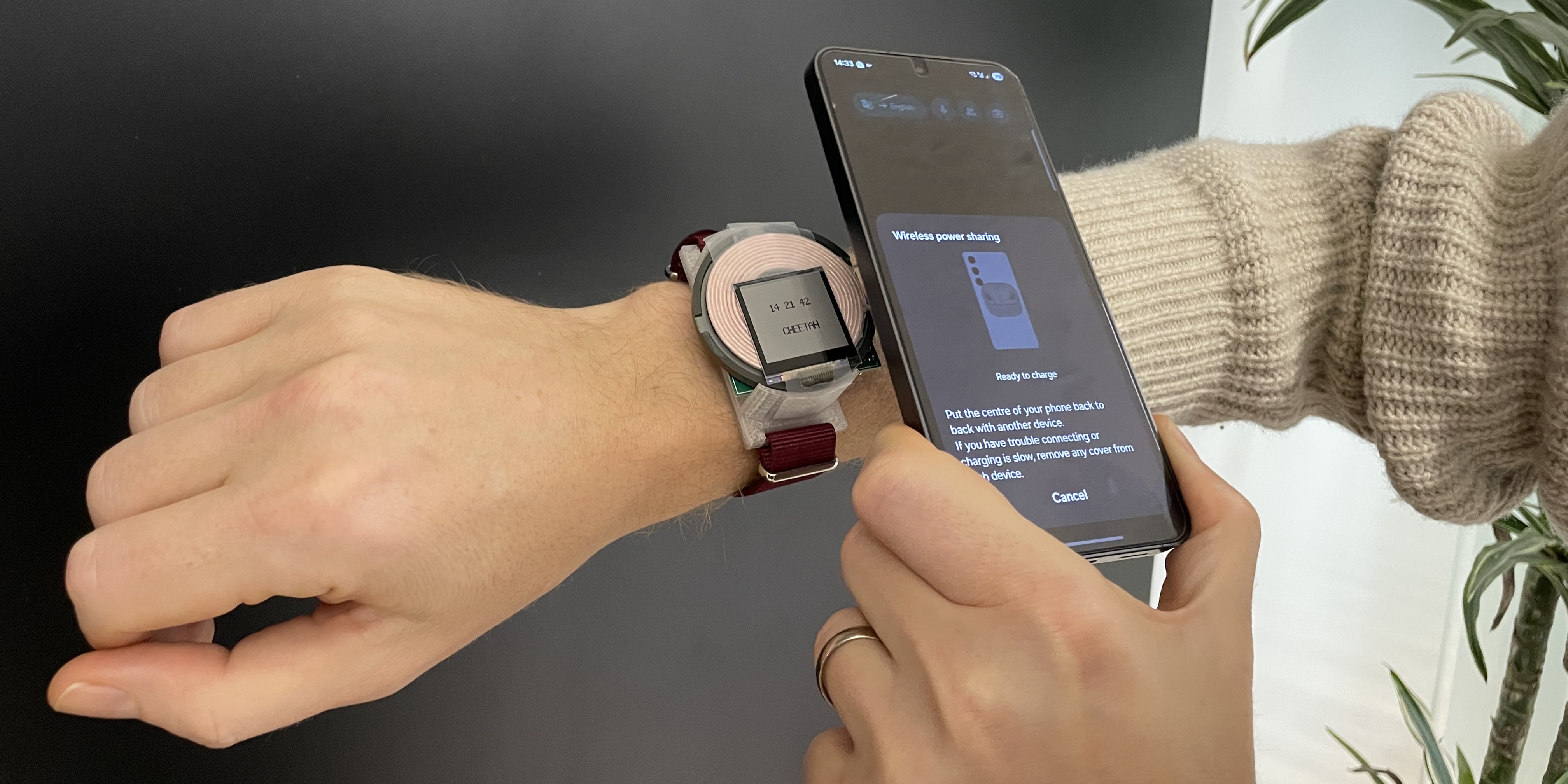
This project includes the hardware and software design of a battery-free wearable device with fast-charging capability, developed by Nokia Bell Labs.
Chikki is an open-source printed circuit board by nokia-steward, from the nokia-steward/Wearables-BatteryFree-Frontend repository on GitHub, published under the MIT licence. It is a 2-layer board of 42 × 29.5 mm with 97 parts on 92 nets, routed with 770 tracks and 105 vias.
It is built around the STM32U031F8P6, ISL9122AIRNZ-T7A and MAX40200AUK, with the TS3A44159PW, 74AUP1G00GW and AB1805-T3 among its other parts. Its parts include 34 capacitors, 19 resistors, 12 ICs, 5 diodes and 3 connectors. It belongs with the STM32 boards of this library.


This project includes the hardware and software design of a battery-free wearable device with fast-charging capability, developed by Nokia Bell Labs.
Despite decades of research on battery-free systems, their adoption in everyday electronics remains limited. Interactive Internet of Things devices such as wearables, personal trackers, and health monitors are increasingly widespread, yet almost all depend on batteries that are environmentally harmful, slow to charge, and have limited lifespans. Existing battery-free devices have seen use only in niche applications with minimal user interaction, primarily due to slow energy harvesting, frequent power interruptions, and restricted sensing capabilities under tight energy constraints. To address these limitations, we present Cheetah, a battery-free architecture that charges rapidly and reliably from ubiquitous wireless chargers, reduces power consumption, and enhances usability.
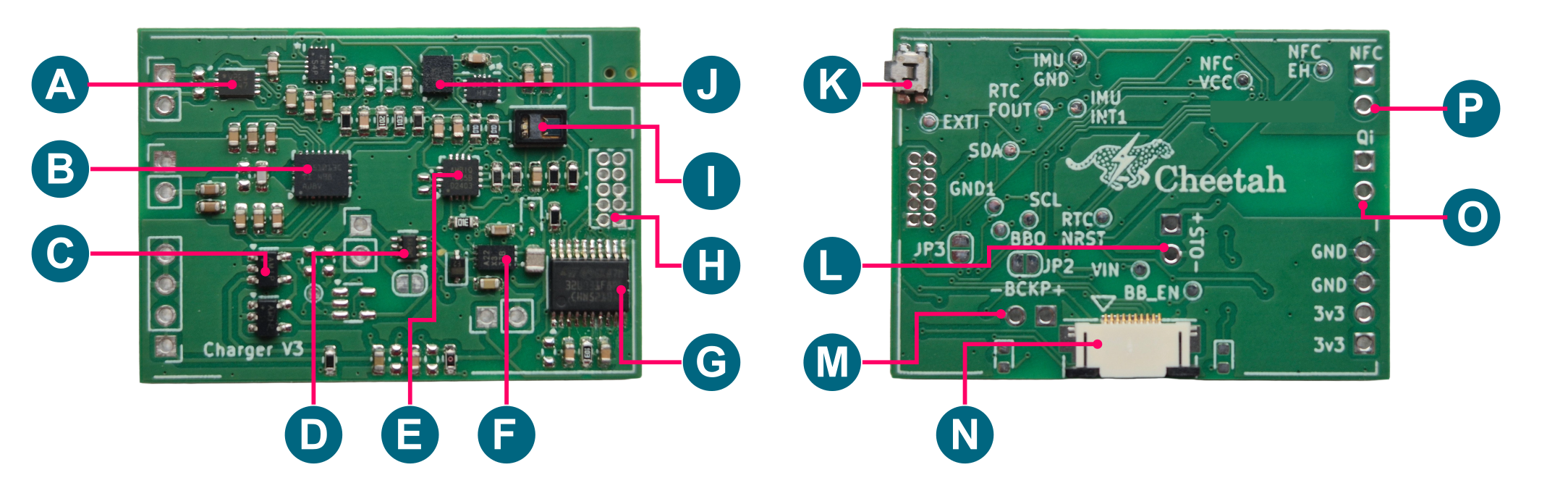
A - ST25DV NFC Tag, B - BQ51013C Qi power receiver, C - MAX40200 ideal diode, D - SIP32432DR3 power switch, E - AM1805 RTC, F - ISL9122A buck-boost converter, G - STM32U031 MCU, H - debug port, I - MAXM86161 Photoplethysmography (PPG) sensor, J - LSM6DSOX IMU, (Back) K - pushbutton, L - primary capacitor connector, M - secondary capacitor connector, N - display connector, O - Qi antenna connector, P - NFC antenna connector.
The project was developed using Kicad v6, and the project files can be found here. The project can be opened using the free and open source software Kicad to view and edit the schematic and layout files.
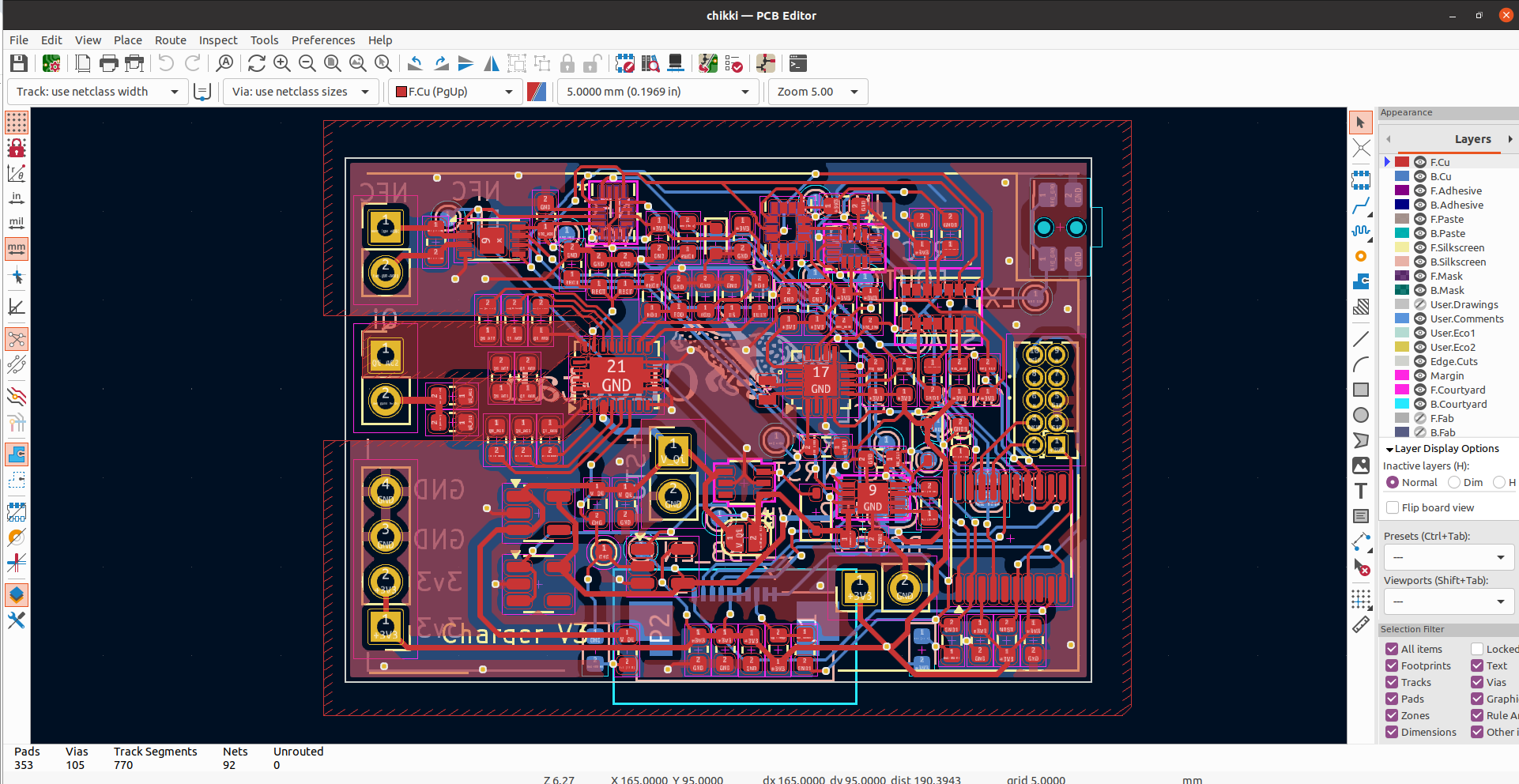
The schematic file can also be found here in pdf file format. Key datasheets of the components used are located here. The datasheets for other compoenents can be found by looking up the part number from the schematic.
The firmware can be found here along with instructions on how to build and flash the code in the readme file here.
The results from this work are published in a research article in Sensys 2026.
Vivian Dsouza, Przemysław Pawełczak, Alessandro Montanari, and Ashok Samraj Thangarajan. 2026. Cheetah: A New Paradigm for Battery-free Wear- able Devices. In ACM/IEEE International Conference on Embedded Artificial Intelligence and Sensing Systems (SenSys ’26), May 11–14, 2026, Saint Malo, France. ACM, New York, NY, USA, 13 pages. https://doi.org/10.1145/3774906.3802775

This work is licensed under a Creative Commons Attribution-NonCommercial- NoDerivatives 4.0 International License.
© 2026 Copyright held by the owner/author(s).


ACM ISBN 979-8-4007-2309-4/26/05 https://doi.org/10.1145/3774906.3802775
| Qty | Value | Footprint | References |
|---|---|---|---|
| 14 | TestPoint | TestPoint:TestPoint_Pad_D1.0mm | TP1, TP2, TP3, TP4, TP5, TP6, TP7, TP8, TP9, TP10, TP11, TP12, TP13, TP14 |
| 11 | 100nF | Capacitor_SMD:C_0603_1608Metric | C1, C16, C18, C19, C20, C22, C23, C24, C27, C29, C34 |
| 5 | 1uF | Capacitor_SMD:C_0603_1608Metric | C7, C25, C26, C30, C31 |
| 5 | C | Capacitor_SMD:C_0603_1608Metric | C10, C11, C21, C32, C33 |
| 3 | 10k | Resistor_SMD:R_0603_1608Metric | R3, R10, R11 |
| 3 | 10uF | Capacitor_SMD:C_0603_1608Metric | C4, C15, C17 |
| 3 | SolderJumper_2_Open | Jumper:SolderJumper-2_P1.3mm_Open_RoundedPad1.0x1.5mm | JP1, JP2, JP3 |
| 2 | 0Ohm | Resistor_SMD:R_0603_1608Metric | R13, R14 |
| 2 | 100k | Resistor_SMD:R_0603_1608Metric | R2, R19 |
| 2 | 100k | Resistor_SMD:R_0603_1608Metric | R15, R16 |
| 2 | 10nF | Capacitor_SMD:C_0603_1608Metric | C9, C12 |
| 2 | 1M | Resistor_SMD:R_0603_1608Metric | R17, R18 |
| 2 | 22nF | Capacitor_SMD:C_0603_1608Metric | C8, C13 |
| 2 | 3k | Resistor_SMD:R_0603_1608Metric | R8, R9 |
| 2 | 470nF | Capacitor_SMD:C_0603_1608Metric | C6, C14 |
| 2 | Antenna_Loop | Connector_PinHeader_2.54mm:PinHeader_1x02_P2.54mm_Vertical | AE1, AE2 |
| 2 | C_Polarized | Connector_PinHeader_2.54mm:PinHeader_1x02_P2.54mm_Vertical | C3, C5 |
| 2 | LED | LED_SMD:LED_0603_1608Metric | D3, D5 |
| 2 | MAX40200AUK | Package_TO_SOT_SMD:SOT-23-5 | U11, U12 |
| 2 | PMEG1020EA,115 | Diode_SMD:D_SOD-323 | D2, D6 |
| 2 | TS3A44159 | antennas:RSV16 | U1, U6 |
| 1 | 1.5k | Resistor_SMD:R_0603_1608Metric | R1 |
| 1 | 10 Ohms | Resistor_SMD:R_0603_1608Metric | R6 |
| 1 | 100 | Resistor_SMD:R_0603_1608Metric | R5 |
| 1 | 100nF | Capacitor_SMD:C_0603_1608Metric | C28 |
| 1 | 1uH | Inductor_SMD:L_0603_1608Metric | L1 |
| 1 | 200 | Resistor_SMD:R_0603_1608Metric | R7 |
| 1 | 22uF | Capacitor_SMD:C_0603_1608Metric | C2 |
| 1 | 42.2k | Resistor_SMD:R_0603_1608Metric | R4 |
| 1 | 527451097 | 527451097:CON_527451097_MOL | J4 |
| 1 | 74AUP1G00 | Package_TO_SOT_SMD:SOT-23-5 | U4 |
| 1 | AB1805 | Package_DFN_QFN:VQFN-16-1EP_3x3mm_P0.5mm_EP1.8x1.8mm | U10 |
| 1 | BQ51013C | Package_DFN_QFN:Texas_VQFN-RHL-20 | U5 |
| 1 | BZT52C5V1T-7 | Diode_SMD:D_SOD-523 | D4 |
| 1 | Conn_01x04_Pin | Connector_PinHeader_2.54mm:PinHeader_1x04_P2.54mm_Vertical | J3 |
| 1 | Conn_ARM_JTAG_SWD_10 | Connector_PinHeader_1.27mm:PinHeader_2x05_P1.27mm_Vertical | J2 |
| 1 | Crystal | antennas:ABS05W_Crystal | Y1 |
| 1 | EVQ-P7C01P | Button_Switch_SMD:SW_SPST_EVQP7C | SW1 |
| 1 | ISL9122AIRNZ-T7A | ISL9122A:SON8_ISL9122_REN | U2 |
| 1 | LOGO | antennas:cheetah_logo2 | G*** |
| 1 | LSM6DSOX | LSM6DSOXTR:PQFN50P250X300X86-14N | U9 |
| 1 | MAXM86161EDF+1 | MAXM86161:21-100309A_MXM | MAXM86161EFD+1 |
| 1 | R | Resistor_SMD:R_0603_1608Metric | R12 |
| 1 | SIP32432DR3-T1GE3 | footprints:SC-70-6L_1p25x2p1-0p65_VIS | U3 |
| 1 | ST25DV64K-IER8C3 | Package_DFN_QFN:DFN-8-1EP_3x2mm_P0.5mm_EP1.36x1.46mm | U7 |
| 1 | STM32U031F8P6 | Package_SO:TSSOP-20_4.4x6.5mm_P0.65mm | U8 |

tuna-f1sh/entree
Entree is a USB-C CAN interface designed to fully support CANnectivity - gets the CAN party started!

tag-designs/hardware
Hardware designs for tags and bases

jtflanagan/AppleTini
Teeny 4.1-based multifunctional Apple II peripheral card


fishpepper/tinyFINITY
Tiny and opensource video transmitter with integrated graphic OSD

TUDSSL/densor
Densor is an intraoral sensor platform, attached to regular dental retainers or aligners, that can take measurements inside the mouth.

It measures 42 × 29.5 mm and has 2 copper layers, 1.6 mm thick.
97 parts, built around the STM32U031F8P6, ISL9122AIRNZ-T7A, MAX40200AUK and TS3A44159PW. The full list of its parts is on this page, with links to each part's symbol and footprint where PCBKit's library has them.
From the nokia-steward/Wearables-BatteryFree-Frontend repository on GitHub, at the commit this page was made from: the board is hardware/kicad/chikki.kicad_pcb and its schematic hardware/kicad/chikki.kicad_sch. PCBKit opens the board in the browser, with nothing to install.
Its repository publishes it under the MIT licence: you may reuse it on that licence's terms (keep the author's notice, and for a copyleft licence share your changes alike).