2 layers71.2 × 38.1 mm

 noeljp/esp32-mqtts-secure
Projet ESP32 avec Mosquitto MQTTs, TLS, login/mdp
ESP32-Ethgate is an open-source printed circuit board by noeljp, from the noeljp/esp32-mqtts-secure repository on GitHub. It is a 2-layer board of 71.2 × 38.1 mm with 120 parts on 147 nets, routed with 624 tracks and 126 vias.
It is built around the AD8606ARMZ-R7, CH340C and ESP32-WROOM-32U, with the AD736ARZ-R7, ADS1115IDGS and HT7233 among its other parts. Its parts include 48 resistors, 39 capacitors, 14 ICs, 12 connectors and 4 diodes. It belongs with the home automation and IoT boards and the ESP32 boards of this library.


This is an ESP32 (ESP32-WROOM-32 module) with LAN8720A PHY project intended to be an ESP-NOW to (wired) MQTT gateway.
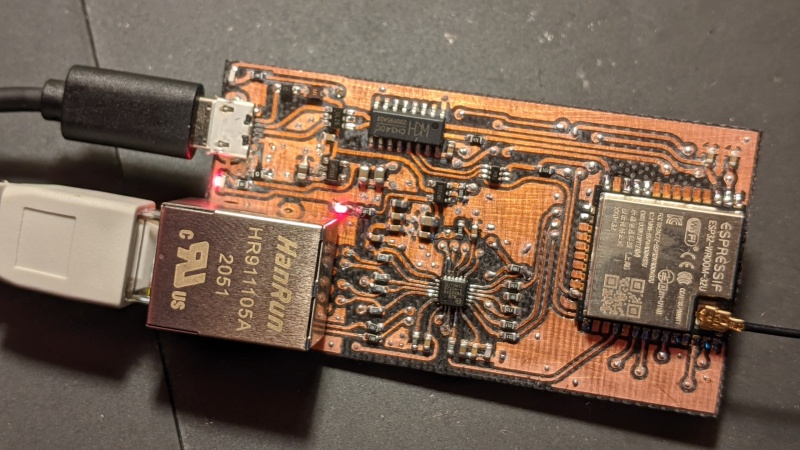
It was designed to be produced in my PCB mill. If your PCB mill can handle QFN24 footprints and double-sided PCB's then you might be able to duplicate this. Or you can just order a PCB from pretty much anywhere. I had a few made by Oshpark.
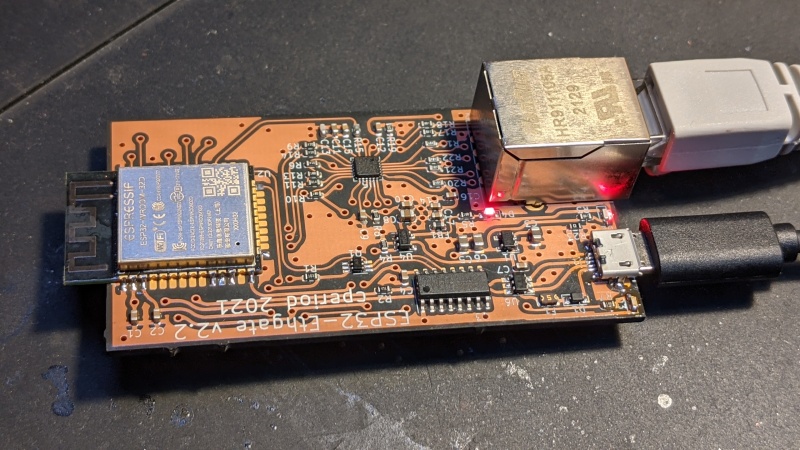
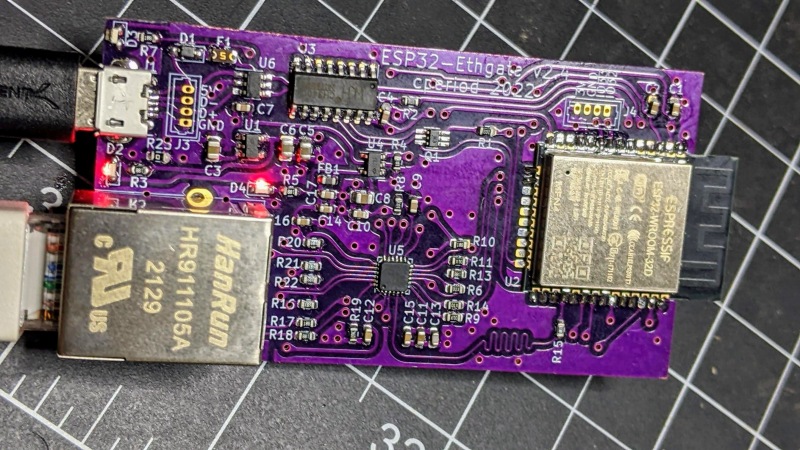
For simplicity, it uses the GPIO17 PLL clock technique rather than the GPIO0-based crystal, and includes a second 3.3v regulator to control the entire ethernet power rail independently. It needs stable USB power, although at some point I might take a stab at a PoE version.
The CH340C runs off the first regulator along with the ESP32. The HT7233 is rated for 300mA, which is just marginal for an ESP32, but so far I haven't noticed any power issues (power consumption for the whole board averages maybe 250mA). I've thrown in some USB ESD protection, a fuse, and some reverse protection (I know that's not supposed to be a problem with USB... things happen, don't ask). ESD protection for the Ethernet port would be a nice-to-have at some point.
The CH340C supports the usual auto-programming. Note that you may need to dial back the default upload baud rate.
I've added a small (1.25mm pitch) header with 3V3, GND, and two GPIO's to allow for things like environmental sensors. Note that temperature sensors will need to stay a minimum of 10cm off the board to avoid the heat thrown by this board. I've also broken out the USB interface with a small header (uUSB connectors can be brittle pieces of junk).
Most of the components are from LCSC. There's an interactive BOM page which should tell you what you need. Passives are 0603 with a few 0805 for the larger capacitors.
The Arduino-ESP32 ETH_LAN8720 sketch should work with the following configuration:
#define LED_BUILTIN 2	// or use a NodeMCU-type of board definition
#define ETH_CLK_MODE    ETH_CLOCK_GPIO17_OUT
#define ETH_POWER_PIN   12
#define ETH_TYPE        ETH_PHY_LAN8720
#define ETH_ADDR        1
#define ETH_MDC_PIN     23
#define ETH_MDIO_PIN    18

ETH.begin(ETH_ADDR, ETH_POWER_PIN, ETH_MDC_PIN, ETH_MDIO_PIN,
	ETH_TYPE, ETH_CLK_MODE)
I flash mine with the ESP32 clock set at 80MHz, which seems to be more stable at 100Mbps connection speeds and draws approximately 25% less power.
| Qty | Value | Footprint | References |
|---|---|---|---|
| 29 | 10K | Resistor_SMD:R_0603_1608Metric | R1, R12, R24, R25, R26, R27, R28, R29, R30, R31, R32, R33, R34, R35, R36, R37 +13 |
| 15 | 100n | Capacitor_SMD:C_0603_1608Metric | C1, C2, C4, C7, C9, C10, C17, C18, C19, C20, C21, C22, C23, C25, C39 |
| 15 | 10u | Capacitor_SMD:C_0805_2012Metric | C3, C26, C27, C28, C29, C30, C35, C36, C37, C38, C40, C41, C42, C43, C44 |
| 7 | 1K5 | Resistor_SMD:R_0603_1608Metric | R3, R5, R7, R10, R13, R17, R18 |
| 4 | 10R | Resistor_SMD:R_0603_1608Metric | R6, R9, R11, R14 |
| 4 | 49R9 | Resistor_SMD:R_0603_1608Metric | R16, R20, R21, R22 |
| 3 | 22u | Capacitor_SMD:C_0805_2012Metric | C5, C6, C8 |
| 3 | AD8606ARM | Package_SO:MSOP-8_3x3mm_P0.65mm | U9, U10, U11 |
| 2 | 10n | Capacitor_SMD:C_0603_1608Metric | C12, C15 |
| 2 | 22n | Capacitor_SMD:C_0603_1608Metric | C14, C16 |
| 2 | AD736ARZ-R7 | Package_SO:SOIC-8-1EP_3.9x4.9mm_P1.27mm_EP2.62x3.51mm | IC1, IC2 |
| 2 | ADS1115IDGS | Package_SO:VSSOP-10_3x3mm_P0.5mm | U7, U8 |
| 2 | HT7233 | Package_TO_SOT_SMD:SOT-23-5 | U1, U4 |
| 2 | RED | LED_SMD:LED_0603_1608Metric_Castellated | D2, D4 |
| 1 | 0R | Resistor_SMD:R_0603_1608Metric | R23 |
| 1 | 12K1 | Resistor_SMD:R_0603_1608Metric | R19 |
| 1 | 1u1R | Capacitor_SMD:C_0603_1608Metric | C11 |
| 1 | 30R | Inductor_SMD:L_0603_1608Metric | FB1 |
| 1 | 33R | Resistor_SMD:R_0603_1608Metric | R15 |
| 1 | 470R | Resistor_SMD:R_0603_1608Metric | R2 |
| 1 | 470p | Capacitor_SMD:C_0603_1608Metric | C13 |
| 1 | 750mA | Fuse:Fuse_0805_2012Metric_Pad1.15x1.40mm_HandSolder | F1 |
| 1 | B5817W | Diode_SMD:D_SOD-323_HandSoldering | D1 |
| 1 | CH340C | Package_SO:SOIC-16_3.9x9.9mm_P1.27mm | U3 |
| 1 | Conn_01x12 | Connector_PinHeader_1.27mm:PinHeader_1x12_P1.27mm_Horizontal | J5 |
| 1 | ESP32-WROOM-32U | CPB:ESP32-WROOM-32U-HandSoldering | U2 |
| 1 | GREEN | LED_SMD:LED_0603_1608Metric_Castellated | D3 |
| 1 | HR911105A | CPB:RJ45_Hanrun_HR911105A_Oval | J2 |
| 1 | IN1_0-10 | Connector_Phoenix_SPT:PhoenixContact_SPT_2.5_3-H-5.0_1x03_P5.0mm_Horizontal | J14 |
| 1 | IN2_0-10 | Connector_Phoenix_SPT:PhoenixContact_SPT_2.5_3-H-5.0_1x03_P5.0mm_Horizontal | J16 |
| 1 | IN3_4-20mA | Connector_Phoenix_SPT:PhoenixContact_SPT_2.5_3-H-5.0_1x03_P5.0mm_Horizontal | J15 |
| 1 | IN4_4-20mA | Connector_Phoenix_SPT:PhoenixContact_SPT_2.5_3-H-5.0_1x03_P5.0mm_Horizontal | J17 |
| 1 | IN5_RMS | Connector_Phoenix_SPT:PhoenixContact_SPT_2.5_2-H-5.0_1x02_P5.0mm_Horizontal | J6 |
| 1 | IN6_RMS | Connector_Phoenix_SPT:PhoenixContact_SPT_2.5_2-H-5.0_1x02_P5.0mm_Horizontal | J7 |
| 1 | IN7_PT100 | Connector_Phoenix_SPT:PhoenixContact_SPT_2.5_3-H-5.0_1x03_P5.0mm_Horizontal | J8 |
| 1 | IN8_PT100 | Connector_Phoenix_SPT:PhoenixContact_SPT_2.5_3-H-5.0_1x03_P5.0mm_Horizontal | J13 |
| 1 | LAN8720A | Package_DFN_QFN:QFN-24-1EP_4x4mm_P0.5mm_EP2.6x2.6mm | U5 |
| 1 | PC847 | Package_DIP:DIP-16_W7.62mm | U13 |
| 1 | UMH3N | Package_TO_SOT_SMD:SOT-363_SC-70-6_Handsoldering | Q1 |
| 1 | USB | Connector_Molex:Molex_PicoBlade_53047-0410_1x04_P1.25mm_Vertical | J3 |
| 1 | USBLC6-2SC6 | Package_TO_SOT_SMD:SOT-23-6_Handsoldering | U6 |
| 1 | USB_B_Micro | CPB:USB_Micro-B_CNC_C10418 | J1 |


Steven-Vokoun/RPI4-and-AD5933-EIS-Analyzer
Independent study project creating a portable potentiostatic EIS solution. Currently under development.

AuroraHealth12/moyoECG_pcb
The PCB design in KiCAD has been updated with a notable change: power control now operates through a button, while the slider switch is exclusively designated for extended storage or shipping purposes in contrast to…
It measures 71.2 × 38.1 mm and has 2 copper layers, 1.6 mm thick.
120 parts, built around the AD8606ARMZ-R7, CH340C, ESP32-WROOM-32U and AD736ARZ-R7. The full list of its parts is on this page, with links to each part's symbol and footprint where PCBKit's library has them.
From the noeljp/esp32-mqtts-secure repository on GitHub, at the commit this page was made from: the board is ESP32-Ethgate-main/ESP32-Ethgate.kicad_pcb and its schematic ESP32-Ethgate-main/ESP32-Ethgate.kicad_sch. PCBKit opens the board in the browser, with nothing to install.
Its repository states no licence, so its author keeps all rights: ask noeljp before reusing the design.