
4 layers230 × 84.9 mm
Tiny, local-first room hardware for Home Assistant and ESPHome.
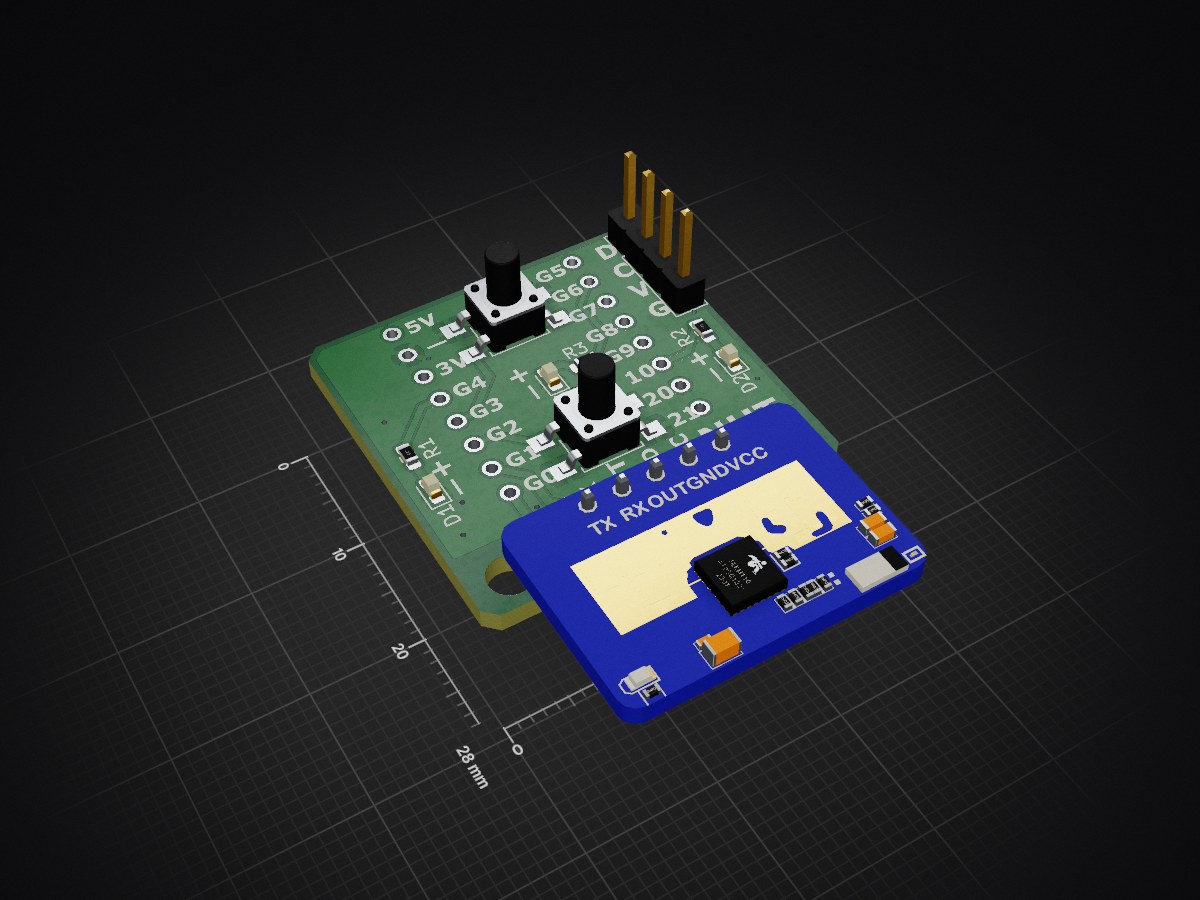
Scoopy is an open-source printed circuit board by NiceHatThanks, from the NiceHatThanks/scoopy-node repository on GitHub. It is a 2-layer board of 28 × 28 mm with 13 parts on 20 nets, routed with 55 tracks and 13 vias.
It is built around the HLK-LD2410C-P, FRC0603F2201TS and PSC-1608U52GC-G4, with the K2-1109SP-H4SA-04 and YLED0603R among its other parts. Its parts include 3 resistors, 3 diodes, 3 connectors and 2 switches. It belongs with the ESP32 boards of this library.


Tiny, local-first room hardware for Home Assistant and ESPHome.
Scoopy is a compact USB-C powered room controller built around an ESP32-C3. V1 combines two physical buttons, three PWM LEDs, optional LD2410C mmWave presence sensing, optional Home Assistant Bluetooth Proxy support, and an I²C expansion connection in a small 3D-printed enclosure.
There are two enclosure variants:
Both variants use the same firmware image. If an LD2410C is not fitted, the rest of Scoopy continues to work normally.
This repository contains the source-available hardware files, versioned STL enclosure exports, ESPHome firmware, captive-portal UI, manufacturing outputs, and project documentation.
docs/assembly.mddocs/troubleshooting.mdhardware/
kicad/ Editable KiCad source files
gerbers/ Fabrication-ready Gerbers and drill files
bom/ Bill of materials and manufacturing exports
enclosure/
compact/ Versioned STL exports for Scoopy Compact
presence/ Versioned STL exports for Scoopy Presence
build/ Assembly photos used by the build guide
firmware/
esphome/ Unified ESPHome configuration and custom components
captive-portal/ Source for the branded Wi-Fi setup page
docs/
setup.md First-time setup and Home Assistant pairing
examples.md Ready-made Home Assistant automations
assembly.md V1 enclosure assembly guide
troubleshooting.md Common setup, firmware and hardware issuesfirmware/esphome/scoopy.yaml is the unified production configuration for both Scoopy variants. The V1 firmware identifies itself as 1.0.0 through the ESPHome project version.
V1 features include:
scoopy-XXXXXX naming using the ESP32 MAC addresssingle, double, and hold event entitiesThe firmware deliberately uses one image for both variants. On Scoopy Compact, LD2410C entities may show as unavailable or Unknown because the radar is not fitted; this does not affect buttons, LEDs, Wi-Fi, OTA, Bluetooth Proxy, or the rest of the device.
Once Scoopy has joined the same network as Home Assistant, ESPHome discovery should find it automatically.
Ready-made automations are in docs/examples.md. The examples cover:
The interactive version at https://nicehatthanks.com/docs/ can take one of your Scoopy Entity IDs and fill the matching Scoopy prefix into the examples automatically.
For normal first-time setup, use https://nicehatthanks.com/setup/ or docs/setup.md.
A fresh or factory-reset Scoopy creates a Wi-Fi network named scoopy-XXXXXX with password scoopy123. Wi-Fi credentials are sent directly to Scoopy through its local setup page; no Scoopy cloud account is involved.
To clear saved Wi-Fi credentials and return to setup mode, hold both physical buttons together for 10 seconds. The middle red LED flashes rapidly near the end of the hold before the reset is performed.
Released firmware can be installed directly from Home Assistant through Scoopy's Firmware Update entity. Scoopy reads the update manifest hosted at:
https://nicehatthanks.com/firmware/scoopy/manifest.json
An OTA update preserves the device identity, saved Wi-Fi credentials, Home Assistant connection, and existing entity IDs.
GitHub contains the versioned raw STL exports for Scoopy Compact and Scoopy Presence.
The slicer-ready Bambu Studio / 3MF project is intentionally not duplicated in this repository. MakerWorld is the single maintained source for the Bambu project and print profile:
See enclosure/README.md for the STL layout and docs/assembly.md for assembly.
V1 uses a 28 × 28 mm carrier PCBA with:
Scoopy Presence uses the LD2410C and the larger enclosure. Scoopy Compact uses the same carrier and firmware without the radar.
Electrical design and manufacturing files are documented in hardware/README.md.
The enclosure build is the same basic process for Compact and Presence: fit the heat-set insert, secure the PCBA, place the two buttons in the lid, then clip the base and lid together while aligning the three light pipes with the LEDs.
For Scoopy Presence, a nylon M2 screw is recommended near the LD2410C because a metal screw may affect the radar.
See the illustrated docs/assembly.md guide.
v1.0.0 is the first formal Scoopy release. The V1 hardware, firmware, STL exports, documentation, and manufacturing files in that release tag form the reproducible V1 baseline.
Development on main may move ahead after the release. Use a release tag when reproducing a known version.
The hardware, firmware, and printable STL files are available so you can inspect Scoopy, build one for yourself, modify it, and experiment with your own non-commercial versions.
Commercial manufacture or sale requires prior permission from Nice Hat Thanks.
See LICENSE for the full terms.
Scoopy is source available for personal and non-commercial use. You may inspect the files, build your own, modify them, and share non-commercial derivatives under the terms in LICENSE.
Commercial manufacture, sale, or other commercial use requires prior written permission from Nice Hat Thanks.
Scoopy is not released under an open-source or open-hardware licence.
| Qty | Value | Footprint | References |
|---|---|---|---|
| 3 | 2.2k | Resistor_SMD:R_0603_1608Metric | R1, R2, R3 |
| 2 | LED - Green | LED_SMD:LED_0603_1608Metric | D1, D2 |
| 2 | SW_Push | Button_Switch_SMD:SW_SPST_TL3305C | SW1, SW2 |
| 1 | Conn_01x04_Pin | Connector_PinHeader_2.54mm:PinHeader_1x04_P2.54mm_Vertical | J3 |
| 1 | ESP32_SuperMini | StyxLib:ESP32-C3-SuperMini | J1 |
| 1 | LD2410C | StyxLib:Ld2410c | J2 |
| 1 | LED - Red | LED_SMD:LED_0603_1608Metric | D3 |
The 11 most common of 13 parts.
It measures 28 × 28 mm and has 2 copper layers, 1.6 mm thick.
13 parts, built around the HLK-LD2410C-P, FRC0603F2201TS, PSC-1608U52GC-G4 and K2-1109SP-H4SA-04. The full list of its parts is on this page, with links to each part's symbol and footprint where PCBKit's library has them.
From the NiceHatThanks/scoopy-node repository on GitHub, at the commit this page was made from: the board is hardware/kicad/scoopy/scoopy.kicad_pcb and its schematic hardware/kicad/scoopy/scoopy.kicad_sch. PCBKit opens the board in the browser, with nothing to install.
Its repository states no licence, so its author keeps all rights: ask NiceHatThanks before reusing the design.


Hossam-Mamdouh/Li-Po_Battery_Charger
USB-C 1S Li-Po Power Management & 3.3 V Supply PCB

TLDSJPWORK/1000base-t1-converter
学習用 1000BASE-T1 ↔ 1000BASE-T メディアコンバーター

0BAB1/HOLY_ESC
An open-source closed loop ESC PCB / Hardware platform. Based on a STM32F051 (Cortex M0 based) MCU. Tested using AM32 ESC software.


gelotek-com/Anki-In-Hardware
Building a physical flashcard device inspired by Anki and spaced repetition.
