Skip to the content
PCBKitNew board
2 layers44.5 × 19 mmNeuroBytes Force Sensor, the printed circuit board in 3D

All NeuroBytes products are based on the ST32L0x series of ARM Cortex-M0+ 32-bit microcontrollers. The boards were designed in KiCad and Inkscape and are released under the terms of the Creative Commons…

Size
44.5 × 19 mm
Copper layers
2
Thickness
1.6 mm
Parts
26
Nets
39
Pads
119
Tracks, vias
251, 36
Pours
1
Routed
Yes
KiCad
KiCad 4
Created
24 Apr 2017
Updated
29 Dec 2018

Overview

NeuroBytes Force Sensor is an open-source printed circuit board by NeuroTinker, from the NeuroTinker/NeuroBytes_Force_Sensor repository on GitHub. It is a 2-layer board of 44.5 × 19 mm with 26 parts on 39 nets, routed with 251 tracks and 36 vias.

It is built around the RCLAMP0503F.TCT and MMBT3904. Its parts include 9 resistors, 5 capacitors, 3 ICs, 3 transistors and 3 connectors. It belongs with the sensors and measurement boards and the STM32 boards of this library.

Main components

2

README

README.md

NeuroBytes Pressure Sensory Neuron

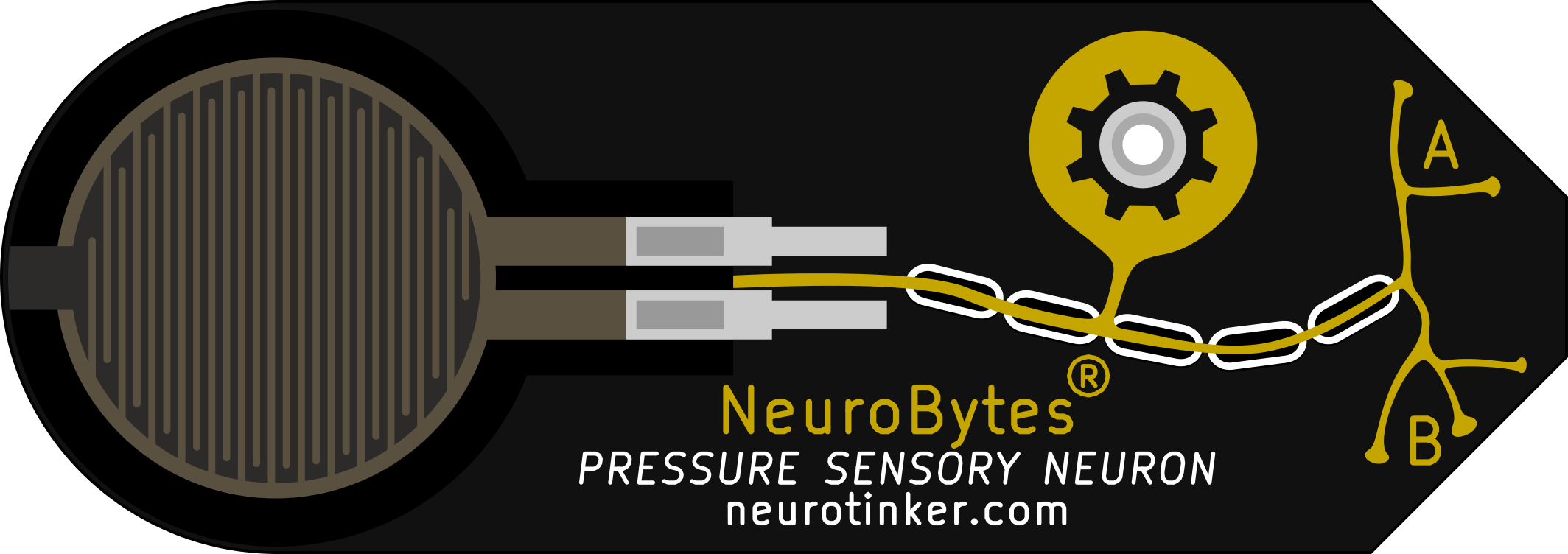
NeuroBytes Force Sensory Neuron PCB front The NeuroBytes Pressure Sensory Neuron is an open-source hardware neuron simulator designed and sold by NeuroTinker, LLC.

All NeuroBytes products are based on the ST32L0x series of ARM Cortex-M0+ 32-bit microcontrollers. The boards were designed in KiCad and Inkscape and are released under the terms of the Creative Commons Attribution-ShareAlike 4.0 license, available here: http://creativecommons.org/licenses/by-sa/4.0/. The NeuroBytes Pressure Sensory Neuron is Certified Open Source Hardware as defined by OSHWA, certification number US000111.

Creative Commons License OSHWA Certification

Parts

26
QtyValueFootprintReferences
31kKiCad_Footprints:ZF_SMD_NonPol_0402R5, R6, R7
3MMBT3904KiCad_Footprints:ZF_SOT23-3LQ1, Q2, Q3
20u1KiCad_Footprints:ZF_SMD_NonPol_0402_capC3, C5
2100KiCad_Footprints:ZF_SMD_NonPol_0402R2, R3
21uCapacitors_SMD:C_0603_HandSolderingC1, C4
2CONN_01X04KiCad_Footprints:ZF_CONN_JST_GHP6, P7
110kKiCad_Footprints:ZF_SMD_NonPol_0402R8
110uKiCad_Footprints:ZF_SMD_nonpol_1206C2
1150KiCad_Footprints:ZF_SMD_NonPol_0402R1
13v3 LDOKiCad_Footprints:ZF_SOT23-5LU2
1JMPKiCad_Footprints:ZF_SMD_NonPol_0402R4
1JST_GH_5-posKiCad_Footprints:ZF_CONN_JST_GH_5POSP1
1LED_RABGKiCad_Footprints:ZF_LED_RGB_SunLED_XZMDKCBDDG45S-9_castD1
1LOGOKiCad_Footprints:ZF_LOGO_Force_SensorG***
1RClamp0503FKiCad_Footprints:ZF_SMD_SOT-353U3
1R_VariableKiCad_Footprints:ZF_SENSOR_FSR_34-00015R9
1STM32L011GxKiCad_Footprints:ZF_IC_UFQFPN28-050U1
1SW_PUSHKiCad_Footprints:ZF_SW_Momentary_SideMtgSW1

Questions

How big is the NeuroBytes Force Sensor PCB?

It measures 44.5 × 19 mm and has 2 copper layers, 1.6 mm thick.

What parts does the NeuroBytes Force Sensor use?

26 parts, built around the RCLAMP0503F.TCT and MMBT3904. The full list of its parts is on this page, with links to each part's symbol and footprint where PCBKit's library has them.

Where can I download the NeuroBytes Force Sensor KiCad files?

From the NeuroTinker/NeuroBytes_Force_Sensor repository on GitHub, at the commit this page was made from: the board is HARDWARE/NeuroBytes_Force_Sensor.kicad_pcb. PCBKit opens the board in the browser, with nothing to install.

Can I use the NeuroBytes Force Sensor design in my own project?

Its repository states no licence, so its author keeps all rights: ask NeuroTinker before reusing the design.

Similar boards

  • 2 layers51.2 × 28.4 mmNeuroBytes Motor Neuron, the printed circuit board in 3D

    NeuroBytes Motor Neuron

    NeuroTinker/NeuroBytes_Motor_Neuron

    All NeuroBytes products are based on the ST32L0x series of ARM Cortex-M0+ 32-bit microcontrollers. The boards were designed in KiCad and Inkscape and are released under the terms of the Creative Commons…

    29 parts
  • 2 layers31.8 × 72.2 mmNeuroBytes NID Enclosed, the printed circuit board in 3D

    NeuroBytes NID Enclosed

    NeuroTinker/NeuroBytes_NID

    The Network Interface Device, or NID, is used to connect an Android tablet or phone to a NeuroBytes network, using UART and SWD depending on desired function.

    74 parts
  • 2 layers51.9 × 18 mmNeuroBytes Tonic Neuron, the printed circuit board in 3D

    NeuroBytes Tonic Neuron

    NeuroTinker/NeuroBytes_Tonic_Neuron

    All NeuroBytes products are based on the ST32L0x series of ARM Cortex-M0+ 32-bit microcontrollers. The boards were designed in KiCad and Inkscape and are released under the terms of the Creative Commons…

    29 parts4
  • 4 layers61 × 46 mmTracking device, the printed circuit board in 3D

    Tracking device

    villetiukuvaara/SpyThing-Hardware

    128 parts4GPL-3.0
  • 4 layers213.4 × 77.5 mmKeyboard steamdeck, the printed circuit board in 3D

    Keyboard steamdeck

    vincentBenet/keyboard_steamdeck

    This project aim to create a minimalist custom keyboard using standard keycaps. The goal is to have no keys restriction compare to a 120% keyboard.

    112 parts1
  • 2 layers46.8 × 19.8 mmNeuroBytes Photoreceptor, the printed circuit board in 3D

    NeuroBytes Photoreceptor

    NeuroTinker/NeuroBytes_Photoreceptor

    All NeuroBytes products are based on the ST32L0x series of ARM Cortex-M0+ 32-bit microcontrollers. The boards were designed in KiCad and Inkscape and are released under the terms of the Creative Commons…

    25 parts
  • 4 layers95 × 55.5 mmEinkPDA keyboard, the printed circuit board in 3D

    EinkPDA keyboard

    TalismanDesign/PocketMage_PDA

    An E-Ink PDA device using the ESP32 S3.

    137 parts2kApache-2.0
  • 4 layers99 × 53.3 mmPSLab, the printed circuit board in 3D

    PSLab

    fossasia/pslab-hardware

    PSLab Hardware Design and Schematics https://pslab.io

    199 parts1.7kApache-2.0