
6 layers84 × 50 mm
Solar ribbit
Ribbit-Network/ribbit-network-frog-hardware
The sensor for the world's largest crowdsourced network of open-source, low-cost, GHG Gas Detection Sensors.
171 parts107MIT

 NessieCircuits/Riotee_CapacitorShield4
The capacitor panel shield plugs into the headers of the Riotee board. It allows flexibly adding more capacitance to your device.
Riotee cap shield is an open-source printed circuit board by NessieCircuits, from the NessieCircuits/Riotee_CapacitorShield repository on GitHub, published under the CERN-OHL-W-2.0 licence. It is a 2-layer board of 55.9 × 22.9 mm with 11 parts on 28 nets, routed with 34 tracks and 28 vias.
It is built around the GRM21BR61A476ME15K and PRT-11376. Its parts include 8 capacitors, 2 connectors and 1 switch.

The capacitor panel shield plugs into the headers of the Riotee board. It allows flexibly adding more capacitance to your device. An 8-position switch is used to selectively connect additional capacitors ranging from tiny ceramics to large supercapacitors.
Latest design files:
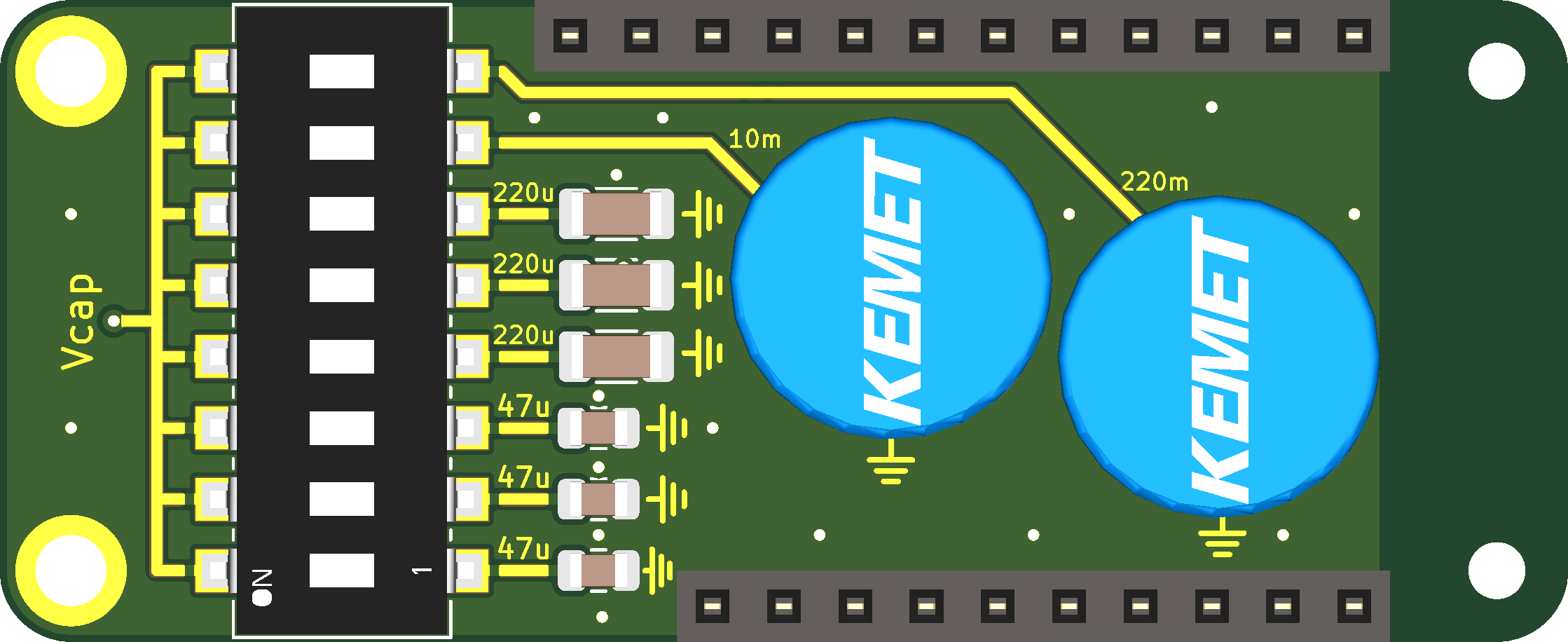
| Qty | Value | Footprint | References |
|---|---|---|---|
| 3 | 220u | Capacitor_SMD:C_1206_3216Metric | C4, C5, C6 |
| 3 | 47u | Capacitor_SMD:C_0805_2012Metric | C1, C2, C3 |
| 1 | 10m | riotee:KM_FG0H103ZF | C7 |
| 1 | 220m | riotee:KM_FG0H103ZF | C8 |
| 1 | Conn_01x10 | riotee:PinSocket_1x10_P2.54mm_Vertical | J2 |
| 1 | Conn_01x12 | riotee:PinSocket_1x12_P2.54mm_Vertical | J1 |
| 1 | SW_DIP_x08 | riotee:TE_1-1825058-9 | SW1 |
Ribbit-Network/ribbit-network-frog-hardware
The sensor for the world's largest crowdsourced network of open-source, low-cost, GHG Gas Detection Sensors.

NessieCircuits/Riotee_SensorShield
The Riotee Sensor Shield adds a microphone, an accelerometer and a temperature and humidty sensor to the Riotee Board.

google/mozc-devices
Circuit diagrams and firmware source code for Gboard DIY keyboards


FrameworkComputer/ExpansionCards
Reference designs and documentation to create Expansion Cards for the Framework Laptop

hoglet67/RGBtoHDMI
Bare-metal Raspberry Pi project that provides pixel-perfect sampling of Retro Computer RGB/YUV video and conversion to HDMI

hackclub/OnBoard
💡 Join 1,000 teenagers and make your first PCB with a $100 grant!

It measures 55.9 × 22.9 mm and has 2 copper layers, 1.6 mm thick.
11 parts, built around the GRM21BR61A476ME15K and PRT-11376. The full list of its parts is on this page, with links to each part's symbol and footprint where PCBKit's library has them.
From the NessieCircuits/Riotee_CapacitorShield repository on GitHub, at the commit this page was made from: the board is kicad/riotee-cap-shield.kicad_pcb and its schematic kicad/riotee-cap-shield.kicad_sch. PCBKit opens the board in the browser, with nothing to install.
Its repository publishes it under the CERN-OHL-W-2.0 licence: you may reuse it on that licence's terms (keep the author's notice, and for a copyleft licence share your changes alike).