4 layers48 × 31.4 mm
Pelletmon
Majr98/pelletmon
Monitor Estyma-compatibile boiler via CANbus with WiFi / IoT.
18 parts1GPL-3.0
 naveesh1/CAN-Cybersecurity-Project
Real-Time Embedded Cybersecurity and Anomalous Message Detection for In-Vehicle CAN Networks
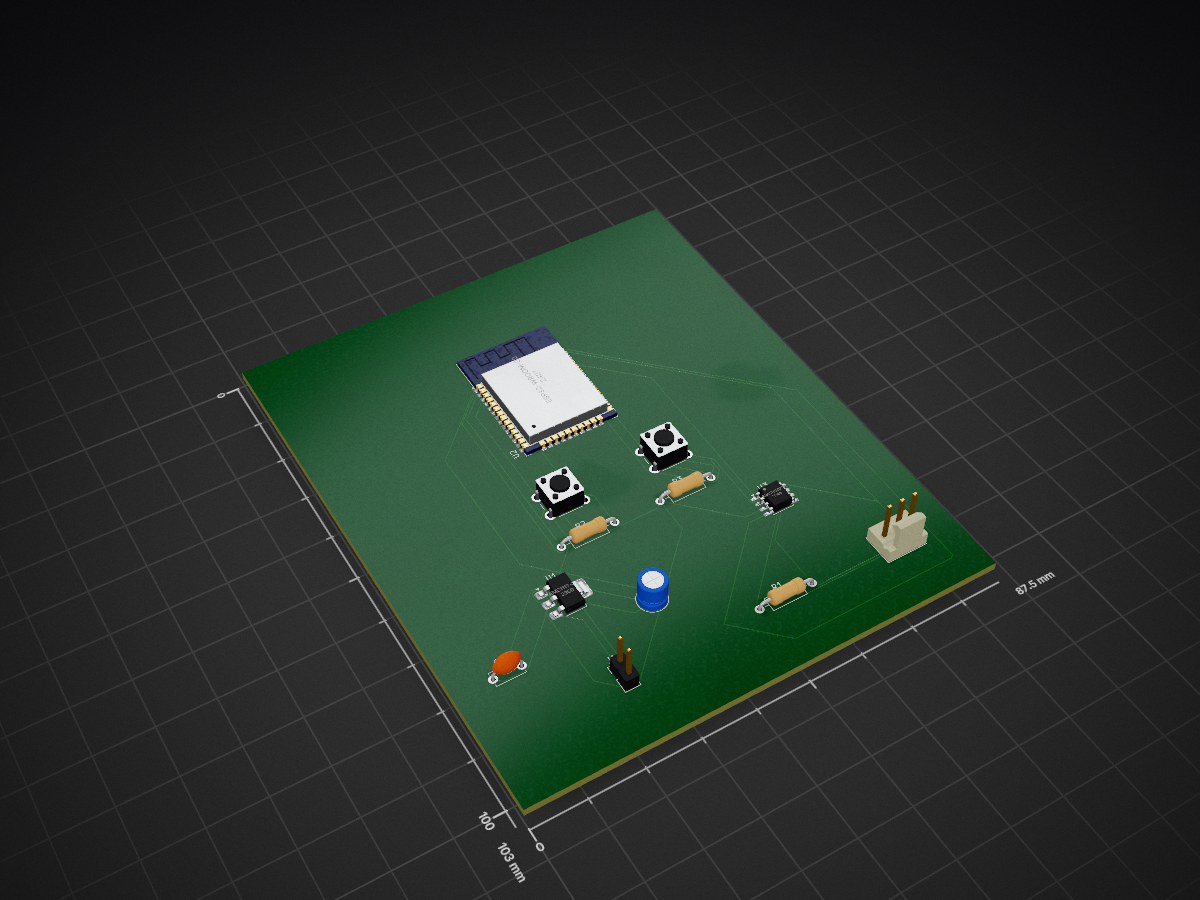
CAN Cybersecurity Hardware is an open-source printed circuit board by naveesh1, from the naveesh1/CAN-Cybersecurity-Project repository on GitHub. It is a 2-layer board of 87.5 × 103 mm with 12 parts on 40 nets, routed with 136 tracks and 0 vias.
It is built around the ESP32-WROOM-32, SN65HVD230D and AMS1117-3.3. Its parts include 3 resistors, 3 ICs, 2 capacitors, 2 connectors and 2 switches. It belongs with the ESP32 boards of this library.


# Real-Time Embedded Cybersecurity and Anomalous Message Detection for In-Vehicle CAN Networks
An embedded automotive cybersecurity prototype that combines CAN traffic simulation, real-time anomaly detection, security monitoring, and ESP32-based CAN hardware design.
---
## 🚗 Project Overview
Modern vehicles rely heavily on Controller Area Network (CAN) communication between electronic control units (ECUs).
Because traditional CAN communication does not inherently provide strong message authentication, abnormal or unauthorized messages can become a security concern.
This project demonstrates a prototype cybersecurity system that:
- Simulates multiple vehicle ECUs
- Generates normal CAN traffic
- Generates controlled anomalous/attack traffic
- Detects suspicious CAN messages
- Performs real-time CAN traffic monitoring
- Displays security alerts through a dashboard
- Designs an ESP32 + CAN transceiver hardware interface
- Produces a PCB design and manufacturing files
**Current status:** Software prototype and PCB hardware design completed. Physical CAN hardware validation is planned as a future extension.
---
## 🎯 Project Objectives
1. Simulate CAN communication between multiple virtual ECUs.
2. Generate both normal and controlled anomalous CAN traffic.
3. Detect suspicious CAN messages using rule-based anomaly detection.
4. Monitor CAN traffic in real time.
5. Visualize security status through a dashboard.
6. Design an ESP32-based CAN hardware interface.
7. Verify the PCB using DRC and Gerber inspection.
---
## 🏗️ System Architecture
  SOFTWARE PROTOTYPE
  Virtual ECUs
  │
  ▼
  CAN Message Generator
  │
  ▼
  Virtual CAN Bus
  │
  ▼
  CAN Traffic Logger
| Qty | Value | Footprint | References |
|---|---|---|---|
| 2 | SW_Push | Button_Switch_THT:SW_PUSH_6mm | SW1, SW2 |
| 1 | 100nF | Capacitor_THT:C_Disc_D5.0mm_W2.5mm_P5.00mm | C1 |
| 1 | 10k | Resistor_THT:R_Axial_DIN0207_L6.3mm_D2.5mm_P10.16mm_Horizontal | R2 |
| 1 | 10kΩ | Resistor_THT:R_Axial_DIN0207_L6.3mm_D2.5mm_P10.16mm_Horizontal | R3 |
| 1 | 10uF | Capacitor_THT:C_Radial_D5.0mm_H5.0mm_P2.00mm | C2 |
| 1 | 120R | Resistor_THT:R_Axial_DIN0207_L6.3mm_D2.5mm_P10.16mm_Horizontal | R1 |
| 1 | AMS1117-3.3 | Package_TO_SOT_SMD:SOT-223-3_TabPin2 | U1 |
| 1 | CAN_BUS | Connector:FanPinHeader_1x03_P2.54mm_Vertical | J2 |
| 1 | ESP32-WROOM-32 | RF_Module:ESP32-WROOM-32 | U2 |
| 1 | POWER_IN | Connector_PinHeader_2.54mm:PinHeader_1x02_P2.54mm_Vertical | J1 |
| 1 | SN65HVD230 | Package_SO:SOIC-8_3.9x4.9mm_P1.27mm | U3 |
Majr98/pelletmon
Monitor Estyma-compatibile boiler via CANbus with WiFi / IoT.

nsm81/VehiclePrecharge_PCB
The precharge board contains the precharge resistors, precharge relay, main relay drivers (with economisers), and a controlling micro.


vyrubaev/TV-Lift-Controller
TVLift Controller is an intelligent controller for TV lift and lower mechanisms, based on the ESP32 microcontroller.

nsm81/VehicleJunctionBox_PCBs
The junction box is an intermediate stage between the accumulator and inverter. It contains an HVD, a current sensor, discharge circuitry, TSAL and TSMPs.

nsm81/VehicleVCU_PCB
A Vehicle Control Unit provides multiple CANBUS transceivers for communication within a vehicle.

ampnics/CAN-to-WiFi-Converter-Dongle-
CAN to WiFi Converter PCB using ESP32! This step-by-step tutorial covers schematic creation, PCB layout, and best practices for signal integrity. Perfect for automotive and IoT applications!

blinken/vandal
An ESP32-based lighting control system for campervans (or anything else)
It measures 87.5 × 103 mm and has 2 copper layers, 1.6 mm thick.
12 parts, built around the ESP32-WROOM-32, SN65HVD230D and AMS1117-3.3. The full list of its parts is on this page, with links to each part's symbol and footprint where PCBKit's library has them.
From the naveesh1/CAN-Cybersecurity-Project repository on GitHub, at the commit this page was made from: the board is CAN-Cybersecurity-Hardware/CAN-Cybersecurity-Hardware.kicad_pcb and its schematic CAN-Cybersecurity-Hardware/CAN-Cybersecurity-Hardware.kicad_sch. PCBKit opens the board in the browser, with nothing to install.
Its repository states no licence, so its author keeps all rights: ask naveesh1 before reusing the design.