2 layers40 × 30 mm
Route10
n3rd-bugs/kiwrap
AI-agent-facing wrapper over KiCad (VS Code extension + MCP server + Connect plugin) — design phase
6 parts
 n3rd-bugs/kiwrap
AI-agent-facing wrapper over KiCad (VS Code extension + MCP server + Connect plugin) — design phase
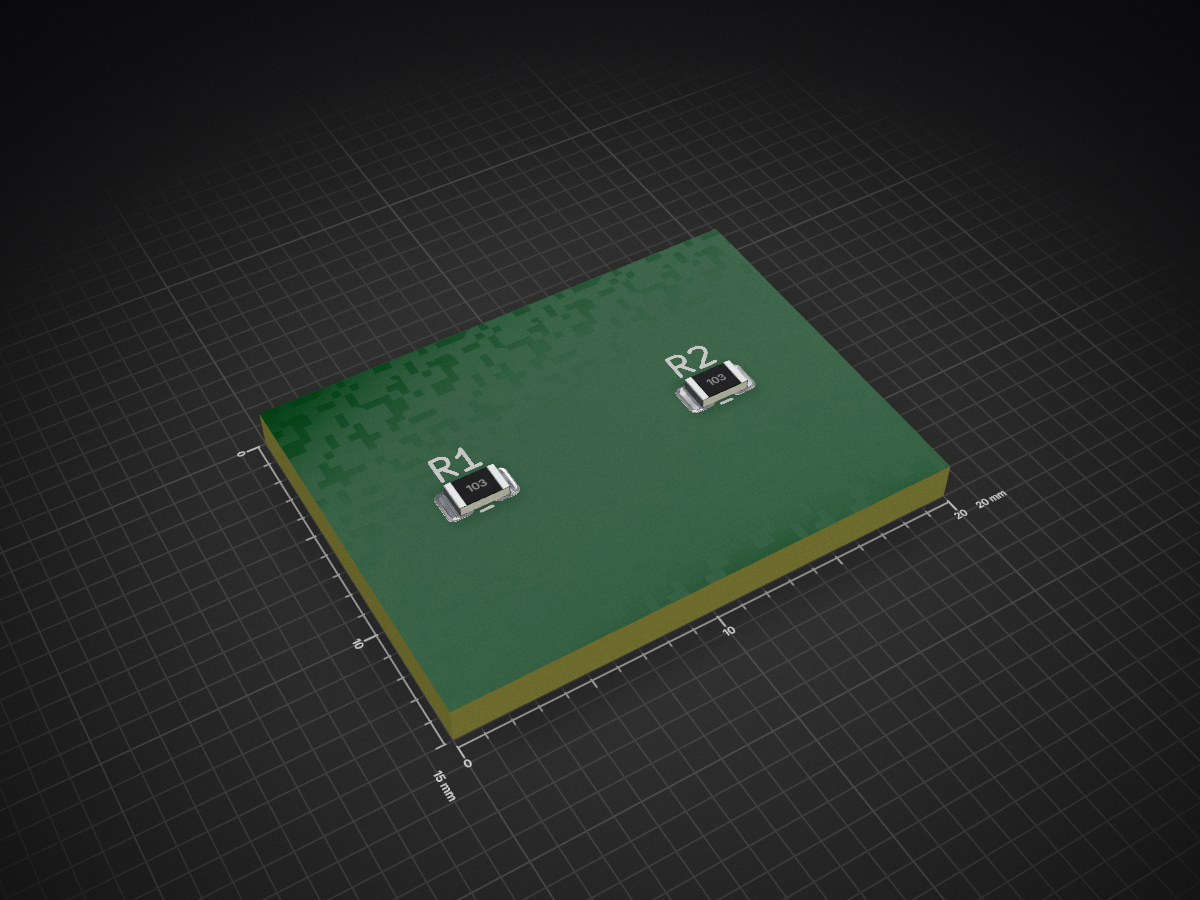
Tiny is an open-source printed circuit board by n3rd-bugs, from the n3rd-bugs/kiwrap repository on GitHub. It is a 2-layer board of 20 × 15 mm with 2 parts on 2 nets.
Status: Phase 1c implemented — 2026-09-20. KiCad 11 (nightly) is the primary target
(decision D16): a headless IPC backend on kicad-cli api-server gives structured, data-first
feedback (D17) — board/schematic items, nets, connectivity, ratsnest — and authors schematics
and boards (symbols, wires, labels, power, hierarchical sheets, annotation, footprint
assignment, board setup, netlist sync, placement, zones, routing primitives) with file-tier
and kicad-cli fallbacks on KiCad 10.0.x, 9 and 8. Phase 1c adds autorouting
(kw_pcb_route_auto / kw_pcb_fix: Freerouting 2.4.1 under a managed JRE 25 over a Specctra
DSN/SES round trip — kiwrap's own codec certified against KiCad's exporter/importer, the
patched kicad-cli pcb export specctra / pcb import-ses on the fork build, mandatory refill +
kicad-cli DRC as the judge), the JLCPCB fabrication profile (kw_fab_export(profile= "jlcpcb"), kw_fab_bom, kw_pcb_setup(preset=…)), intent (kw_intent, diffed by
kw_sch_check) and the D5 reference board eval. An agent conversation over MCP stdio
builds a two-sheet LDO + 555 blinker from nothing to gerbers — hand-routed and autorouted — with
ERC 0 / parity 0 / DRC 0 on the 10.99 nightly (ipc11) and 10.0.6 (file)
(tests/test_e2e_authoring.py), and the ESP32-S3 reference board (29 parts, 3 sheets, 2 layers)
from kw_intent to a JLCPCB bundle with the grader green — ERC 0, intent diff empty, unrouted
0, must_fix 0 — on both (tests/test_e2e_reference_board.py; numbers below). A source-build
bench of the fork carries the CLI/IPC additions listed in docs/UPSTREAM.md.
Phase 2 (integrated and verified end to end, 2026-09-20): the VS Code extension. extension/
(TypeScript, MIT, a private .vsix built by scripts/build_extension.ps1 into dist/) is an MCP
client of its own kiwrap serve; it shows Live KiCad — the real, sandboxed stock KiCad editors
(10.0.x / 10.99) streamed live into the .kicad_pcb / .kicad_sch tabs by the Rust helper
helper/kiwrap-live.exe (Windows.Graphics.Capture, loopback + token). The user sees the agent's
edits live; to edit by hand they raise KiCad (the tab's Raise KiCad button, a double-click) and
work in the real window — decision D20: the live view with native interaction is the product, the
cloaked/injecting modes measured in DISPLAY.md stay parked as experiments. Plus ERC/DRC in the
Problems panel, a KiCad picker and a one-command Claude Code setup. The server side is the
kw_live tool (a sandboxed GUI session whose API socket the ipc11 provider binds to) and the
two-server model: the agent's own kiwrap serve finds the extension's session through its record
and writes into the same window — measured in extension/test/e2e (12/12 in a real dev host): an
agent's kw_pcb_place over a second MCP client repainted the live tab 431-474 ms after the call
started (kw_pcb_place 870-979 ms via ipc11), Raise KiCad put the real pcbnew / eeschema in the
foreground within ~0.9 s (GetForegroundWindow), on 10.99 and on 10.0.6. Details and the numbers:
docs/EXTENSION.md (§9.1, §9.2), user guide
extension/README.md, the measured display investigation
docs/DISPLAY.md, screenshots docs/research/display/img/phase2-*.png.
kiwrap lets an AI agent (Claude Code inside VS Code; Windows only — decision D18) do end-to-end electronics development on KiCad — spec → schematic → ERC → board → placement → routing → DRC → fabrication files — as a wrapper over installed KiCad binaries so KiCad can be upgraded underneath (7 → 8 → 9 → 10 → 11).
git clone git@github.com:n3rd-bugs/kiwrap.git; cd kiwrap
.\scripts\bootstrap.ps1          # uv, deps, private JRE 25 + Freerouting into %LOCALAPPDATA%\kiwrap (Linux: scripts/bootstrap.sh)
uv run kiwrap env                # discovered KiCad installs + capability records
uv run pytest -q                 # ~5 min with four KiCads installed; ~1 min without KiCad
uv run kiwrap serve              # MCP server over stdio (Claude Code picks it up from .mcp.json)
.\scripts\build_extension.ps1     # VS Code extension + helper -> dist\kiwrap-<ver>.vsix (needs Node 24 + Rust stable-msvc)
code --install-extension .\dist\kiwrap-0.1.0.vsix   # then "kiwrap: Select KiCad", "kiwrap: Configure Claude Code"
Tools (34): kw_env, kw_project (create / status / retarget / upgrade_preview),
kw_project_upgrade (the only conversion of a project to a newer KiCad file format; Claude Code
asks the user on every call), kw_snapshot, kw_job, kw_help,
kw_live (launch / attach / status / screenshot / detach / raise a sandboxed GUI KiCad the
extension displays and the ipc11 provider writes into),
kw_intent (declare nets / rails / interfaces; diffed against KiCad's netlist by kw_sch_check),
kw_lib_search / kw_lib_info (FTS index over the sym-/fp-lib-tables), the schematic authoring
tools kw_sch_add_symbol (absolute pin endpoints back), kw_sch_connect, kw_sch_add_item
(power, PWR_FLAG, labels, sheets), kw_sch_edit, kw_sch_annotate, kw_sch_assign_footprints,
the reads kw_sch_get (symbols with pin nets, wires, labels, hierarchy, netlist), kw_sch_stats,
kw_sch_check (ERC + netlist), kw_sch_diff (KiCad 11), the board authoring tools
kw_pcb_setup, kw_pcb_sync (KiCad's netlist, parity-checked), kw_pcb_place, kw_pcb_zones,
kw_pcb_route (track / via primitives with per-net DRC deltas), kw_pcb_route_auto
(Freerouting over DSN/SES, a background job with pass / unrouted progress), kw_pcb_fix (rip up
the nets of must_fix violations and re-route them until DRC is clean), the reads kw_pcb_get
(footprints, pads, tracks, vias, zones, nets, connectivity), kw_pcb_check (courtyard overlaps,
off-board, unrouted / ratsnest), kw_pcb_drc, kw_fab_bom, kw_fab_export (generic or the
JLCPCB profile: Protel gerbers, PTH/NPTH drills, corrected CPL, BOM, zip), and the secondary
renders kw_sch_render / kw_pcb_render. Every tool names its provider (ipc11, file,
cli, codec, cli:<v>+<patch>) and any degradation. The agent-facing protocol is in
AGENTS.md and the skill in
.claude/skills/kiwrap-flow/SKILL.md.
File formats and consent (D21, D24). A project runs on the installed KiCad that writes its
files' own format. A write that would move the files to a newer format stops with
E_FORMAT_UPGRADE_REQUIRED, whose data.upgrade_args are the arguments of
kw_project_upgrade(project, from_kicad, to_kicad, files). That tool is published with
_meta["anthropic/requiresUserInteraction"]: true, so Claude Code (2.1.199 and later) shows the
user a permission card for every call, whatever the allow rules or permission mode (a headless
session denies it); the VS Code extension's modal calls the same tool. The receipt records which gate and client approved the
call, and its snapshot_before undoes the conversion. scripts/e2e_consent.py is the manual
end-to-end checklist for that card (docs/VERIFICATION.md claim 13).
Recorded by tests/test_e2e_reference_board.py and tests/test_e2e_authoring.py (each run
writes <project>/.kiwrap/e2e-out.json and e2e-log.json with provider_used per call):
| flow | KiCad | writes | DSN/SES | router | result |
|---|---|---|---|---|---|
| ESP32-S3 reference board, 29 parts / 52 nets | 10.99.0-4083 | ipc11 (+ file for sheets, no-connects, footprints, setup) | codec | Freerouting 2.4.1, run-dependent: 4 passes, 21.7 s, 221 tracks + 34 vias, 70 -> 0 unrouted (full-suite run); or 18 passes, 12.3 s, 231 + 38, 70 -> 1 (score plateau) and kw_pcb_fix 2 rounds (the net alone stalls, the 2 mm neighbourhood closes it) -> 0 | ERC 0, intent diff 0 (strict), parity 0, DRC 0 must_fix / 0 unconnected after refill, grade passed, 18 JLCPCB files, 202-206 tool calls, 4.5-5.4 min |
| ESP32-S3 reference board | 10.0.6 | file | codec | 4 passes, 39.8 s, 217 tracks + 28 vias, 70 -> 0 (full-suite run); or 18 passes, 12.3 s, 204 + 38, 70 -> 1 and kw_pcb_fix 1 round -> 0 | ERC 0, intent diff 0, parity 0, DRC 0/0, grade passed, 18 files, 202 tool calls, 2.1 min |
| blinker, 11 parts / 8 nets, autorouted | 10.99.0-4083 | ipc11 | codec | 2 passes, 3.2 s, 37-38 tracks + 5-6 vias, 21 -> 0 unrouted, no fix needed | DRC 0 must_fix / 0 unconnected (1 review: the nightly's own lib_footprint_mismatch on import), gerbers + drill + pos, 2.8 min |
| blinker, autorouted | 10.0.6 | file | codec | 2 passes, 3.2 s, 36-37 tracks + 5-6 vias, 21 -> 0 unrouted, no fix needed | DRC 0/0, gerbers + drill + pos, 56 s |
ecc83 demo stripped to 0 copper (2 and 4 layers), tests/test_route_auto_providers_live.py | bench 10.99.0+acdc6a3061 | file | cli:10.99.0+specctra-jobs (patched kicad-cli); the codec's DSN == the CLI's | 0 unrouted | DRC 0/0 on both, kw_pcb_fix closes two stripped nets through the same chain |
Unrouted is always KiCad's unconnected_items count after pcb drc --refill-zones --save-board,
never Freerouting's own score. Pour order matters for the router: the B.Cu GND plane before
routing, the F.Cu pour after (docs/ARCHITECTURE.md §8).
src/kiwrap/            single MIT distribution (src layout)
  platform/            Windows/Linux seam — the only place that inspects sys.platform
  installation.py      KiCadInstallation + discover()/find()   (registry, Program Files, PATH; Linux: apt/Flatpak/Snap/AppImage)
  capability.py        capability record per FULL semver, seeded from data/kicad_version_matrix.json + --help probes
  sandbox.py           sandboxed KICAD_CONFIG_HOME roots; the user's own KiCad config is read-only (tests assert its hash)
  formats/             zero-dependency: lossless CST, board/schematic models, geometry + analyses (overlaps, connectivity, ratsnest), parsers
  backends/cli/        kicad-cli adapters with the verified quirks (ERC JSON ×100, exit codes, .kicad_prl, out dirs, …) + structured exports
  backends/ipc/        KiCad 11 headless IPC sessions (kicad-python), mm-unit readers, connectivity queries, writes, T5 probe
  core/                MCP server, kw_* tools, receipts/teaching errors, stage machine + gates, locks, snapshots, jobs
conformance/           T1 CST round-trip, T2 file models vs KiCad, T4 kicad-cli help drift, T5 IPC handler snapshot, T6 quirks, T7 IPC writes + Specctra codec vs KiCad's DSN/SES, T8 writers vs KiCad + corpus
tests/                 unit + live tests (auto-skip without KiCad)
extension/             the VS Code extension (TypeScript, MIT): MCP client of `kiwrap serve`, Live KiCad tabs, Problems panel, Configure Claude Code
helper/                Rust workspace (MIT): kiwrap-live.exe, the Windows.Graphics.Capture + input helper the extension bundles
scripts/ bootstrap.ps1 / bootstrap.sh, build_extension.ps1 (-> dist/*.vsix), engines.json (pinned JRE/Freerouting), seed_config_root.py, ci/, dev/One Python MCP server (kiwrap-core, kw_* tools) is the only agent contract; a thin
TypeScript VS Code extension is a client of it (its own instance; the agent runs another, both
sharing the storage home and the per-project lock), shows the sandboxed KiCad GUI that kw_live
launched inside VS Code tabs through a Rust capture helper, and feeds ERC/DRC into the Problems
panel; the KiWrap Connect KiCad plugin of the Phase-0 plan is not needed while kw_live owns
the GUI it displays. On KiCad 11 the primary backend is the headless IPC API (kicad-cli api-server, driven through kicad-python): structured reads of every board and schematic item,
connectivity, netlist and hierarchy, and writes as undoable commits. Underneath sits an in-house
lossless s-expression engine that models boards and schematics on every version 7–11 (pin
endpoints, courtyards, zone fills, connectivity, a ratsnest estimate verified against KiCad's own
DRC) and is the only schematic path on ≤ 10. ERC/DRC/exports come exclusively from kicad-cli —
KiCad is the judge. Routing will be Freerouting 2.4.1 over DSN/SES (managed JRE 25). Every tool
answers in millimetres with its provider (ipc11, file, cli) and any degradation named; stage
gates (ERC → sync → place → route → DRC → fab) are server-enforced. Where KiCad exposes no
structured surface (ratsnest export, DRC/ERC over the API, headless jobs) the private fork
n3rd-bugs/kicad-fork carries the additions until they are merged upstream.
Windows 11; KiCad 7.0.6, 8.0.9, 9.0.9, 10.0.6 and the 10.99 nightly (10.99.0-4083, KiCad 11
preview) side by side under C:\Program Files\KiCad, plus the registered source builds under
C:\kiwrap-builds; Python 3.11 + uv; Node 24 LTS and Rust 1.95 stable-msvc (the extension build);
VS Code 1.138; Java 17 on PATH (Freerouting 2.4.1 needs 25 → managed JRE); VS 2022 17.14 (MSVC
14.44) + vcpkg for the KiCad source bench; cdb from the Windows 10 SDK. Linux code paths exist behind the platform seam
but are out of scope (D18).
| Qty | Value | Footprint | References |
|---|---|---|---|
| 2 | 10k | R_0805_2012Metric | R1, R2 |
It measures 20 × 15 mm and has 2 copper layers, 1.6 mm thick.
2 parts. The full list of its parts is on this page, with links to each part's symbol and footprint where PCBKit's library has them.
From the n3rd-bugs/kiwrap repository on GitHub, at the commit this page was made from: the board is conformance/corpus/8.0/tiny_routed/tiny.kicad_pcb. PCBKit opens the board in the browser, with nothing to install.
Its repository states no licence, so its author keeps all rights: ask n3rd-bugs before reusing the design.
n3rd-bugs/kiwrap
AI-agent-facing wrapper over KiCad (VS Code extension + MCP server + Connect plugin) — design phase

n3rd-bugs/kiwrap
AI-agent-facing wrapper over KiCad (VS Code extension + MCP server + Connect plugin) — design phase

n3rd-bugs/kiwrap
AI-agent-facing wrapper over KiCad (VS Code extension + MCP server + Connect plugin) — design phase

n3rd-bugs/kiwrap
AI-agent-facing wrapper over KiCad (VS Code extension + MCP server + Connect plugin) — design phase

n3rd-bugs/kiwrap
AI-agent-facing wrapper over KiCad (VS Code extension + MCP server + Connect plugin) — design phase

n3rd-bugs/kiwrap
AI-agent-facing wrapper over KiCad (VS Code extension + MCP server + Connect plugin) — design phase

n3rd-bugs/kiwrap
AI-agent-facing wrapper over KiCad (VS Code extension + MCP server + Connect plugin) — design phase

n3rd-bugs/kiwrap
AI-agent-facing wrapper over KiCad (VS Code extension + MCP server + Connect plugin) — design phase

n3rd-bugs/kiwrap
AI-agent-facing wrapper over KiCad (VS Code extension + MCP server + Connect plugin) — design phase

n3rd-bugs/kiwrap
AI-agent-facing wrapper over KiCad (VS Code extension + MCP server + Connect plugin) — design phase

n3rd-bugs/kiwrap
AI-agent-facing wrapper over KiCad (VS Code extension + MCP server + Connect plugin) — design phase

n3rd-bugs/kiwrap
AI-agent-facing wrapper over KiCad (VS Code extension + MCP server + Connect plugin) — design phase

hzeller/rpi-rgb-led-matrix
Controlling up to three chains of 64x64, 32x32, 16x32 or similar RGB LED displays using Raspberry Pi GPIO


adamws/kicad-kbplacer
KiCad plugin for automatic keyboard's key placement and routing

Luos-io/luos_engine
Open-source and real-time orchestrator for cyber-physical-systems, to easily design, test and deploy embedded applications and digital twins.

NVNTLabs/switch2-SDEX2M2
Micro SD Express to M.2 NVME Adapter for Nintendo Switch 2

BlueSCSI/BlueSCSI-v2
BlueSCSI v2/Ultra - an open source, open hardware, SCSI emulator using the Pi Pico PR2040 and Pico 2 RP2350

ohmtech-rdi/eurorack-blocks
Software to Hardware Prototyping for Eurorack using C++, Max/Gen~ or Faust
