4 layers24.5 × 14 mm
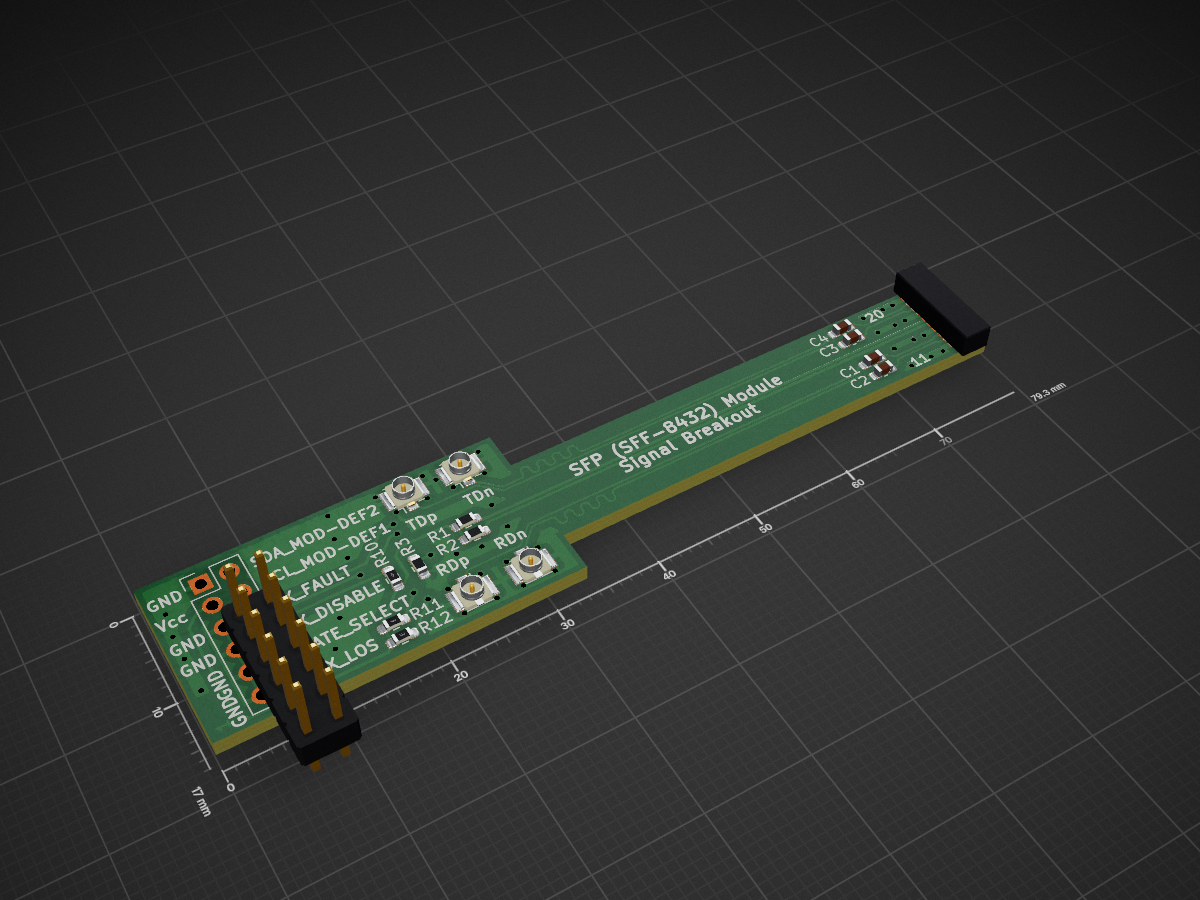
 mwrnd/SFP_Plug_Breakout20
Pluggable SFP Module Breakout
SFP Plug Breakout is an open-source printed circuit board by mwrnd, from the mwrnd/SFP_Plug_Breakout repository on GitHub, published under the BSD-2-Clause licence. It is a 4-layer board of 79.3 × 17 mm with 16 parts on 18 nets, routed with 331 tracks and 47 vias.
Its parts include 6 resistors, 6 connectors and 4 capacitors. It belongs with the interfaces and adapters boards of this library.
Work-in-Progress - First Revision gerbers being tested.
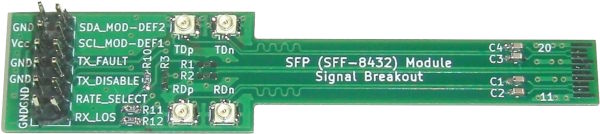
Pluggable SFP (SFF INF-8074i) and SFP+ (SFF-8432) Module Breakout for developing SFP modules. PCB must be manufactured with a 1.0mm thickness.
Similar Projects: SFP-Breakout-Board, SFP_BreakoutBoard, SFP-Loopback-Board, and Sfp-breakout(osmocom.org).
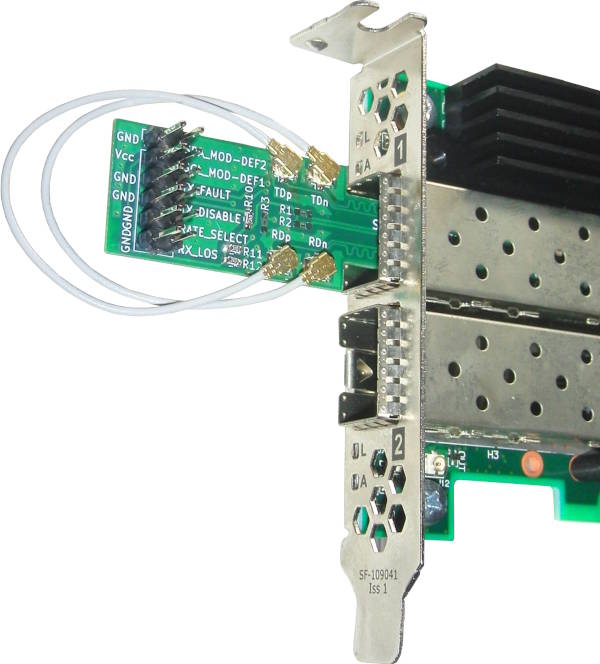
One trivial use is an SFP Loopback:
Differential pair parameters were calculated based on a board thickness of 1.0mm.
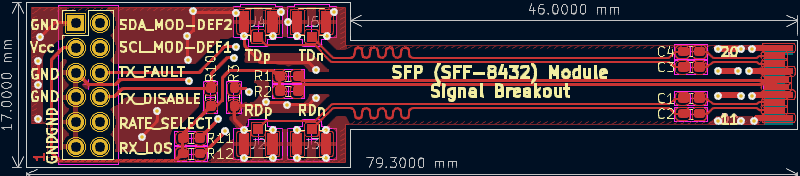
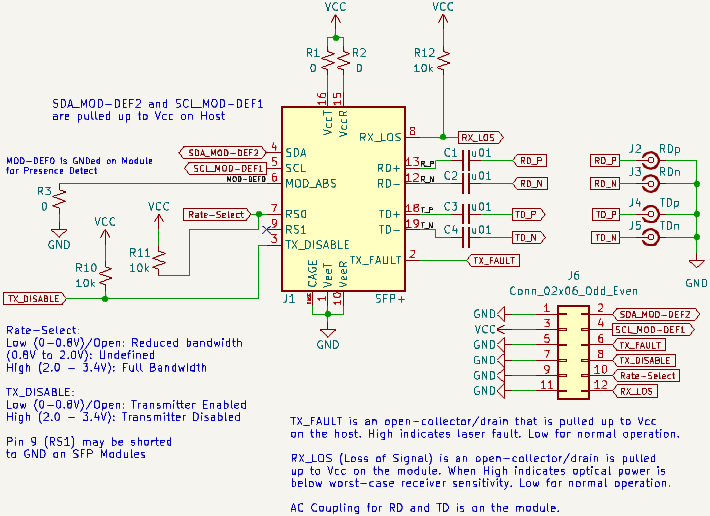
The 0.1" Header is designed to accept jumpers for the TX_FAULT, RX_LOS, TX_DISABLE, and optionally Rate-Select signals.
TX_FAULT, RX_LOS, and TX_DISABLE jumpers need to be mounted for normal operation. These signals are pulled up to Vcc with 10k resistors but are Active-Low.
I have been testing with general purpose capacitors for the RX and TX DC-Blocking capacitors (C1, C2, C3, C4) but at <10Gbps bitrates. Capacitors will need to be sized smaller, 0402 or even 0201, and more effort would need to go into their selection for high bitrates. Look for capacitors designed for high-frequency.
| Designator(s) | Part Number | Quantity | Value | Footprint | Availability |
|---|---|---|---|---|---|
| C1, C2, C3, C4 | GRM1885C1H103JA01D | 4 | 0.01uF | Capacitor_SMD:C_0603_1608Metric | DigiKey |
| R1, R2, R3 | RMCF0603ZT0R00 | 3 | 0-Ohm | Resistor_SMD:R_0603_1608Metric | DigiKey |
| R10, R11, R12 | RNCF0603DTE10K0 | 3 | 10k-Ohm | Resistor_SMD:R_0603_1608Metric | DigiKey |
| J6 | PH2-12-UA | 1 | N/A | Conn_02x06 | DigiKey |
| J2, J3, J4, J5 | CONUFL001-SMD-T | 4 | N/A | U.FL_w_Label:U.FL_Hirose_w_Label | DigiKey |
| None | QPC02SXGN-RC | 4 | N/A | 1x2 0.1" Jumper | DigiKey |
| U.FL-to-U.FL | 2015698-2 | 2 | N/A | None - Optional Part for Testing | DigiKey |
| Qty | Value | Footprint | References |
|---|---|---|---|
| 4 | u01 | Capacitor_SMD:C_0603_1608Metric_Pad1.08x0.95mm_HandSolder | C1, C2, C3, C4 |
| 3 | 0 | Resistor_SMD:R_0603_1608Metric_Pad0.98x0.95mm_HandSolder | R1, R2, R3 |
| 3 | 10k | Resistor_SMD:R_0603_1608Metric_Pad0.98x0.95mm_HandSolder | R10, R11, R12 |
| 1 | Conn_02x06_Odd_Even | Connector_PinHeader_2.54mm:PinHeader_2x06_P2.54mm_Vertical | J6 |
| 1 | RDn | U.FL_w_Label:U.FL_Hirose_w_Label | J3 |
| 1 | RDp | U.FL_w_Label:U.FL_Hirose_w_Label | J2 |
| 1 | SFP+ | SFP_Plug:SFP_Plug | J1 |
| 1 | TDn | U.FL_w_Label:U.FL_Hirose_w_Label | J5 |
| 1 | TDp | U.FL_w_Label:U.FL_Hirose_w_Label | J4 |


mackieks/melonHD
Lontium LT6711A HDMI to USB-C DP Alt Mode Converter Module for portablizers


It measures 79.3 × 17 mm and has 4 copper layers, 1.61 mm thick.
16 parts. The full list of its parts is on this page, with links to each part's symbol and footprint where PCBKit's library has them.
From the mwrnd/SFP_Plug_Breakout repository on GitHub, at the commit this page was made from: the board is SFP_Plug_Breakout.kicad_pcb and its schematic SFP_Plug_Breakout.kicad_sch. PCBKit opens the board in the browser, with nothing to install.
Its repository publishes it under the BSD-2-Clause licence: you may reuse it on that licence's terms (keep the author's notice, and for a copyleft licence share your changes alike).