2 layers151 × 118 mm

 mrKuzmich/DigiLightM_pcb1
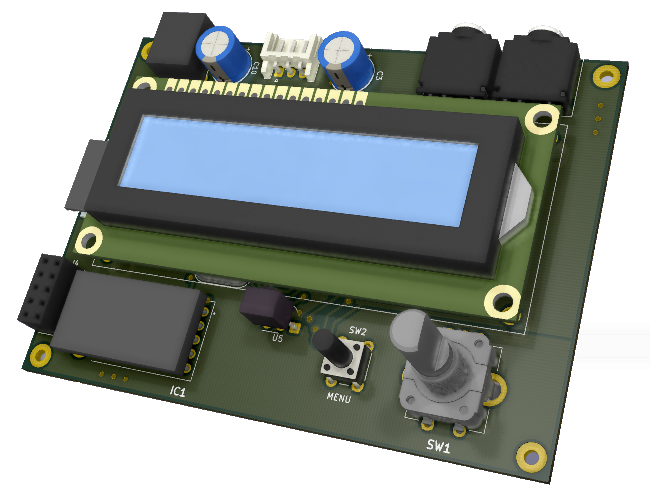
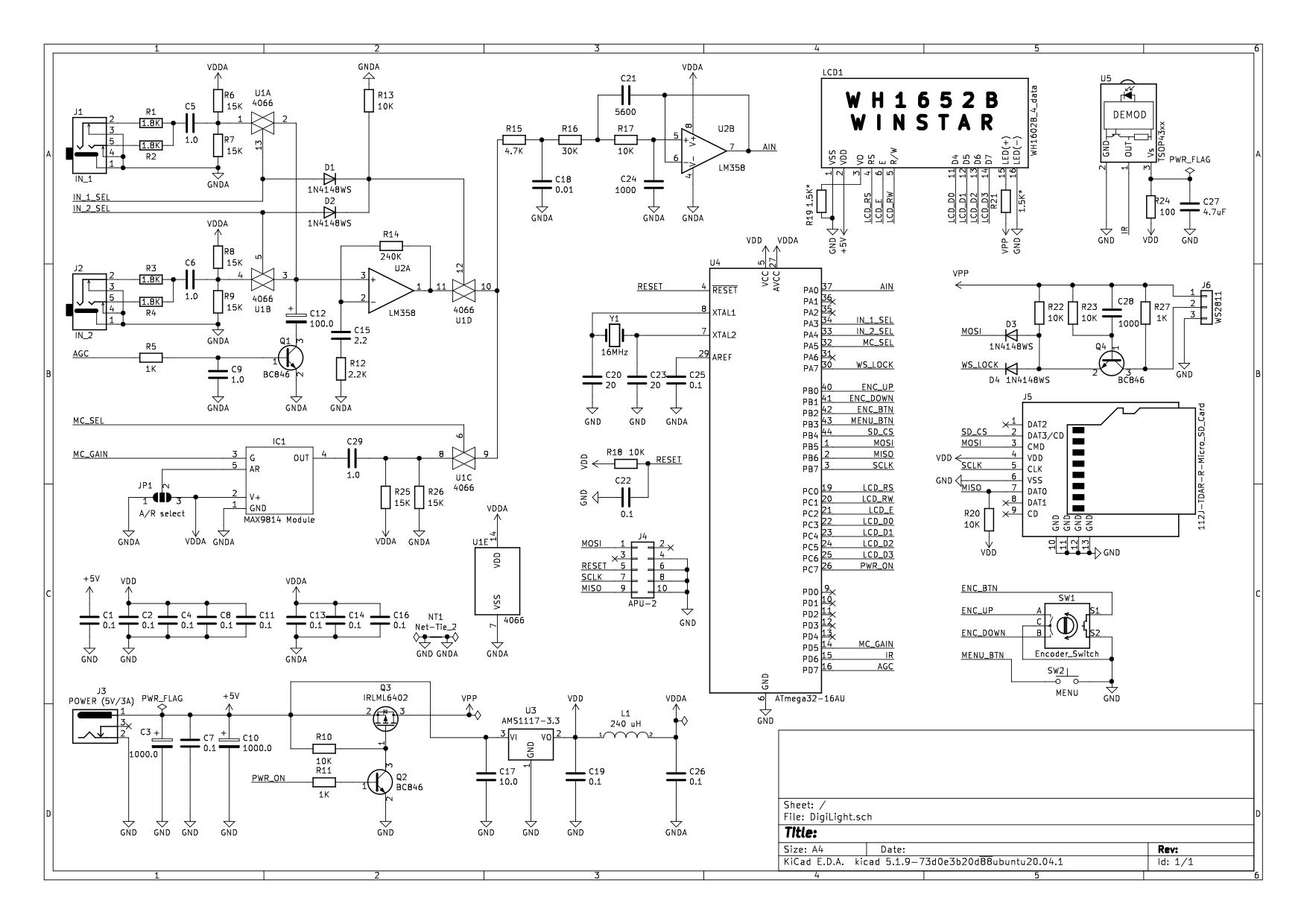
Digital light organ DigiLight-M. Schematic and PCB.
DigiLight is an open-source printed circuit board by mrKuzmich, from the mrKuzmich/DigiLightM_pcb repository on GitHub. It is a 2-layer board of 95 × 70 mm with 88 parts on 78 nets, routed with 726 tracks and 69 vias.
It is built around the ATMEGA32-16AU, LM358 and WS2811, with the AMS1117-3.3, 1N4148WS and BC846 among its other parts. Its parts include 29 capacitors, 27 resistors, 6 ICs, 6 connectors and 4 diodes. It belongs with the AVR (ATmega, ATtiny) boards of this library.


DigiLight-M is a project of digital light organ with automat of light effects. This project based on DigiLight project of user AVR.
This part of the project contains the schematic of the device itself and PCB. The source codes of the ATMega32 microcontroller firmware in the C language you can see in another part of the project DigiLightM_firmware.
DigiLightM_firmware repository.
| Qty | Value | Footprint | References |
|---|---|---|---|
| 13 | 0.1 | Capacitor_SMD:C_1206_3216Metric | C1, C2, C4, C7, C8, C11, C13, C14, C16, C19, C22, C25, C26 |
| 7 | 10K | Resistor_SMD:R_1206_3216Metric | R10, R13, R17, R18, R20, R22, R23 |
| 6 | 15K | Resistor_SMD:R_1206_3216Metric | R6, R7, R8, R9, R25, R26 |
| 4 | 1.0 | Capacitor_SMD:C_1206_3216Metric | C5, C6, C9, C29 |
| 4 | 1.8K | Resistor_SMD:R_1206_3216Metric | R1, R2, R3, R4 |
| 4 | 1N4148WS | Diode_SMD:D_SOD-323 | D1, D2, D3, D4 |
| 3 | 1K | Resistor_SMD:R_1206_3216Metric | R5, R11, R27 |
| 3 | BC846 | Package_TO_SOT_SMD:SOT-23 | Q1, Q2, Q4 |
| 2 | 1.5K* | Resistor_SMD:R_1206_3216Metric | R19, R21 |
| 2 | 1000 | Capacitor_SMD:C_1206_3216Metric | C24, C28 |
| 2 | 1000.0 | Capacitor_THT:CP_Radial_D8.0mm_P5.00mm | C3, C10 |
| 2 | 20 | Capacitor_SMD:C_1206_3216Metric | C20, C23 |
| 1 | 0.01 | Capacitor_SMD:C_1206_3216Metric | C18 |
| 1 | 10.0 | Capacitor_SMD:C_1206_3216Metric | C17 |
| 1 | 100 | Resistor_SMD:R_1206_3216Metric | R24 |
| 1 | 100.0 | Capacitor_Tantalum_SMD:CP_EIA-3528-21_Kemet-B_Pad1.50x2.35mm_HandSolder | C12 |
| 1 | 112J-TDAR-R-Micro_SD_Card | ExternalLib:112JTDARR | J5 |
| 1 | 16MHz | Crystal:Crystal_HC49-4H_Vertical | Y1 |
| 1 | 2.2 | Capacitor_SMD:C_1206_3216Metric | C15 |
| 1 | 2.2K | Resistor_SMD:R_1206_3216Metric | R12 |
| 1 | 240 uH | Inductor_SMD:L_1210_3225Metric | L1 |
| 1 | 240K | Resistor_SMD:R_1206_3216Metric | R14 |
| 1 | 30K | Resistor_SMD:R_1206_3216Metric | R16 |
| 1 | 4.7K | Resistor_SMD:R_1206_3216Metric | R15 |
| 1 | 4.7uF | Capacitor_SMD:C_1206_3216Metric | C27 |
| 1 | 4066 | Package_SO:SOIC-14_3.9x8.7mm_P1.27mm | U1 |
| 1 | 5600 | Capacitor_SMD:C_1206_3216Metric | C21 |
| 1 | A/R select | Jumper:SolderJumper-3_P1.3mm_Open_RoundedPad1.0x1.5mm | JP1 |
| 1 | AMS1117-3.3 | Package_TO_SOT_SMD:SOT-223-3_TabPin2 | U3 |
| 1 | APU-2 | Connector_PinSocket_2.54mm:PinSocket_2x05_P2.54mm_Vertical | J4 |
| 1 | ATmega32-16AU | Package_QFP:TQFP-44_10x10mm_P0.8mm | U4 |
| 1 | Encoder_Switch | ExternalLib:PEC11R4220FS0024 | SW1 |
| 1 | IN_1 | ExternalLib:PJ-307 | J1 |
| 1 | IN_2 | ExternalLib:PJ-307 | J2 |
| 1 | IRLML6402 | Package_TO_SOT_SMD:SOT-23 | Q3 |
| 1 | LM358 | Package_SO:SOIC-8_3.9x4.9mm_P1.27mm | U2 |
| 1 | MAX9814 Module | ExternalLib:1713 | IC1 |
| 1 | MENU | Button_Switch_THT:SW_PUSH_6mm_H13mm | SW2 |
| 1 | Net-Tie_2 | NetTie:NetTie-2_SMD_Pad2.0mm | NT1 |
| 1 | POWER (5V/3A) | ExternalLib:DC-044 | J3 |
| 1 | TSOP43xx | OptoDevice:Vishay_MOLD-3Pin | U5 |
| 1 | WH1602B_4_data | ExternalLib:WC1602A_4_data | LCD1 |
| 1 | WS2811 | Connector_JST:JST_EH_S3B-EH_1x03_P2.50mm_Horizontal | J6 |
The 83 most common of 88 parts.


belishaza-jordan/Atmega32
An embedded user-interface project built on the ATmega32 microcontroller. A 16×2 LCD displays a menu and parameter values while push buttons let the user navigate menus, adjust settings, and save values.

naslaizer/ATmega32_External_Event_Object_Counter
ATmega32-based External Event Object Counter utilizing hardware interrupts (INT0), an 8-bit parallel 16x2 LCD display, and a custom single-layer curved-track PCB layout.

ShreksHellraiser/Vintage-Keyboard-Memory-Replacement
ABANDONED UNFINISHED - A memory replacement PCB that adds sample loading and saving to the SK-1

yesitha/Smart-Ventilator
This project aims to develop a low cost smart ventilator system that requires minimum professional interaction to operate using Atmega32 Microcontroller
It measures 95 × 70 mm and has 2 copper layers, 1.6 mm thick.
88 parts, built around the ATMEGA32-16AU, LM358, WS2811 and AMS1117-3.3. The full list of its parts is on this page, with links to each part's symbol and footprint where PCBKit's library has them.
From the mrKuzmich/DigiLightM_pcb repository on GitHub, at the commit this page was made from: the board is DigiLight.kicad_pcb and its schematic DigiLight.kicad_sch. PCBKit opens the board in the browser, with nothing to install.
Its repository states no licence, so its author keeps all rights: ask mrKuzmich before reusing the design.