2 layers145 × 165 mm

 monero-project/kastelo115
The Sekura Monero Hardware Wallet
Breaknext is an open-source printed circuit board by monero-project, from the monero-project/kastelo repository on GitHub. It is a 2-layer board of 53.3 × 64 mm with 15 parts on 36 nets, routed with 5 tracks and 0 vias.
The Breakneck design includes rich features typical of a developer edition hardware wallet.


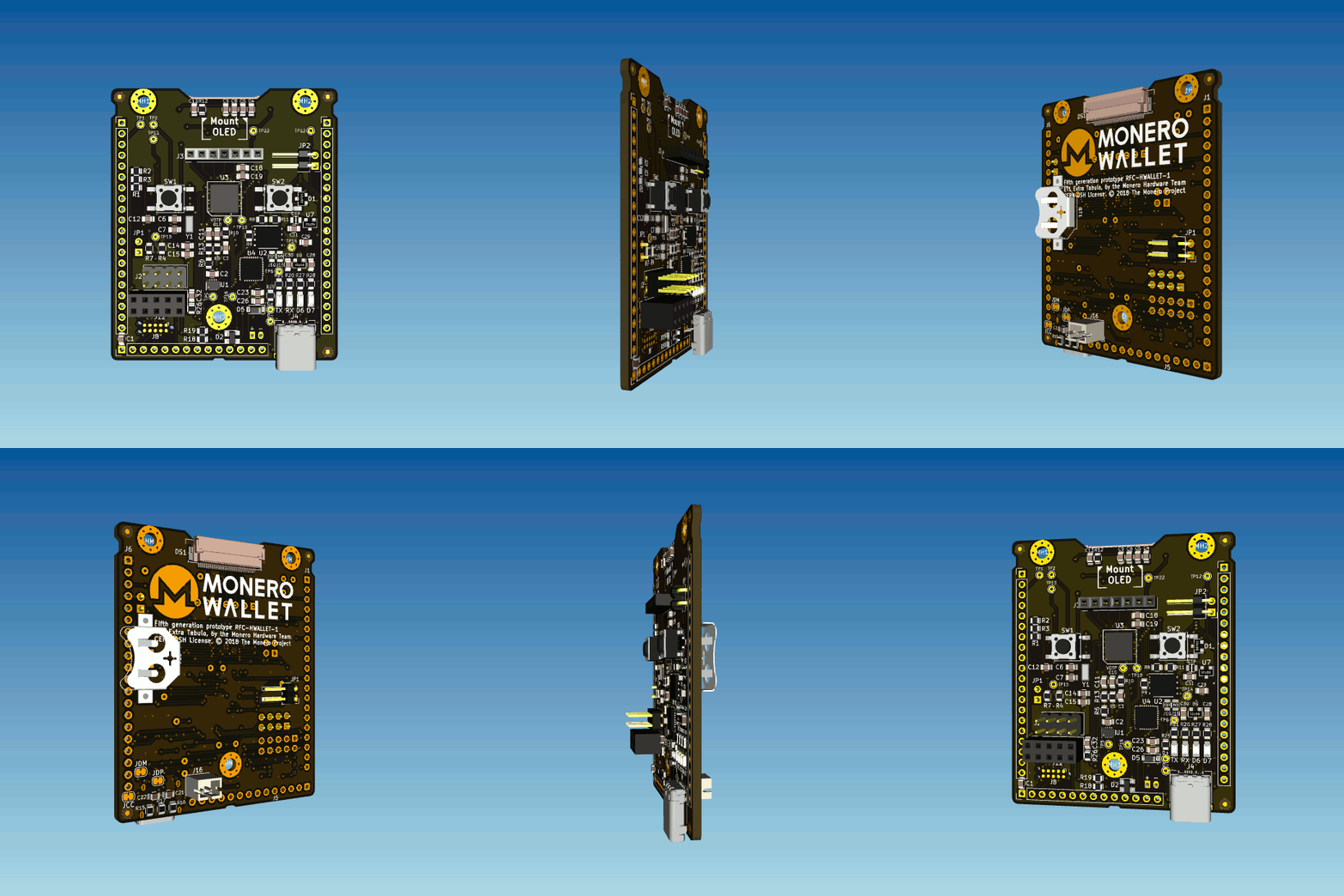
The Breakneck design consists of several files, some which are not tracked in revision control but are part of project releases.
Fabrication subdirectories contain files meant for printing, assembly, and other production work.
Other subdirectories exist to provide conveniently formatted files generated from source.
A Makefile serves project management tasks allowing for scripting and automation.
| Qty | Value | Footprint | References |
|---|---|---|---|
| 1 | Fiducial-PCB | Monero_Local:Fiducial_1mm_Dia_2.54mm_Outer_CopperBottom | FID3 |
| 1 | Monerologo-mid | Monero_Local:MoneroCircleCombi | LOGO1 |
The 2 most common of 15 parts.


google/mozc-devices
Circuit diagrams and firmware source code for Gboard DIY keyboards

hoglet67/RGBtoHDMI
Bare-metal Raspberry Pi project that provides pixel-perfect sampling of Retro Computer RGB/YUV video and conversion to HDMI

mntmn/amiga2000-gfxcard
MNT VA2000, an Open Source Amiga 2/3/4000 Graphics Card (Zorro II/III), written in Verilog

hackclub/OnBoard
💡 Join 1,000 teenagers and make your first PCB with a $100 grant!

kenp-io/not-for-airpods-repairs
The content of this repository is licensed under the WTFPL License. Please have a close look at the terms before using this material.

Luos-io/luos_engine
Open-source and real-time orchestrator for cyber-physical-systems, to easily design, test and deploy embedded applications and digital twins.

Chrismettal/EleLab_v2
Cheap DIY lab system for hobbyists and the tinkering folk

It measures 53.3 × 64 mm and has 2 copper layers, 1.6 mm thick.
15 parts. The full list of its parts is on this page, with links to each part's symbol and footprint where PCBKit's library has them.
From the monero-project/kastelo repository on GitHub, at the commit this page was made from: the board is hardware/breaknext/breaknext.kicad_pcb. PCBKit opens the board in the browser, with nothing to install.
Its repository states no licence, so its author keeps all rights: ask monero-project before reusing the design.