2 layers36.9 × 16.9 mm
Tiny solar supply
Mo-Kara/kicad-learning-projects
KiCad practice boards recreated from public tutorials while learning PCB design
17 parts

 Mo-Kara/kicad-learning-projects
KiCad practice boards recreated from public tutorials while learning PCB design
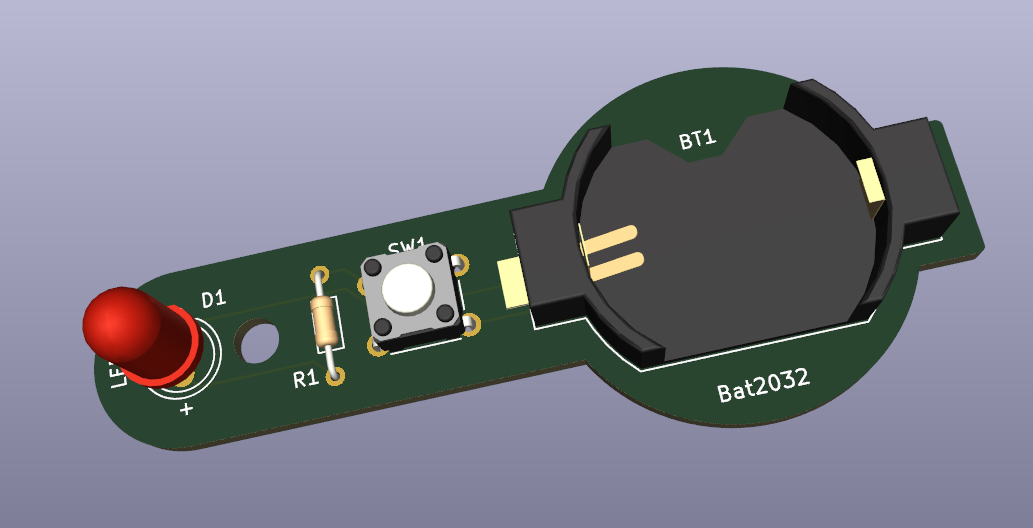
LED Torch is an open-source printed circuit board by Mo-Kara, from the Mo-Kara/kicad-learning-projects repository on GitHub. It is a 2-layer board of 62.7 × 26.4 mm with 5 parts on 4 nets, routed with 13 tracks and 0 vias.
Its parts include 1 resistor, 1 diode and 1 switch.
Practice boards I recreated in KiCad while learning schematic capture, footprints, PCB layout and fabrication output. These are learning projects: the designs were reproduced from public tutorials and open designs, not original work. The goal was to practise the workflow and to understand each circuit, not to claim the designs.
tiny-solar-supply)Solar-powered 3.3 V boost converter built around the AP3015 (output set by the 1 MΩ / 604 kΩ feedback divider), with a 2N7002 switch, SS14 Schottky diodes and SMD parts. I reviewed the layout and noted improvements for a Rev B (switching loop, feedback routing, ground plane, output switch-off).
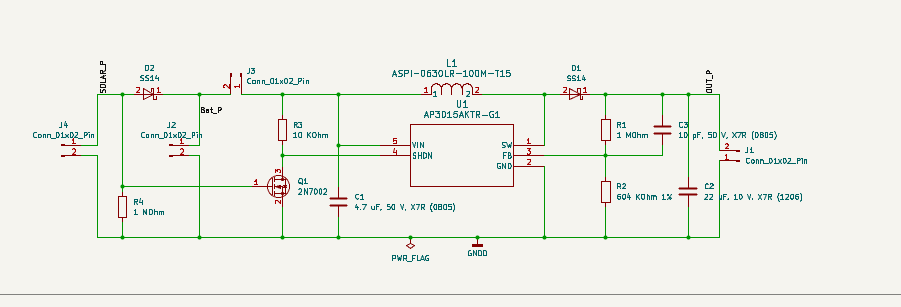
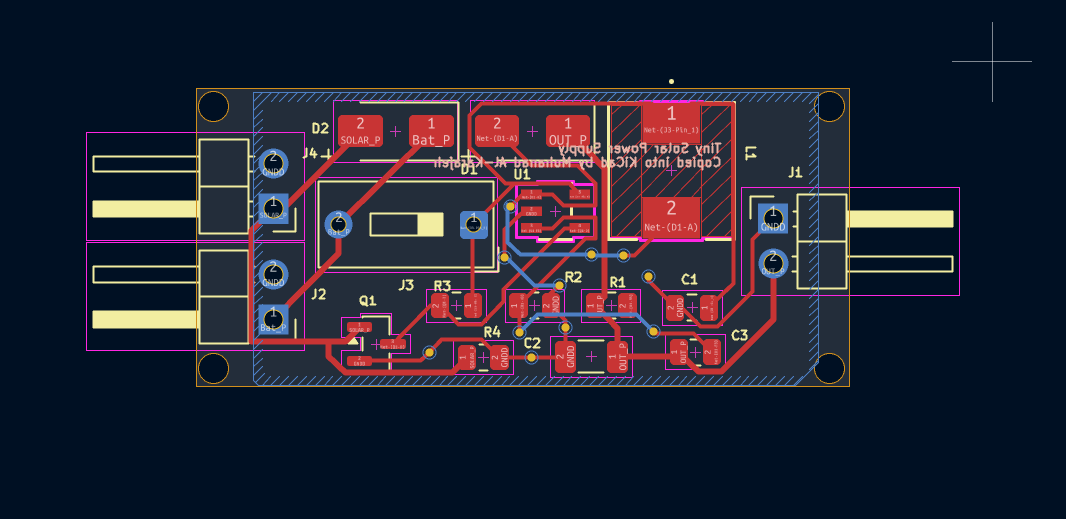
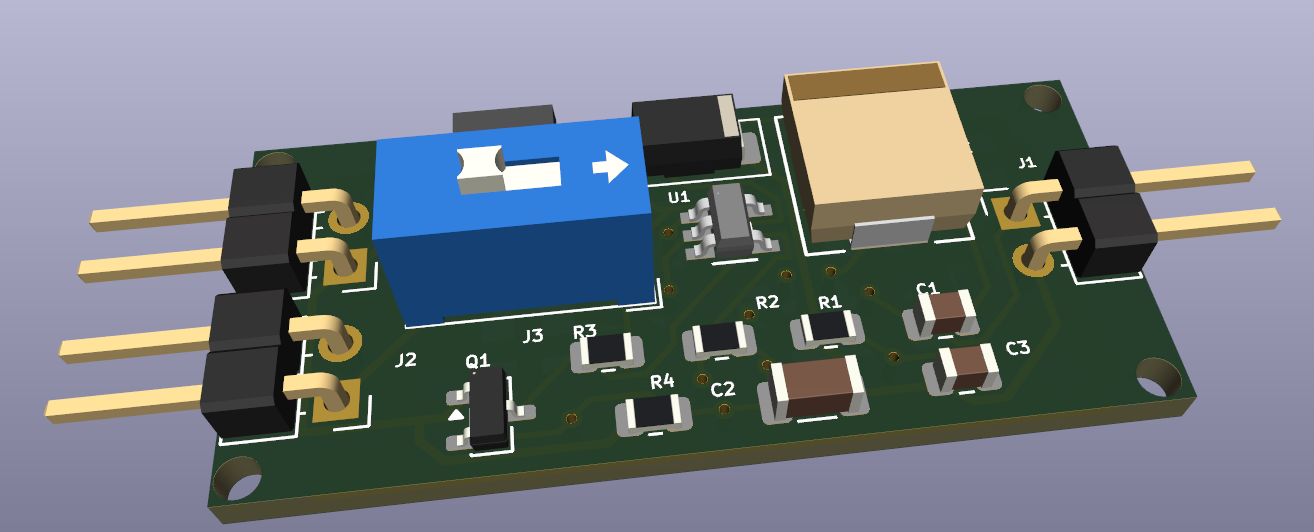
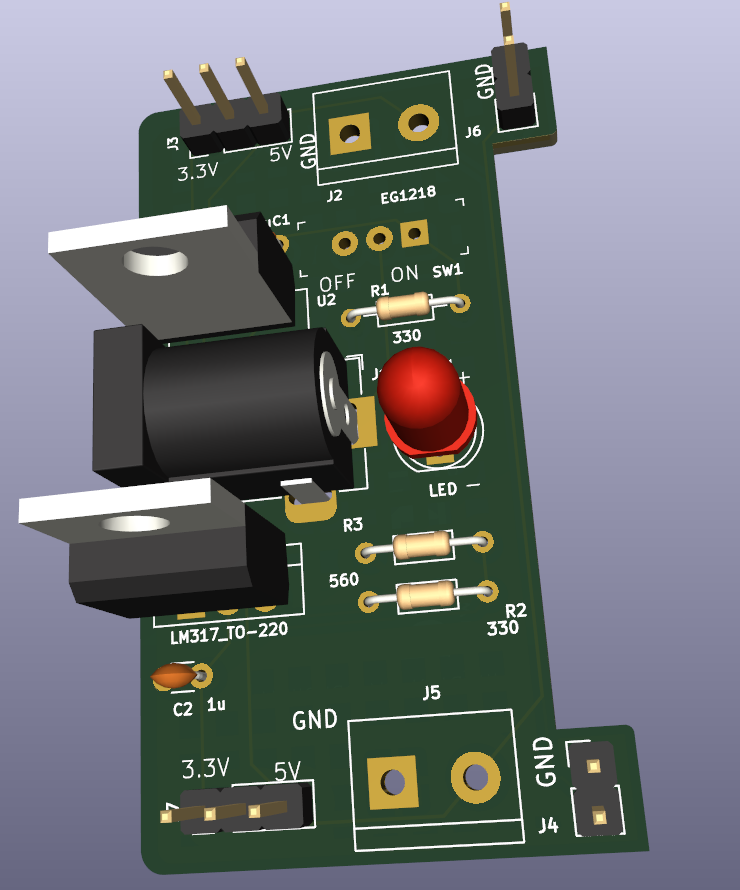
breadboard-power-supply)LM317 adjustable supply with 3.3 V / 5 V header outputs, power LED, slide switch and screw terminals. Includes Gerber files.
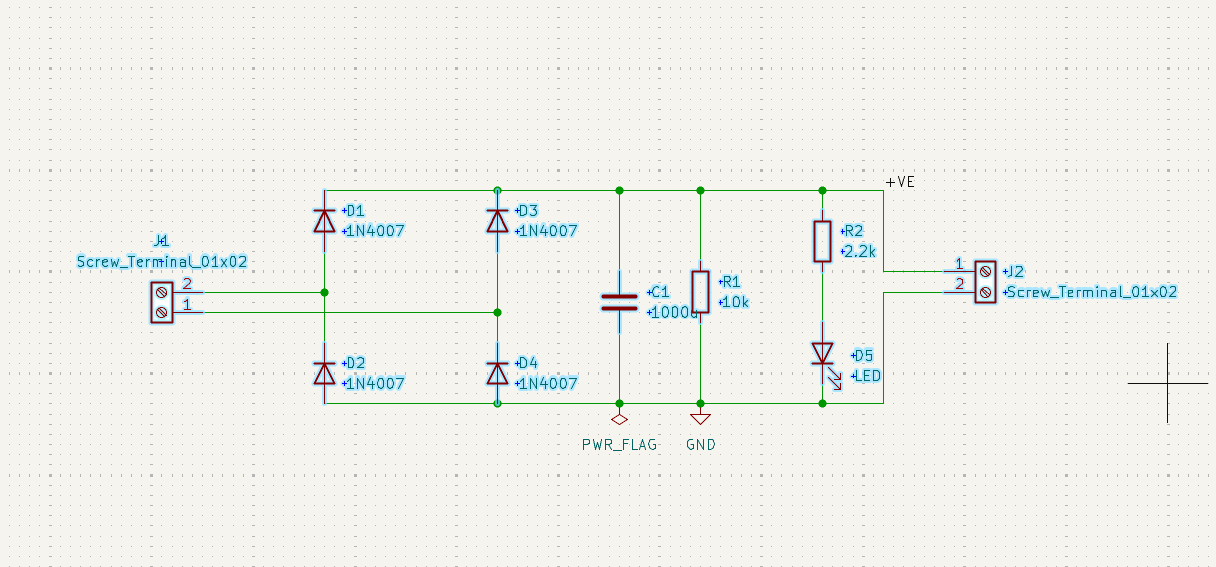
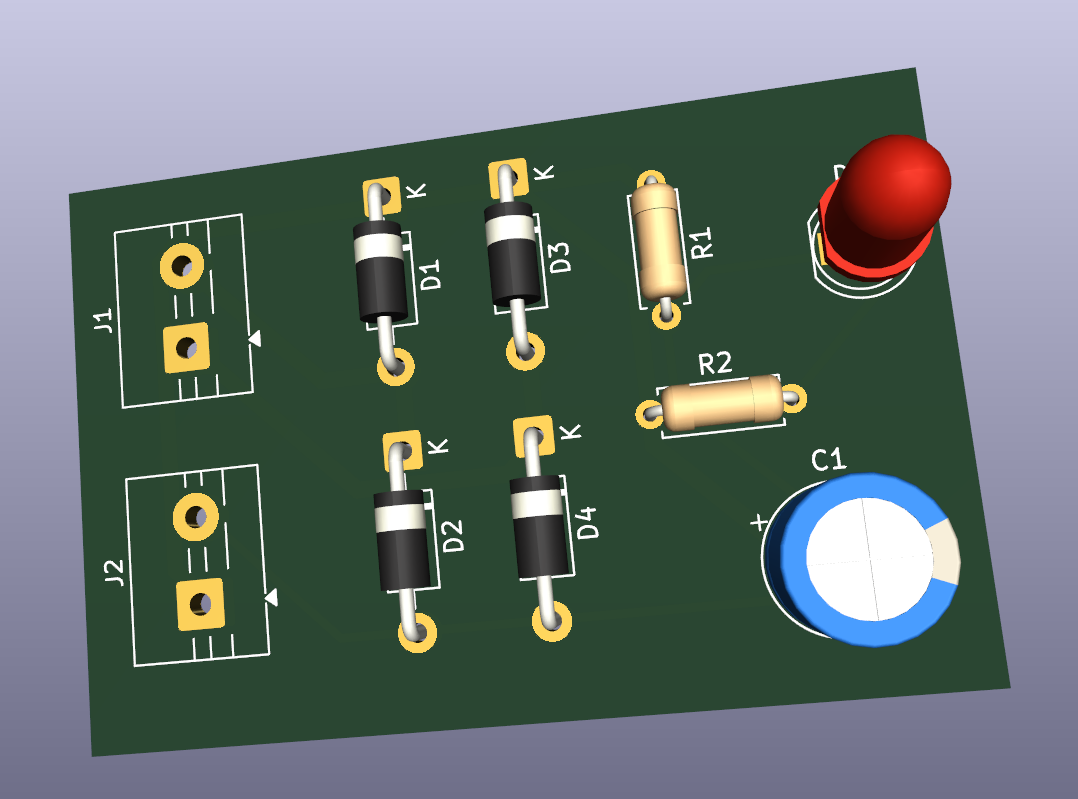
bridge-rectifier)Four 1N4007 diodes, a 1000 µF smoothing capacitor and a 10 kΩ bleeder resistor and an LED indicator (2.2 kΩ) on a through-hole board with screw terminals.
led-torch)CR2032 coin-cell LED light with push button and series resistor. Includes Gerber files.
arduino-nano-board: custom Arduino Nano footprint practice (no complete board yet).mcu-datalogger: early project files for an MCU data logger (not finished)..kicad_pro file in each folder.Mohanad Al-Karajeh, Systems Engineering student, Graz.
| Qty | Value | Footprint | References |
|---|---|---|---|
| 1 | Bat2032 | Battery:BatteryHolder_Keystone_1058_1x2032 | BT1 |
| 1 | LED | LED_THT:LED_D5.0mm | D1 |
| 1 | R | Resistor_THT:R_Axial_DIN0204_L3.6mm_D1.6mm_P7.62mm_Horizontal | R1 |
| 1 | SW_DPDT_x2 | Button_Switch_THT:SW_TH_Tactile_Omron_B3F-100x | SW1 |
The 4 most common of 5 parts.
Mo-Kara/kicad-learning-projects
KiCad practice boards recreated from public tutorials while learning PCB design

Mo-Kara/kicad-learning-projects
KiCad practice boards recreated from public tutorials while learning PCB design


joypad-ai/joypad-os
Universal controller firmware for building adapters, dongles, and custom controllers.

OLIMEX/OLINUXINO
OLINUXINO is Open Source / Open Hardware, low cost from EUR 24 Linux Industrial grade Single Board Computer capable to operate -25+85C

jamro/tiny-engineer
A small desktop robot that brings an AI coding assistant to life, physically acting out when it reads files, thinks, writes code, and finishes work.

hackclub/OnBoard
💡 Join 1,000 teenagers and make your first PCB with a $100 grant!


Luos-io/luos_engine
Open-source and real-time orchestrator for cyber-physical-systems, to easily design, test and deploy embedded applications and digital twins.
It measures 62.7 × 26.4 mm and has 2 copper layers, 1.6 mm thick.
5 parts. The full list of its parts is on this page, with links to each part's symbol and footprint where PCBKit's library has them.
From the Mo-Kara/kicad-learning-projects repository on GitHub, at the commit this page was made from: the board is led-torch/LED Torch.kicad_pcb and its schematic arduino-nano-board/arduino_nano.kicad_sch. PCBKit opens the board in the browser, with nothing to install.
Its repository states no licence, so its author keeps all rights: ask Mo-Kara before reusing the design.