2 layers98 × 48 mm

 mjhagen/dap
Firmware for a portable DAP using a AVR128DA48 and VS1063 chip.
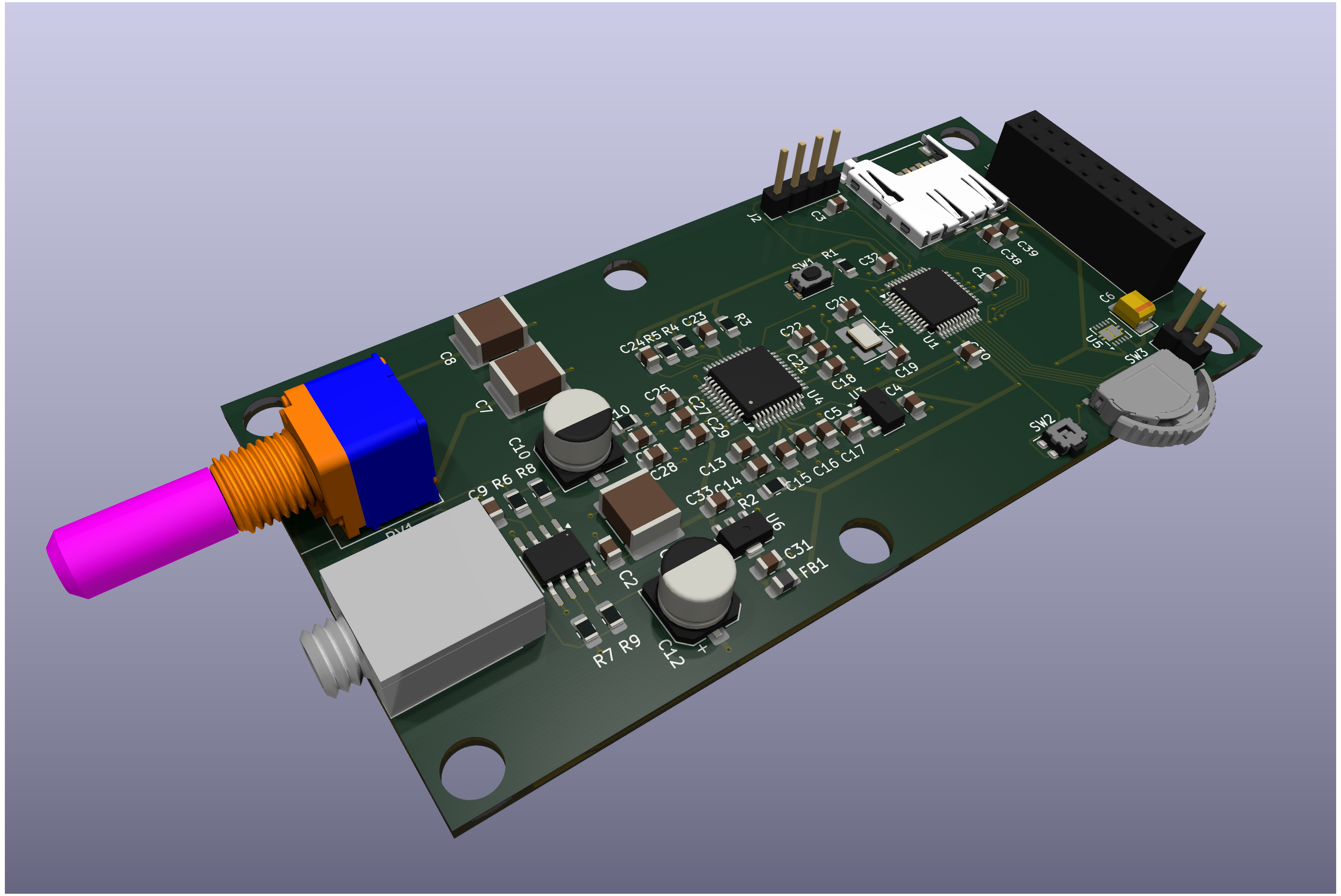
AVR128DA48 is an open-source printed circuit board by mjhagen, from the mjhagen/dap repository on GitHub. It is a 2-layer board of 98 × 48 mm with 72 parts on 99 nets, routed with 427 tracks and 111 vias.
It is built around the TPS7A2033PDBVR-TP, MAMK2520H2R2M and MAMK2520T4R7M. Its parts include 38 capacitors, 14 resistors, 6 ICs, 5 connectors and 3 switches.


Firmware for a distraction‑free portable audio player built around AVR128DA48.
No networking. No background services. Boot fast, play audio.
The primary development environment is curiosity_nano, which targets the Microchip Curiosity Nano board and uses UPDI for flashing.
pio run -e curiosity_nano
pio run -e curiosity_nano -t upload
Available environments:
curiosity_nano (Main Development) - Curiosity Nano target with UPDI uploadavr128da48 - generic AVR128DA48 buildcuriosity_nano_ssd1333_minimal - controller smoke test for the SSD1333 panelCurrent hardware baseline:
SPI1 on PC0..PC3 (MOSI/MISO/SCK/CS)PD5 (XCS) and PD6 (XDCS) for control chip-selectsSPI0 is reserved for VS1163A data/control trafficCurrent microSD pin map:
PC0 -> microSD DI / breakout MOSIPC1 -> microSD DO / breakout MISOPC2 -> microSD CLK / breakout SCKPC3 -> microSD CS.elfAVR128DA48.elf and step through executionNote: PlatformIO does not provide a simulator for AVR‑DA devices.
src/
  main.c
  board/        clocks, pin mapping
  drivers/      spi, gpio, timers, ssd1333
  display/      panel binding for the current 176x176 target
  middleware/   sdcard, fatfs
app/ ui, input, playerDetailed firmware documentation now lives in docs/firmware/.
Start there for architecture, runtime scheduling, UI behavior, driver boundaries, and build/debug notes.
Browse limits and the 4096-byte player ring buffer were re-evaluated after the
structural SRAM cleanup and intentionally left unchanged. With about 4.9 KB of
remaining static headroom, further cuts would trade UI breadth or decoder margin
for little practical benefit.
A dedicated boot-time probe was added to hammer vuMeter during playback, keep the timing statistics in RAM, and show the results on the OLED after a fixed capture window.
Measured on hardware over 10.001 s with fallback playback of Alabama Shakes - Sound & Color/02. Don't Wanna Fight.flac:
2406 successful VU reads, about 240 Hz average successful read rate517 us, about 1.9 kHz1813 us, about 552 Hz94.1 msPractical conclusion:
30 fps or 60 fps metersSPI1 is the real limiter for visual update rate3 dB stepsFatFs libraryCore playback engine and UI are functional on the SSD1333 176×176 single-panel hardware. Current focus is stable playback and responsive controls under real device load.
| Qty | Value | Footprint | References |
|---|---|---|---|
| 16 | 100 nF | Capacitor_SMD:C_0805_2012Metric_Pad1.18x1.45mm_HandSolder | C1, C3, C13, C15, C16, C17, C18, C21, C22, C23, C25, C27, C29, C30, C32, C38 |
| 4 | 0kΩ | Resistor_SMD:R_0805_2012Metric_Pad1.20x1.40mm_HandSolder | R10, R14, R15, R16 |
| 4 | 1µF | Capacitor_SMD:C_0805_2012Metric_Pad1.18x1.45mm_HandSolder | C2, C9, C31, C33 |
| 3 | 10 kΩ | Resistor_SMD:R_0805_2012Metric_Pad1.20x1.40mm_HandSolder | R2, R3, R4 |
| 3 | 10 µF | Capacitor_SMD:C_0805_2012Metric_Pad1.18x1.45mm_HandSolder | C24, C28, C39 |
| 3 | 10µF | Capacitor_SMD:C_0805_2012Metric_Pad1.18x1.45mm_HandSolder | C34, C35, C36 |
| 2 | 1 µF | Capacitor_SMD:C_2220_5750Metric_Pad1.97x5.40mm_HandSolder | C7, C8 |
| 2 | 18 pF | Capacitor_SMD:C_0805_2012Metric_Pad1.18x1.45mm_HandSolder | C19, C20 |
| 2 | 4.7µF | Capacitor_SMD:C_0805_2012Metric_Pad1.18x1.45mm_HandSolder | C4, C5 |
| 2 | 470µF | Capacitor_SMD:CP_Elec_6.3x5.8 | C10, C12 |
| 1 | 0.1µF | Capacitor_SMD:C_0805_2012Metric_Pad1.18x1.45mm_HandSolder | C26 |
| 1 | 1 µF | Capacitor_SMD:C_0805_2012Metric_Pad1.18x1.45mm_HandSolder | C14 |
| 1 | 100 kΩ | Resistor_SMD:R_0805_2012Metric_Pad1.20x1.40mm_HandSolder | R5 |
| 1 | 100nF | Capacitor_SMD:C_0805_2012Metric_Pad1.18x1.45mm_HandSolder | C6 |
| 1 | 100Ω | Resistor_SMD:R_0805_2012Metric_Pad1.20x1.40mm_HandSolder | R13 |
| 1 | 10µF | Capacitor_SMD:C_2220_5750Metric_Pad1.97x5.40mm_HandSolder | C11 |
| 1 | 12.288 MHz | Crystal:Crystal_SMD_3225-4Pin_3.2x2.5mm_HandSoldering | Y2 |
| 1 | 20 kΩ | Resistor_SMD:R_0805_2012Metric_Pad1.20x1.40mm_HandSolder | R6 |
| 1 | 20kΩ | Resistor_SMD:R_0805_2012Metric_Pad1.20x1.40mm_HandSolder | R7 |
| 1 | 33 kΩ | Resistor_SMD:R_0805_2012Metric_Pad1.20x1.40mm_HandSolder | R8 |
| 1 | 330 Ω | Resistor_SMD:R_0805_2012Metric_Pad1.20x1.40mm_HandSolder | R1 |
| 1 | 33kΩ | Resistor_SMD:R_0805_2012Metric_Pad1.20x1.40mm_HandSolder | R9 |
| 1 | AVR128DA48x-xPT | Package_QFP:TQFP-48_7x7mm_P0.5mm | U1 |
| 1 | Battery | Connector_PinHeader_2.54mm:PinHeader_1x02_P2.54mm_Vertical | J1 |
| 1 | Conn_02x10_Odd_Even | Connector_PinSocket_2.54mm:PinSocket_2x10_P2.54mm_Vertical | J2 |
| 1 | FerriteBead_Small | Inductor_SMD:L_0805_2012Metric_Pad1.05x1.20mm_HandSolder | FB1 |
| 1 | Headphones | Connector_Audio:SWITCHCRAFT_35RAPC3BH3 | J4 |
| 1 | MAMK2520H2R2M | MAMK2520H2R2M:INDC2520X120N | L1 |
| 1 | MAMK2520T4R7M | MAMK2520H2R2M:INDC2520X120N | L2 |
| 1 | MCP1603L | Package_TO_SOT_SMD:TSOT-23-5 | U5 |
| 1 | MEM2061-01-188-00-A_REVA | MEM2061-01-188-00-A_REVA:GCT_MEM2061-01-188-00-A_REVA | J3 |
| 1 | NetTie_2 | NetTie:NetTie-2_SMD_Pad2.0mm | NT1 |
| 1 | PLSJ-1 | Button_Switch_SMD:Knitter_PLSJ-1 | SW1 |
| 1 | Programming | Connector_PinHeader_2.54mm:PinHeader_1x04_P2.54mm_Vertical | J5 |
| 1 | R_Potentiometer_Dual_MountingPin | Potentiometer_THT:Potentiometer_Alps_RK097_Dual_Horizontal | RV1 |
| 1 | SW_Push | Button_Switch_SMD:SW_Push_1P1T_NO_CK_KMR2 | SW3 |
| 1 | SW_Push | Button_Switch_SMD:SW_SPST_EVQP7A | SW2 |
| 1 | TPA6111A2DR | Package_SO:Texas_HTSOP-8-1EP_3.9x4.9mm_P1.27mm_EP2.95x4.9mm_Mask2.4x3.1mm_ThermalVias | U3 |
| 1 | TPS63001DRCT | Package_SON:Texas_DRC0010J_ThermalVias | U4 |
| 1 | TPS7A2033PDBVR | Package_TO_SOT_SMD:SOT-23-5 | U6 |
| 1 | VS1163A | Package_QFP:LQFP-48_7x7mm_P0.5mm | U2 |


mjhagen/dap
Firmware for a portable DAP using a AVR128DA48 and VS1063 chip.

nathaniel-fargo/audio-spectrum-vibes
A fun little display piece for vibing to the audio spectrum. Inspired by Apple's iOS media player 5 bar spectrum analyzer.


UzixLS/zxevo1010-board
10x10cm PCB variant of ZX-Evolution project for G738/G706 enclosure

UzixLS/zxuno1010-board
10x10cm PCB variant of ZX-UNO project for G738/G706 enclosure


hoeken/frothfet
Yarrboard load controller board with current sense, volt sense, fuses, and sender support.
It measures 98 × 48 mm and has 2 copper layers, 1.6 mm thick.
72 parts, built around the TPS7A2033PDBVR-TP, MAMK2520H2R2M and MAMK2520T4R7M. The full list of its parts is on this page, with links to each part's symbol and footprint where PCBKit's library has them.
From the mjhagen/dap repository on GitHub, at the commit this page was made from: the board is Hardware-v2/AVR128DA48.kicad_pcb and its schematic AVR128DA48/AVR128DA48.kicad_sch. PCBKit opens the board in the browser, with nothing to install.
Its repository states no licence, so its author keeps all rights: ask mjhagen before reusing the design.