2 layers37 × 19 mm
Passive rpi hub75-adapter
hzeller/rpi-rgb-led-matrix
Controlling up to three chains of 64x64, 32x32, 16x32 or similar RGB LED displays using Raspberry Pi GPIO
2 parts4.4kGPL-2.0

 mikeysklar/sdio-shim
Direct-connect shim board compatible with the Adafruit SDIO breakout for solder-free Feather connection (no breadboard)
Sdio shim is an open-source printed circuit board by mikeysklar, from the mikeysklar/sdio-shim repository on GitHub, published under the GPL-3.0 licence. It is a 2-layer board of 30 × 26.4 mm with 2 parts on 9 nets, routed with 46 tracks and 0 vias.
It belongs with the interfaces and adapters and microcontroller boards boards of this library.
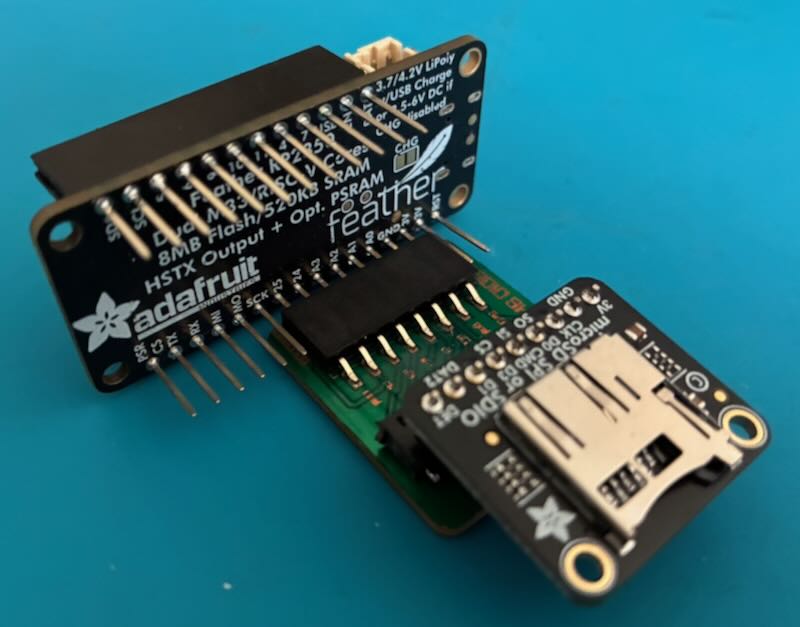
A direct-connect shim PCB that mates the Adafruit SDIO microSD breakout to a Feather — no breadboard required.
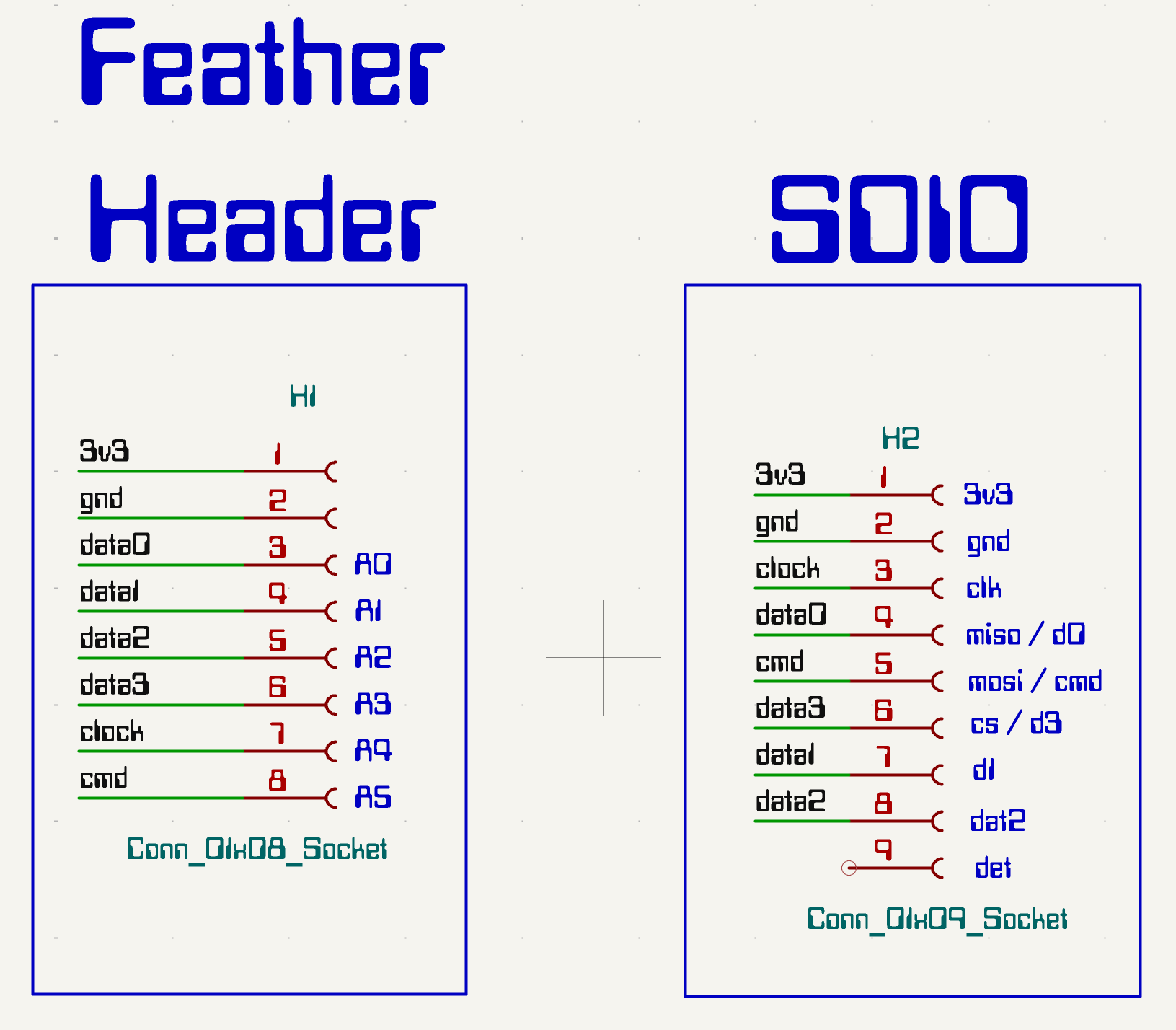
A simple passive shim that routes a Feather's analog-rail pins to an SDIO microSD breakout (Adafruit #4682 or a fork of it), so a stock 4-bit SDIO card hangs off any Feather without eating the SPI, UART, or I2C buses.
No active parts. It's a router: Feather header on one side, breakout connector on the other, eight nets between them. The shim itself carries zero components — the #4682 already provides the pull-ups, bypass/bulk caps, and card-detect resistor the SDIO spec requires.
Design files are in kicad/.
Chosen so the six SD logic lines land on contiguous Feather positions (A0→D25) while leaving every labeled bus free.
| Feather | GPIO | SDIO signal | Notes |
|---|---|---|---|
| 3V | — | Power | |
| GND | — | Ground | |
| A0 | 26 | DAT0 | data block must stay consecutive (PIO) |
| A1 | 27 | DAT1 | |
| A2 | 28 | DAT2 | |
| A3 | 29 | DAT3 | |
| D24 | 24 | CLK | any GPIO — placed here to stay on-rail |
| D25 | 25 | CMD |
Freed for peripherals: SCK/MOSI/MISO (GPIO22/23/20 — full SPI bus), TX/RX (GPIO0/1 — UART0), SDA/SCL (I2C, other rail). Card-detect is dropped (leave the breakout's DET pad unconnected).
D24/D25 carry CLK/CMD because they sit physically right after A0–A3 on the rail and are plain GPIOs — so the SD wiring stays crossing-free and costs you nothing labeled. TX/RX would work electrically but would burn the UART.
import board, sdioio, storage
sd = sdioio.SDCard(
    clock=board.D24,
    command=board.D25,
    data=(board.A0, board.A1, board.A2, board.A3),
    frequency=37_500_000,
)
storage.mount(storage.VfsFat(sd), "/sd")Measured bulk transfer over 4-bit SDIO in CircuitPython, using the Adafruit benchmark setup. Both boards use this shim with the Adafruit MicroSD SPI/SDIO breakout (#4682).
| Chip | Board | Bus | Clock (MHz) | Write (MB/s) | Read (MB/s) |
|---|---|---|---|---|---|
| RP2350 | Feather + SDIO Shim | SDIO | 37.5 | 14.9 | 13.0 |
| ESP32-S3 | Feather + SDIO Shim | SDIO | 40 | 4.5 | 7.1 |
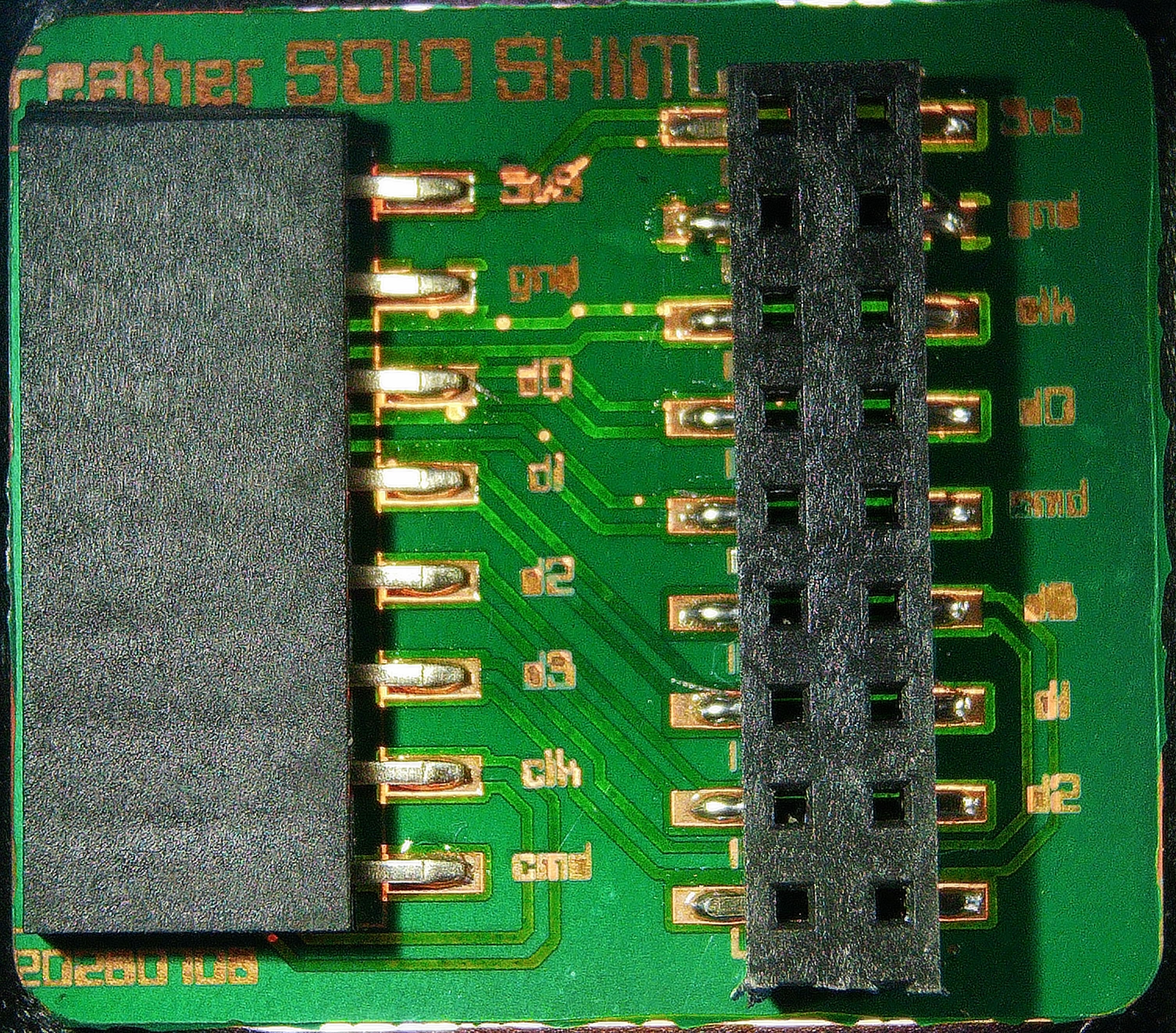
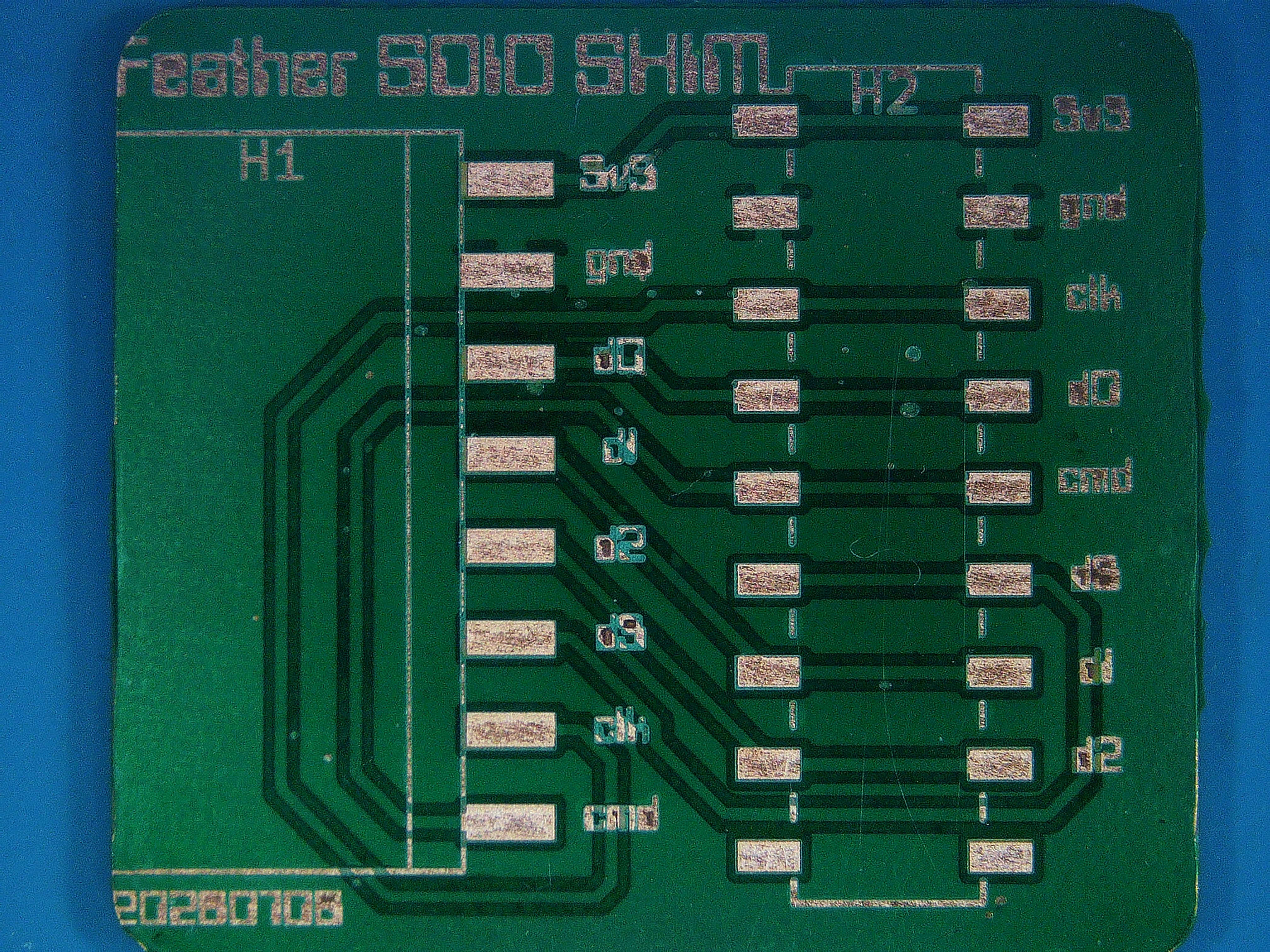
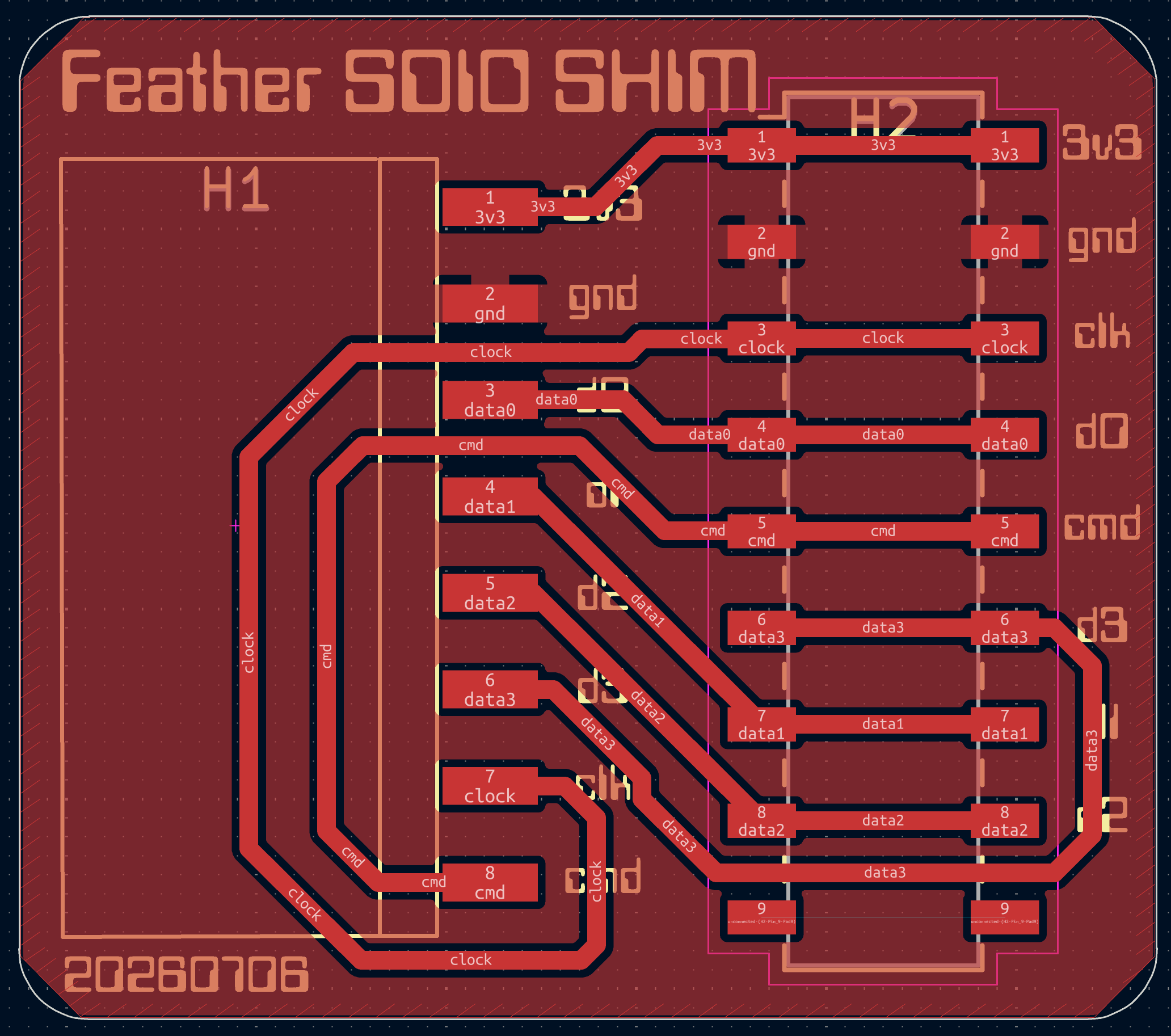
| Qty | Value | Footprint | References |
|---|---|---|---|
| 1 | Conn_01x08_Socket | footprints:header-rt-ang-smd | H1 |
| 1 | Conn_01x09_Socket | footprints:2x09-adafruit-smt-featherwing-4743 | H2 |
hzeller/rpi-rgb-led-matrix
Controlling up to three chains of 64x64, 32x32, 16x32 or similar RGB LED displays using Raspberry Pi GPIO


adamws/kicad-kbplacer
KiCad plugin for automatic keyboard's key placement and routing

Luos-io/luos_engine
Open-source and real-time orchestrator for cyber-physical-systems, to easily design, test and deploy embedded applications and digital twins.

NVNTLabs/switch2-SDEX2M2
Micro SD Express to M.2 NVME Adapter for Nintendo Switch 2

BlueSCSI/BlueSCSI-v2
BlueSCSI v2/Ultra - an open source, open hardware, SCSI emulator using the Pi Pico PR2040 and Pico 2 RP2350

ohmtech-rdi/eurorack-blocks
Software to Hardware Prototyping for Eurorack using C++, Max/Gen~ or Faust

It measures 30 × 26.4 mm and has 2 copper layers, 1.6 mm thick.
2 parts. The full list of its parts is on this page, with links to each part's symbol and footprint where PCBKit's library has them.
From the mikeysklar/sdio-shim repository on GitHub, at the commit this page was made from: the board is kicad/sdio-shim.kicad_pcb and its schematic kicad/sdio-shim.kicad_sch. PCBKit opens the board in the browser, with nothing to install.
Its repository publishes it under the GPL-3.0 licence: you may reuse it on that licence's terms (keep the author's notice, and for a copyleft licence share your changes alike).