4 layers18 × 26 mm
 miket6000/SimpleTracker2
A simple GPS Tracker for model rocketry.
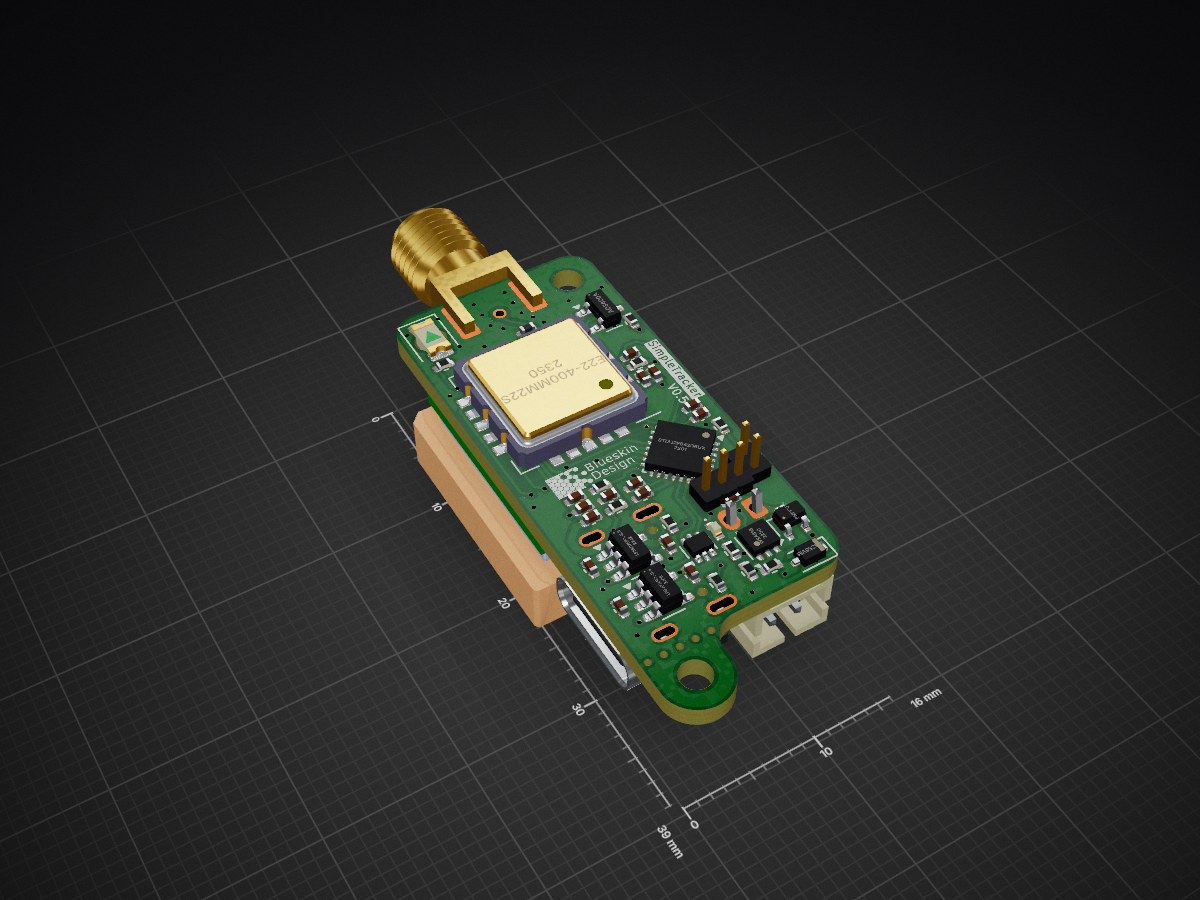
GPS Tracker is an open-source printed circuit board by miket6000, from the miket6000/SimpleTracker repository on GitHub, published under the CERN-OHL-W-2.0 licence. It is a 4-layer board of 16 × 39 mm with 47 parts on 55 nets, routed with 377 tracks and 69 vias.
It is built around the E22-400MM22S, LP5907MFX-3.3 and USBLC6-2P6, with the AO3400A and PMF170XP among its other parts. Its parts include 16 capacitors, 11 resistors, 7 ICs, 4 connectors and 3 diodes. It belongs with the radio and wireless and power boards and the STM32 boards of this library.


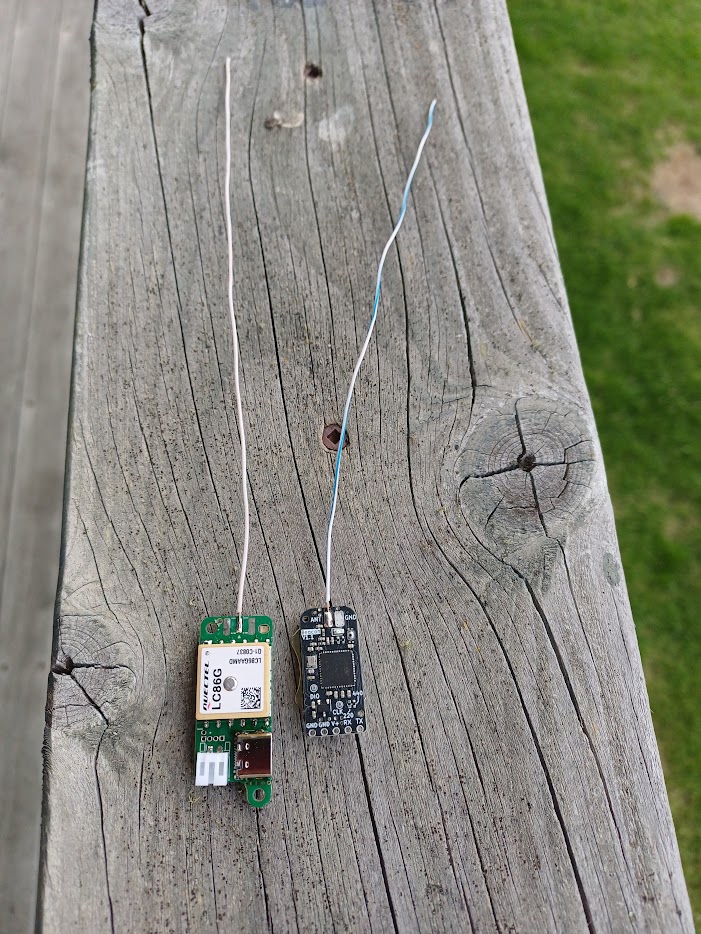
SimpleTracker is a low cost and easy to use GPS tracker for model rocketry. It can operate of a single 3.7V lipo battery and has a built in charger to enable "plug-&-play" usability. The GPS coordinates of the SimpleTracker are transmitted via 433MHz LoRa every second providing several km of tracking range depending on the antenna used on the SimpleTracker and the ground station. SimpleTracker can also be used as a minimal ground station, reporting the location of a paired tracker via USB serial connection to a PC or phone.
The hardware is fairly minimal. It consist of a battery charger, two 3.3V linear power supplies, a LoRa radio module, GPS and a micro controller with a couple of LEDs to provide status. Bootmode can be enabled by removing the battery and shorting the 'b' and 'v' pins together on the PCB while plugging the tracker into USB. This will put the device into DFU mode so that it can be programmed using dfu-util or STM's programming utilities.
The tracker can be powered by either USB (such as when used as a ground station) or via an AltusMetrum compatible 1s lithium battery. There is an included battery charger that will charge the battery at 100mA if USB is plugged in, so it is recommended that the tracker battery be between 100mAh (to avoid charging it too fast) and 300mAh (to avoid taking too long to charge). Of course there is no upper limit on the capacity of the battery, you can always unplug it to use an external charger if the charge is too slow.
The firmware is "good enough". It can be flashed to the tracker by disconnecting the battery and shorting the "boot" pin to the 3V3 pin right beside it and then plugging in the USB C cable. This will put the tracker into DFU bootloader mode where it can be programmed using CubeIDE or dfu-util.
On power up the module will listen on 434MHz SF 9 BW 125kHz for a command asking for it's UID, or telling it to start transmitting on another channel. Alternatively it can recieve a command via USB if it's acting as a ground station in which case it will issue commands to other trackers. This is all orchestrated by the application.
The LED provides status information via as follows:
I decided the application deserved it's own repository, so has been moved to https://github.com/miket6000/SimpleSuite. It is built and tested in Linux, with plans on supporting Android.
| Qty | Value | Footprint | References |
|---|---|---|---|
| 6 | 100n | Capacitor_SMD:C_0402_1005Metric | C3, C4, C5, C12, C13, C15 |
| 5 | 1u | Capacitor_SMD:C_0402_1005Metric | C6, C7, C8, C9, C16 |
| 4 | 10k | Resistor_SMD:R_0402_1005Metric | R2, R4, R7, R8 |
| 3 | 100k | Resistor_SMD:R_0402_1005Metric | R3, R5, R6 |
| 2 | 10u | Capacitor_SMD:C_0402_1005Metric | C1, C11 |
| 2 | 4u7 | Capacitor_SMD:C_0402_1005Metric | C2, C10 |
| 2 | 5k1 | Resistor_SMD:R_0402_1005Metric | R9, R10 |
| 2 | LP5907MFX-3.3 | Package_TO_SOT_SMD:SOT-23-5 | U3, U4 |
| 2 | MountingHole | MountingHole:MountingHole_2.2mm_M2 | H1, H2 |
| 1 | 1SS355VM | Diode_SMD:D_SOD-323F | D2 |
| 1 | 1k | Resistor_SMD:R_0402_1005Metric | R1 |
| 1 | 330n | Inductor_SMD:L_0402_1005Metric | L1 |
| 1 | 33p | Capacitor_SMD:C_0402_1005Metric | C14 |
| 1 | 470R | Resistor_SMD:R_0402_1005Metric | R11 |
| 1 | AO3400A | Package_TO_SOT_SMD:SOT-23 | Q2 |
| 1 | Antenna_Shield | Footprints:SMA_EdgeMount | AE1 |
| 1 | BOOT | Connector_PinHeader_1.27mm:PinHeader_1x02_P1.27mm_Vertical | J2 |
| 1 | Battery_Connector | Connector_JST:JST_PH_S2B-PH-K_1x02_P2.00mm_Horizontal | J1 |
| 1 | E22-400MM22S | Footprints:LCC-20_10x10_Pitch1.27mm | U2 |
| 1 | LC86G | Footprints:XCVR_LC86G_AA | U6 |
| 1 | PMF170XP | Package_TO_SOT_SMD:SOT-323_SC-70 | Q1 |
| 1 | RED_LED | LED_SMD:LED_0402_1005Metric | D1 |
| 1 | RED_LED | LED_SMD:LED_1206_3216Metric_ReverseMount_Hole1.8x2.4mm | D3 |
| 1 | STM32F042G6Ux | Package_DFN_QFN:QFN-28_4x4mm_P0.5mm | U5 |
| 1 | SWD | Connector_PinHeader_1.27mm:PinHeader_1x03_P1.27mm_Vertical | J4 |
| 1 | USBLC6-2P6 | Package_TO_SOT_SMD:SOT-666 | U7 |
| 1 | USB_C_Receptacle_USB2.0_16P | Connector_USB:USB_C_Receptacle_GCT_USB4105-xx-A_16P_TopMnt_Horizontal | J3 |
| 1 | WS4518 | Package_DFN_QFN:DFN-6-1EP_2x2mm_P0.65mm_EP1x1.6mm | U1 |
It measures 16 × 39 mm and has 4 copper layers, 1.56 mm thick.
47 parts, built around the E22-400MM22S, LP5907MFX-3.3, USBLC6-2P6 and AO3400A. The full list of its parts is on this page, with links to each part's symbol and footprint where PCBKit's library has them.
From the miket6000/SimpleTracker repository on GitHub, at the commit this page was made from: the board is hardware/GPS Tracker.kicad_pcb and its schematic hardware/GPS Tracker.kicad_sch. PCBKit opens the board in the browser, with nothing to install.
Its repository publishes it under the CERN-OHL-W-2.0 licence: you may reuse it on that licence's terms (keep the author's notice, and for a copyleft licence share your changes alike).

CU-Rocketry/flight_computer
Competition Flight Computer Module 25-26


peterisza/mobilecg
MobilECG II is an open source clinical grade Holter ECG. For more information, please visit http://mobilecg.hu.

psas/lv3.1-recovery
design, analysis, CAD, and testing for the LV3.1 recovery system


anp369/esp12-battery-breakout
Small breakout board with possibility to run it battery powered. Mirror of https://gitlab.com/anphi/esp12-battery-breakout Report errors there.