2 layers74.5 × 56.3 mm
PowerBook
BlueSCSI/BlueSCSI-v2
BlueSCSI v2/Ultra - an open source, open hardware, SCSI emulator using the Pi Pico PR2040 and Pico 2 RP2350
83 parts459GPL-3.0
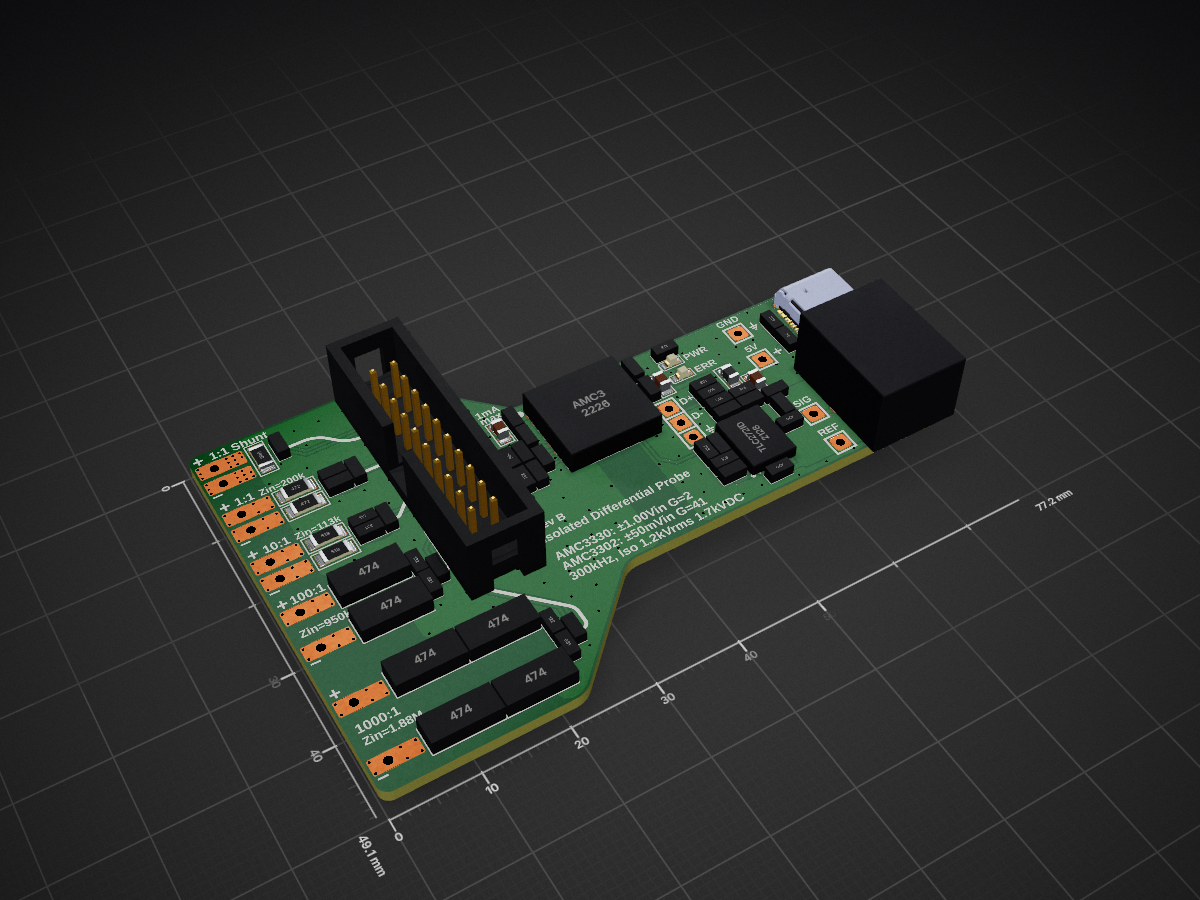
 michael0093/Isolated-Diff-Probe
Isolated differential probe based on the Ti AMC3302 and AMC3330
IsoDiffProbe B is an open-source printed circuit board by michael0093, from the michael0093/Isolated-Diff-Probe repository on GitHub. It is a 2-layer board of 77.2 × 49.1 mm with 83 parts on 48 nets, routed with 309 tracks and 219 vias.
It is built around the TLC272ID and PBY201209T-601Y-N. Its parts include 32 resistors, 23 capacitors, 3 connectors, 2 ICs and 2 diodes.


The Ti AMC33xx are differential isolated analog amplifiers rated for minimum 1.2kVrms insulation. The AMC3302 is intended for current shunt inputs as it has a +/-50mVpp input with a fixed gain of 41, whereas the AMC3330 is better for voltage measurements as it has a +/-1Vpp input and a fixed gain of 2. In these probes the AMC33xx do all the work, with their differential output converted to single-ended by a dual op-amp to better suit most oscilloscopes. By using two 2.54" jumpers on the 2x10 header, you can select between various input attenuators for low to high voltage use.
The power supply must be isolated from your scope as the scope "GND" of the SMA connector is a 50%VDD bias voltage. The schematic has two modifications from the rev A to rev A2 design - refer to the rev B schematic and follow the notes. The modifications are:
The design was originally done in Altium and then converted to KiCad so appologies that the KiCad sch/pcb may not link up quite right. For that reason there are no propper rev B output files, and also note the rev B PCB still has outstanding changes as noted on the schematic.
Other opamps with GBWP >1MHz or so should perform similarly, the OPA2376 is just what was on hand. Based on practical usage, the AMC3302 with a 0R01 shunt works best for currents >=3mA with fc=100kHz. The AMC3330 on 1:1 range works best for voltages >=10mV and fc=300kHz.
Only use the high voltage inputs if you are suitably qualified to measure lethal voltages and completely understand the risks. This project is provided as reference material only and anyone who attempts to make it must fully understand the risks and limitations of the isolator used - this project has absolutely no warranty and may be completely unsuitable for your use case. Use completely at your own risk!
| Qty | Value | Footprint | References |
|---|---|---|---|
| 20 | Test Point | E General.PcbLib:TP | TP1, TP2, TP3, TP4, TP5, TP10, TP11, TP12, TP13, TP14, TP15, TP16, TP17, TP18, TP19, TP20 +4 |
| 7 | 100nF | NixieClock_RevA.PcbLib:0603 | C3, C5, C6, C10, C16, C17, C18 |
| 7 | 10k | NixieClock_RevA.PcbLib:0603 | R3, R16, R17, R20, R21, R24, R29 |
| 7 | NF | NixieClock_RevA.PcbLib:0603 | C1, C2, C9, C13, C14, R4, R5 |
| 6 | 470k | E General.PcbLib:MMB0207 | R15, R23, R26, R27, R31, R32 |
| 3 | 10pF | NixieClock_RevA.PcbLib:0603 | C11, C20, C21 |
| 3 | 10uF / 25V | NixieClock_RevA.PcbLib:0805_cap_Rounded | C4, C7, C8 |
| 3 | 220R | NixieClock_RevA.PcbLib:0603 | R11, R13, R33 |
| 2 | 1nF | NixieClock_RevA.PcbLib:0603 | C12, C15 |
| 2 | 47R | NixieClock_RevA.PcbLib:0603 | R18, R25 |
| 2 | 4k7 | NixieClock_RevA.PcbLib:1206 | R2, R6 |
| 2 | 51k | NixieClock_RevA.PcbLib:1206 | R9, R14 |
| 2 | 5k1 | NixieClock_RevA.PcbLib:0603 | R7, R8 |
| 1 | 0R01 | NixieClock_RevA.PcbLib:1206 | R1 |
| 1 | 11k | NixieClock_RevA.PcbLib:0603 | R10 |
| 1 | 1M | NixieClock_RevA.PcbLib:0603 | R34 |
| 1 | 1k2 | NixieClock_RevA.PcbLib:0603 | R28 |
| 1 | 1k3 | NixieClock_RevA.PcbLib:0603 | R19 |
| 1 | 330R | NixieClock_RevA.PcbLib:0603 | R12 |
| 1 | 680R | NixieClock_RevA.PcbLib:0603 | R30 |
| 1 | 820R | NixieClock_RevA.PcbLib:0603 | R22 |
| 1 | 82pF | NixieClock_RevA.PcbLib:0603 | C19 |
| 1 | AMC3 | E GF.PcbLib:DW0016B | U1 |
| 1 | GRN | E GF.PcbLib:LED-0603 | D2 |
| 1 | Header 10X2 | E Connectors.PcbLib:IDC20 | P1 |
| 1 | PBY201209T-601Y-N | NixieClock_RevA.PcbLib:0805_Rounded | L1 |
| 1 | RED | E GF.PcbLib:LED-0603 | D1 |
| 1 | SMA Conn | NixieClock_RevA.PcbLib:SMA_SMD | J2 |
| 1 | TLC272ID | E General.PcbLib:SO-8 | U2 |
| 1 | USB C 6-Pin | NixieClock_RevA.PcbLib:USB-C_6pin_Conn | J1 |
It measures 77.2 × 49.1 mm and has 2 copper layers, 1.6 mm thick.
83 parts, built around the TLC272ID and PBY201209T-601Y-N. The full list of its parts is on this page, with links to each part's symbol and footprint where PCBKit's library has them.
From the michael0093/Isolated-Diff-Probe repository on GitHub, at the commit this page was made from: the board is KiCad rev B/IsoDiffProbe_B.kicad_pcb and its schematic KiCad rev A/IsoDiffProbe.kicad_sch. PCBKit opens the board in the browser, with nothing to install.
Its repository states no licence, so its author keeps all rights: ask michael0093 before reusing the design.
BlueSCSI/BlueSCSI-v2
BlueSCSI v2/Ultra - an open source, open hardware, SCSI emulator using the Pi Pico PR2040 and Pico 2 RP2350


GaudiLabs/OpenLaserScanningMicroscope
Open Source Laser Scanning Microscope


plinkysynth/plinky_public
a public release of the plinky sw and hw

freeDSP/freeDSP-aurora
freeDSP ADAU1452 with 8 analog input, 8 analog outputs, S/P-DIF I/O, ADAT I/O, USB Audio Class2, WiFi, Bluetooth

zoemaestra/hair-electrolysis-machine-usb-c
A fork of scd31's hair electrolysis machine but with USB-C and optimised for cheaper assembly with JLCPCB