2 layers103 × 30.5 mm
 mhellar/speakhard2
A handheld speech beat machine on an ESP32-S3. Four instruments (SAM voice, Talkie LPC voice, bytebeat, a 12-piece drum kit) on a 16-step sequencer, seven voice FX plus stutter/reverse/tape-stop/scratch, and a live HUD…
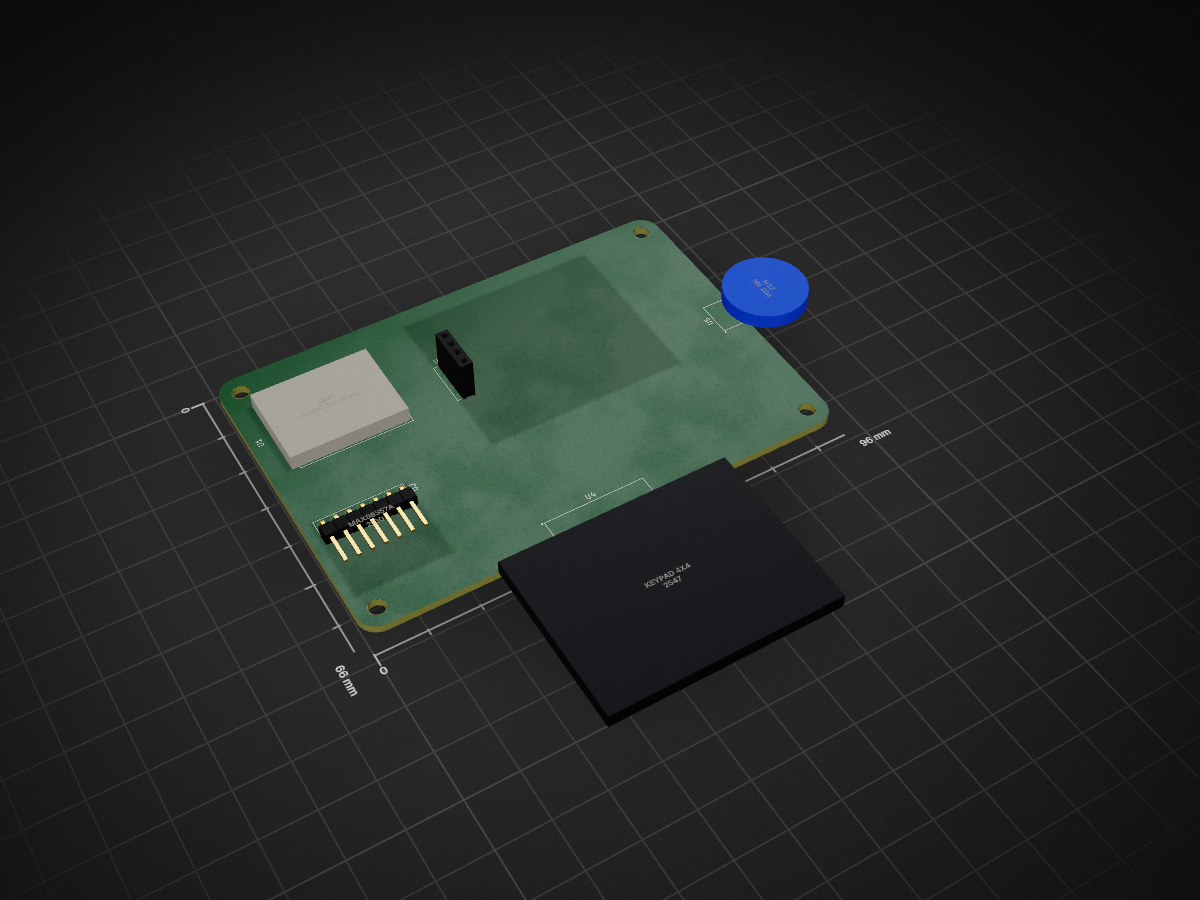
Keypad synth revA is an open-source printed circuit board by mhellar, from the mhellar/speakhard repository on GitHub, published under the GPL-3.0 licence. It is a 2-layer board of 96 × 66 mm with 9 parts on 20 nets, routed with 63 tracks and 0 vias.
It belongs with the keyboards and input and audio and music boards and the ESP32 boards of this library.
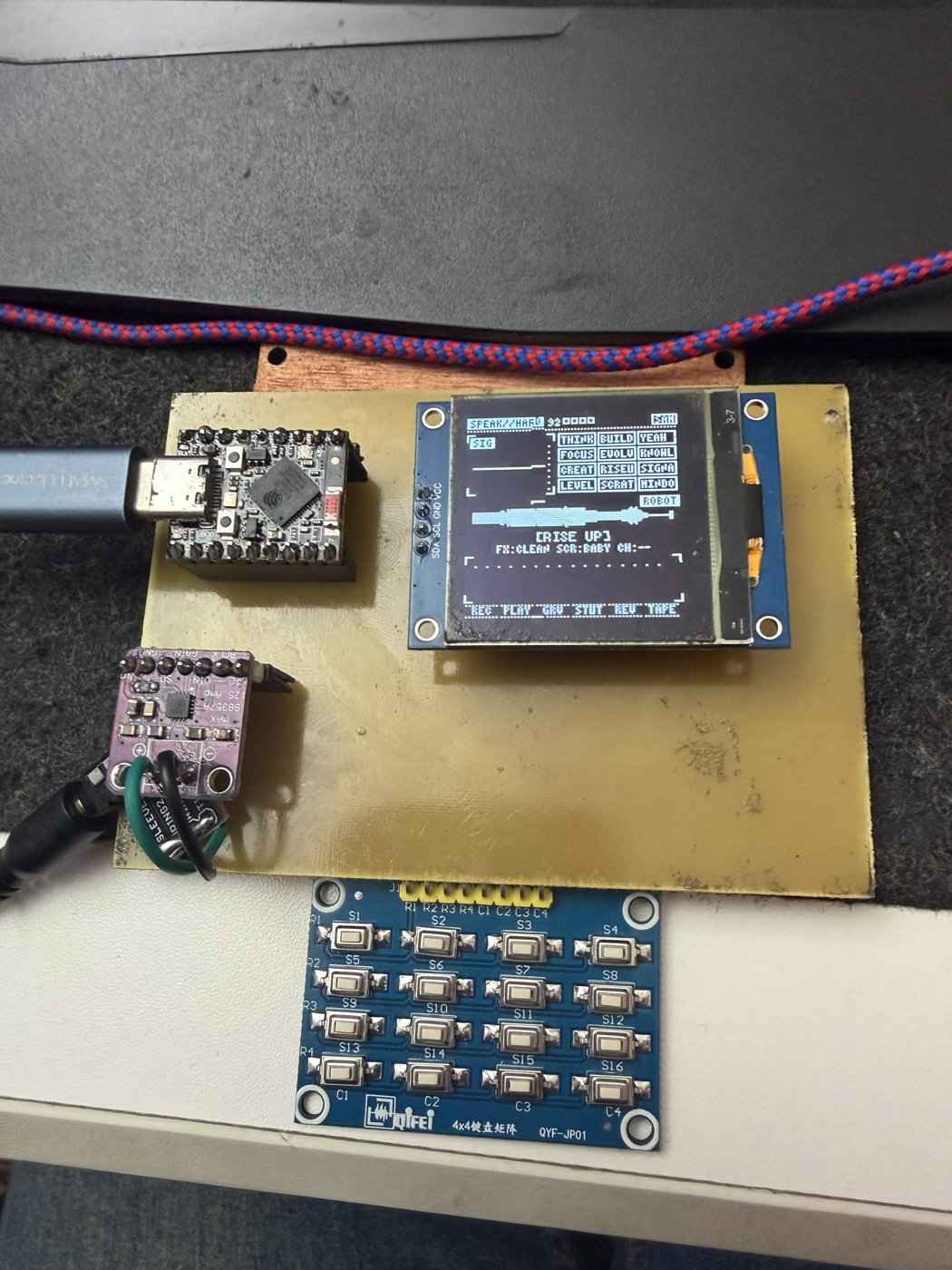
A handheld speech beat machine on an ESP32-S3. Four instruments (SAM voice, Talkie LPC voice, bytebeat, a 12-piece drum kit) on a 16-step sequencer, seven voice FX plus stutter/reverse/tape-stop/scratch, and a live HUD on a 128x128 OLED.
Co-created by Mark Hellar and Claude (Anthropic AI): hardware, design and sound direction by Mark; firmware and PCB layout co-written with Claude. PCB milled and soldered by Mark Hellar.
| Part | Notes |
|---|---|
| ESP32-S3 SuperMini | 4 MB flash, 2 MB PSRAM (PSRAM is required) |
| 1.5" SH1107 128x128 I2C OLED | header order VCC GND SCL SDA |
| MAX98357A I2S amp breakout + small speaker | VIN from 5V |
| 4x4 tact keypad module (QYF-JP01) | passive matrix, mounts on edge pads off the bottom edge |
| Pot module (optional) | edge pads on the right edge; not used by this firmware |
| Function | GPIO |
|---|---|
| OLED SDA / SCL | 9 / 8 |
| Keypad rows R1-R4 | 2, 3, 4, 5 |
| Keypad columns C1-C4 | 6, 7, 13, 12 |
| Amp LRC / BCLK / DIN | 1 / 44 / 43 |
| Pot wiper / pot high leg (driven HIGH) | 10 / 11 |
Single-sided, all copper on B.Cu, designed for CNC isolation milling on a 100 x 70 mm copper-clad blank. Modules plug into female headers; the keypad and pot modules lie on SMD edge pads with their right-angle pins.
hardware/ KiCad 10 project (schematic, PCB, symbol library, ks_cnc.pretty footprints)hardware/cnc/ Gerbers (B.Cu, Edge.Cuts), PTH/NPTH drills, a 1:1 fit-test PDF, and ready-made GRBL G-code:
1_isolation_0.1vbit.nc (0.1 mm 20 deg V-bit, Z -0.05) -> 2_holes_1.0drill.nc -> 3_mounting_2.0drill.nc -> 4_outline_score_0.1vbit.nc.
load_and_mirror.tcl regenerates the G-code in FlatCAM (mirrored, since the copper is on the bottom);
fix_drill_spinup.py patches drill files for GRBL laser mode. See CNC_CHEATSHEET.txt.Print PRINT_1to1_fit_test.pdf and check your modules against it before milling: the OLED, keypad and pot outlines were measured from photos and typical specs.
firmware/speakbeat_hard/ is the instrument. firmware/keypad_bringup/ is a quick test (keys play notes, OLED grid).
Build with the Arduino IDE or arduino-cli:
arduino-cli compile --fqbn "esp32:esp32:esp32s3:CDCOnBoot=cdc,PSRAM=enabled" firmware/speakbeat_hard
arduino-cli upload  --fqbn "esp32:esp32:esp32s3:CDCOnBoot=cdc,PSRAM=enabled" -p <port> firmware/speakbeat_hard
If the board sits silent after an upload, press RST: on the SuperMini the auto-reset can leave it in the bootloader.
Audio runs at 22.05 kHz in a task on core 0 (it also scans the keypad); the display loop runs on core 1.
The left keypad column holds the modifiers; the other 12 keys are pads.
[MODE ] [ pad 0 ] [ pad 1 ] [ pad 2 ]
[FX   ] [ pad 3 ] [ pad 4 ] [ pad 5 ]
[SEQ  ] [ pad 6 ] [ pad 7 ] [ pad 8 ]
[SHIFT] [ pad 9 ] [ pad 10] [ pad 11]
Tap a modifier for its quick action. Hold it and the screen shows what the 12 pads do while it's held.
| Modifier | Tap | Hold + pad 0..11 |
|---|---|---|
| MODE | next mode | SAM, TALK, BYTE, DRUM, VOL-, VOL+, BANK, voices ROBOT / SAM / ELF / E.T. / BRUTE |
| FX | next FX | CLEAN, CRUSH, ECHO, GRAIN, SWARM, VOX, MEGA, then momentary STUTTER, REVERSE, TAPE, UNDER, and scratch style |
| SEQ | REC on/off | REC, PLAY, GROOVE, AUTO, BPM-, BPM+, MUTATE, CHORDS, CLR VOX, CLR DRM, CLR BYT, CLR ALL |
| SHIFT | PLAY/STOP | per mode, see below |
| Mode | Pads | SHIFT + pad |
|---|---|---|
| SAM | 12 words; tap = say, hold = scratch | scratch the word |
| TALK | 12 LPC words, 4 banks (LIFTOFF, SKY, MATH, PHONETIC); tap = say, hold = scrub the frames | WHISPER, MONO, FREEZE, STRETCH, PITCH-, PITCH+, PITCH 0, GLITCH, BACKWARD, FORMANT-, FORMANT+, RESET |
| BYTE | 12 bytebeat formulas; tap = latch, hold = momentary | RATE/2, RATE*2, A-, A+, B-, B+, SYNC, STOP, CRUSH, REVERSE, RANDOM, RESET |
| DRUM | KICK SNARE CLAP HAT / OPEN 808 ANVIL PIPE / SLAM ZAP CRASH CHUG; tap = hit, hold = roll | mute that drum |
With REC on, everything you play is quantized into the 16 steps. It boots stopped with an empty pattern.
tools/drumsim.py is a Python port of the drum engine that prints each hit's level; run it after changing the PERC[] table.Details in THIRD_PARTY.md.
GPL v3. See LICENSE.
| Qty | Value | Footprint | References |
|---|---|---|---|
| 4 | MountingHole_3.2mm_M3 | MountingHole:MountingHole_3.2mm_M3 | H1, H2, H3, H4 |
| 1 | ESP32-S3_SuperMini | ks_cnc:ESP32-S3_SuperMini_CNC | U1 |
| 1 | Keypad 4x4 | ks_cnc:EdgePads_Keypad4x4_CNC | U4 |
| 1 | MAX98357A | ks_cnc:MAX98357A_Module_CNC | U2 |
| 1 | OLED 1.5in SH1107 | ks_cnc:OLED_1.5in_128x128_I2C_CNC | U3 |
| 1 | Pot 10k | ks_cnc:EdgePads_Pot_CNC | U5 |
It measures 96 × 66 mm and has 2 copper layers, 1.6 mm thick.
9 parts. The full list of its parts is on this page, with links to each part's symbol and footprint where PCBKit's library has them.
From the mhellar/speakhard repository on GitHub, at the commit this page was made from: the board is hardware/keypad_synth_revA.kicad_pcb and its schematic hardware/keypad_synth_revA.kicad_sch. PCBKit opens the board in the browser, with nothing to install.
Its repository publishes it under the GPL-3.0 licence: you may reuse it on that licence's terms (keep the author's notice, and for a copyleft licence share your changes alike).


FrameworkComputer/ExpansionCards
Reference designs and documentation to create Expansion Cards for the Framework Laptop

VoronDesign/Voron-Hardware
Cool Hardware designed by the Voron Design group

hackclub/OnBoard
💡 Join 1,000 teenagers and make your first PCB with a $100 grant!


adamws/kicad-kbplacer
KiCad plugin for automatic keyboard's key placement and routing