2 layers103 × 30.5 mm

 mhellar/blasteroid-megasynth1
At boot it plays a generative splash that's different every time: two random geometry scenes (string-art mandala, polygon rings, flow-field particles, a rotating tunnel, a 3D Lissajous knot), glitch cuts.
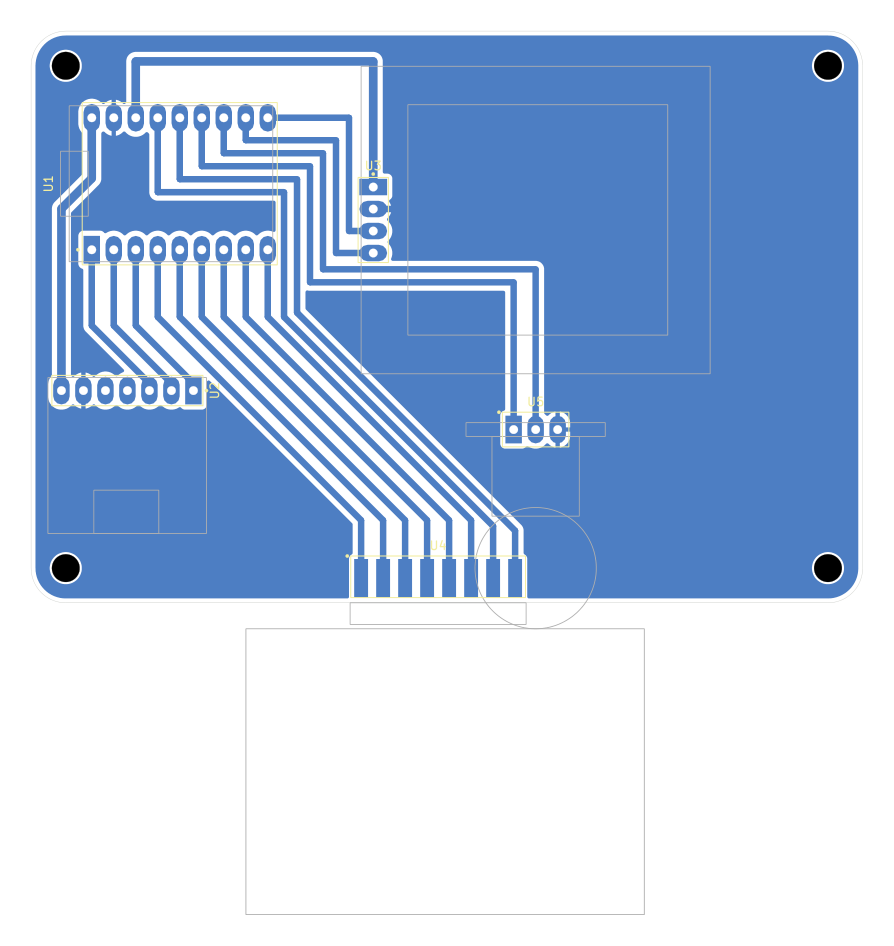
Keypad synth revB is an open-source printed circuit board by mhellar, from the mhellar/blasteroid-megasynth repository on GitHub, published under the GPL-3.0 licence. It is a 2-layer board of 96 × 66 mm with 9 parts on 20 nets, routed with 61 tracks and 0 vias.
It belongs with the keyboards and input and audio and music boards and the ESP32 boards of this library.
Experimental industrial ambient on an ESP32-S3. A slow machine drone you build from layers, two robot mouths (SAM, the 1982 Software Automatic Mouth, and the Talkie Speak & Spell LPC voice) that can freeze into drones, get scratched on a knob and talk to each other, a box of industrial noises, and a huge reverb "space". It runs on a 4x4 keypad, one rotary pot, a 128x128 OLED and a small speaker.
At boot it plays a generative splash that's different every time: two random geometry scenes (string-art mandala, polygon rings, flow-field particles, a rotating tunnel, a 3D Lissajous knot), glitch cuts. Then everything converges into the Blasteroid: a cyborg cyclops in wraparound shades. His eye charges up, two lasers burn BLASTEROID / MEGASYNTH in from opposite ends, SAM says the name, and Talkie answers "OPERATIONAL".

The board is a single-sided PCB designed to be milled on a desktop CNC. The modules plug into headers or edge pads, so there's no SMD soldering.
| Folder | Contents |
|---|---|
firmware/blasteroid_megasynth/ | The Blasteroid Megasynth sketch (Arduino), with SAM's C core and the Talkie vocabularies bundled alongside |
firmware/keypad_bringup/ | Bring-up test: I2C scan, every key plays a note, pot = volume. Flash this first |
firmware/short_finder/ | Finds pins shorted to GND or to each other on a freshly milled board (pull-ups only, safe) |
hardware/kicad/ | KiCad project for the board (rev B: pot standing under the OLED), custom symbols + footprints |
hardware/cnc/ | Gerbers + drills, G-code for a Genmitsu Cubiko (GRBL), FlatCAM script, 1:1 fit-test print, cheat sheet |
tools/ | splash_preview.py: a Python mirror of the boot splash that renders storyboards (python splash_preview.py <seed> <seconds...>, needs numpy + Pillow) |
| Ref | Part | Notes |
|---|---|---|
| U1 | ESP32-S3 SuperMini | 2x 1x9 female headers. Needs PSRAM (e.g. 4 MB flash / 2 MB PSRAM) |
| U2 | MAX98357A I2S amp breakout | 1x7 female header, VIN on 5 V, plus a small 4-8 ohm speaker |
| U3 | 1.5" 128x128 OLED, SH1107, I2C | 1x4 female header (VCC GND SCL SDA) |
| U4 | 4x4 tact keypad module (passive matrix, e.g. QYF-JP01) | hangs off the bottom edge; its right-angle pins lie on 8 edge pads |
| U5 | 10k rotary pot module (3 pins) | stands in 3 holes under the OLED, knob towards the keypad |
| 100 x 70 mm single-sided copper clad | board is 96 x 66 mm, M3 holes |
| Function | GPIO |
|---|---|
| OLED SDA / SCL | 9 / 8 |
| Amp DIN / BCLK / LRC | 43 (TX) / 44 (RX) / 1 |
| Keypad rows R1-R4 / columns C1-C4 | 2 3 4 5 / 6 7 13 12 |
| Pot wiper / pot high leg | 10 / 11 (driven HIGH as the pot's supply), low leg to GND |
The amp uses the TX/RX pins, so USB CDC On Boot must be Enabled (serial goes over native USB).
esp32:esp32:esp32s3:CDCOnBoot=cdc,PSRAM=enabledkeypad_bringup first to check the keys, pot, OLED and speaker, then blasteroid_megasynth.arduino-cli compile --fqbn esp32:esp32:esp32s3:CDCOnBoot=cdc,PSRAM=enabled firmware/blasteroid_megasynth
arduino-cli upload --fqbn esp32:esp32:esp32s3:CDCOnBoot=cdc,PSRAM=enabled -p COMx firmware/blasteroid_megasynthTips:
U8G2_SH1107_PIMORONI_128X128 constructor. The generic SH1107 one shifts the picture by 32 px.[MODE ] [ pad 0 ] [ pad 1 ] [ pad 2 ] left column: tap = quick action,
[FX ] [ pad 3 ] [ pad 4 ] [ pad 5 ] HOLD = the screen shows what the 12 pads do
[SEQ ] [ pad 6 ] [ pad 7 ] [ pad 8 ]
[SHIFT] [ pad 9 ] [ pad 10] [ pad 11]| Key | tap | hold + pad |
|---|---|---|
| MODE | next mode (HUM > SAM > TALK > MACH) | modes, volume, Talkie bank, REPLAY the boot film, SAM voice (ROBOT SAM GHOST DEEP) |
| FX | next voice FX | CLEAN ECHO RADIO GRAIN DEEP VOX CHOIR, momentary STUTTER / REVERSE / TAPE STOP / UNDERWATER, INFINITE (reverb freeze) |
| SEQ | REC on/off | PLAY, CROSSTALK, AUTO, BPM -/+, MUTATE, RANDOM machines (sparse > busy > factory), clears, SILENCE |
| SHIFT | PLAY/STOP | per mode: drone octave / brightness / LFO speed / detune; SAM words backwards; Talkie bends; machine mutes |
The knob
Modes
Single-sided, all copper on B.Cu, made for isolation milling. The Gerbers also work at a board house as a 1-layer board.
Full steps are in hardware/cnc/CNC_CHEATSHEET.txt: V-bit isolation, 1.0 mm drill, 2.0 mm drill, outline score.
The keypad's pins solder flat onto edge pads, and the pot stands in 3 holes.
Isolation gutters: with a single 0.1 mm V-bit pass, several SuperMini pads stayed shorted to the ground pour.
load_and_mirror.tclnow isolates with 3 passes (about a 0.3 mm gutter). The ready-made1_isolation_0.1vbit.ncis the older single-pass file, so regenerate it with FlatCAM (set the path at the top of the script). After milling, meter every header pad to GND before soldering, or flashshort_finderon a populated board.
Print PRINT_1to1_fit_test.pdf at 100% and check your modules against it before milling. The keypad and pot
outlines were measured from photos.
Licensed under the GNU GPL v3 (see LICENSE), matching the bundled SAM and Talkie code.
| Qty | Value | Footprint | References |
|---|---|---|---|
| 4 | MountingHole_3.2mm_M3 | MountingHole:MountingHole_3.2mm_M3 | H1, H2, H3, H4 |
| 1 | ESP32-S3_SuperMini | ks_cnc:ESP32-S3_SuperMini_CNC | U1 |
| 1 | Keypad 4x4 | ks_cnc:EdgePads_Keypad4x4_CNC | U4 |
| 1 | MAX98357A | ks_cnc:MAX98357A_Module_CNC | U2 |
| 1 | OLED 1.5in SH1107 | ks_cnc:OLED_1.5in_128x128_I2C_CNC | U3 |
| 1 | Pot 10k | ks_cnc:Pot_Standing_CNC | U5 |
It measures 96 × 66 mm and has 2 copper layers, 1.6 mm thick.
9 parts. The full list of its parts is on this page, with links to each part's symbol and footprint where PCBKit's library has them.
From the mhellar/blasteroid-megasynth repository on GitHub, at the commit this page was made from: the board is hardware/kicad/keypad_synth_revB.kicad_pcb and its schematic hardware/kicad/keypad_synth_revB.kicad_sch. PCBKit opens the board in the browser, with nothing to install.
Its repository publishes it under the GPL-3.0 licence: you may reuse it on that licence's terms (keep the author's notice, and for a copyleft licence share your changes alike).


FrameworkComputer/ExpansionCards
Reference designs and documentation to create Expansion Cards for the Framework Laptop

VoronDesign/Voron-Hardware
Cool Hardware designed by the Voron Design group

hackclub/OnBoard
💡 Join 1,000 teenagers and make your first PCB with a $100 grant!


adamws/kicad-kbplacer
KiCad plugin for automatic keyboard's key placement and routing