2 layers157.5 × 30.5 mm
Tube Driver
median-dispersion/GMT-Geiger-Counter
Geiger-Müller tube based Geiger counter.
45 partsGPL-3.0
 mfrisch3/ece315_project
LED button game
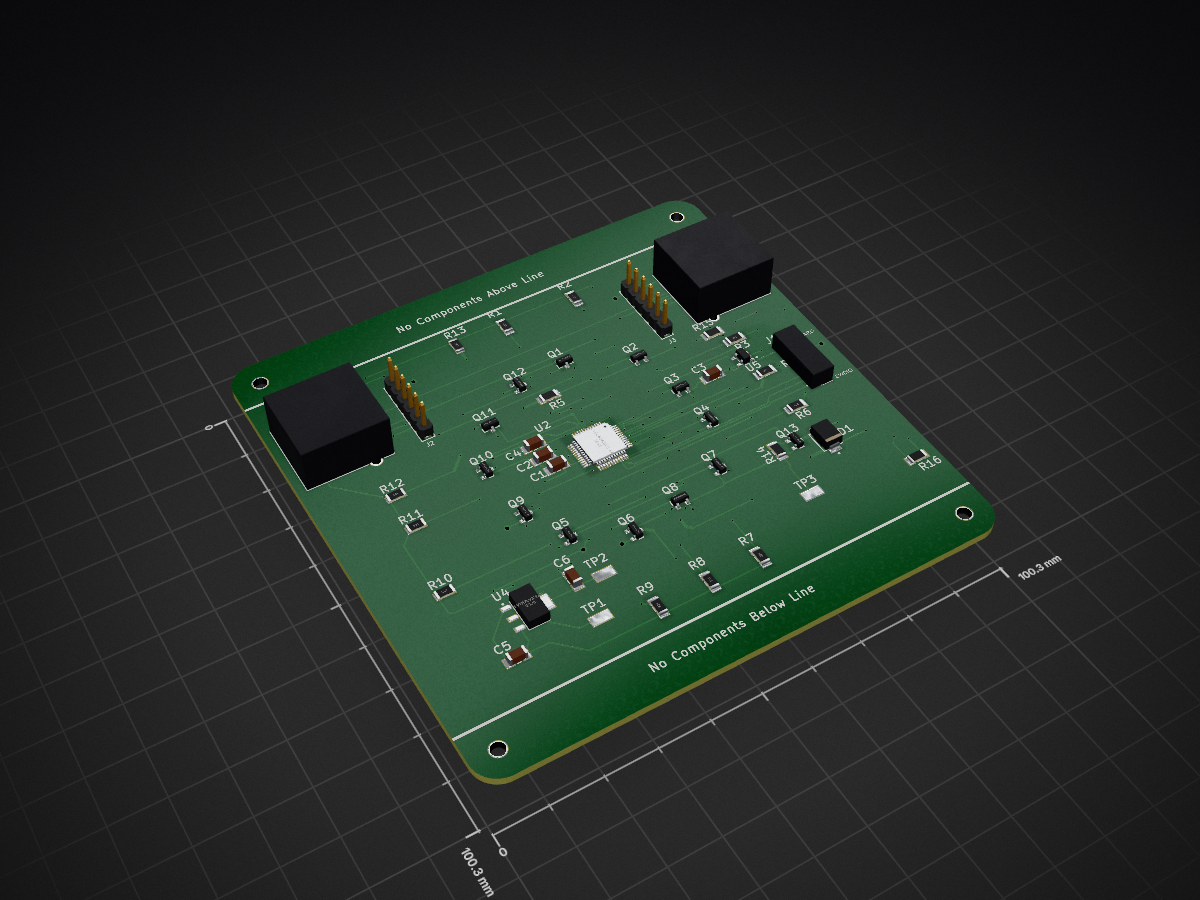
ECE315 is an open-source printed circuit board by mfrisch3, from the mfrisch3/ece315_project repository on GitHub. It is a 2-layer board of 100.3 × 100.3 mm with 67 parts on 52 nets, routed with 701 tracks and 145 vias.
It is built around the CY8C4045AZI-S413, SN74AHC1G08DBVR and TL3300DF160Q, with the TLV1117LV33DCYR, 2N7002-7-F-ES and 150120GS75000 among its other parts. Its parts include 16 resistors, 13 transistors, 6 capacitors, 5 ICs and 5 connectors.


This is a minimal starter application template for PSoC™ 4 devices.
Provide feedback on this code example.
ModusToolbox™ software v2.4 or later
Note: This code example version requires ModusToolbox™ software version 2.4 or later and is not backward compatible with v2.3 or older versions.
Board support package (BSP) minimum required version: 2.0.0
Programming language: C
Associated parts: PSoC™ 4000S, PSoC™ 4100S, PSoC™ 4100S Plus, PSoC™ 4500S, and PSoC™ 4100S Max
GCC_ARM) - Default value of TOOLCHAINARM)IAR)TARGETThis example uses the board's default configuration. See the kit user guide to ensure that the board is configured correctly.
Note: The PSoC™ 4 kits ship with KitProg2 installed. The ModusToolbox™ software requires KitProg3. Before using this code example, make sure that the board is upgraded to KitProg3. The tool and instructions are available in the Firmware Loader GitHub repository. If you do not upgrade, you will see an error like "unable to find CMSIS-DAP device" or "KitProg firmware is out of date".
This example requires no additional software or tools.
| Resources | Links |
|---|---|
| Application notes | AN79953 – Getting started with PSoC™ 4 |
| Code examples | Using ModusToolbox™ software on GitHub Using PSoC™ Creator |
| Device documentation | PSoC™ 4 datasheets PSoC™ 4 technical reference manuals |
| Development kits | Visit www.cypress.com/microcontrollers-mcus-kits and use the options in the Select your kit section to filter kits by Product family or Features. |
| Libraries on GitHub | mtb-pdl-cat2 – PSoC™ 4 peripheral driver library (PDL) mtb-hal-cat2 – Hardware abstraction layer (HAL) library |
| Tools | Eclipse IDE for ModusToolbox™ software – ModusToolbox™ software is a collection of easy-to-use software and tools enabling rapid development with Infineon MCUs, covering applications from embedded sense and control to wireless and cloud-connected systems using AIROC™ Wi-Fi and Bluetooth® connectivity devices. PSoC™ Creator – IDE for PSoC™ and FM0+ MCU development |
Cypress provides a wealth of data at www.cypress.com to help you select the right device, and quickly and effectively integrate it into your design.
Document title: CE230705 - PSoC™ 4: empty application template
| Version | Description of change |
|---|---|
| 1.0.0 | New code example |
| 2.0.0 | Major update to support ModusToolbox™ software v2.2, added support for new kits This version is not backward compatible with ModusToolbox™ software v2.1 |
| 2.1.0 | Added support for new kits |
© Cypress Semiconductor Corporation, 2020-2021. This document is the property of Cypress Semiconductor Corporation, an Infineon Technologies company, and its affiliates ("Cypress"). This document, including any software or firmware included or referenced in this document ("Software"), is owned by Cypress under the intellectual property laws and treaties of the United States and other countries worldwide. Cypress reserves all rights under such laws and treaties and does not, except as specifically stated in this paragraph, grant any license under its patents, copyrights, trademarks, or other intellectual property rights. If the Software is not accompanied by a license agreement and you do not otherwise have a written agreement with Cypress governing the use of the Software, then Cypress hereby grants you a personal, non-exclusive, nontransferable license (without the right to sublicense) (1) under its copyright rights in the Software (a) for Software provided in source code form, to modify and reproduce the Software solely for use with Cypress hardware products, only internally within your organization, and (b) to distribute the Software in binary code form externally to end users (either directly or indirectly through resellers and distributors), solely for use on Cypress hardware product units, and (2) under those claims of Cypress’s patents that are infringed by the Software (as provided by Cypress, unmodified) to make, use, distribute, and import the Software solely for use with Cypress hardware products. Any other use, reproduction, modification, translation, or compilation of the Software is prohibited.
TO THE EXTENT PERMITTED BY APPLICABLE LAW, CYPRESS MAKES NO WARRANTY OF ANY KIND, EXPRESS OR IMPLIED, WITH REGARD TO THIS DOCUMENT OR ANY SOFTWARE OR ACCOMPANYING HARDWARE, INCLUDING, BUT NOT LIMITED TO, THE IMPLIED WARRANTIES OF MERCHANTABILITY AND FITNESS FOR A PARTICULAR PURPOSE. No computing device can be absolutely secure. Therefore, despite security measures implemented in Cypress hardware or software products, Cypress shall have no liability arising out of any security breach, such as unauthorized access to or use of a Cypress product. CYPRESS DOES NOT REPRESENT, WARRANT, OR GUARANTEE THAT CYPRESS PRODUCTS, OR SYSTEMS CREATED USING CYPRESS PRODUCTS, WILL BE FREE FROM CORRUPTION, ATTACK, VIRUSES, INTERFERENCE, HACKING, DATA LOSS OR THEFT, OR OTHER SECURITY INTRUSION (collectively, "Security Breach"). Cypress disclaims any liability relating to any Security Breach, and you shall and hereby do release Cypress from any claim, damage, or other liability arising from any Security Breach. In addition, the products described in these materials may contain design defects or errors known as errata which may cause the product to deviate from published specifications. To the extent permitted by applicable law, Cypress reserves the right to make changes to this document without further notice. Cypress does not assume any liability arising out of the application or use of any product or circuit described in this document. Any information provided in this document, including any sample design information or programming code, is provided only for reference purposes. It is the responsibility of the user of this document to properly design, program, and test the functionality and safety of any application made of this information and any resulting product. "High-Risk Device" means any device or system whose failure could cause personal injury, death, or property damage. Examples of High-Risk Devices are weapons, nuclear installations, surgical implants, and other medical devices. "Critical Component" means any component of a High-Risk Device whose failure to perform can be reasonably expected to cause, directly or indirectly, the failure of the High-Risk Device, or to affect its safety or effectiveness. Cypress is not liable, in whole or in part, and you shall and hereby do release Cypress from any claim, damage, or other liability arising from any use of a Cypress product as a Critical Component in a High-Risk Device. You shall indemnify and hold Cypress, including its affiliates, and its directors, officers, employees, agents, distributors, and assigns harmless from and against all claims, costs, damages, and expenses, arising out of any claim, including claims for product liability, personal injury or death, or property damage arising from any use of a Cypress product as a Critical Component in a High-Risk Device. Cypress products are not intended or authorized for use as a Critical Component in any High-Risk Device except to the limited extent that (i) Cypress’s published data sheet for the product explicitly states Cypress has qualified the product for use in a specific High-Risk Device, or (ii) Cypress has given you advance written authorization to use the product as a Critical Component in the specific High-Risk Device and you have signed a separate indemnification agreement.
Cypress, the Cypress logo, and combinations thereof, WICED, ModusToolbox, PSoC, CapSense, EZ-USB, F-RAM, and Traveo are trademarks or registered trademarks of Cypress or a subsidiary of Cypress in the United States or in other countries. For a more complete list of Cypress trademarks, visit cypress.com. Other names and brands may be claimed as property of their respective owners.
| Qty | Value | Footprint | References |
|---|---|---|---|
| 13 | 2N7002-7-F | Vault:FP-SOT23-MFG | Q1, Q2, Q3, Q4, Q5, Q6, Q7, Q8, Q9, Q10, Q11, Q12, Q13 |
| 8 | 330R | Vault:FP-CRCW1206-e3-IPC_A | R1, R2, R3, R4, R6, R7, R8, R9 |
| 6 | 1uF | Vault:CAPC3216X180X50ML20T25 | C1, C2, C3, C4, C5, C6 |
| 4 | 150120GS75000 | Vault:WL-SMCW_1206_150120xx75000 | LED_G1, LED_G2, LED_G3, LED_G4 |
| 4 | 560R | Vault:RESC3216X70X50LL05T20 | R10, R11, R12, R13 |
| 4 | MHOLE_2_55MM | PAPR:MHOLE_2_55MM | MH1, MH2, MH3, MH4 |
| 4 | SML-LX1206IC-TR | Vault:LUMX-SML-LX1206IC_V | LED_R1, LED_R2, LED_R3, LED_R4 |
| 4 | SML-LX1206YC-TR | Vault:LUMX-SML-LX1206YC-TR_V | LED_Y1, LED_Y2, LED_Y3, LED_Y4 |
| 3 | 5019 | Vault:KSTN-5019_V | TP1, TP2, TP3 |
| 3 | RC1206FR-0710KL | Vault:RESC3116X65X40ML10T20 | R14, R15, R16 |
| 2 | Miscellaneous Connectors:HDR1X6 | J2, J3 | |
| 2 | 615008138221 | Vault:615008138221 | J4, J5 |
| 1 | 10129380-905002BLF | ECE315:AMPHENOL_10129380-905002BLF | J1 |
| 1 | 10KOhm | Vault:RESC3116X65X40ML10T20 | R5 |
| 1 | B340LB-13-F | Vault:FP-SMB-MFG | D1 |
| 1 | B3U-1000P | Vault:FP-B3U-1000P-MFG | SW1 |
| 1 | Bucky | ece353-2022:WalkingBucky | U1 |
| 1 | CMT-8540S-SMT | ECE315:CUI_CMT-8540S-SMT | LS1 |
| 1 | CY8C4045AZI-S413 | ECE315:TQFP48_7X7 | U2 |
| 1 | SN74AHC1G08DBVR | Vault:FP-DBV0005A-MFG | U5 |
| 1 | TL3300DF160Q | ECE315:TL3300DF160Q | U3 |
| 1 | TLV1117LV33DCYR | Vault:DCY0004A_N | U4 |
It measures 100.3 × 100.3 mm and has 2 copper layers, 1.6 mm thick.
67 parts, built around the CY8C4045AZI-S413, SN74AHC1G08DBVR, TL3300DF160Q and TLV1117LV33DCYR. The full list of its parts is on this page, with links to each part's symbol and footprint where PCBKit's library has them.
From the mfrisch3/ece315_project repository on GitHub, at the commit this page was made from: the board is ECE_315_PCB_Project/ECE315.kicad_pcb and its schematic ECE_315_PCB_Project/01-Revision_History_and_Contents.kicad_sch. PCBKit opens the board in the browser, with nothing to install.
Its repository states no licence, so its author keeps all rights: ask mfrisch3 before reusing the design.
median-dispersion/GMT-Geiger-Counter
Geiger-Müller tube based Geiger counter.

ncsurobotics/SW8E-Regulator-Carseat
Holding board for the on-board computer dual regulator setup

NabuCasa/yellow
Home Assistant Yellow - hardware for Home Assistant which grows with your needs.

sanketh0103/5V_SMPS-with-Timer
240V - 5V SMPS 1A Power supply, it has a relay that can be used to control mains powered devices. This PCB can also act as a timed switch.

fliperama86/superpico-digital
SuperPico Digital is a digital-to-digital HDMI mod for 2-chip SNES consoles using the Raspberry Pi Pico 2 (RP2350)

alvarop/swd2usbc
Have you ever wanted to debug your device over USB-C? Sometimes there's not enough room for a JTAG/SWD connector, or even Tag-Connect pads!

LSUTigerRacing/Electronics
This repository contains all of the KiCad Schematics for the 2026 TigerRacing Formula SAE's Electronics Subsystem.
