2 layers90 × 140 mm
Drumkid
mattybrad/drumkid
Version 4 was the first successful working design, with full code, schematics, Gerbers, etc available on GitHub.
70 parts137

 mattybrad/drumkid137
Version 4 was the first successful working design, with full code, schematics, Gerbers, etc available on GitHub.
Drumkid is an open-source printed circuit board by mattybrad, from the mattybrad/drumkid repository on GitHub. It is a 2-layer board of 90 × 120 mm with 61 parts on 47 nets, routed with 416 tracks and 11 vias.
It is built around the ATMEGA328P-PU and LM386. Its parts include 15 capacitors, 11 resistors, 7 switches, 6 connectors and 5 diodes. It belongs with the AVR (ATmega, ATtiny) boards of this library.


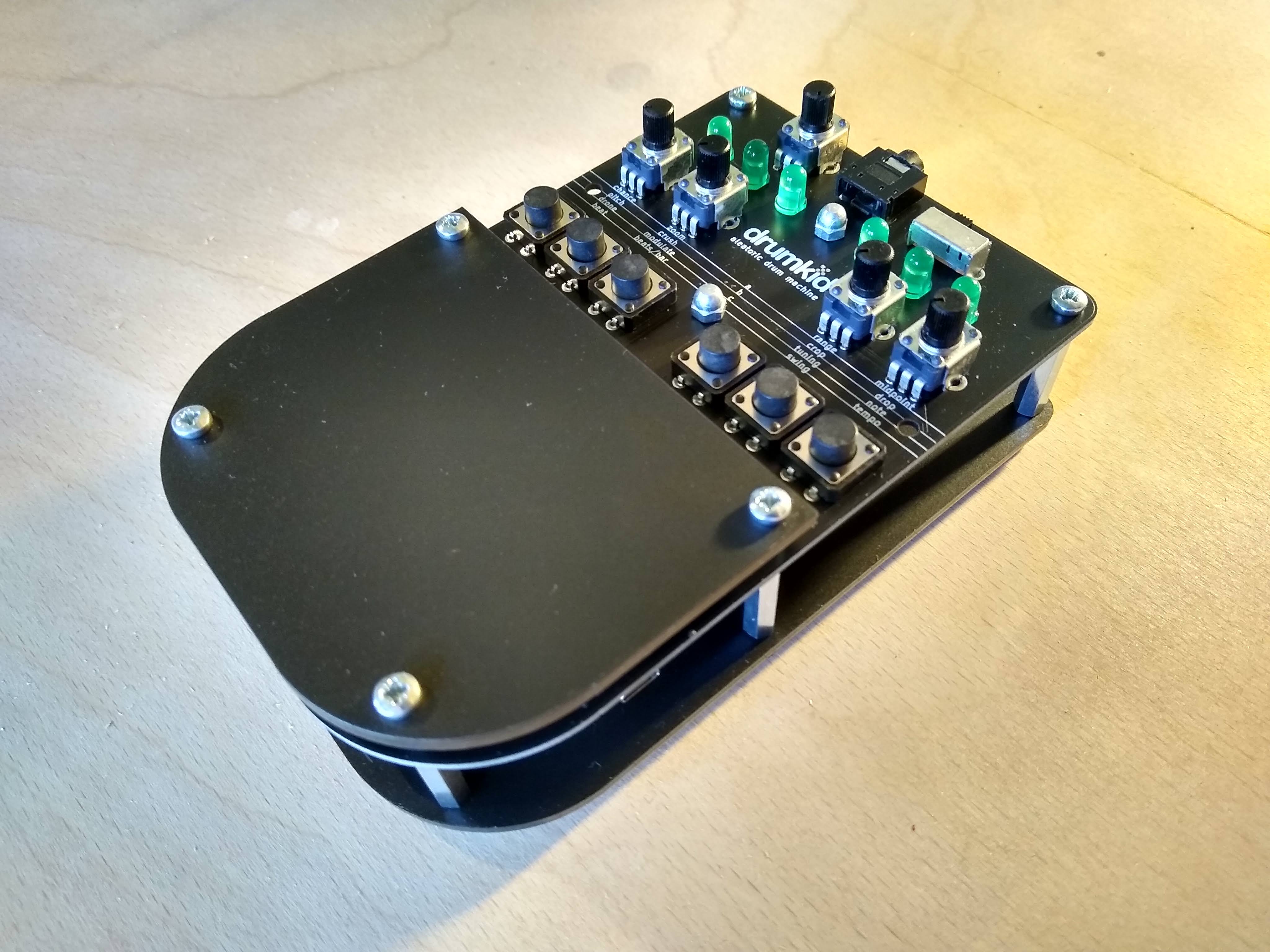
A drum machine which generates rhythms using probability. Imagine a traditional step-based drum machine, but where various dice are rolled for each step, with the resulting numbers used to determine the behaviour of the beat.
You can buy Drumkid fully assembled or as a kit from <mattbradshawdesign.com>
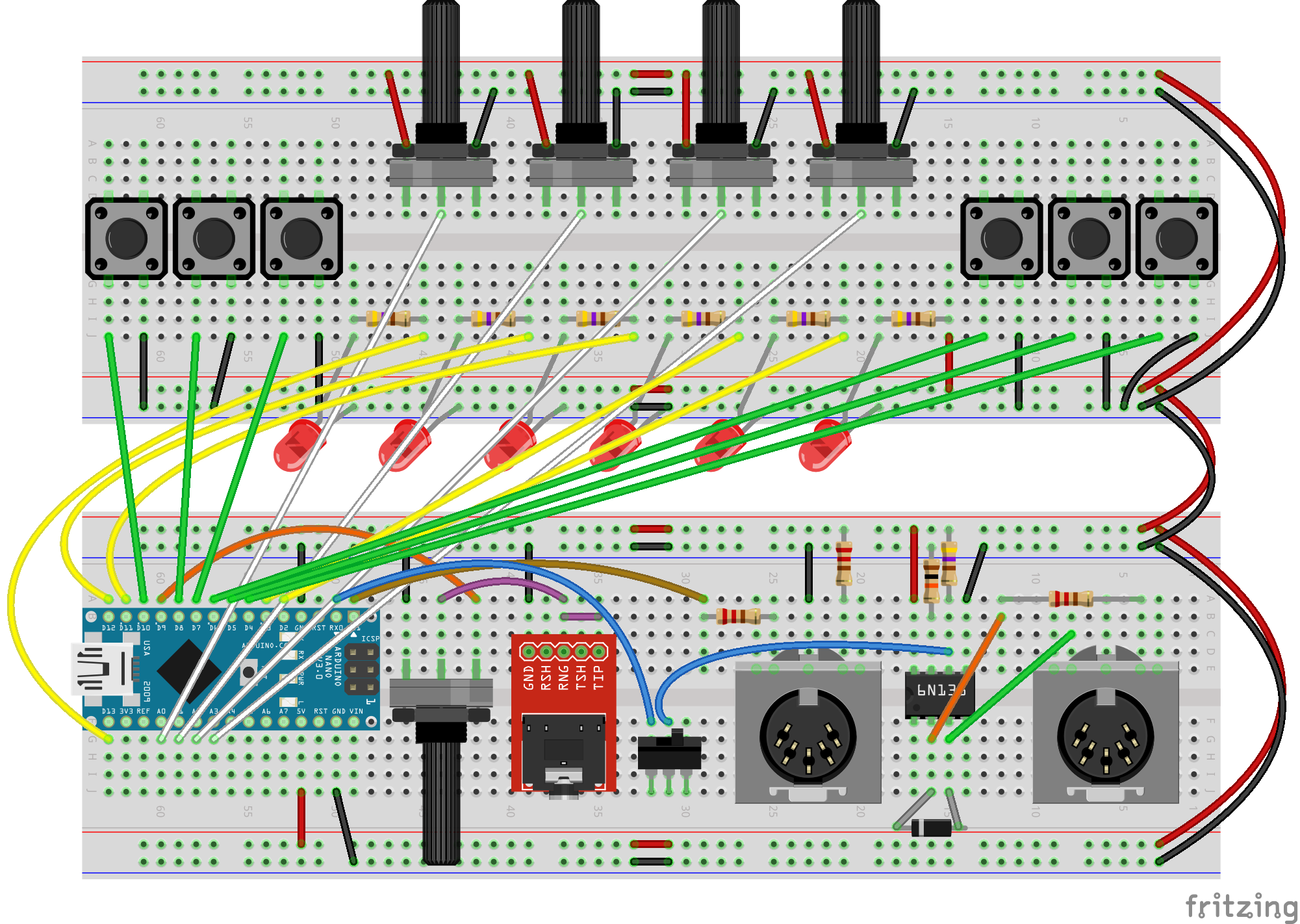
DrumKid is based around an Arduino Nano, and coded using the Arduino IDE. Audio is produced by the Mozzi library. You can build a version of DrumKid using an Arduino, a breadboard, and standard electronic components, or you can build/buy the "full" version described below.
DrumKid is a portable, handheld, battery-powered instrument with a minimalist design. It consists of a PCB (printed circuit board) for the front panel, featuring knobs, buttons, LEDs, a power switch and a headphone/line output. The electronics are protected/enclosed by two laser-cut acrylic pieces and six metal standoffs.
This project is almost entirely open source. The code, breadboard layout, schematics, Gerber (PCB) files, and laser-cutter files are all included in the repository, with the aim of making this project easy to duplicate and adapt. Please note that the project depends on the Mozzi library, which is released under a Creative Commons non-commercial licence. I have used it here with kind permission from its creator, but please be aware that if you create a commercial product using this code, you will need to request permission from him. Go to https://sensorium.github.io/Mozzi/ for more details.
Versions 1-3 were early prototypes.
Version 4 was the first successful working design, with full code, schematics, Gerbers, etc available on GitHub.
Version 5 contained various PCB errors and has been superseded.
Versions 6 onwards were used in the final product, with version 10 being the latest at the time of writing.
| Qty | Value | Footprint | References |
|---|---|---|---|
| 6 | SW_Push | headphone:SW_PUSH-12mm_Wuerth-430476085716_NOSILK | SW2, SW3, SW4, SW5, SW6, SW7 |
| 5 | 220 | headphone:R_Axial_DIN0207_L6.3mm_D2.5mm_P10.16mm_Horizontal_VALMOD | R3, R4, R5, R6, R7 |
| 5 | LED | headphone:LED_D5.0mm_NOSILK | D2, D3, D4, D5, D6 |
| 4 | CP | Capacitor_THT:CP_Radial_D6.3mm_P2.50mm | C7, C8, C11, C12 |
| 4 | R_POT | headphone:Potentiometer_Alps_RK09K_Single_Vertical_NOSILK | RV2, RV3, RV4, RV5 |
| 2 | 100nF | Capacitor_THT:C_Disc_D3.4mm_W2.1mm_P2.50mm | C16, C18 |
| 2 | 10k | headphone:R_Axial_DIN0207_L6.3mm_D2.5mm_P10.16mm_Horizontal_VALMOD | R2, R9 |
| 2 | 10uF | Capacitor_THT:CP_Radial_D6.3mm_P2.50mm | C15, C17 |
| 2 | 22pF | Capacitor_THT:C_Disc_D3.4mm_W2.1mm_P2.50mm | C5, C6 |
| 2 | C | Capacitor_THT:C_Disc_D3.4mm_W2.1mm_P2.50mm | C4, C9 |
| 2 | Conn_01x04_Female | Connector_PinHeader_2.54mm:PinHeader_1x04_P2.54mm_Vertical | J1, J6 |
| 2 | Conn_01x05_Female | Connector_PinHeader_2.54mm:PinHeader_1x05_P2.54mm_Vertical | J5, J8 |
| 1 | 10 | headphone:R_Axial_DIN0207_L6.3mm_D2.5mm_P10.16mm_Horizontal_VALMOD | R11 |
| 1 | 10k | headphone:Potentiometer_Alps_RK09K_Single_Vertical_NOSILK | RV1 |
| 1 | 1k | headphone:R_Axial_DIN0207_L6.3mm_D2.5mm_P10.16mm_Horizontal_VALMOD | R10 |
| 1 | 2.2uF | Capacitor_THT:CP_Radial_D6.3mm_P2.50mm | C13 |
| 1 | 220nF | Capacitor_THT:C_Disc_D3.4mm_W2.1mm_P2.50mm | C14 |
| 1 | 220uF | Capacitor_THT:CP_Radial_D6.3mm_P2.50mm | C10 |
| 1 | 47 | headphone:R_Axial_DIN0207_L6.3mm_D2.5mm_P10.16mm_Horizontal_VALMOD | R1 |
| 1 | 470 | headphone:R_Axial_DIN0207_L6.3mm_D2.5mm_P10.16mm_Horizontal_VALMOD | R8 |
| 1 | ATmega328P-PU | Package_DIP:DIP-28_W7.62mm_Socket | U2 |
| 1 | AudioJack3_Ground_Switch | headphone:Tayda_3.5mm_stereo_TRS_jack_A-853_NOSILK | J9 |
| 1 | Battery | Connector_Wire:SolderWirePad_1x02_P5.08mm_Drill1.5mm | BT1 |
| 1 | Conn_01x06_Female | Connector_PinHeader_2.54mm:PinHeader_1x06_P2.54mm_Vertical | J7 |
| 1 | Crystal | Crystal:Crystal_HC49-4H_Vertical | Y1 |
| 1 | LM386 | Package_DIP:DIP-8_W7.62mm_Socket | U3 |
| 1 | SW_SPDT | headphone:EG1206_NOSILK | SW1 |
The 53 most common of 61 parts.
mattybrad/drumkid
Version 4 was the first successful working design, with full code, schematics, Gerbers, etc available on GitHub.

mattybrad/drumkid
Version 4 was the first successful working design, with full code, schematics, Gerbers, etc available on GitHub.

mattybrad/drumkid
Version 4 was the first successful working design, with full code, schematics, Gerbers, etc available on GitHub.

mattybrad/drumkid
Version 4 was the first successful working design, with full code, schematics, Gerbers, etc available on GitHub.

mattybrad/drumkid
Version 4 was the first successful working design, with full code, schematics, Gerbers, etc available on GitHub.

mattybrad/drumkid
Version 4 was the first successful working design, with full code, schematics, Gerbers, etc available on GitHub.

leomil72/LM80C
A Z80-based homebrew computer withTMS9918, AY-3-8910, Z80 CTC, Z80 PIO, and Z80 SIO


oskitone/scout_2_prototype
This is a prototype around a PCB I sent off to fab in March 2022... that I'm slowly bringing back to life. I'm kind of using it as a springboard for the next thing, whatever that is and whenever it happens!


profdc9/RFBitBanger
A QRP digital transceiver created from readily available parts for off-the-grid maintenance

oskitone/poly555
The POLY555 is a polyphonic, analog, square wave synth based on the 555 timer chip.

robfinch/Cores
Cores ===== RTF's Cores Use at your own risk. Welcome to my galaxy of cores. Contained in the directories are IP cores, source code for digital circuits.

It measures 90 × 120 mm and has 2 copper layers, 1.6 mm thick.
61 parts, built around the ATMEGA328P-PU and LM386. The full list of its parts is on this page, with links to each part's symbol and footprint where PCBKit's library has them.
From the mattybrad/drumkid repository on GitHub, at the commit this page was made from: the board is pcb/v4/drumkid.kicad_pcb. PCBKit opens the board in the browser, with nothing to install.
Its repository states no licence, so its author keeps all rights: ask mattybrad before reusing the design.