2 layers281.8 × 166.9 mm
Micro redox semi split
makenova/micro_redox
A family of boards inspired by the microdox and ferris
96 parts13

 makenova/micro_redox13
A family of boards inspired by the microdox and ferris
Micro redox split is an open-source printed circuit board by makenova, from the makenova/micro_redox repository on GitHub. It is a 2-layer board of 99.7 × 162.5 mm with 20 parts on 24 nets, routed with 392 tracks and 18 vias.
Its parts include 2 ICs and 1 switch. It belongs with the AVR (ATmega, ATtiny) boards of this library.
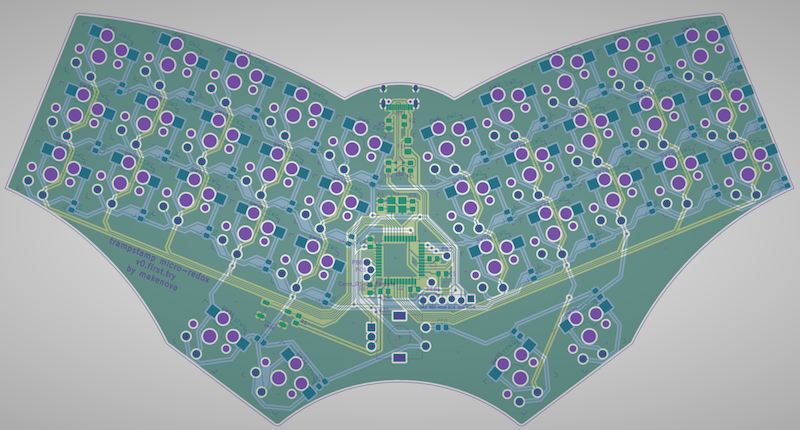
There are production files in the "gerbers" directory for the pcb and a skeleton case. Simply upload the zip files to your PCB manufacturer of choice.
If you do not get this assembled by a factory you can find an interactive BOM in bom directory.
Starting firmware can be found on my QMK fork in the makenova branch.
| Qty | Value | Footprint | References |
|---|---|---|---|
| 17 | MX-NoLED | keyswitches:Kailh_socket_PG1350_optional_reversible | MX1, MX2, MX3, MX4, MX5, MX6, MX7, MX8, MX10, MX11, MX12, MX13, MX14, MX15, MX16, MX17 +1 |
| 1 | ProMicro | kbd:ProMicro_v2-makenova-micro-redox | U1 |
| 1 | SW_SPST | random-keyboard-parts:SKQG-1155865-makenova-reversible | SW1 |
| 1 | TRRS | Keebio-Parts:TRRS-PJ-320A-no-Fmask-makenova-reversible | U2 |
makenova/micro_redox
A family of boards inspired by the microdox and ferris


atopile/atopile
Design circuit boards with code! ✨ Get software-like design reuse 🚀, validation, version control and collaboration in hardware; starting with electronics ⚡️

davidphilipbarr/Sweep
Sweep - a small promicro based keyboard inspired by the Ferris.

rusefi/rusefi
rusefi - GPL internal combustion engine control unit

hoglet67/RGBtoHDMI
Bare-metal Raspberry Pi project that provides pixel-perfect sampling of Retro Computer RGB/YUV video and conversion to HDMI

hackclub/OnBoard
💡 Join 1,000 teenagers and make your first PCB with a $100 grant!

FreeYourStream/freedeck-hardware
all the stuff you need to build your own FreeDeck
It measures 99.7 × 162.5 mm and has 2 copper layers, 1.6 mm thick.
20 parts. The full list of its parts is on this page, with links to each part's symbol and footprint where PCBKit's library has them.
From the makenova/micro_redox repository on GitHub, at the commit this page was made from: the board is micro_redox_split/micro_redox_split.kicad_pcb. PCBKit opens the board in the browser, with nothing to install.
Its repository states no licence, so its author keeps all rights: ask makenova before reusing the design.