13 layers100 × 100 mm

 mackieks/thundervolt36
Stylish, highly integrated power hat for Nintendo Wii, with software-controlled undervolting
Thundervolt hw1 is an open-source printed circuit board by mackieks, from the mackieks/thundervolt repository on GitHub. It is a 13-layer board of 46.9 × 54.8 mm with 59 parts on 33 nets, routed with 807 tracks and 458 vias.
It is built around the TPS628681ARQYR, TPS628682ARQYR and NX7002BKMYL. Its parts include 27 capacitors, 7 ICs, 6 resistors, 4 inductors and 1 diode. It belongs with the AVR (ATmega, ATtiny) boards of this library.


Thundervolt is a suite of open-source hardware and software that enables software-configurable undervolting of 4-layer Wiis.
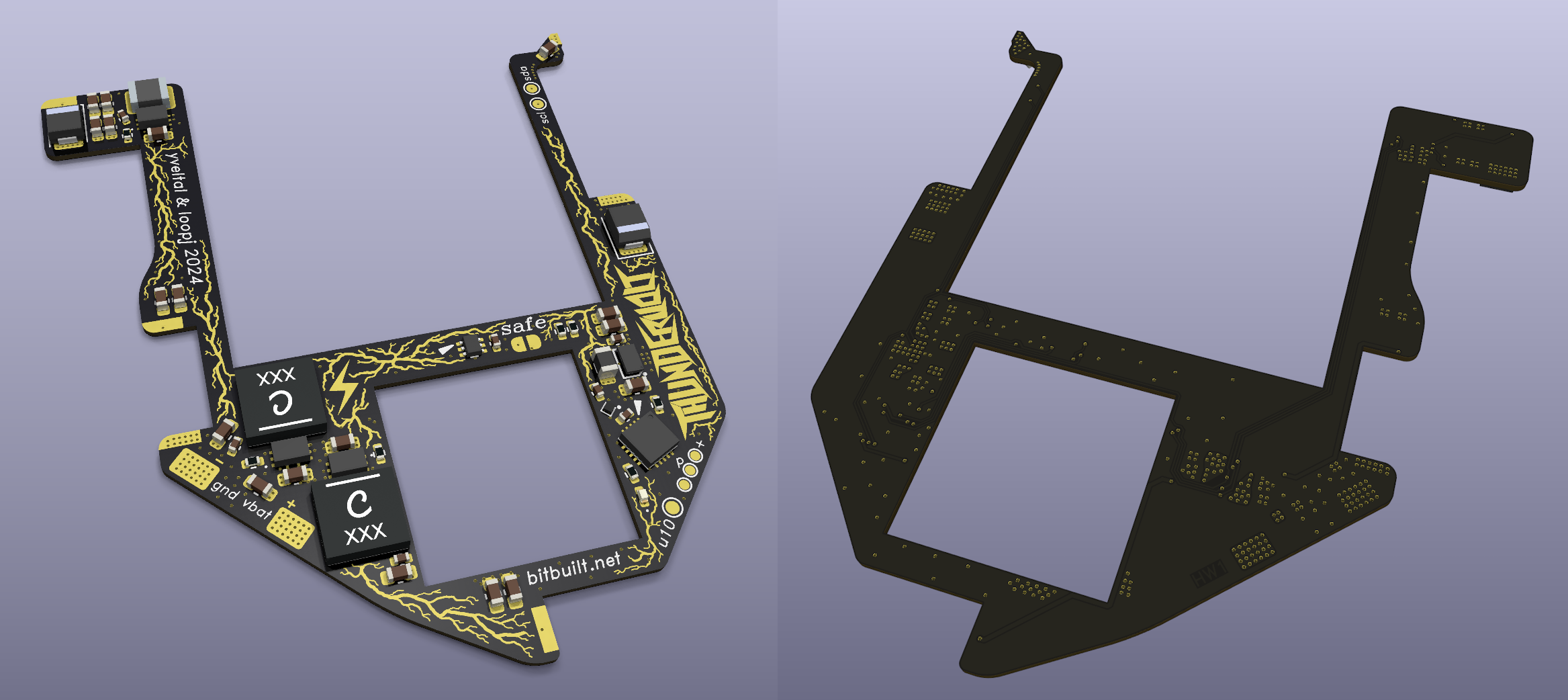
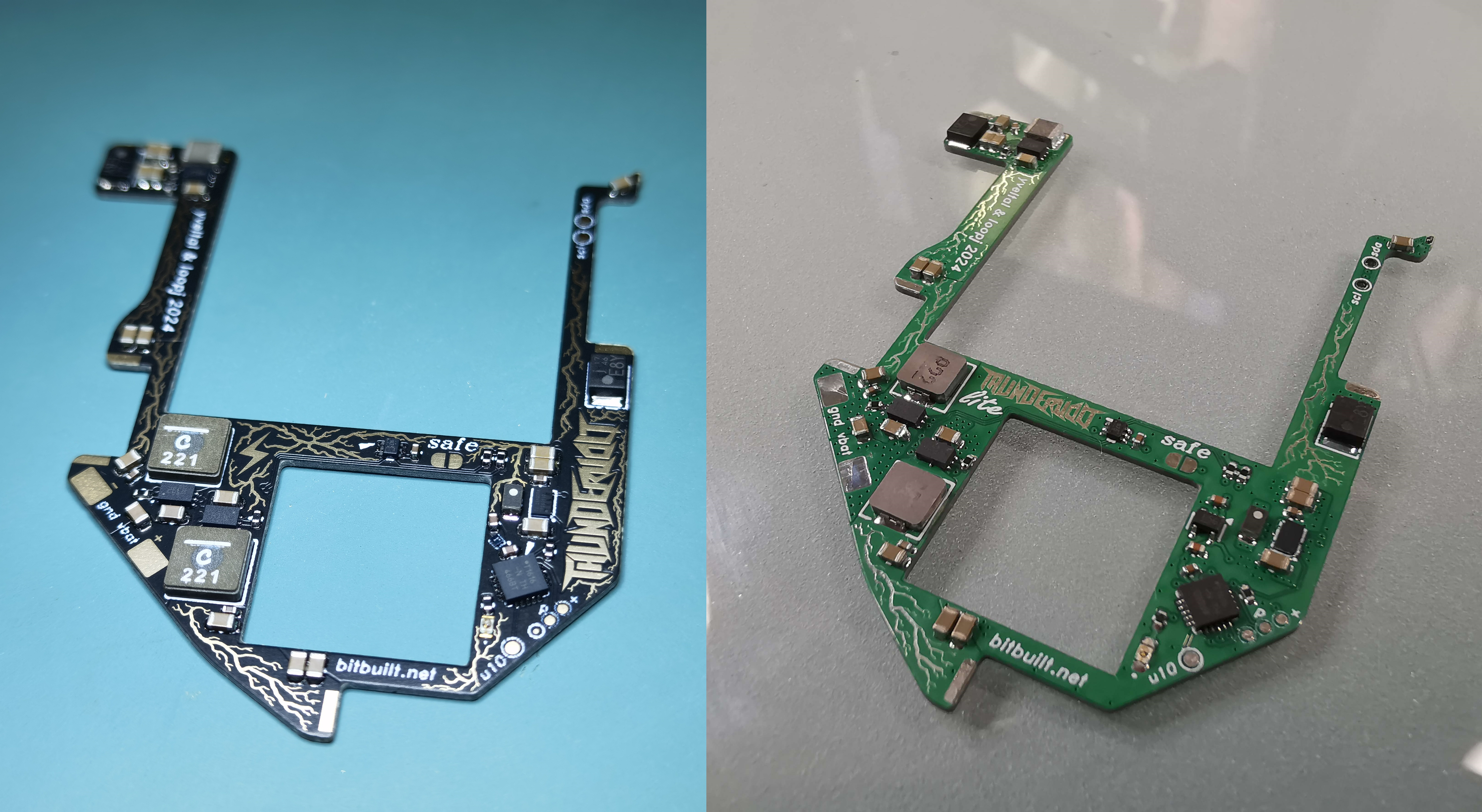
The Thundervolt PCBs (Thundervolt 1 and Thundervolt Lite shown) are stylish, highly-integrated power hats for 4-layer Wiis that solder directly to the Wii motherboard. Only 3 wires are necessary to connect Thundervolt to the Wii (I2C and Reset). Power is supplied via two additional wires.
The Thundervolt homebrew app (Dolphin debug version shown) provides granular control over each voltage regulator on the Thundervolt board, as well as emergency overtemperature protection with a configurable threshold.
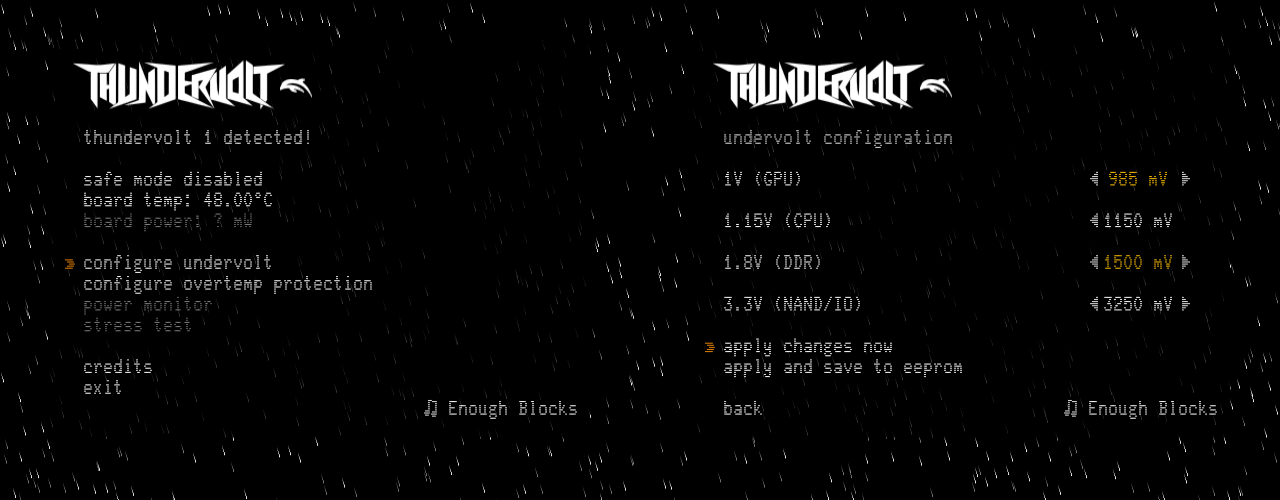
Users can apply changes live, and save settings to Thundervolt's EEPROM for persistence across reboots.
More functionality such as CPU/GPU/MEM stress tests and a power monitor for Thundervolt 2 will be added to the app in the future.
Adding a full BMS to Thundervolt would require major sacrifices to regulator efficiency, thermal performance, and cost. A companion board called Mjolnir is in development to fulfill these needs, and will feature tight integration with the existing Thundervolt ecosystem.
See the hardware folder for details on ordering and assembling Thundervolt PCBs.
The homebrew app is pretty self explanatory; see the demo on YouTube for details. A full writeup will come later.
Thundervolt hardware designed by YveltalGriffin
Thundervolt firmware by loopj
Thundervolt homebrew by:
Thundervolt hardware is licensed under Solderpad Hardware License v2.1.
Thundervolt software (firmware + homebrew) is provided under The MIT License.
| Qty | Value | Footprint | References |
|---|---|---|---|
| 18 | 22uF | Capacitor_SMD:C_0603_1608Metric | C1, C3, C4, C6, C10, C11, C12, C13, C15, C16, C18, C19, C20, C21, C23, C24 +2 |
| 5 | 0.1uF | Capacitor_SMD:C_0402_1005Metric | C2, C8, C14, C17, C26 |
| 2 | 133k | Resistor_SMD:R_0402_1005Metric | R1, R7 |
| 2 | 150uF | Capacitor_Tantalum_SMD:CP_EIA-3528-15_AVX-H | C5, C189 |
| 2 | 1uF | Capacitor_SMD:C_0402_1005Metric | C22, C25 |
| 2 | 220nH | SamacSys_Parts:XFL5015152MEC | L1, L2 |
| 2 | 4.7k | Resistor_SMD:R_0402_1005Metric | R4, R5 |
| 2 | GND | project-footprints:TestPoint_Pad_3x1.0mm | TP5, TP7 |
| 2 | SDA | TestPoint:TestPoint_Pad_D1.0mm | TP6, TP8 |
| 2 | TPS628681ARQYR | SamacSys_Parts:TPS628680ARQYR | U1, U2 |
| 1 | 1V0 | project-footprints:TestPoint_Pad_3x1.0mm | TP4 |
| 1 | 1V15 | project-footprints:TestPoint_Pad_3x1.0mm | TP3 |
| 1 | 1V8 | project-footprints:TestPoint_Pad_3x1.0mm | TP2 |
| 1 | 220nH | SamacSys_Parts:INDC3225X120N | L3 |
| 1 | 249k | Resistor_SMD:R_0402_1005Metric | R2 |
| 1 | 3V3 | project-footprints:TestPoint_Pad_1.5x1.0mm | TP1 |
| 1 | 470nH | Inductor_SMD:L_0805_2012Metric | L4 |
| 1 | 86.6k | Resistor_SMD:R_0402_1005Metric | R3 |
| 1 | ATTINY1616-MNR | Package_DFN_QFN:VQFN-20-1EP_3x3mm_P0.4mm_EP1.7x1.7mm | U5 |
| 1 | GND | TestPoint:TestPoint_Pad_D1.0mm | TP11 |
| 1 | LED | SamacSys_Parts:LED_0603_1608Metric | D1 |
| 1 | LP5907UVX-1.8_NOPB | SamacSys_Parts:BGA4C35P2X2_64X64X44 | IC4 |
| 1 | NX7002BKMYL | Package_DFN_QFN:Diodes_DFN1006-3 | Q1 |
| 1 | SCL | TestPoint:TestPoint_Pad_D1.0mm | TP9 |
| 1 | SolderJumper_2_Open | Jumper:SolderJumper-2_P1.3mm_Open_RoundedPad1.0x1.5mm | JP1 |
| 1 | TMP1075NDRLR | SamacSys_Parts:SOTFL50P160X60-6N | U7 |
| 1 | TPS628682ARQYR | SamacSys_Parts:TPS628680ARQYR | U3 |
| 1 | TPS63810YFFR | SamacSys_Parts:BGA15C40P3X5_134X226X62 | U4 |
| 1 | UPDI | TestPoint:TestPoint_Pad_D1.0mm | TP12 |
| 1 | VBAT | TestPoint:TestPoint_Pad_D1.0mm | TP10 |
It measures 46.9 × 54.8 mm and has 13 copper layers, 0.6 mm thick.
59 parts, built around the TPS628681ARQYR, TPS628682ARQYR and NX7002BKMYL. The full list of its parts is on this page, with links to each part's symbol and footprint where PCBKit's library has them.
From the mackieks/thundervolt repository on GitHub, at the commit this page was made from: the board is hardware/KiCad/thundervolt_1/thundervolt_hw1.kicad_pcb and its schematic hardware/KiCad/thundervolt_1/thundervolt_hw1.kicad_sch. PCBKit opens the board in the browser, with nothing to install.
Its repository states no licence, so its author keeps all rights: ask mackieks before reusing the design.

murexrobotics/electrical
Highly integrated electronics design and printed circuit boards (PCBs) for the MATE ROV Competition. Attempt the impossible.

Redherring32/100W-Charging-PCB
100W USB C PD Lithium Ion charging PCB based on the TPS25750D and BQ25713