2 layers65 × 56 mm

 lolwutboi987/evleda
Local stdio MCP and agent skills for safe, deterministic automation of an installed KiCad®.
Reference usb c 3v3 r2 is an open-source printed circuit board by lolwutboi987, from the lolwutboi987/evleda repository on GitHub, published under the Apache-2.0 licence. It is a 2-layer board of 50 × 30 mm with 23 parts on 21 nets, routed with 125 tracks and 14 vias.
Its parts include 9 resistors, 4 capacitors, 2 ICs, 2 diodes and 2 connectors.
EvlEDA is a downloadable local MCP server and agent skill that lets Codex and Claude Code work with KiCad already installed on the user's computer. It is not a CAD application, does not replace KiCad's schematic or PCB editors, and does not provide a browser, desktop studio, hosted service, HTTP endpoint, account system, or listening socket.
The client launches evleda-mcp as a child process and exchanges MCP JSON-RPC
over stdin/stdout. KiCad project files remain ordinary native .kicad_pro,
.kicad_sch, and .kicad_pcb files that users open and edit in KiCad. KiCad is
the authoritative native editor and native ERC/DRC/render/export tool.
Install · What is different · Status · Architecture · Security
EvlEDA puts a narrow, typed boundary between an AI client and local KiCad work:
The internal canonical model and compiler are guardrails, not a second CAD product or editor. Their job is to make supported transformations reviewable and fail closed when a KiCad construct cannot be represented without loss.
Requirements are Python 3.12+ and a local KiCad 10 installation for native operations. Node.js is not used or required.
git clone https://github.com/lolwutboi987/evleda.git
cd evleda
python -m pip install .
evleda-mcp doctor
evleda-mcp smoke
Register the local stdio command directly:
# Codex CLI
codex mcp add evleda -- evleda-mcp serve --require-kicad

# Claude Code
claude mcp add evleda -s user -- evleda-mcp serve --require-kicad
The repository also contains installable Codex and Claude Code plugin metadata
under plugins/evleda/; the plugin adds the same local stdio MCP command and a
workflow skill. See installation for the complete setup
and diagnostics.
doctor reports the exact trusted KiCad executable, version, and SHA-256. It
never selects an executable from PATH or an executable-selection environment
variable. If protected-platform discovery does not find KiCad, pass a reviewed
absolute --kicad-cli path in the MCP command.
The MCP tool list is the contract for the active version and configuration. Read, native verification, render, and export operations may depend on a configured project and KiCad installation. Any mutation is available only as a typed, feature-gated operation and must follow its exact preview/approval contract. If a tool is not advertised, the client must not simulate it with a shell or direct file writes.
EvlEDA never needs an inbound port. Do not start it with a web server, expose it through a tunnel, or treat a cloud development task as a hosted runtime.
The repository includes reference-usb-c-3v3-r2, a deeply checked USB-C 5 V
sink to 3.3 V / 100 mA output-only board. It is a demo and acceptance-test
fixture, not EvlEDA's editor, not a design template silently applied to a user
project, and not a production hardware release.
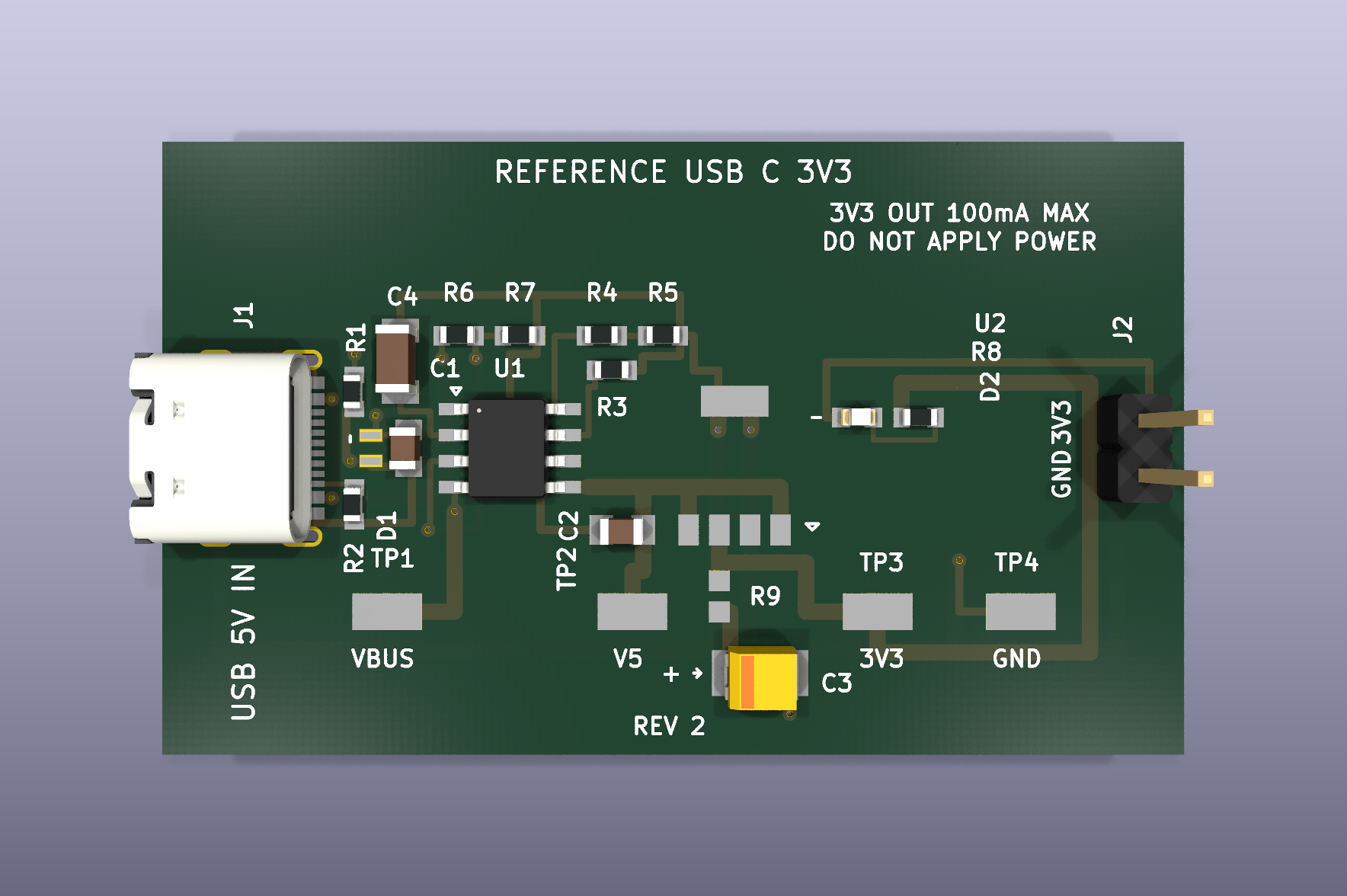
Open the native project at
examples/reference_usb_c_3v3_r2/reference_usb_c_3v3_r2.kicad_pro
or inspect its
FINAL_VERIFICATION.md.
The evidence records KiCad 10.0.6 ERC/DRC results, compiler/reparse parity,
source preservation, renders, BOM, and a deliberately non-release CAM
candidate. J2 is output-only: 3V3 OUT 100mA MAX / DO NOT APPLY POWER.
Many KiCad MCPs prioritize broad interactive command coverage. EvlEDA prioritizes a smaller outcome-level surface with content-addressed evidence, exact-revision approval, isolated source-preserving native checks, and an explicit separation between digital verification and manufacturing release. That safety/evidence architecture is the distinction—not a replacement editor or a claim to have more KiCad features. See the factual comparison.
Read SECURITY.md before enabling the plugin and docs/RELEASE_STATUS.md before using hardware outputs.
python -m pip install -e ".[dev]"
python scripts/check_release_static.py
python -m pytest -q
python .github/scripts/validate_plugin_skill.py
The public project is Python-only. Local files from an earlier browser/HTTP prototype are intentionally ignored and are not part of Git, CI, wheels, source distributions, plugins, or the EvlEDA product.
Some frozen digest-domain strings and generated KiCad library IDs retain
flux-clone or FluxGenerated. They are immutable compatibility/evidence
identifiers, not public branding or a browser-product dependency. Renaming them
would invalidate existing receipts and requires an explicit versioned migration.
Original EvlEDA software and documentation are licensed under Apache-2.0. Hardware designs and examples are licensed under CERN-OHL-P-2.0. See NOTICE and THIRD_PARTY_NOTICES.md for controlling scope.
EvlEDA is independent of and is not endorsed by KiCad, the KiCad project, LF Projects, or the Linux Foundation. KiCad trademarks are registered to the Linux Foundation; “KiCad” is used only to describe interoperability. All other marks belong to their owners.
| Qty | Value | Footprint | References |
|---|---|---|---|
| 1 | 0.247A eFuse/OVC latch-off | FluxGenerated:fp_5564ef8e90135a4cab1a74819024c718 | U1 |
| 1 | 100k 1% | FluxGenerated:fp_d99751e93f3256fd8c87b489a89e8300 | R7 |
| 1 | 100nF 25V C0G +/-5% | FluxGenerated:fp_f05ca65025de54698aa04f889cf47686 | C4 |
| 1 | 10mOhm 1% | FluxGenerated:fp_a78d751717985e30a9b25a0cb605c4c8 | R9 |
| 1 | 1k 1% | FluxGenerated:fp_9d00c8daf3f55af19c700b7644697803 | R8 |
| 1 | 1uF 16V X7R | FluxGenerated:fp_28444cc44b245b32932e3c565fab864f | C1 |
| 1 | 200k 1% | FluxGenerated:fp_d6f66386fa4d59b88b037b6158b253de | R4 |
| 1 | 200k 1% | FluxGenerated:fp_3163cbb05ab85a1f898c4cf9d50a1faf | R5 |
| 1 | 22uF 10V polymer +/-20% | FluxGenerated:fp_8e8257a25c905439acc2c3b5f98b1773 | C3 |
| 1 | 249k 1% | FluxGenerated:fp_0103de7ad7895269a7c4e91d7b1dbdc5 | R6 |
| 1 | 3.3V 1A LDO | FluxGenerated:fp_7794963ceebb5e36b7b6c301eeb69b9b | U2 |
| 1 | 3.83k 1% | FluxGenerated:fp_f4348b9e701754f5a067cdbaf9dc46a6 | R3 |
| 1 | 3V3 | FluxGenerated:fp_9742af839cae5d1ca864cdcc649a4639 | TP3 |
| 1 | 3V3 OUT 100mA MAX / DO NOT APPLY POWER | FluxGenerated:fp_c3c523f49a555f1b812006a8faf7f241 | J2 |
| 1 | 4.7uF 25V X7R | FluxGenerated:fp_94882bf011bc5f1e87e4d85eee6343ee | C2 |
| 1 | 5.1k 1% | FluxGenerated:fp_61ca670da6f25095bf4bb2528b3dc8c6 | R2 |
| 1 | 5.1k 1% | FluxGenerated:fp_c36a820555e9516cab46827f347b914e | R1 |
| 1 | 5.5V unidirectional TVS | FluxGenerated:fp_929f98521d3156dda8c73d91d0622a82 | D1 |
| 1 | GND | FluxGenerated:fp_f6ef917635c75d7ead58f80bfe8f17b8 | TP4 |
| 1 | USB-C 5V sink | FluxGenerated:fp_b854396d140d58c6a824a7f89b75ad9e | J1 |
| 1 | V5_PROTECTED | FluxGenerated:fp_9594eee5612e51d184b21d9037a20fdb | TP2 |
| 1 | VBUS_RAW | FluxGenerated:fp_27ac22f87e2a5f909718f99a7580d7b8 | TP1 |
| 1 | green 0603 LED | FluxGenerated:fp_2e6b5cac73ae53399429af7b381e190a | D2 |

google/mozc-devices
Circuit diagrams and firmware source code for Gboard DIY keyboards


Duet3D/Duet-2-Hardware
The KiCAD source for the Duet 3d printer controller see www.duet3d.com
It measures 50 × 30 mm and has 2 copper layers, 0.8 mm thick.
23 parts. The full list of its parts is on this page, with links to each part's symbol and footprint where PCBKit's library has them.
From the lolwutboi987/evleda repository on GitHub, at the commit this page was made from: the board is examples/reference_usb_c_3v3_r2/reference_usb_c_3v3_r2.kicad_pcb and its schematic examples/reference_usb_c_3v3_r2/reference_usb_c_3v3_r2.kicad_sch. PCBKit opens the board in the browser, with nothing to install.
Its repository publishes it under the Apache-2.0 licence: you may reuse it on that licence's terms (keep the author's notice, and for a copyleft licence share your changes alike).