
2 layers44.5 × 46.9 mm
OSO SWAT B1-jig
joeycastillo/Sensor-Watch
A board replacement for the classic Casio F-91W wristwatch
31 parts2.1k
A PC (And Rolling Door) Control System using ESP32 S3 and a custom PCB
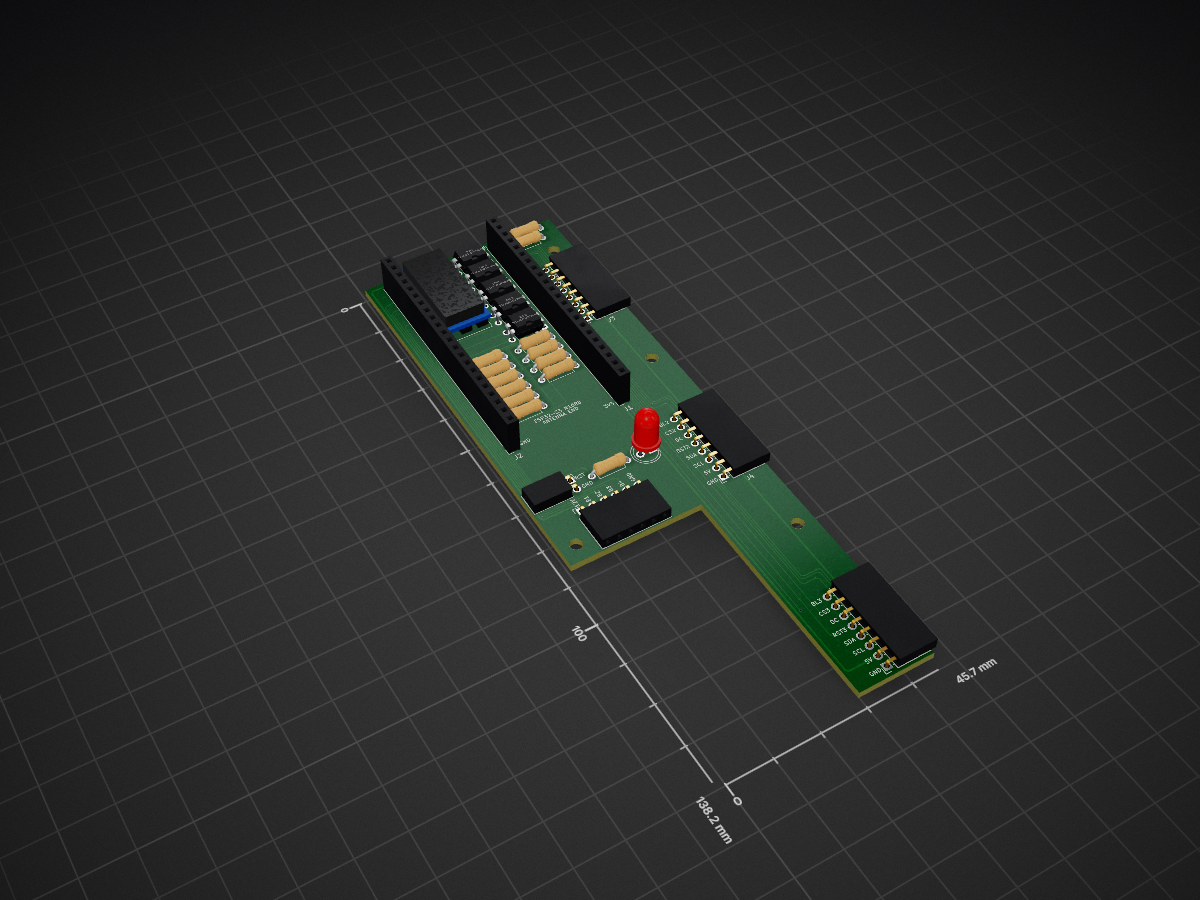
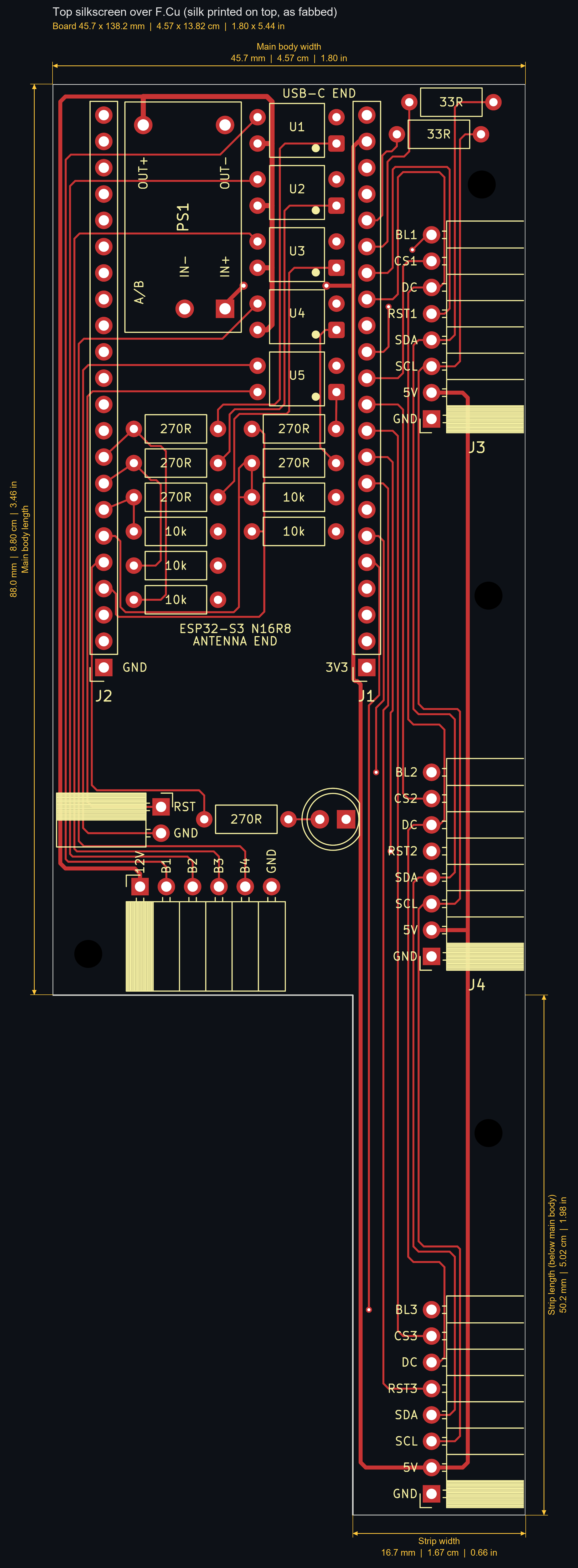
Layouts is an open-source printed circuit board by lnminh1411, from the lnminh1411/ESP32-PC-Control-System repository on GitHub. It is a 2-layer board of 45.7 × 138.2 mm with 31 parts on 56 nets, routed with 300 tracks and 7 vias.
Its parts include 13 resistors, 7 connectors, 5 ICs and 1 diode.
I needed my PC online at all time, because sometime at school or work I need to remote control the PC back at home. And as I measured, the idle time alone costs me ~40KWh (~7usd) per month. So, I built this for 30usd instead of buying a boring and expensive IP KVM, while adding a tons more features to fit my over-engineering stuffs hobby.
|
An ESP32-S3 carrier board that lives inside a PC case. It drives three 2.4" displays, turns the PC on and off, presses the motherboard's reset line and works a 4-button door remote, all from one ESP32-S3-N16R8 module on a custom 2-layer PCB. A Windows helper feeds it the PC's stats and carries its commands back to the PC. |
This is the main project; the others work with it.
| Project | Role for this board |
|---|---|
| PC Hardware Control Service (PcHwCtl) | Windows service the helper calls over the PcHwCtl pipe: sensor feed, fans and RGB, monitors, power actions, Process Lasso night config, webcam presence and screenshots |
| Local LLM stack | Local AI stack. Its status shows on the panels, and the Discord Local Agent tab controls it through the helper's !ai relay |
| ESP32 Human Presence Radar | Add-on presence board (mmWave radar and ToF) for the presence rules (AFK, away, intruder lock, night). New; the link to this board is in development |
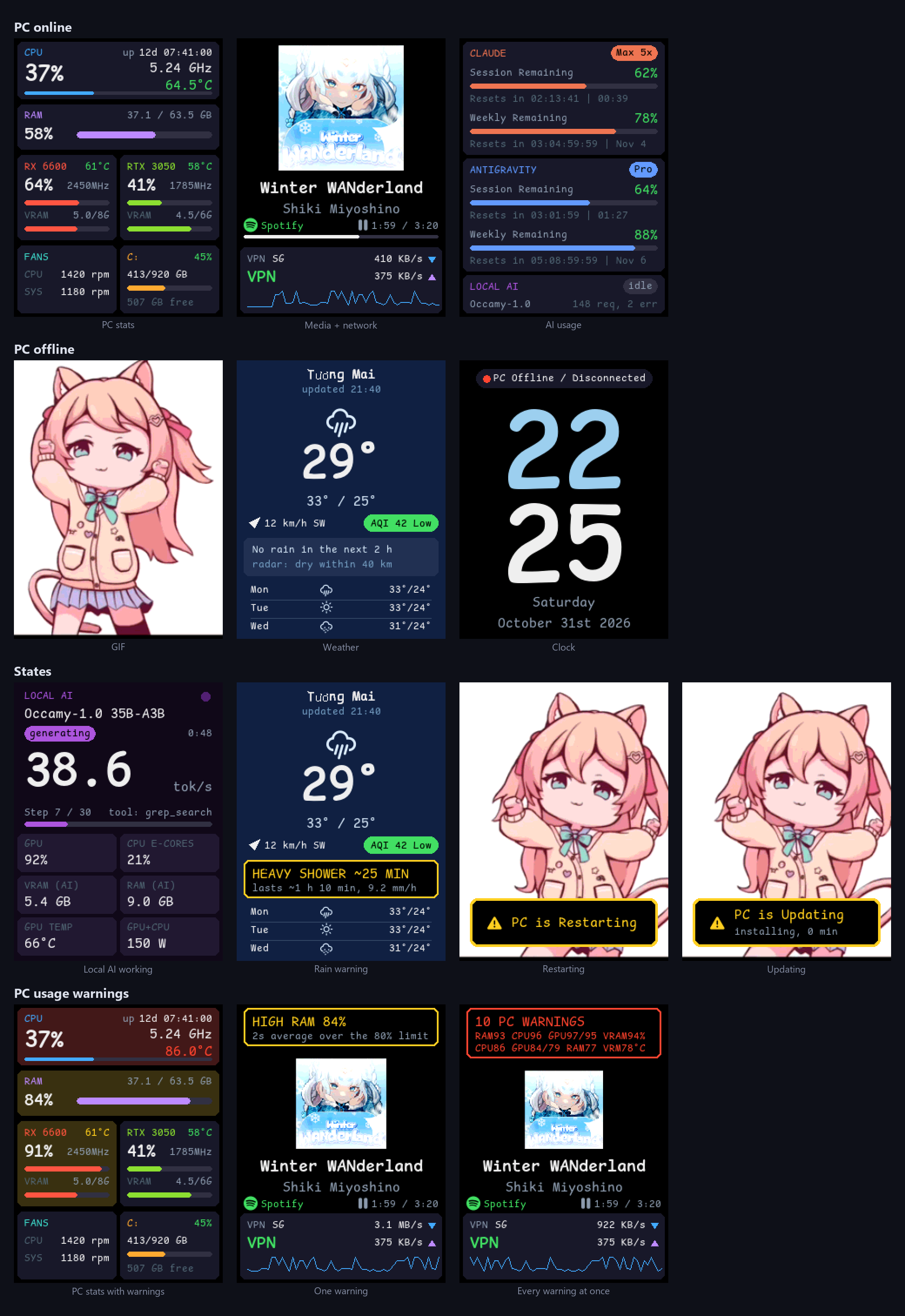
Every face, captured from the board with shot. The stats are made up; the
layout is real. What each panel shows and when: docs/screens.md.
firmware/
(docs/firmware.md).ESP32-Helper.exe, a .NET 10 Windows service with a
user-session half, in host/pc_stats/
(docs/helper.md).enclosure/.Copy firmware/main/settings_example.h to settings.h and fill in the
secrets (docs/settings.md).
Build and flash over USB (docs/build-and-flash.md):
firmware/idf.cmd build
python scripts/idf_flash.py --no-build
Build and install the PC helper from an elevated shell (docs/helper.md):
host/pc_stats/build.cmd
powershell -ExecutionPolicy Bypass -File host/pc_stats/install.ps1
Set the BIOS and Windows up for Wake-on-LAN
(docs/power-and-night.md), then set a home with
weather home <lat>,<lon> on the console (docs/console.md).
| Page | Covers |
|---|---|
| screens.md | The faces, warnings on them, PC usage warnings |
| hardware.md | The board, pin map, assembly, the eFuse fix, bring-up findings, building the PCB |
| firmware.md | Modules, display pipeline, tasks, ESP-IDF options, PSRAM hardening |
| console.md | Every console command |
| power-and-night.md | Power control, Wake-on-LAN setup, night and low power mode, the power-on brownout |
| discord.md | Channels, the control panel, Pushover, screenshots |
| weather.md | Weather sources, nowcast, warnings, OwnTracks, Pushover, call budgets |
| helper.md | The PC helper; full reference in host/pc_stats/README.md |
| settings.md | settings.h, the secrets, and every other key |
| build-and-flash.md | Building, flashing, uploads, screenshots, CI |
| layouts.md | JSON dashboard layouts |
| benchmark.md | Memory and speed measurements |
| security.md | Accepted risks, where secrets live, what to check if an attack is suspected |
| pc-power-detection.md, recovery-and-physical-access.md | Design notes |
| documentations_summary.md | Every doc in the repo in one list |
| Path | Contents |
|---|---|
firmware/ | The board's firmware |
host/pc_stats/ | The PC helper (README) |
pcb/ | atopile netlist, KiCad board, footprints (README) |
scripts/ | PCB build chain, flashing, uploads, screenshots (README) |
enclosure/ | CadQuery model of the case (README) |
docs/ | The pages above |
Rev 3.1 is fabricated and assembled, and the firmware runs on it: all three panels, PC power detection, the stats link, Wi-Fi, Wake PC, the Discord bot, live weather with OwnTracks and Pushover, and night mode are in daily use. Still to do: test the door buttons B1-B4 on the real keyfob, and build the firmware in CI.
| Qty | Value | Footprint | References |
|---|---|---|---|
| 6 | 270R | R_Axial_DIN0207_L6.3mm_D2.5mm_P10.16mm_Horizontal | R1, R2, R3, R4, R5, R6 |
| 5 | 10k | R_Axial_DIN0207_L6.3mm_D2.5mm_P10.16mm_Horizontal | R7, R10, R11, R12, R13 |
| 5 | main.ato:Optocoupler | DIP-4_W7.62mm | U1, U2, U3, U4, U5 |
| 4 | MountingHole_2.7mm_M2.5 | MountingHole_2.7mm_M2.5 | MH1, MH2, MH3, MH4 |
| 3 | main.ato:DisplaySocket | PinSocket_1x08_P2.54mm_Horizontal | J3, J4, J5 |
| 2 | 33R | R_Axial_DIN0207_L6.3mm_D2.5mm_P10.16mm_Horizontal | R8, R9 |
| 2 | main.ato:Header1x22 | PinSocket_1x22_P2.54mm_Vertical | J1, J2 |
| 1 | main.ato:BoostModuleBS01 | Boost_CKCS_BS01 | PS1 |
| 1 | main.ato:IsolatedPair | PinSocket_1x02_P2.54mm_Horizontal | J6 |
| 1 | main.ato:KeyfobSocket | PinSocket_1x06_P2.54mm_Horizontal | J7 |
| 1 | main.ato:StatusLED | LED_D5.0mm | D1 |
joeycastillo/Sensor-Watch
A board replacement for the classic Casio F-91W wristwatch

hoglet67/RGBtoHDMI
Bare-metal Raspberry Pi project that provides pixel-perfect sampling of Retro Computer RGB/YUV video and conversion to HDMI

hackclub/OnBoard
💡 Join 1,000 teenagers and make your first PCB with a $100 grant!

openwch/ch32v003
CH32V003 is an ultra-cheap RISC-V MCU with 2KB SRAM, 16KB flash, and up to 18 GPIOs that sells for under $0.10

Luos-io/luos_engine
Open-source and real-time orchestrator for cyber-physical-systems, to easily design, test and deploy embedded applications and digital twins.

BlueAndi/Pixelix
Full RGB LED matrix, based on an ESP32 and WS2812B LEDs or emulated LEDs on TFT.


It measures 45.7 × 138.2 mm and has 2 copper layers, 1.6 mm thick.
31 parts. The full list of its parts is on this page, with links to each part's symbol and footprint where PCBKit's library has them.
From the lnminh1411/ESP32-PC-Control-System repository on GitHub, at the commit this page was made from: the board is pcb/layouts/default/default.kicad_pcb. PCBKit opens the board in the browser, with nothing to install.
Its repository states no licence, so its author keeps all rights: ask lnminh1411 before reusing the design.