2 layers116.8 × 30 mm
Type d
google/mozc-devices
Circuit diagrams and firmware source code for Gboard DIY keyboards
14 parts3kApache-2.0
 lmtreser/LED-Pong
Pong! revisited with Arduino
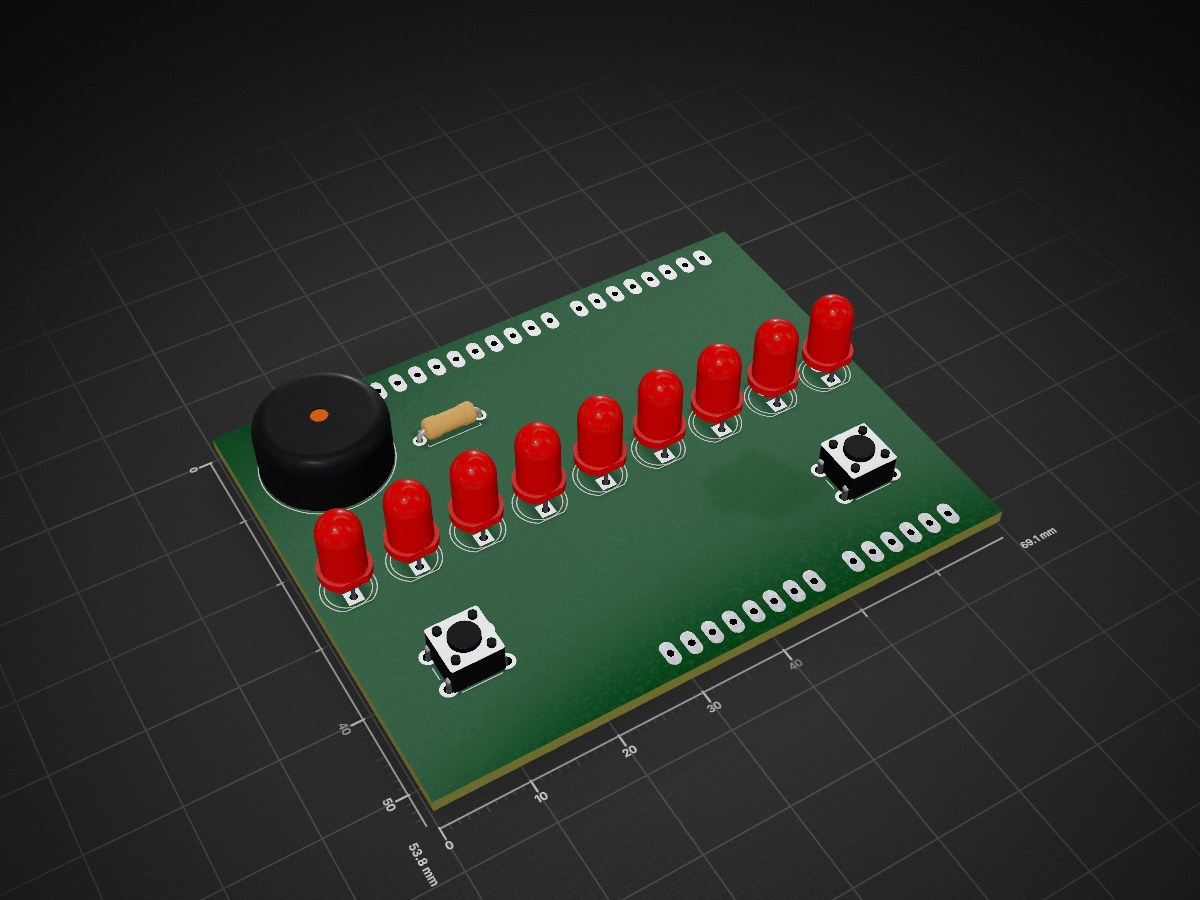
LED Pong is an open-source printed circuit board by lmtreser, from the lmtreser/LED-Pong repository on GitHub, published under the MIT licence. It is a 2-layer board of 69.1 × 53.8 mm with 14 parts on 30 nets, routed with 40 tracks and 0 vias.
Its parts include 9 diodes, 2 switches and 1 resistor.
Simple juego al estilo Pong! con Arduino, LEDs y pulsadores. Se puede construir como un shield o con otro formato. Es un trabajo original de @newsonator.
En Tinkercad hay disponible un circuito de simulación publico.

Tanto la idea original como el firmware de @newsonator están protegidos por su respectiva licencia, por favor visitar los sitios web donde se encuentran alojados para mayor información. El resto del trabajo está protegido por la Licencia MIT. Puedes acceder a la versión original de la licencia (en inglés) a través del archivo LICENSE o en línea en The MIT License (MIT). También proporcionamos una traducción no oficial desde Wikipedia:
Copyright (c) 2024 Lucas Martín Treser
Por la presente se concede permiso, libre de cargos, a cualquier persona que obtenga una copia de este software y de los archivos de documentación asociados (el "Software"), a utilizar el Software sin restricción, incluyendo sin limitación los derechos a usar, copiar, modificar, fusionar, publicar, distribuir, sublicenciar, y/o vender copias del Software, y a permitir a las personas a las que se les proporcione el Software a hacer lo mismo, sujeto a las siguientes condiciones:
El aviso de copyright anterior y este aviso de permiso se incluirán en todas las copias o partes sustanciales del Software.
EL SOFTWARE SE PROPORCIONA "COMO ESTÁ", SIN GARANTÍA DE NINGÚN TIPO, EXPRESA O IMPLÍCITA, INCLUYENDO PERO NO LIMITADO A GARANTÍAS DE COMERCIALIZACIÓN, IDONEIDAD PARA UN PROPÓSITO PARTICULAR E INCUMPLIMIENTO. EN NINGÚN CASO LOS AUTORES O PROPIETARIOS DE LOS DERECHOS DE AUTOR SERÁN RESPONSABLES DE NINGUNA RECLAMACIÓN, DAÑOS U OTRAS RESPONSABILIDADES, YA SEA EN UNA ACCIÓN DE CONTRATO, AGRAVIO O CUALQUIER OTRO MOTIVO, DERIVADAS DE, FUERA DE O EN CONEXIÓN CON EL SOFTWARE O SU USO U OTRO TIPO DE ACCIONES EN EL SOFTWARE.
| Qty | Value | Footprint | References |
|---|---|---|---|
| 9 | LED | LED_THT:LED_D5.0mm | D1, D2, D3, D4, D5, D6, D7, D8, D9 |
| 2 | SW_Push | Button_Switch_THT:SW_PUSH_6mm | SW1, SW2 |
| 1 | 100 | Resistor_THT:R_Axial_DIN0207_L6.3mm_D2.5mm_P7.62mm_Horizontal | R1 |
| 1 | Arduino UNO | libs:Arduino_UNO_R3_OVAL | A1 |
| 1 | Buzzer | Buzzer_Beeper:Buzzer_15x7.5RM7.6 | BZ1 |
google/mozc-devices
Circuit diagrams and firmware source code for Gboard DIY keyboards


hackclub/OnBoard
💡 Join 1,000 teenagers and make your first PCB with a $100 grant!


Twotoz/C5VRX
Ultra-minimal, zero-CPU 5.8 GHz analog FPV video receiver using ESP32-C5 Wi-Fi 6 PHY MODEM_DIAG, BitScrambler WBFM demodulation & resistor DAC CVBS


It measures 69.1 × 53.8 mm and has 2 copper layers, 1.6 mm thick.
14 parts. The full list of its parts is on this page, with links to each part's symbol and footprint where PCBKit's library has them.
From the lmtreser/LED-Pong repository on GitHub, at the commit this page was made from: the board is sch_pcb/LED Pong.kicad_pcb and its schematic sch_pcb/LED Pong.kicad_sch. PCBKit opens the board in the browser, with nothing to install.
Its repository publishes it under the MIT licence: you may reuse it on that licence's terms (keep the author's notice, and for a copyleft licence share your changes alike).