2 layers159.5 × 30 mm
Type f
google/mozc-devices
Circuit diagrams and firmware source code for Gboard DIY keyboards
25 parts3kApache-2.0
 lissyx/sensorweb-nodeMCU-PMS30037
A SensorWeb Thing for PMS3003 particle sensor (PM2.5), based on nodeMCU 1.0 board
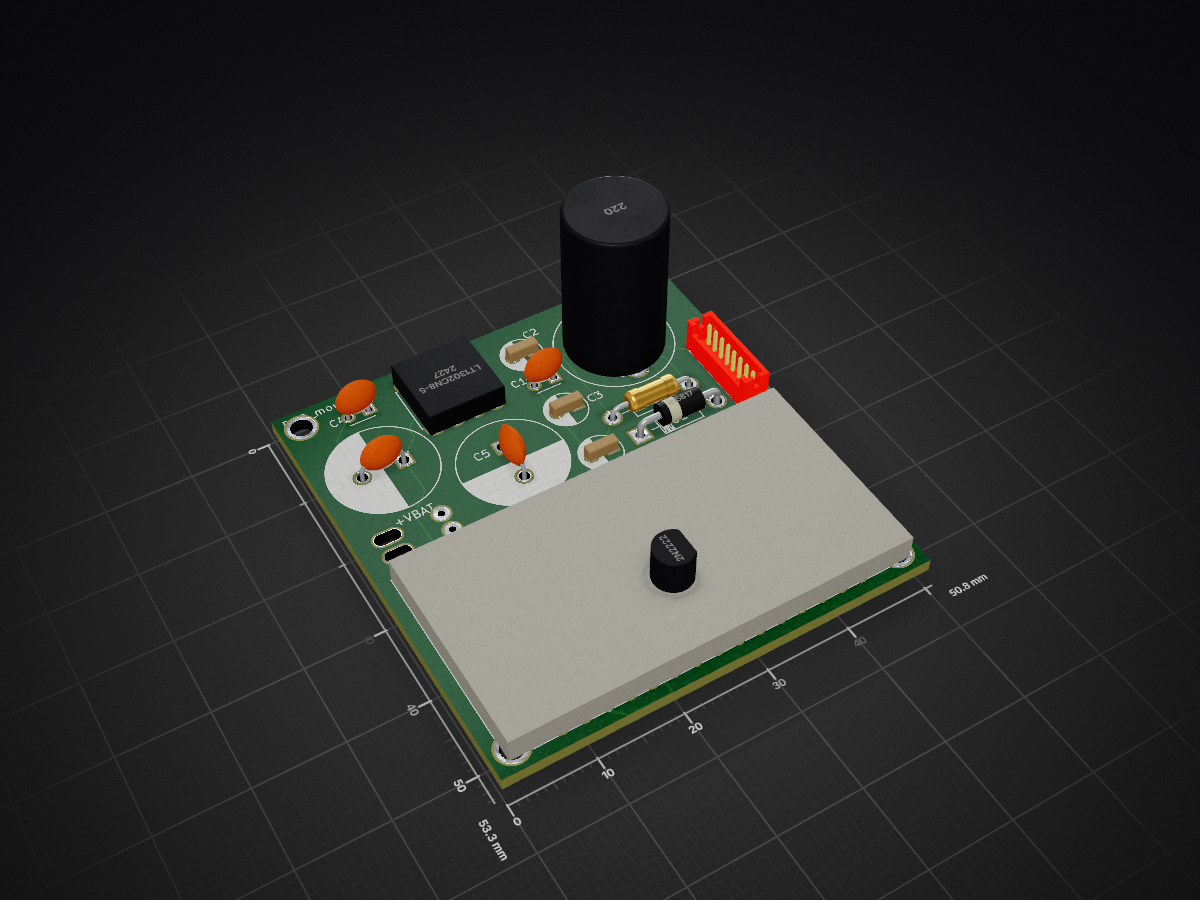
Sensorweb nodeMCU is an open-source printed circuit board by lissyx, from the lissyx/sensorweb-nodeMCU-PMS3003 repository on GitHub, published under the MIT licence. It is a 2-layer board of 50.8 × 53.3 mm with 25 parts on 12 nets, routed with 171 tracks and 4 vias.
It is built around the PMS3003 and LT1302CN8-5#PBF. Its parts include 8 capacitors, 3 resistors, 1 IC, 1 diode and 1 transistor. It belongs with the sensors and measurement boards and the ESP8266 boards of this library.

This repo aims at providing a PM2.5 (and others) sensor that pushes data to the Internets, namely AirCasting API. It uses a PMS3003 + NodeMCU v1.0 (ESP-12E), as it was built as a side-project to augment (now defunct) Mozilla SensorWeb project with something that could be autonomous and outdoor.
Ensure to configure board in Arduino IDE as:
For first flash, ensure you properly populate data/ subdirectory with:
wifi.jsonntp.jsonaircasting.json
Please follow the templates named .in, copy them as the proper name under
data/. Then in Arduino IDE, flash using Tools, ESP8266 Sketch Data Upload.Default configuration should be for AirCasting.org website, but it is expected to work on any instance following their API.
Then you can build and flash. It should boot and work.
Serial debugging should work over USB. The same data is sent over the wire,
defaulting to UDP multicast address 239.0.0.1, port 8899.
To be able to handle outdoor, original SensorWeb project has been augmented with a power source. This leads to the design of a small PCB that serves several purposes:
The power part of the PCB is inspired from Adafruit's Minty Boost: https://learn.adafruit.com/minty-boost/overview
Solar power cannot be available 100% of the time, so it is battery-backed, using the kit provided by Adafruit: https://learn.adafruit.com/usb-dc-and-solar-lipoly-charger?view=all
Solar panel are also provided, though they can be found at a lot of different places.
Any LiPo or LiIon should work.
Checkout the Kicad project for exact references.
| Qty | Value | Footprint | References |
|---|---|---|---|
| 4 | PCB_mount | Wire_Pads:SolderWirePad_single_2-5mmDrill | , , , |
| 3 | 220µF | Capacitors_ThroughHole:C_Radial_D5_L6_P2.5 | C2, C3, C8 |
| 2 | 0.1µF | Capacitors_ThroughHole:C_Disc_D3_P2.5 | C1, C4 |
| 2 | 10k | Resistors_ThroughHole:Resistor_Horizontal_RM10mm | R1, R2 |
| 2 | 4700µF | Capacitors_ThroughHole:C_Radial_D12.5_L25_P5 | C5, C6 |
| 1 | +VBAT | Wire_Pads:SolderWirePad_single_0-8mmDrill | +VBAT |
| 1 | -VBAT | Wire_Pads:SolderWirePad_single_0-8mmDrill | -VBAT |
| 1 | 1N5817 | Diodes_ThroughHole:Diode_DO-41_SOD81_Horizontal_RM10 | D1 |
| 1 | 1µF | Capacitors_ThroughHole:C_Radial_D5_L6_P2.5 | C7 |
| 1 | 22µH | Inductors_NEOSID:Neosid_Inductor_Sd14 | L1 |
| 1 | 2N2222 | TO_SOT_Packages_THT:TO-92_Inline_Narrow_Oval | Q1 |
| 1 | 2ohm / 10ohm | Resistors_ThroughHole:Resistor_Horizontal_RM10mm | R3 |
| 1 | LT1302CN8-5 | Power_Integrations:PDIP-8 | U1 |
| 1 | NodeMCU-1.0 | nodemcu:nodemcu | MCU1 |
| 1 | PMS3003 | Connectors_Molex:Molex_PicoBlade_53047-0810 | P1 |
The 23 most common of 25 parts.
google/mozc-devices
Circuit diagrams and firmware source code for Gboard DIY keyboards

davidphilipbarr/Sweep
Sweep - a small promicro based keyboard inspired by the Ferris.


hackclub/OnBoard
💡 Join 1,000 teenagers and make your first PCB with a $100 grant!

xyphro/UsbGpib
Versatile, cheap and portable USB to GPIB converter (USBTMC class based)


jes/scamp-cpu
A homebrew 16-bit CPU with a homebrew Unix-like-ish operating system.

It measures 50.8 × 53.3 mm and has 2 copper layers, 1.6 mm thick.
25 parts, built around the PMS3003 and LT1302CN8-5#PBF. The full list of its parts is on this page, with links to each part's symbol and footprint where PCBKit's library has them.
From the lissyx/sensorweb-nodeMCU-PMS3003 repository on GitHub, at the commit this page was made from: the board is sensorweb-nodeMCU/sensorweb-nodeMCU.kicad_pcb. PCBKit opens the board in the browser, with nothing to install.
Its repository publishes it under the MIT licence: you may reuse it on that licence's terms (keep the author's notice, and for a copyleft licence share your changes alike).