
2 layers66.9 × 74.5 mm

Coin-operated vending machine using flip-flop counter logic, no microcontroller.
VENDO is an open-source printed circuit board by lgdl-design, from the lgdl-design/vending_machine repository on GitHub. It is a 2-layer board of 90 × 55 mm with 20 parts on 27 nets, routed with 233 tracks and 0 vias.
Its parts include 8 resistors, 5 ICs and 4 connectors.
A coin-counting vending machine that uses flip-flop logic to count coins. It runs on a custom-built PCB and does not use a microcontroller.
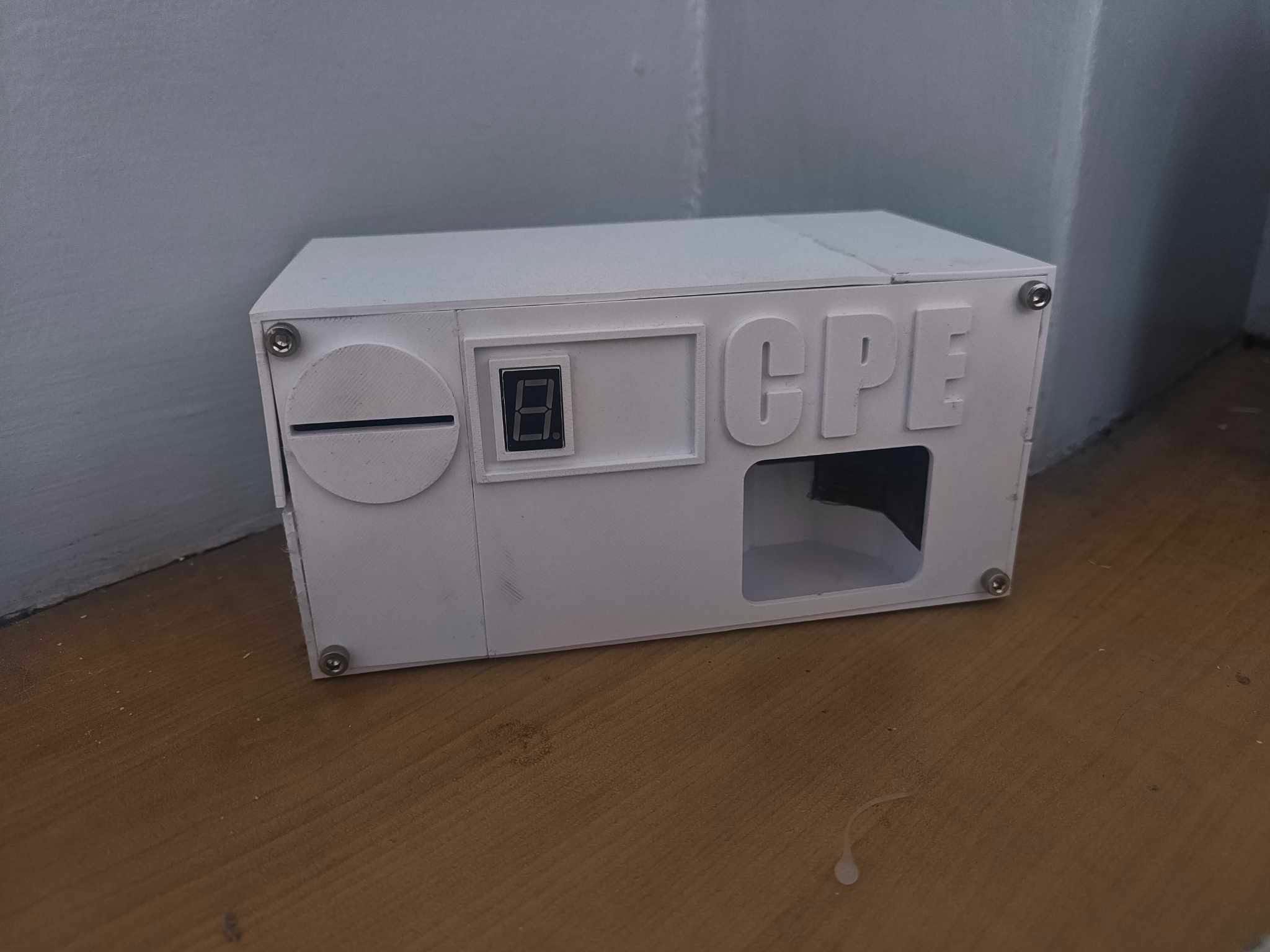
The vending machine was designed as a college project to demonstrate the use of flip-flops in practical circuits. We used a JK flip-flop based asynchronous counter. The IR sensor input drives the count up directly rather than a separate clock signal. The JK flip-flops also let us reset the counter using the IR sensor at the end of the machine once the object is dispensed.
The machine runs on a custom-built PCB that houses the logic components, including the gates, flip-flops, and the other parts that operate the rest of the machine. The PCB's output goes to a 7-segment display that shows the current coin count, and to the motor driver that drives the dispensing motor.
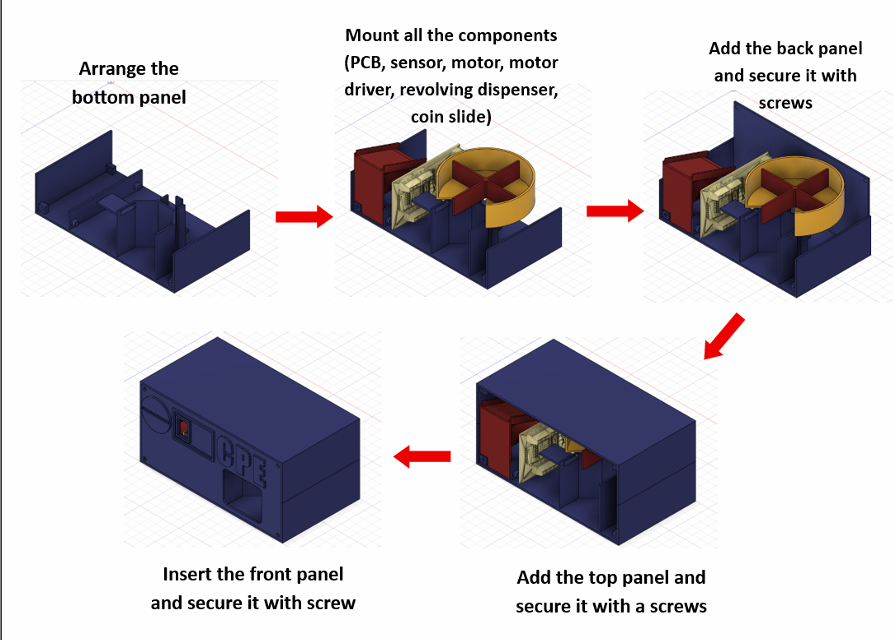
3D-printed body, designed in Autodesk Fusion:
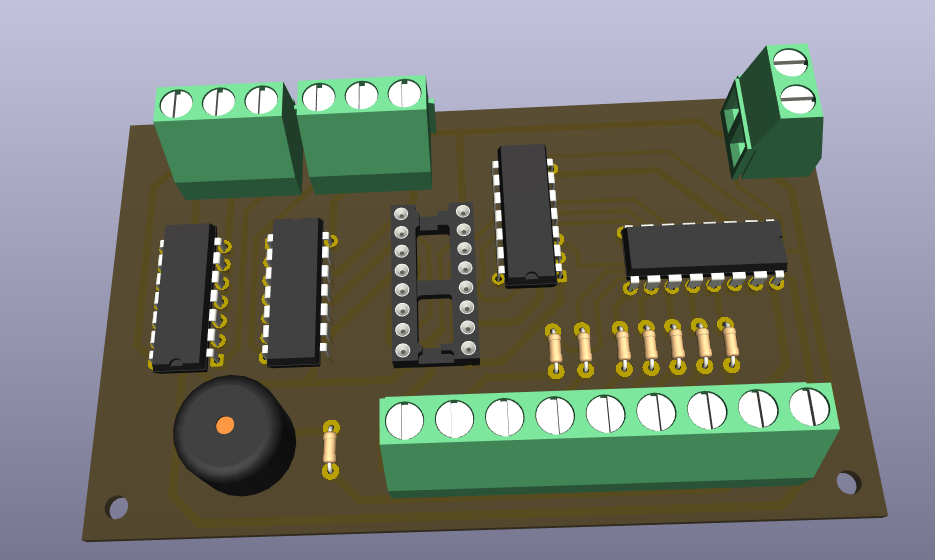
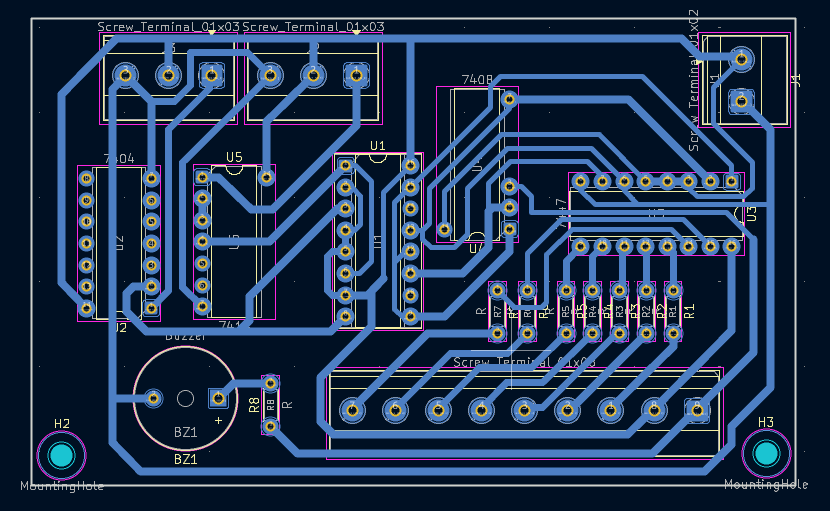
Designed in KiCAD and fabricated by toner transfer.
| Qty | Value | Footprint | References |
|---|---|---|---|
| 8 | R | Resistor_THT:R_Axial_DIN0204_L3.6mm_D1.6mm_P5.08mm_Horizontal | R1, R2, R3, R4, R5, R6, R7, R8 |
| 2 | MountingHole | MountingHole:MountingHole_2.7mm | H2, H3 |
| 2 | Screw_Terminal_01x03 | TerminalBlock_Phoenix:TerminalBlock_Phoenix_MKDS-1,5-3-5.08_1x03_P5.08mm_Horizontal | J2, J3 |
| 1 | 7404 | Package_DIP:DIP-14_W7.62mm | U2 |
| 1 | 7408 | Package_DIP:DIP-14_W7.62mm | U4 |
| 1 | 7414 | Package_DIP:DIP-14_W7.62mm | U5 |
| 1 | 7447 | Package_DIP:DIP-16_W7.62mm | U3 |
| 1 | 74LS76 | Package_DIP:DIP-16_W7.62mm_Socket | U1 |
| 1 | Buzzer | Buzzer_Beeper:Buzzer_12x9.5RM7.6 | BZ1 |
| 1 | Screw_Terminal_01x02 | TerminalBlock_Phoenix:TerminalBlock_Phoenix_MKDS-1,5-2-5.08_1x02_P5.08mm_Horizontal | J1 |
| 1 | Screw_Terminal_01x08 | TerminalBlock_Phoenix:TerminalBlock_Phoenix_MKDS-1,5-9-5.08_1x09_P5.08mm_Horizontal | J4 |


atopile/atopile
Design circuit boards with code! ✨ Get software-like design reuse 🚀, validation, version control and collaboration in hardware; starting with electronics ⚡️

davidphilipbarr/Sweep
Sweep - a small promicro based keyboard inspired by the Ferris.

rusefi/rusefi
rusefi - GPL internal combustion engine control unit

hoglet67/RGBtoHDMI
Bare-metal Raspberry Pi project that provides pixel-perfect sampling of Retro Computer RGB/YUV video and conversion to HDMI

hackclub/OnBoard
💡 Join 1,000 teenagers and make your first PCB with a $100 grant!

FreeYourStream/freedeck-hardware
all the stuff you need to build your own FreeDeck
It measures 90 × 55 mm and has 2 copper layers, 1.6 mm thick.
20 parts. The full list of its parts is on this page, with links to each part's symbol and footprint where PCBKit's library has them.
From the lgdl-design/vending_machine repository on GitHub, at the commit this page was made from: the board is VendoPCB/VENDO.kicad_pcb. PCBKit opens the board in the browser, with nothing to install.
Its repository states no licence, so its author keeps all rights: ask lgdl-design before reusing the design.